
Welcome. If you have never traded anything in your life — never bought a stock, never opened a brokerage account, never once looked at a price chart — you are in exactly the right place. This is the beginning of the road, and we are going to walk it slowly, one plain sentence at a time.
You have probably heard the word "options" thrown around. Maybe a friend bragged about turning a small amount of money into a large amount overnight. Maybe you heard someone else lost their whole account in a week. Both stories are real, and by the end of this guide you will understand exactly why both are possible with the same tool. That understanding is the first and most important thing a beginner can own.
Let's start from zero.
What Is an Option, in Plain English?
An option is a contract. That's it. A contract is just a written agreement between two people that says, "Here is what each of us is allowed to do, and here are the rules." An option is a specific kind of contract about buying or selling something — usually shares of a company's stock.
Here is the one sentence that matters most, and we will repeat it many times because it is the heart of everything:
An option gives you the RIGHT, but not the OBLIGATION, to buy or sell a stock at a set price, on or before a set date.
Read that again slowly. There are two magic words in there.
Right means you are allowed to do something. You have permission. Nobody can stop you.
Obligation means you are forced to do something. You have no choice.
An option gives you the first (the right) without the second (the obligation). You get to decide later whether you actually want to go through with the deal. If it works out in your favor, you use your right. If it doesn't, you simply walk away and let the contract expire, worthless. The most you can lose is what you paid for the contract in the first place — a point we'll come back to again and again.
A Real-Life Analogy Before Any Numbers
Forget the stock market for a second. Imagine you find your dream house. The price is $300,000. You love it, but your own house hasn't sold yet, and you won't have the cash for 60 days.
So you go to the seller and say: "Here's $3,000. In exchange, promise to hold this house for me for 60 days at $300,000. If I come back with the money, you sell it to me at that price. If I don't come back, you keep the $3,000 and we're done."
That $3,000 agreement is an option.
Now think about what you just bought. You bought the right to buy the house at $300,000 — but you are not obligated to. Look at what happens next:
- If a highway gets announced next door and the house is now worth only $250,000, you walk away. You lose your $3,000, but you dodged a terrible $300,000 purchase. Good trade.
- If a new tech campus is announced and the house jumps to $400,000, you happily pay the $300,000 you locked in — and you just captured a $100,000 gain for a $3,000 bet. Fantastic trade.
That is exactly how a stock option works. The $3,000 is called the premium. The $300,000 is called the strike price. The 60 days is the expiration. You now already understand the three most important words in options, and we've barely started.
Why Do Options Even Exist?
New traders often ask, "Why not just buy the stock?" It's a fair question. Options exist because they solve real problems for real people. Three big reasons:
1. Protection (this is the original purpose). Options were invented so people who own something valuable could protect themselves against a price drop. A farmer could lock in a price for his crop months ahead of the harvest so a bad market wouldn't wipe him out. A big investor who owns a lot of stock can pay a small premium to guarantee they can sell at a certain price if the market crashes — like buying insurance on a car. This is the honorable, boring, and genuinely useful heart of the options world.
2. Leverage (this is what draws the crowds). Leverage means controlling a large amount of something with a small amount of money. One option contract typically controls 100 shares of stock (remember that number — it's everywhere). If a stock costs $200 per share, buying 100 shares costs $20,000. But an option controlling those same 100 shares might cost only a few hundred dollars. That small outlay can produce large percentage gains — and large percentage losses. Leverage is a magnifying glass. It makes the sun brighter, and it also starts fires.
3. Flexibility. Options let you build positions that profit from a stock going up, going down, or even going nowhere at all. Regular shares only really pay off when the price rises. Options give you more tools. More tools also means more ways to hurt yourself, which is precisely why we're teaching you carefully.
Why a Beginner Should Care — and Be Careful
Here is the honest truth, told the Hollow Point way. Options are one of the most powerful instruments a small trader can use. They are also one of the fastest ways to lose money if you don't understand them. Both things are true at once.
The reason we teach them carefully — not with hype, not with promises of getting rich by Friday — is that the same feature that makes options exciting (leverage) is the same feature that makes them dangerous. A magnifying glass doesn't care whether you're starting a warming fire or burning down your house. It just magnifies.
Beginners should care because options, understood properly, let you do two beautiful things:
- Define your risk. When you buy an option, you know the exact maximum you can lose before you ever place the trade: the premium. Not a penny more. That is a rare and precious thing in the trading world, and it fits perfectly with the number-one rule at Hollow Point: protect your capital first.
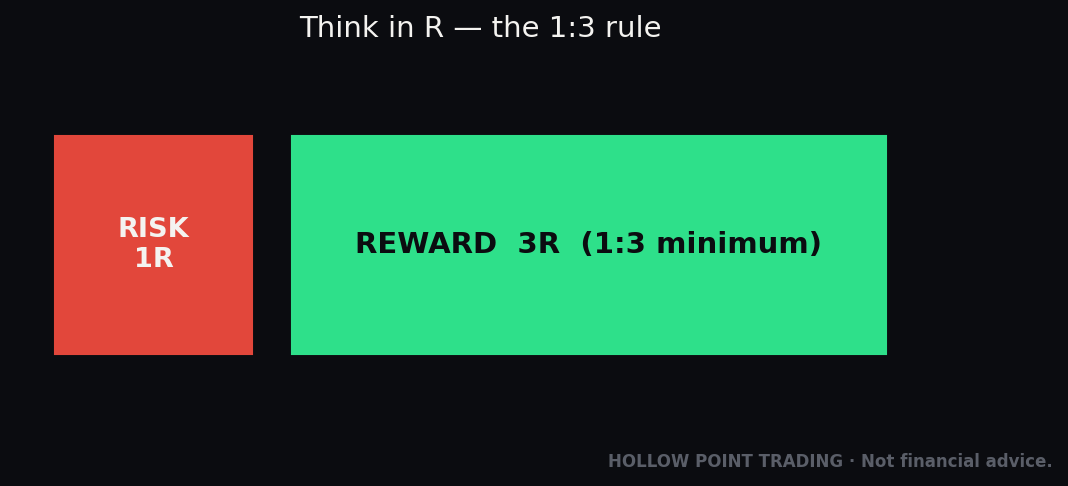
- Control your reward-to-risk. Because a small premium can produce a large payoff, options make it possible to structure trades where you risk one dollar to potentially make three. That 1-to-3 reward-to-risk idea is the backbone of disciplined trading, and options are a natural home for it.
But — and this is a big but — you must learn the mechanics cold before risking a single real dollar. This guide is step one of that learning. Do not skip ahead.
The Two Types: Calls vs. Puts at a Glance
There are exactly two basic kinds of options. Just two. Everything else in the entire options universe is built from these two Lego bricks. Learn them and you've learned the alphabet.
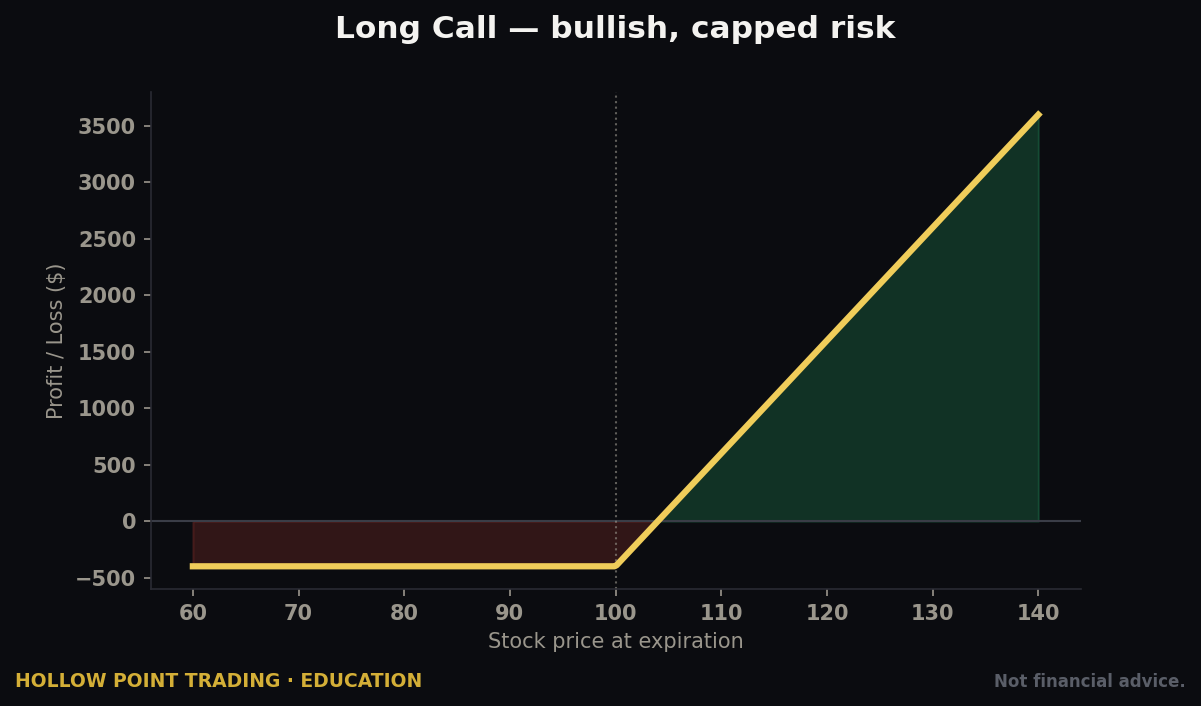
A CALL is the right to BUY a stock at the strike price. You buy a call when you think the stock is going to go UP. "Call it up" is the classic memory trick. If you expect the price to rise, a call lets you lock in today's lower price and profit from the climb.
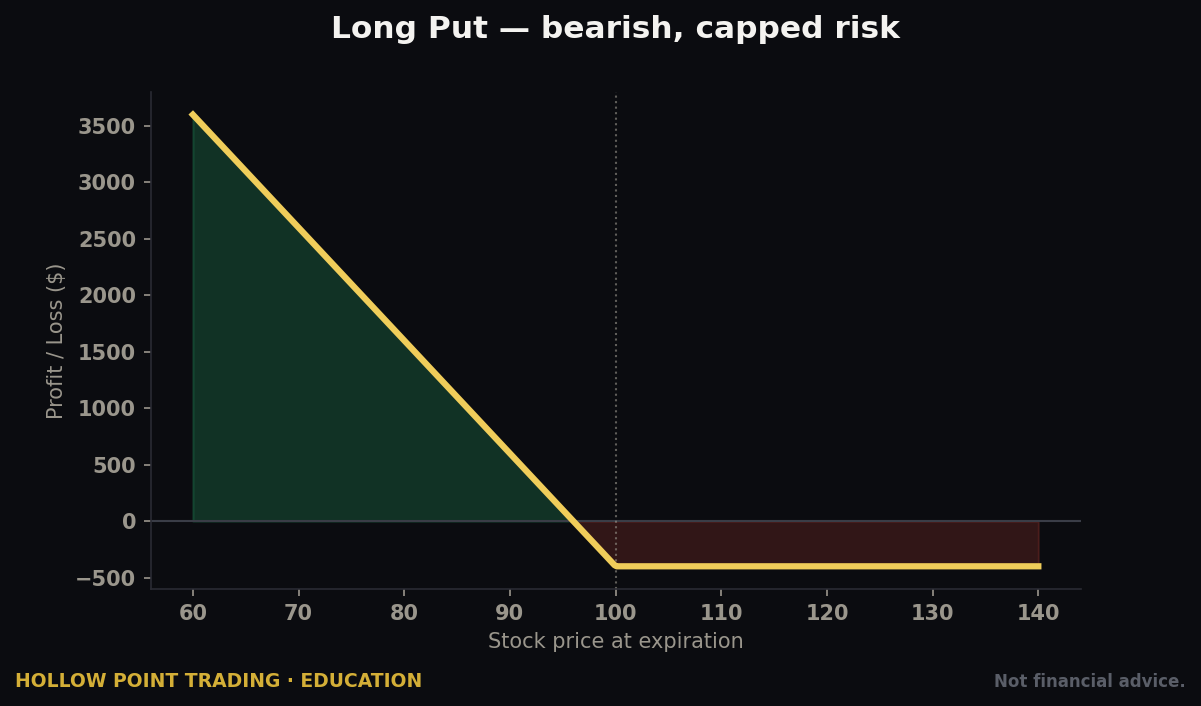
A PUT is the right to SELL a stock at the strike price. You buy a put when you think the stock is going to go DOWN. "Put it down" is the memory trick. If you expect the price to fall, a put lets you lock in today's higher selling price and profit from the drop — or protect stock you already own from losing value.
That's the whole menu, at least for buyers:
- Think it goes up? Buy a call.
- Think it goes down? Buy a put.
Let's make it stick with a tiny picture in words. Say a stock is trading at $100.
- You buy a call with a $100 strike. The stock rises to $120. Your call lets you buy at $100 something now worth $120. You made money. The higher it goes, the more you make.
- You buy a put with a $100 strike. The stock falls to $80. Your put lets you sell at $100 something now worth only $80. You made money. The lower it goes, the more you make.
In both cases, if the stock moves the wrong way, you simply don't use the option. It expires, you lose only your premium, and you move on. Right, not obligation — always.
The Core Vocabulary — Every Word You Need Right Now
Before we do a full worked example, let's nail down the vocabulary. Keep this section bookmarked. When you get confused later — and you will — come back here.
Underlying. The thing the option is about — usually the stock. If you buy an option on Apple, Apple stock is the "underlying." The option's value comes from the underlying, like a shadow comes from the object that casts it.
Strike price (or just "strike"). The set price named in the contract — the price at which you'd buy (call) or sell (put) the underlying. In our house example, this was the $300,000. Strikes come in many levels; you choose the one you want.
Expiration date (or "expiry"). The deadline. The last day the option is valid. After it passes, the contract is over — used or worthless. Options can expire in days, weeks, months, or over a year out. In our house example, this was the 60 days.
Premium. The price you pay to buy the option — the cost of the contract itself. This was the $3,000 in the house deal. When you buy an option, the premium is the most you can lose. Full stop.
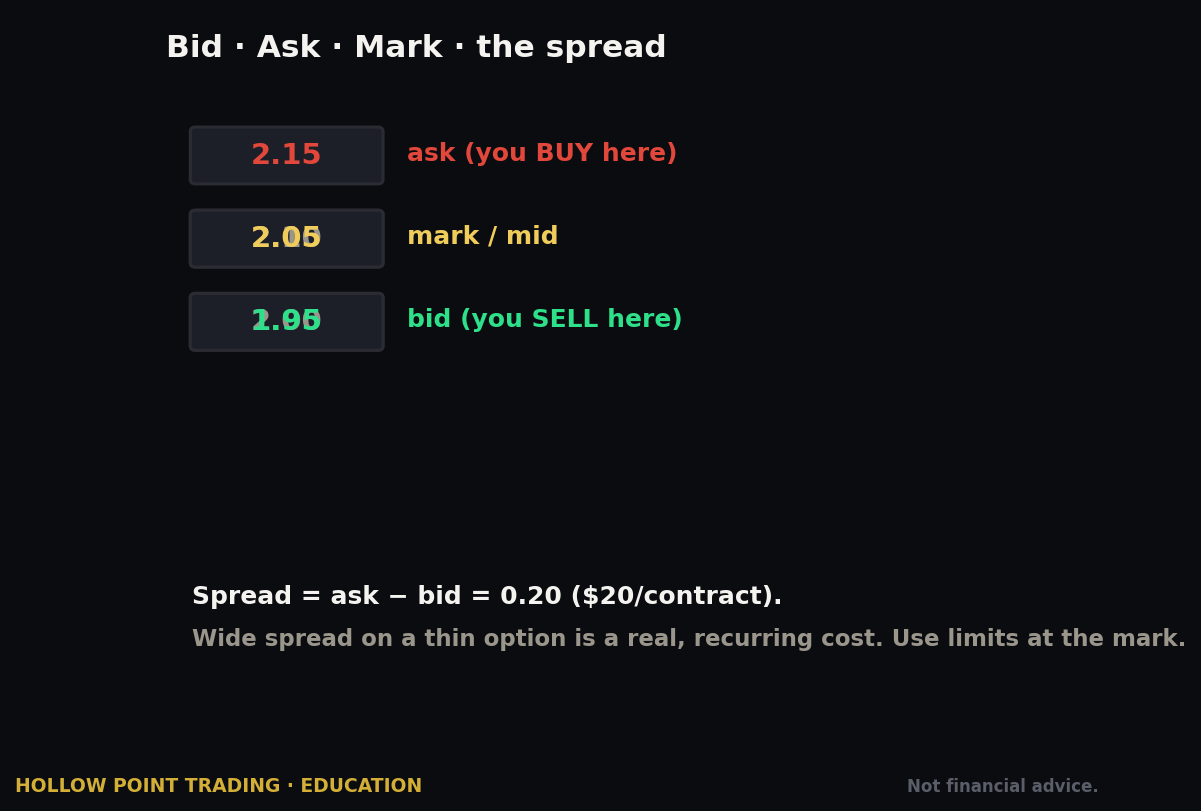
Contract = 100 shares. One standard stock option contract controls 100 shares of the underlying. This is the single most common thing beginners forget, and it causes real accidents. If an option is quoted at "$2.00," it does not cost you $2. It costs $2 × 100 = $200, because one contract covers 100 shares. Quoted prices are per share; you pay for 100 of them. Burn this into your memory.
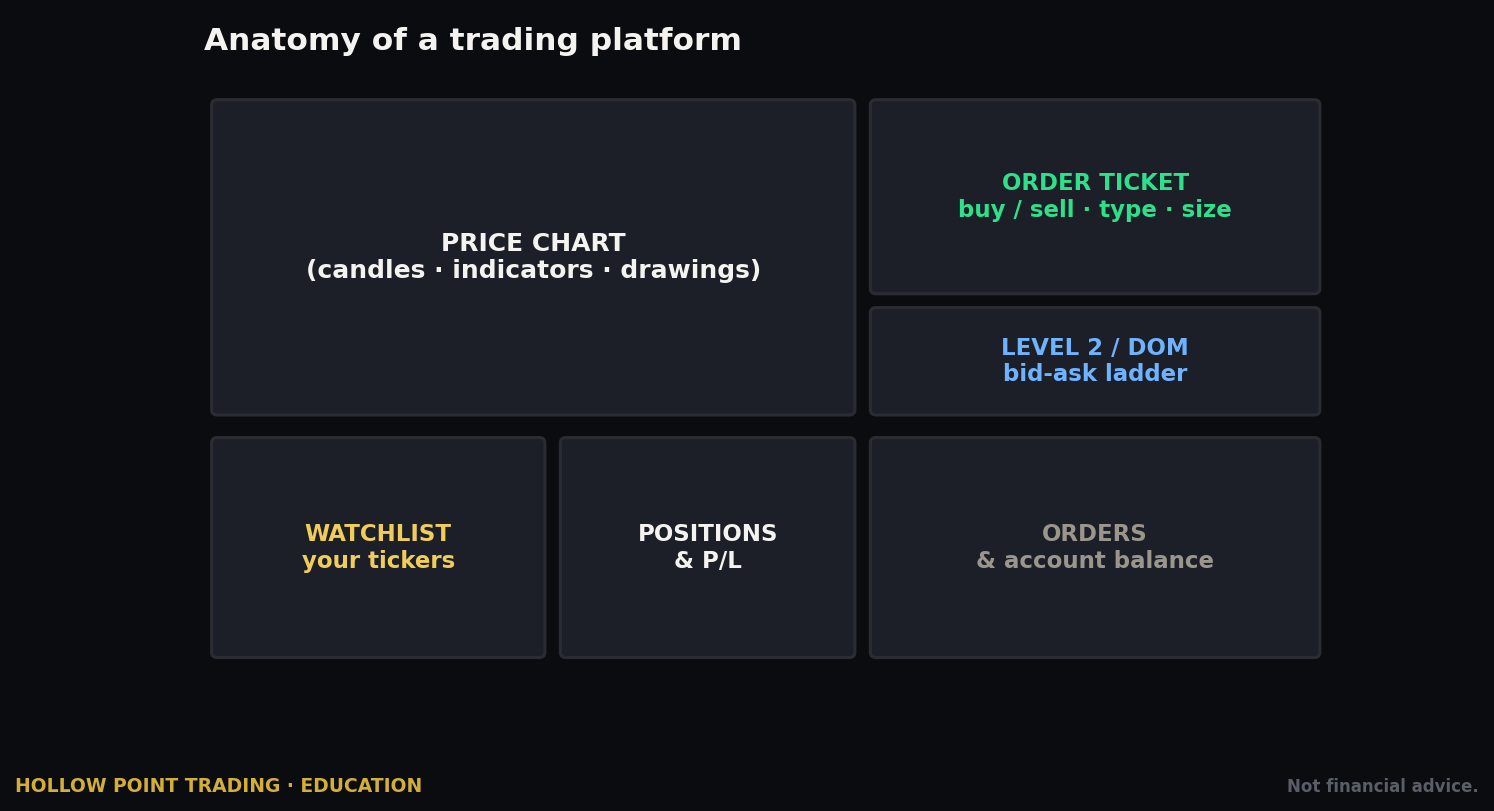
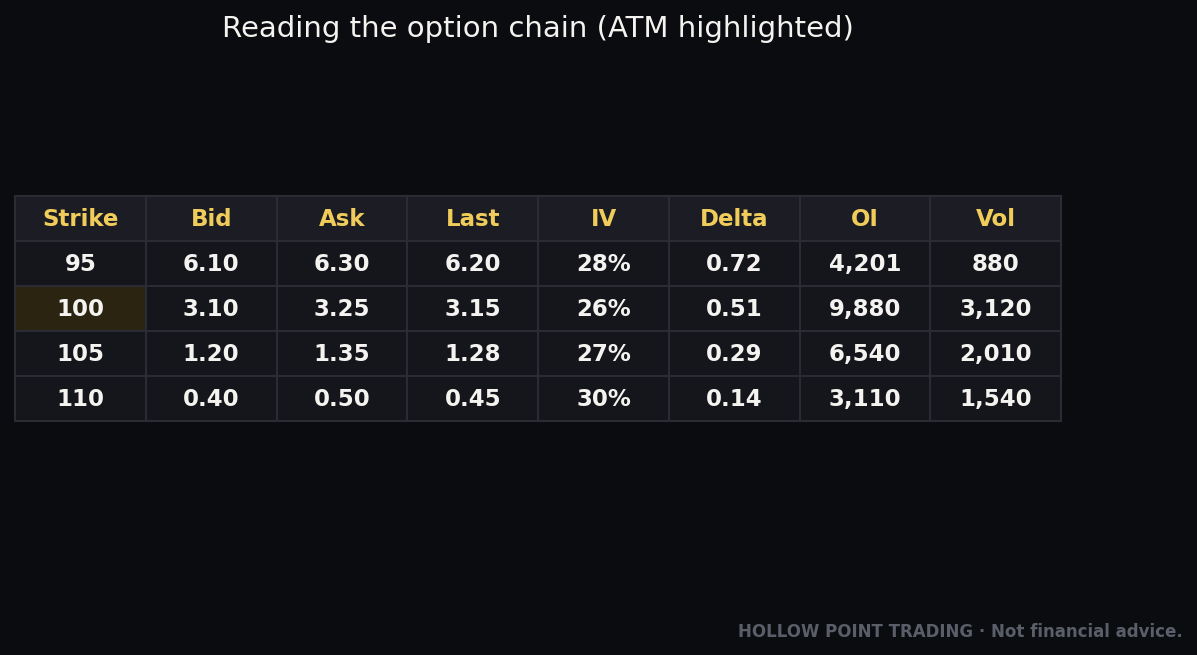
Bid and ask. The bid is the price a buyer is willing to pay right now; the ask is the price a seller wants. You generally buy at the ask and sell at the bid. The small gap between them is the "spread" — a hidden cost of doing business.
In the money (ITM). The option would be worth exercising right now. A call is in the money when the stock is above the strike (you'd get to buy cheap). A put is in the money when the stock is below the strike (you'd get to sell high).
Out of the money (OTM). The opposite. The option would be worthless if it expired right now. A call is out of the money when the stock is below the strike; a put is out of the money when the stock is above the strike. Out-of-the-money options are cheaper — because they need the stock to move before they pay off.
At the money (ATM). The stock price and the strike are roughly equal. Right on the fence.
Exercise. To use your right — to actually buy (call) or sell (put) the shares at the strike. Beginners rarely exercise; instead they usually just sell the option contract itself to someone else for a profit or loss. More on that in a moment.
Assignment. The flip side, which matters mostly to option sellers. If you sold an option and the buyer exercises, you are "assigned" — you're now obligated to fulfill your end. This is why selling options carries obligations that buying them does not. As a beginner, you'll almost always start as a buyer, where risk is defined and life is simpler.
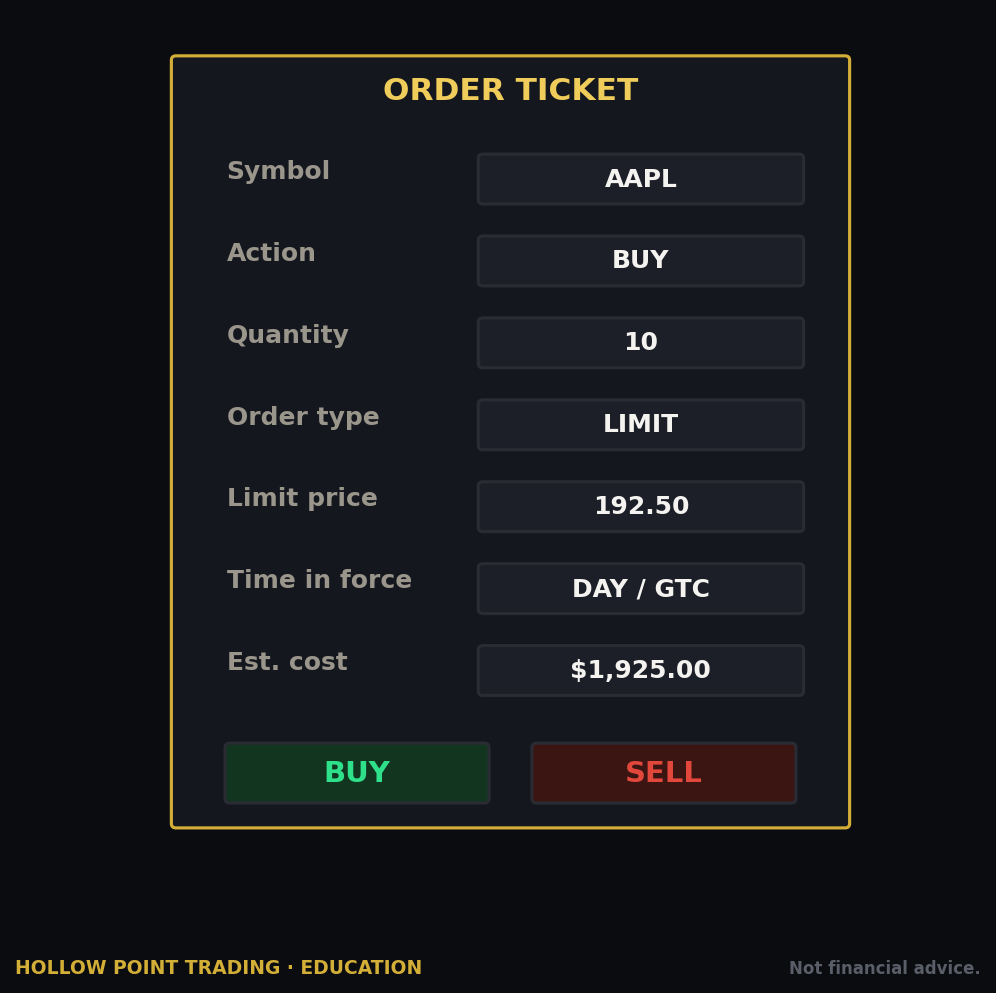
How an Option Actually Works, Step by Step
Let's walk through the entire life of an option trade the way a beginner would actually experience it. No jargon left undefined.
Step 1 — You form an opinion. You look at a company — let's call it Bright Motors, trading at $50 a share — and you believe it's going to rise over the next month. Maybe there's good news coming. Maybe the chart looks strong. The point is you have a directional view: up.
Step 2 — You choose call or put. You think it's going up, so you choose a call (the right to buy).
Step 3 — You choose a strike. You pick a strike price of $52. You're saying, "I want the right to buy Bright Motors at $52." Notice the stock is at $50 right now, so a $52 strike call is out of the money — the stock has to climb past $52 before this option has real muscle. Out-of-the-money options are cheaper, but they need a real move to pay off.
Step 4 — You choose an expiration. You give yourself time to be right. You pick an expiration about one month away. More time costs more premium, because more time means more chance for the stock to move your way.
Step 5 — You see the premium and do the math. The broker shows the call quoted at $1.50. Remember the rule: that's per share, and one contract is 100 shares. So one contract costs $1.50 × 100 = $150. That $150 is your total risk. The worst thing that can happen is you lose $150. That is the entire downside, known in advance. Peace of mind.
Step 6 — You place the trade. You buy one contract for $150. You now own the right to buy 100 shares of Bright Motors at $52 anytime before expiration.
Step 7 — Time passes and you make a decision. This is where the story branches, and understanding the branches is understanding options.
A Fully Worked Beginner Example — All Three Endings
Let's finish the Bright Motors trade three different ways so you can feel how options behave. You bought one $52 call for $150 (premium of $1.50 per share × 100 shares), with the stock starting at $50.
Ending A — The stock rises (the win). Good news hits and Bright Motors climbs to $58 by expiration. Your $52 call is now deeply in the money — you have the right to buy at $52 something worth $58. That's $6 of value per share. Across 100 shares, that contract is now worth about $6 × 100 = $600.
You paid $150. It's worth $600. You simply sell the contract to another trader and pocket the difference:
- Money in: $600
- Money out: $150
- Profit: $450
That's a $450 gain on a $150 bet — a 300% return — while the stock itself only rose from $50 to $58, about 16%. That is leverage. The magnifying glass worked in your favor. Notice, too, that you never needed $5,200 to buy 100 shares; you controlled them for $150.
Ending B — The stock falls (the loss, but a defined one). Instead, bad news hits. Bright Motors drops to $44. Your $52 call — the right to buy at $52 — is worthless. Why would anyone use the right to buy at $52 when they could buy in the open market at $44? Nobody would. So the option expires worthless.
- Money in: $0
- Money out: $150
- Loss: $150
Here's the crucial lesson: you lost your entire premium, but not one penny more. Compare that to owning 100 actual shares. If you'd bought 100 shares at $50 ($5,000) and it fell to $44, you'd be down $600 — four times your option loss — and you'd have $5,000 tied up the whole time. The option capped your loss automatically. This is the "defined risk" beauty of buying options, and it's why they fit the protect-capital-first mindset so well.
Ending C — The stock goes nowhere (the quiet lesson). Bright Motors drifts sideways and closes at $51 at expiration — up a little, but still below your $52 strike. Your call is out of the money by a dollar. It expires worthless.
- Money in: $0
- Money out: $150
- Loss: $150
Wait — the stock went up, and you still lost? Yes. And this catches nearly every beginner off guard. You needed the stock to rise past your strike of $52, and by enough to cover the $1.50 you paid — meaning above $53.50 — just to break even. This is the concept of breakeven: for a call, it's the strike plus the premium ($52 + $1.50 = $53.50). Being merely "right about direction" isn't enough. You have to be right about direction, distance, and timing all at once. Options are a three-part exam, not a one-part one.
The Silent Killer: Time Decay
There's one more force every beginner must meet early, because it works against option buyers every single day: time decay (the fancy word is "theta").
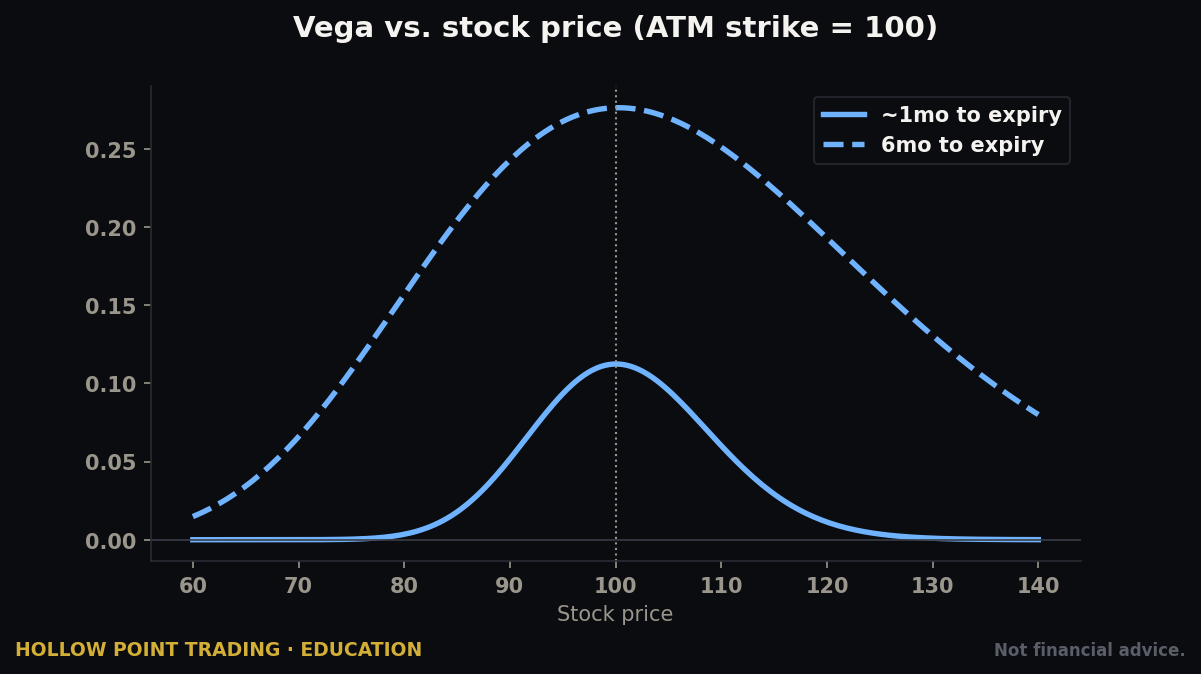
An option is partly a bet on time. Every day that passes with the stock not moving your way, your option loses a little value — like an ice cube slowly melting on the counter. Even if the stock sits perfectly still, your option gets cheaper as expiration approaches, because there's less time left for the move you're hoping for.
This is why "the stock went nowhere and I still lost" happens. Time was quietly draining your premium the whole time. Time decay speeds up in the final weeks before expiration. It's the reason experienced traders are so careful about how much time they buy — too little, and the clock crushes you before you're right; too much, and you overpay. For now, just know the ice cube is melting, always, and it melts faster near the end.
The Beginner Mistakes to Avoid
You will be tempted by every one of these. Everyone is. Reading them now means you'll recognize the trap when it's staring at you.
Mistake 1 — Forgetting the ×100. You see an option priced at $3 and think it's cheap, then discover you spent $300 per contract, or $3,000 on ten contracts. Always multiply by 100. Always.
Mistake 2 — Buying cheap, far out-of-the-money options because they "could 10x." These are the lottery tickets of the market. They're cheap for a reason: they almost never pay off. Beginners load up on them chasing a jackpot and slowly bleed to zero. Cheap is not the same as good value.
Mistake 3 — Ignoring time decay. Buying an option a few days before expiration because it's cheap, then watching it evaporate as the melting ice cube does its work. Give your trades enough time to be right.
Mistake 4 — Betting the account on one trade. Because options are cheap per contract, it's easy to put a huge chunk of your money into a single position. Then one bad day erases it. Never risk money you can't afford to lose entirely — remember, buying an option means the whole premium is genuinely at risk.
Mistake 5 — Confusing "right about direction" with "profit." As Ending C taught us, the stock can move your way and you can still lose if it doesn't move far enough, fast enough. Respect the breakeven.
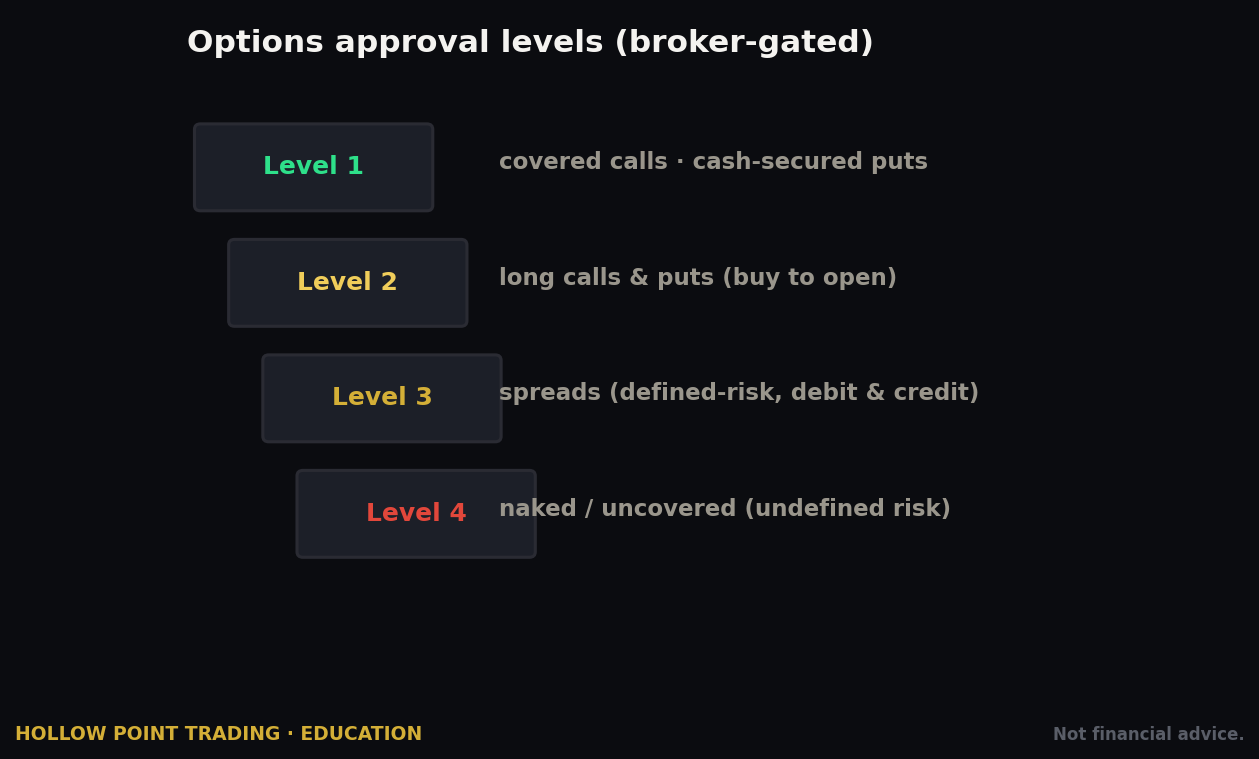
Mistake 6 — Selling options before you understand obligations. Selling (rather than buying) options can carry undefined, sometimes enormous risk, because you take on the obligation side. Beginners should start as buyers, where the maximum loss is known and small. Learn to walk before you run.
Mistake 7 — Trading with no plan. Entering because it "feels like it's going up," with no target, no exit, no maximum loss decided in advance. This is gambling wearing a trader's costume. A plan — where you get in, where you get out if you're wrong, where you take profit if you're right — is what separates a trader from a gambler.
Your Simple Options Cheat-Sheet
Tape this to your monitor. Everything above, compressed:
The one sentence: An option is the RIGHT, not the obligation, to buy or sell a stock at a set price by a set date.
The two types:
- CALL = right to buy → you think price goes UP ("call it up")
- PUT = right to sell → you think price goes DOWN ("put it down")
The four words:
- Strike = the locked-in price
- Expiration = the deadline
- Premium = what you pay (and, as a buyer, your max loss)
- Contract = 100 shares (always multiply the quoted price by 100)
The three questions before any trade:
- Which direction, and why? (Your reason.)
- How much can I lose, exactly? (The premium — is it small enough?)
- Where's my breakeven, and is the move realistic in the time I have?
The breakeven formulas:
- Call breakeven = strike + premium
- Put breakeven = strike − premium
The golden rule: When you buy an option, the most you can lose is the premium. Never put in more than you're truly willing to lose.
How Options Fit the Bigger Hollow Point Picture
Everything you just learned is a tool. And at Hollow Point Trading, we believe a tool is only as good as the discipline of the hand that holds it. So here's how options fit the way we think.
We move macro to sector to stock. That means we start big — what's the overall market doing, is it strong or weak? Then we narrow to the sector — which industries are leading, which are lagging? Only then do we get to the individual stock. An option is the final, precise instrument at the end of that funnel. You don't reach for the option first; you reach for it last, after the bigger picture has told you which direction and which name deserves your capital. An option on a strong stock, in a strong sector, in a strong market, is a very different thing from a random lottery ticket bought on a hunch.
We hold to reward-to-risk of at least 1-to-3. Remember Ending A, where a $150 risk produced a $450 gain? That's a 1-to-3 trade — risking one unit to make three. Options are beautifully suited to this because your risk (the premium) is defined up front, which makes the math clean. Before you enter, you should already know: "I'm risking $150 to potentially make $450 or more." If the trade doesn't offer at least that ratio, you pass. No exceptions, no "just this once."
We believe in discipline over prediction. Nobody — not us, not anyone — knows what the market will do next. What we can control is our rules: how much we risk, when we exit, whether the setup meets our standards. The trader who follows good rules with a mediocre crystal ball beats the trader with a great crystal ball and no rules, every single time. Options reward this mindset because the defined risk of buying them means your rules can be enforced automatically — the premium is your line in the sand.
And above all, we protect capital first. You cannot trade tomorrow if you blow up today. The reason we've spent this entire guide hammering "the most you can lose is the premium," "always multiply by 100," "respect time decay," and "start as a buyer" is that survival is the whole game. Big returns are meaningless if a single bad week ends your account. Learn the mechanics cold. Trade small. Live to trade another day.
Where You Go From Here
You now understand what an option is — a contract giving you the right, not the obligation, to buy (call) or sell (put) a stock at a set strike price, by a set expiration date, for a price called the premium, with one contract controlling 100 shares. You understand why they exist, how leverage cuts both ways, how a real trade plays out across winning, losing, and going-nowhere endings, and the mistakes that catch nearly every beginner.
That is a genuine foundation. Most people who trade options never actually learned this part; they jumped straight to the exciting screenshots and skipped the alphabet. You didn't. That patience is your first edge.
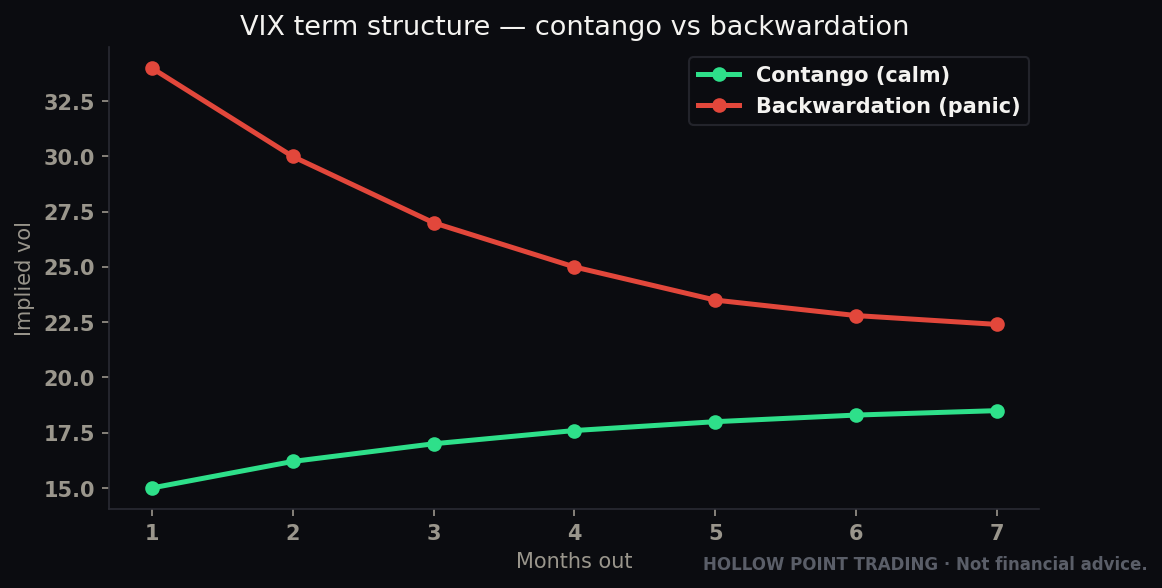
The next steps in this beginner series will go deeper — how to actually read an option quote screen, how to pick the right strike and expiration for a given idea, how time decay and volatility change prices, and how to build a real, rule-based plan around a single trade. But none of that matters without today's foundation, so let it settle. Re-read this guide. Say the one sentence out loud until it's automatic. Do the math on a few practice examples without risking a dime.
The market will still be there when you're ready. It always is. Learn carefully, trade small, and let the rules — not the excitement — lead you.
Bound by rules, feared by trade.