
You want to trade options. Good. But before a single dollar leaves your account, you're going to do something that separates the traders who survive from the traders who blow up in three weeks: you're going to practice with fake money first. It's called paper trading, and it is the single most valuable free tool a beginner has. This guide teaches you exactly what it is, how to do it so it actually prepares you, what to work on, and how to know when you're ready to go live — starting small, protecting your capital, and never confusing luck with skill.
Let's start from zero.
What Paper Trading Actually Is (In Plain English)
Paper trading means placing pretend trades in a realistic simulator using fake money, so you can learn how everything works without risking a cent of your own cash. The name comes from the old days when traders would literally write their imaginary trades on paper — "I would have bought here, I would have sold there" — and add up the results at the end of the week.
Today it's not paper anymore. It's software. Your broker (the company that lets you place trades, like Fidelity, Charles Schwab's thinkorswim, Webull, or Tastytrade) gives you a paper trading account, sometimes called a demo account or simulated account. It looks and works almost exactly like the real thing. You get a fake balance — usually $100,000 in play money — and you can buy and sell using live market prices. The only difference is that the money isn't real, so your wins don't make you rich and your losses don't hurt you.
Think of it like a flight simulator. Pilots log hundreds of hours in a simulator before they ever touch a real cockpit. The simulator throws engine failures and storms at them so that when a real emergency happens, their hands already know what to do. Paper trading is your flight simulator. The market will absolutely throw storms at you. You want your hands to already know the drill.
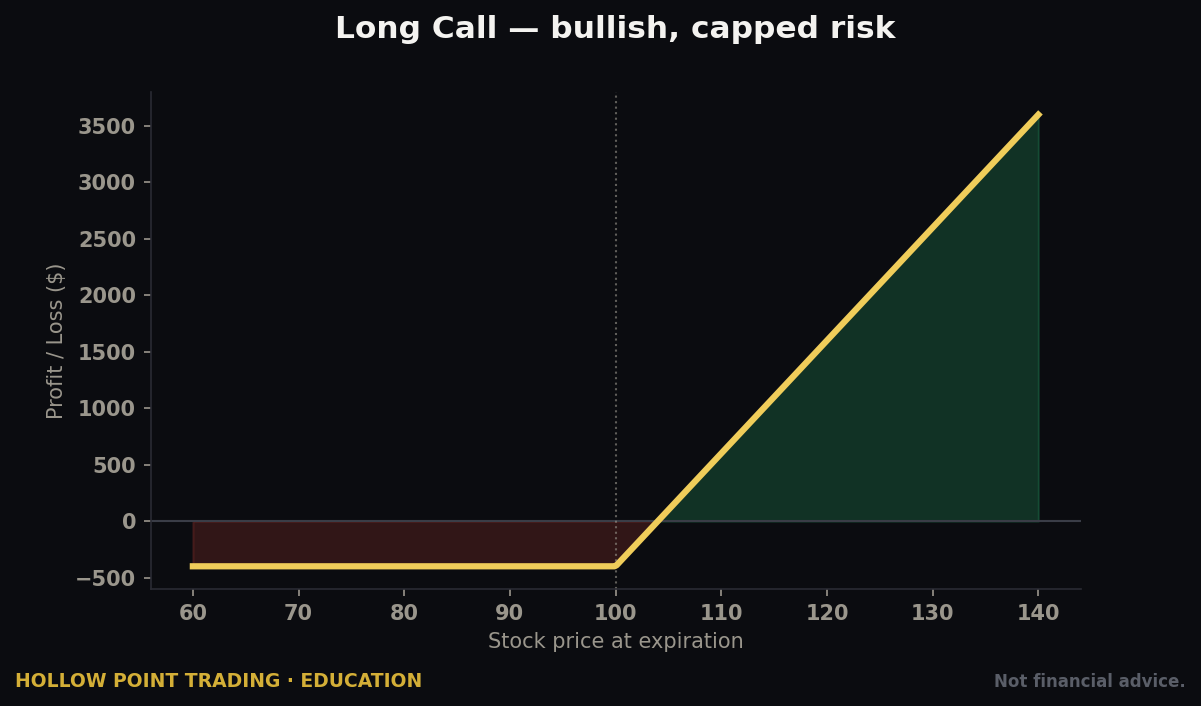
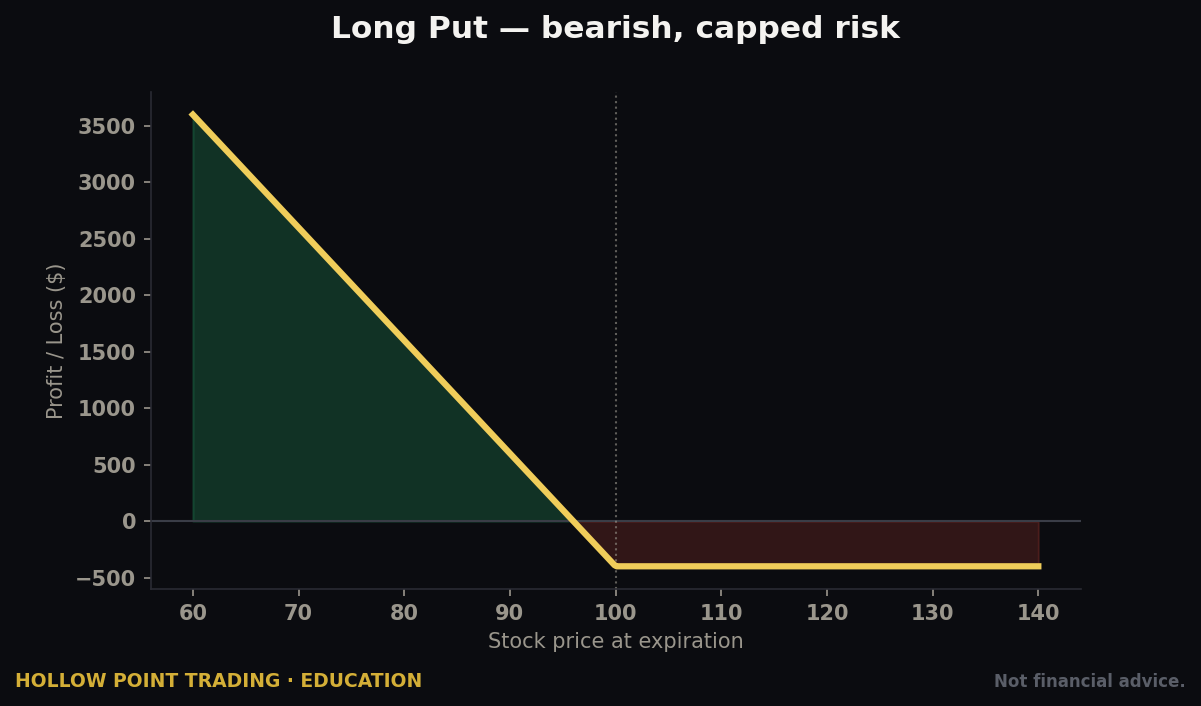
Now, a quick word on what an option even is, because this is the beginner track and we define everything. An option is a contract that gives you the right — but not the obligation — to buy or sell a stock at a set price before a set date. A call option is a bet that a stock will go up. A put option is a bet that a stock will go down. Each contract normally controls 100 shares of the stock. The price you pay for the option is called the premium. Options are powerful because a small amount of money can control a lot of stock — but that same power means you can lose your entire premium fast if you're wrong. That's exactly why beginners practice first.
Why a Beginner Should Care (This Part Is Not Optional)
Here is the hard truth that no one selling you a course wants to say out loud: most people who start trading options lose money, and many lose it in the first month. Not because options are a scam, but because they jumped into a live cockpit having never flown. They didn't know how to place an order. They didn't understand that an option loses value every single day just from time passing. They panicked, clicked the wrong button, and turned a small mistake into an account-ending one.
Paper trading removes the two things that destroy beginners: ignorance and expensive mistakes. Every dumb error you're going to make — and you will make dozens — costs you exactly zero dollars in the simulator. You'll buy a call when you meant to buy a put. You'll forget an option expires on Friday. You'll size a position way too big. In real money, each of those is a painful, sometimes catastrophic loss. In paper trading, each one is a free lesson.
There's a second reason, and it's deeper. Paper trading teaches you that trading is a skill of discipline, not prediction. Beginners think the game is guessing which way the stock goes. It isn't. The real game is managing risk — knowing exactly how much you'll lose if you're wrong, and making sure your wins are bigger than your losses over time. At Hollow Point Trading, the phrase we live by is bound by rules, feared by trade. You become dangerous in the market not by predicting better than everyone else, but by following your rules better than everyone else. Paper trading is where you build those rules before real money makes you emotional.
And it's free. There is no downside. Anyone who tells a beginner to skip paper trading and "learn by doing" with real money is telling you to learn to swim by jumping off a boat in the ocean.
How Paper Trading Works, Step by Step
Let's walk through the whole thing as if you've never opened a trading app in your life.
Step 1: Open a paper trading account. Pick a broker that offers a good simulator. Popular beginner-friendly ones include thinkorswim (from Charles Schwab), Webull, and Tastytrade — all of them have a paper/demo mode. You sign up, and somewhere in the app there's a toggle or a separate mode labeled "Paper" or "Simulated." Flip it on. You now have a fake balance, usually $100,000. Ignore that huge number for now — we'll talk about why it's a trap in a minute.
Step 2: Learn the order screen. This is the panel where you actually place a trade. For an option you'll choose: the ticker (the stock's symbol, like AAPL for Apple), whether you want a call or a put, the strike price (the set price in the contract), the expiration date (the deadline), and the quantity (how many contracts). Then you'll pick an order type. A market order buys immediately at whatever the current price is. A limit order buys only at a price you set or better. Beginners should use limit orders — they keep you in control of what you pay.
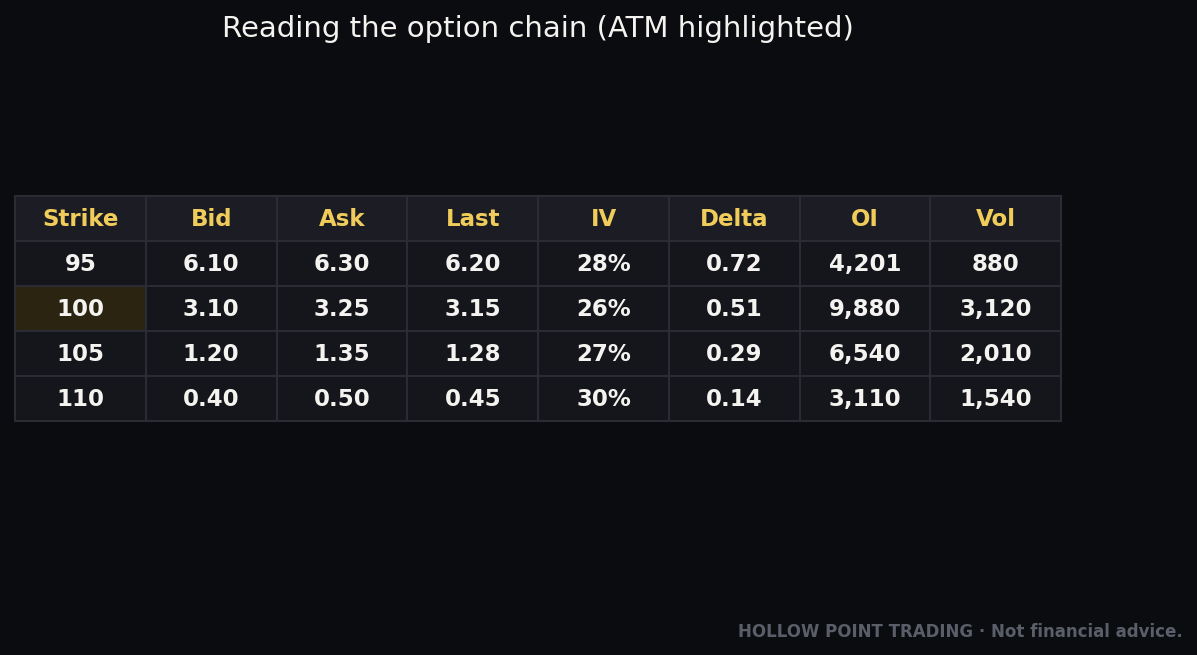
Step 3: Read the option chain. The option chain is a big table showing every available strike price and expiration for a stock, with the current premiums. It looks intimidating. In the simulator you can stare at it for an hour with zero pressure, clicking around until it makes sense. That freedom to poke at things without consequence is the whole point.
Step 4: Place a pretend trade. Let's say you think Apple is going up this week. You buy one call option. You set a limit price. You click confirm. Congratulations — you own a simulated position. Nothing real happened, but the app now tracks that position against live prices exactly as if it were real.
Step 5: Manage the trade. This is where the learning actually lives. You watch the position. When the stock moves your way, the premium rises and you're "up." When it moves against you, the premium falls and you're "down." You practice deciding when to take profit (sell for a gain) and when to cut a loss (sell to stop the bleeding). You place a stop-loss — an order that automatically sells if the price drops to a level you set, capping your damage.
Step 6: Journal it. After you close the trade, you write down what you did and why. We'll cover journaling in depth below, but know now that a paper trade you don't record is a lesson you'll forget.
How to Make Paper Trading Actually Realistic
Here's the catch nobody warns beginners about: paper trading is only useful if you take it seriously. The simulator makes it easy to cheat yourself, and if you do, you'll learn nothing and walk into live trading overconfident. Let's make it real.
Trade the account size you'll actually have. The simulator hands you $100,000 in fake money. But if you're going to start live trading with $2,000, then trading like you have $100,000 teaches you nothing about your real life. Mentally set your paper account to your real starting size. If you'll have $2,000, pretend you have $2,000. A trade that risks $500 is a rounding error on $100,000 but a quarter of a $2,000 account. Size for the account you'll really fund.
Feel the money. The reason real trading is hard is emotion — the fear when you're losing, the greed when you're winning. Fake money removes that emotion, which is both the gift and the danger of paper trading. To bridge the gap, treat every dollar as if it were real. When you're down $300 on paper, sit in that discomfort. Ask yourself honestly: would I hold this if it were rent money? If the answer is no, close it. Practicing the emotional discipline is more valuable than practicing the mechanics.
Don't take trades you couldn't take live. In the sim it's tempting to buy 50 contracts because, hey, it's fake. Don't. If your real account could only afford 1 contract, trade 1 contract. Otherwise you're rehearsing a play you'll never run.
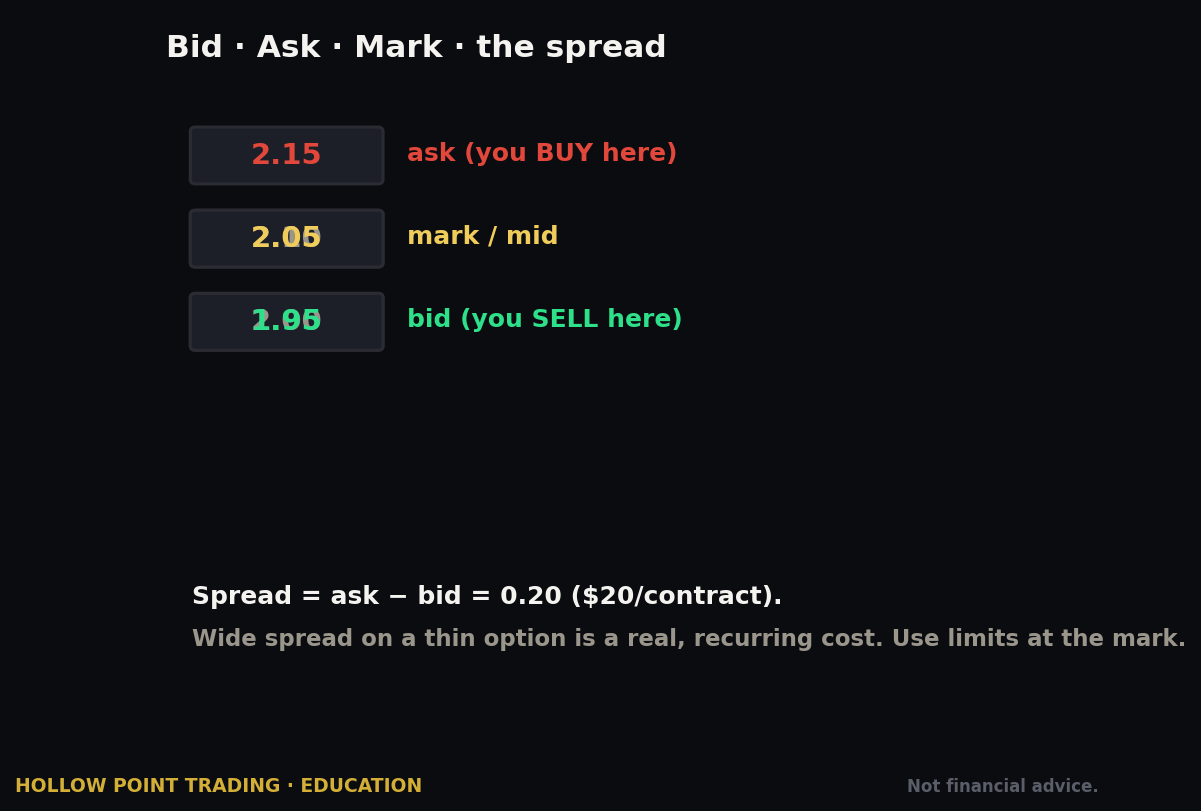
Use realistic fills. A fill is when your order actually executes at a price. Simulators sometimes give you perfect fills that you'd never get in the real, fast-moving market — especially on options, which can have wide gaps between the buy price and sell price (that gap is called the spread). Assume you'll get slightly worse prices live than you do in the sim. Build in that cushion mentally so real trading doesn't shock you.
Trade real market hours with real focus. Don't half-watch a paper trade while scrolling your phone. Sit down during actual market hours (for U.S. stocks that's 9:30 a.m. to 4:00 p.m. Eastern) and give it the same attention you'd give real money. The habit you build is the habit you'll keep.
What to Actually Work On (Not Just "Make Fake Money")
A beginner's goal in paper trading is NOT to run $100,000 into $200,000. Anyone can get lucky. Your goal is to build repeatable skills and prove you can follow rules. Here's your curriculum.
1. Master the mechanics until they're boring. Placing orders, setting stops, reading the chain, closing positions, rolling — do them until you could do them in your sleep. In a real trade, fumbling with buttons while the price moves against you is how small losses become big ones.
2. Learn how options lose value over time. Options have a built-in enemy called theta — the amount of value an option loses each day just because time is passing and the deadline is getting closer. This is called time decay. A beginner who doesn't understand theta buys an option, watches the stock go nowhere for three days, and is baffled that they're losing money. In the sim, buy an option and deliberately hold it through a flat day so you feel theta eat your premium. Free lesson, painful in real life.
3. Practice position sizing. Position sizing means deciding how much money to put into a single trade. The classic beginner rule is to never risk more than 1-2% of your account on one trade. On a $2,000 account, that's $20-$40 of risk per trade. Practice calculating this every single time before you enter. It feels tedious. It's the most important habit you'll ever build.
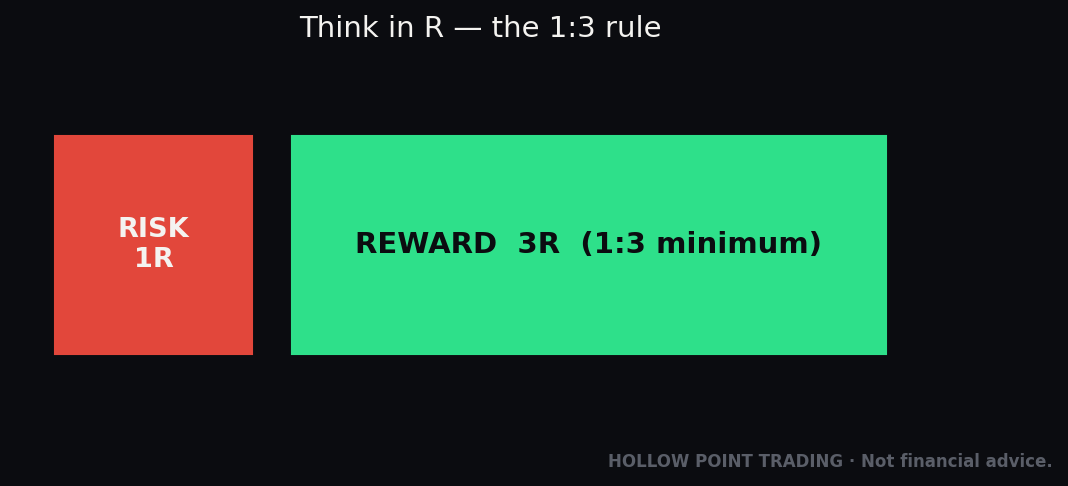
4. Practice the 1:3 reward-to-risk ratio. This is core Hollow Point Trading discipline. Reward-to-risk compares how much you stand to gain versus how much you're willing to lose. A 1:3 ratio means for every $1 you risk, you're aiming to make $3. Why does this matter so much? Because it means you can be wrong more than half the time and still make money. If you risk $100 to make $300, you can lose three trades ($300) and win just one ($300) and break even — win any more than that and you're profitable. Paper trading is where you drill this until it's automatic: before every entry, define your exit-if-wrong and your target-if-right, and only take the trade if the target is at least three times the risk.
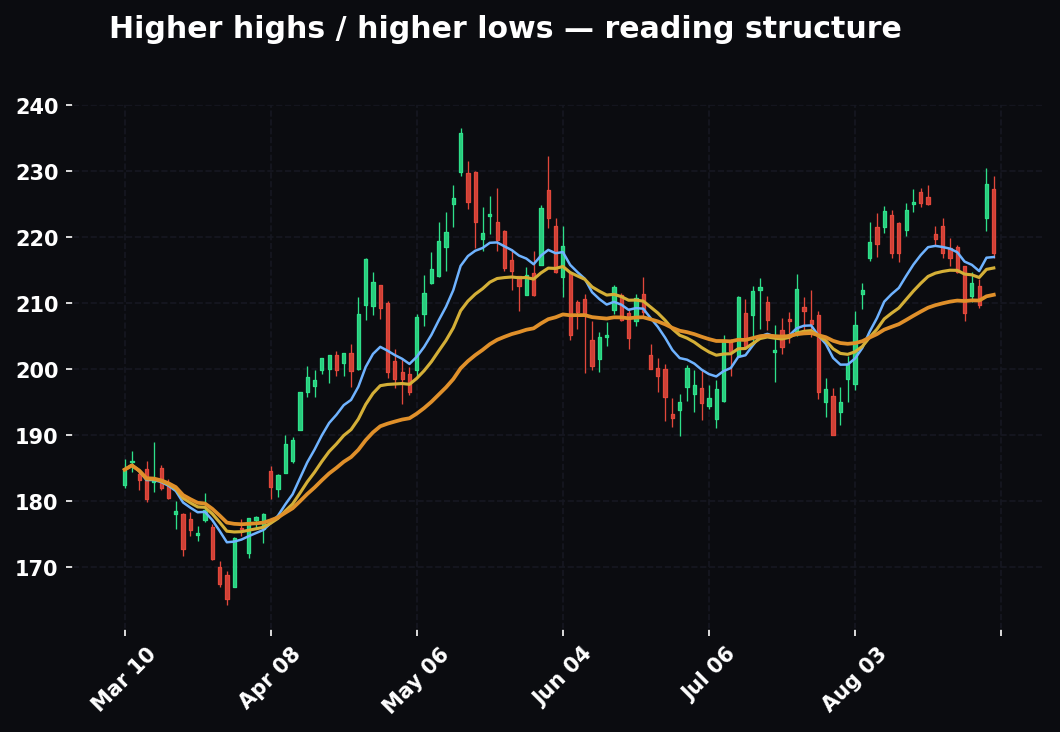
5. Practice reading the bigger picture — the HPT way. Good trades don't start with the stock. They start with the whole board. At Hollow Point we teach macro to sector to stock: first look at the overall market (is it a day where everything's falling?), then the sector (is technology strong or weak today?), then finally the individual stock. Practice this top-down read in the sim. A beautiful setup on one stock means little if the entire market is puking. Learning to see that context — for free, in the sim — is a skill most beginners never build.
6. Practice doing nothing. The hardest skill in trading is sitting on your hands when there's no good setup. Beginners force trades out of boredom. Use paper trading to practice patience — some days the right move is zero trades. If you can't stay disciplined with fake money, you have no chance with real money.
A Fully Worked Beginner Example
Let's walk through one complete paper trade from start to finish, with real-ish numbers, so you see exactly how this feels.
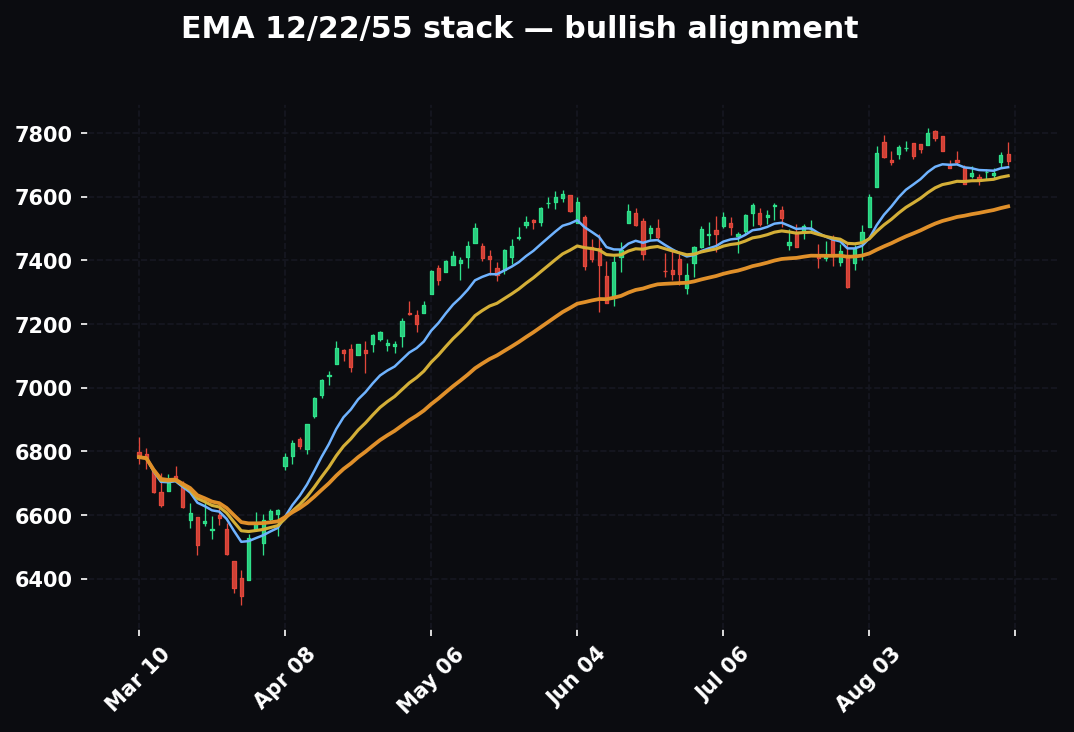
Setup. It's Monday morning. Your paper account is set to a realistic $2,000 (ignore the fake $100,000). You do your top-down read: the overall market is calm and slightly green, the technology sector is strong, and you notice Apple (AAPL) has been steadily climbing and is holding above a price level it bounced off twice last week. That's your macro-to-sector-to-stock check, all pointing the same direction: up.
The plan, written BEFORE you click anything. You decide to buy one call option. Apple is trading at $230. You choose a call with a strike price of $232 that expires in about two weeks (giving yourself time so theta doesn't eat you alive in one day). The premium is quoted at $3.00 per share. Since one contract controls 100 shares, this costs you $3.00 × 100 = $300.
Wait — pause. $300 on a $2,000 account is 15% of your money on one trade. That breaks the 1-2% risk rule badly if you'd lose it all. But here's the nuance: you won't hold it to zero. Your plan includes a stop. Let's define risk properly.
Defining risk and reward. You decide that if the premium drops from $3.00 to $2.00, you're wrong and you're out. That's a $1.00 loss per share × 100 = $100 risk. For your target, you apply the 1:3 rule: you want to make three times that, so $300 profit, which means selling when the premium hits $6.00 ($3.00 gain × 100 = $300). Your risk is $100, your reward target is $300. Clean 1:3.
That $100 risk is 5% of your $2,000 account — still a touch high for a strict beginner, so in a real refinement you might buy a cheaper option or accept a tighter stop. But for this example, let's run it.
Placing the trade. You use a limit order at $3.00 so you don't overpay. It fills. You now own one simulated AAPL call. You immediately note your stop ($2.00) and target ($6.00) in your journal.
Managing it. Tuesday, Apple ticks up to $233. Your premium rises to $3.80. You're up $80. Beginner instinct screams "take the profit!" But your plan said target $6.00, and the reason for the trade — strong stock, strong sector — is still intact. You hold. Discipline over impulse.
The outcome. By Thursday, Apple pushes to $237. Your call premium hits $6.10. Your target was $6.00. You sell. You bought at $3.00, sold at $6.10 — a gain of $3.10 per share × 100 = $310 profit. You just made 15% on your account on one disciplined trade.
The alternate ending you must also practice. Now imagine instead Apple dropped Tuesday to $228. Your premium fell to $1.95, below your $2.00 stop. Your rule says out. You sell and take the $105 loss without hesitation, without hoping, without "just giving it one more day." That obedience — cutting the loss exactly where you said you would — is the whole game. In paper trading you rehearse it so that live, when your heart is pounding, your hand still obeys the rule.
Journal both. Win or lose, you write down: the setup, your reasoning, your entry, stop, target, the outcome, and one honest sentence on whether you followed your plan. Over 50 trades, this journal becomes the most valuable document you own.
The Beginner Mistakes to Avoid
Trading the fake balance instead of your real one. Covered above, but it's the number one killer. Size for the account you'll actually fund.
Treating it like a video game. Random clicking, giant positions, no plan — because it's "just fake money." You're not building skill, you're building bad habits. Every paper trade gets a written plan or it doesn't happen.
Only paper trading your wins. Some beginners quietly ignore their losing paper trades and only count the good ones. This is lying to yourself. Track everything. Your win rate (the percentage of trades that made money) and your average win versus average loss are the numbers that tell you if you're actually ready.
Ignoring costs. Real trades have commissions (fees the broker charges) and the spread we mentioned. A sim can make you feel more profitable than you'd be live. Assume real trading is slightly harder than the sim shows.
Paper trading forever. The opposite mistake. Some people are so scared of real money they sim for two years and never go live. At some point the fake money stops teaching you, because the missing ingredient — real emotion — can only be trained with real dollars. The goal is graduation, not permanent residency.
Not understanding what you're trading. Buying an option because it's "cheap" without understanding theta, the strike, or the expiration. Cheap options are often cheap because they're likely to expire worthless. Learn why a trade should work before you place it, even in the sim.
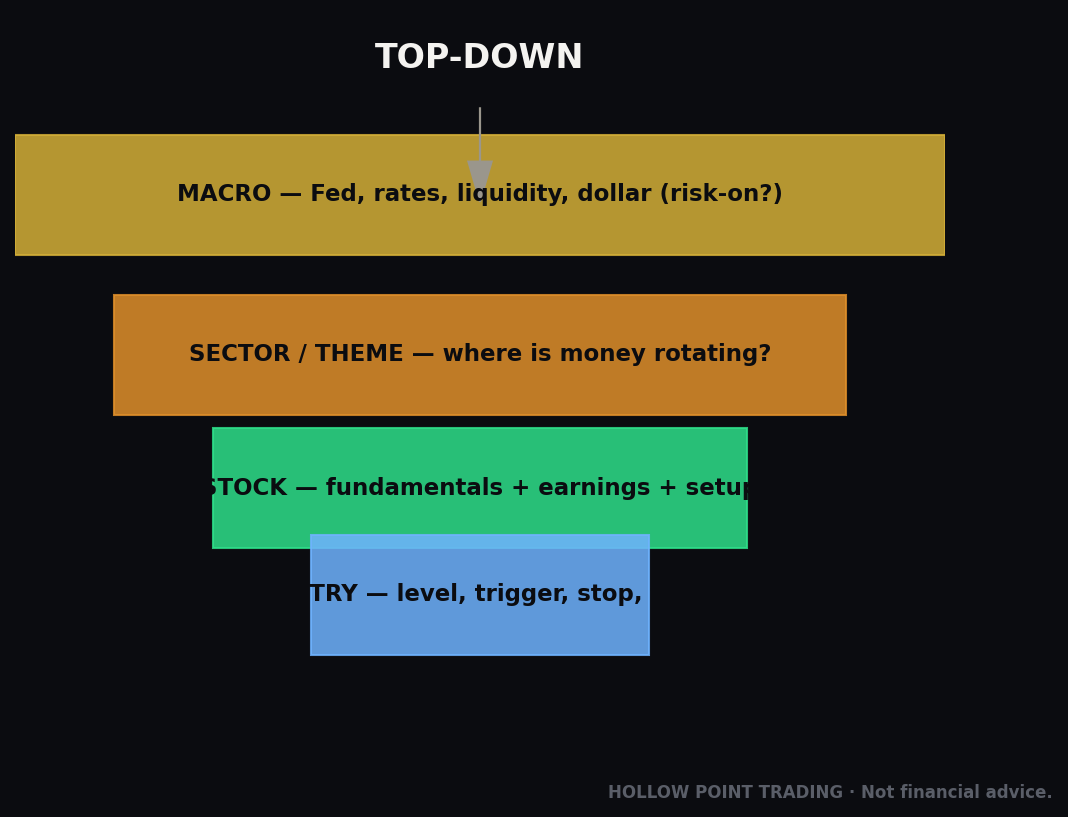
Skipping the top-down read. Jumping straight to a stock chart without checking the market and sector. You'll take great-looking trades on days the whole market is against you. Macro, then sector, then stock — every time.
Confusing luck with skill. A few big wins early can make a beginner feel like a genius. In the sim, judge yourself over 30-50 trades minimum, not 3. One lucky streak proves nothing.
When to Go Live — And Go Small
So how do you know you're ready to trade real money? Not by a feeling. By evidence. Here are the honest signals.
You've placed at least 30-50 paper trades. Enough that the mechanics are automatic and you've seen both winning and losing streaks.
You followed your plan on the vast majority of them. Notice the standard: not that you won most, but that you followed your rules most. A profitable simulator run where you ignored your own stops means you got lucky and learned nothing. A slightly losing run where you obeyed every rule means you're actually building the right habit.
Your journal shows consistent 1:3 planning and real risk management. You define risk and reward before every trade, and you size at 1-2% per trade without being told.
You can sit out bad days. You've proven you don't force trades when there's no setup.
When those boxes are checked, you go live — and you go live absurdly small. This is the golden rule of the transition. Fund your account with only money you can afford to lose entirely, and then trade even smaller than that. If you have $2,000, don't trade like it's $2,000 on day one. Trade one cheap contract. Risk $20. The point of your first live trades is not to make money — it's to feel real emotion for the first time and prove you can still follow your rules while your heart is racing.
Because here's what the sim can never teach you: the feeling of real loss. The first time real money is on the line, your hands may shake, your judgment may wobble, and trades you managed perfectly on paper suddenly feel impossible. That's why you start small — small enough that the emotional lesson is cheap. As you prove to yourself, over weeks and months, that you can trade live with the same discipline you had on paper, you slowly increase size. Slowly. Protecting capital always comes first, because a trader with capital can trade tomorrow, and a trader who blew up cannot.
Your Simple Paper Trading Cheat-Sheet
Print this. Tape it where you trade.
Before you start:
- Open a paper account (thinkorswim, Webull, Tastytrade, etc.)
- Mentally set it to your REAL starting balance
- Commit to journaling every single trade
Before EVERY trade:
- Top-down read: market → sector → stock (all agree?)
- Write the plan: entry, stop (exit if wrong), target (exit if right)
- Check the ratio: is the target at least 3× the risk? (1:3)
- Check the size: is your risk 1-2% of your account or less?
- Understand it: do you know the strike, expiration, and theta?
While in the trade:
- Obey your stop, no exceptions, no "one more day"
- Don't grab profits early if the plan and setup are intact
- Sit out if there's no clean setup — doing nothing is a position
After every trade:
- Journal: setup, reasoning, entry, stop, target, result
- One honest line: did I follow my plan? (win OR lose)
Ready to go live when:
- 30-50+ paper trades logged
- You followed your rules on most of them
- Consistent 1:3 planning and 1-2% sizing
- You can sit out bad days
- Then: fund only what you can lose, and trade even smaller than that
How This Fits the Bigger Hollow Point Picture
Paper trading isn't a beginner phase you graduate from and forget. It's your permanent laboratory. Even experienced traders drop back into the sim to test a new strategy before risking real capital. It's where ideas go to be proven or killed for free.
But more than that, paper trading is where you first learn the Hollow Point truth: the market cannot be predicted, only managed. Everything we teach — the macro-to-sector-to-stock read, the 1:3 reward-to-risk discipline, protecting capital before chasing gains, sizing small — is a system of rules designed to keep you alive long enough to get good. The trader who wins isn't the one who guesses direction best. It's the one who, on their worst day, still cut the loss exactly where the plan said, still refused the trade that didn't fit, still sized small when greed screamed to size big.
That obedience is a muscle. Paper trading is the gym where you build it, for free, with no risk, before the market ever gets to test you for real. Beginners who skip this step aren't braver — they're just paying tuition in real dollars to learn lessons the simulator gives away for nothing.
Start today. Open the demo. Set it to your real size. Take one disciplined trade, journal it, and do it again fifty times. By the time you go live small, you won't be hoping you're ready. You'll have the proof.
Bound by rules, feared by trade.