
Start Here: You've Never Traded, and That's Fine
Let's build this from the ground floor, because the ground floor is exactly where most option beginners get quietly wiped out.
When you buy an option, you are not buying the stock. You are buying a contract — a small agreement that gives you the right (but not the obligation) to buy or sell a stock at a specific price, before a specific date. Think of it like a coupon. A coupon at a store says "you may buy this TV for $400 anytime before December 31st." If the TV's real price shoots up to $600, your coupon is suddenly valuable — you can buy at $400 and the world will pay you $600. If the TV's price falls to $300, nobody wants your $400 coupon, and it eventually expires worthless.
Two words you'll see everywhere:
- A call is a coupon that lets you buy a stock at a set price. You buy calls when you think the price is going up.
- A put is a coupon that lets you sell a stock at a set price. You buy puts when you think the price is going down.
The set price on that coupon — the price you're allowed to buy or sell at — is called the strike price. That's the whole subject of this guide. Not whether to buy a call or a put (that's your direction). This is about which strike to pick once you've chosen a direction. It is the single most under-taught decision a beginner faces, and getting it wrong is how people who were right about the direction still lose money.
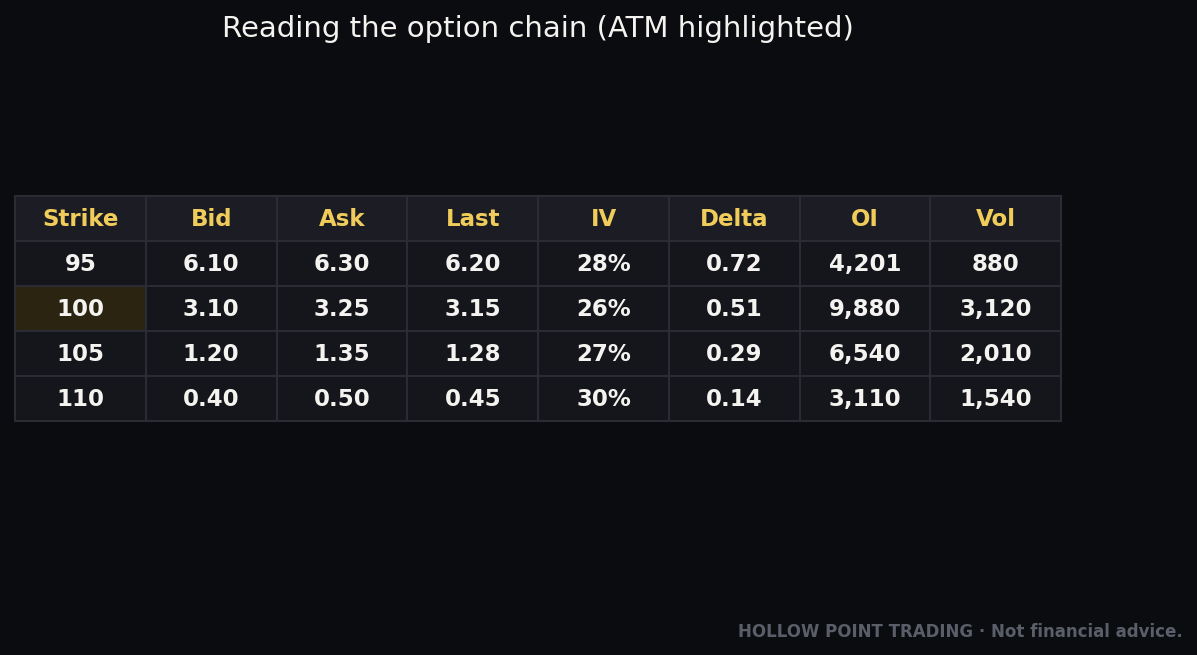
By the end of this, you'll understand three little labels — ITM, ATM, OTM — a number called delta that acts like a rough chance-o-meter, and a simple, repeatable way to pick a strike that matches what you actually believe. You'll be able to use it Monday.
What ITM, ATM, and OTM Actually Mean (Plain English)
Every strike price you can pick falls into one of three buckets, defined entirely by where the strike sits relative to the stock's current price. Let's use a real-ish example the whole way through.
Say a stock — we'll call it Maple Corp, ticker MPL — is trading at $100 right now. You think it's going up, so you're shopping for calls (the right to buy).
In-The-Money (ITM) — the strike is below the current price (for a call). A $90 call on a $100 stock is In-The-Money. Why? Because the right to buy at $90 when the stock is already $100 has real, built-in value — $10 of it. That $10 of "already-in-your-favor" value is called intrinsic value. It's the part of the coupon that would be worth something even if the stock froze in place forever.
At-The-Money (ATM) — the strike is roughly equal to the current price. A $100 call on a $100 stock is At-The-Money. It has essentially zero built-in value right now — the right to buy at $100 when the stock is $100 saves you nothing yet — but it's right on the fence, one good move from paying off.
Out-Of-The-Money (OTM) — the strike is above the current price (for a call). A $110 call on a $100 stock is Out-Of-The-Money. Right now it has zero intrinsic value — why pay for the right to buy at $110 when you could just buy at $100 in the open market? It's pure hope. It only becomes worth something if MPL actually climbs past $110.
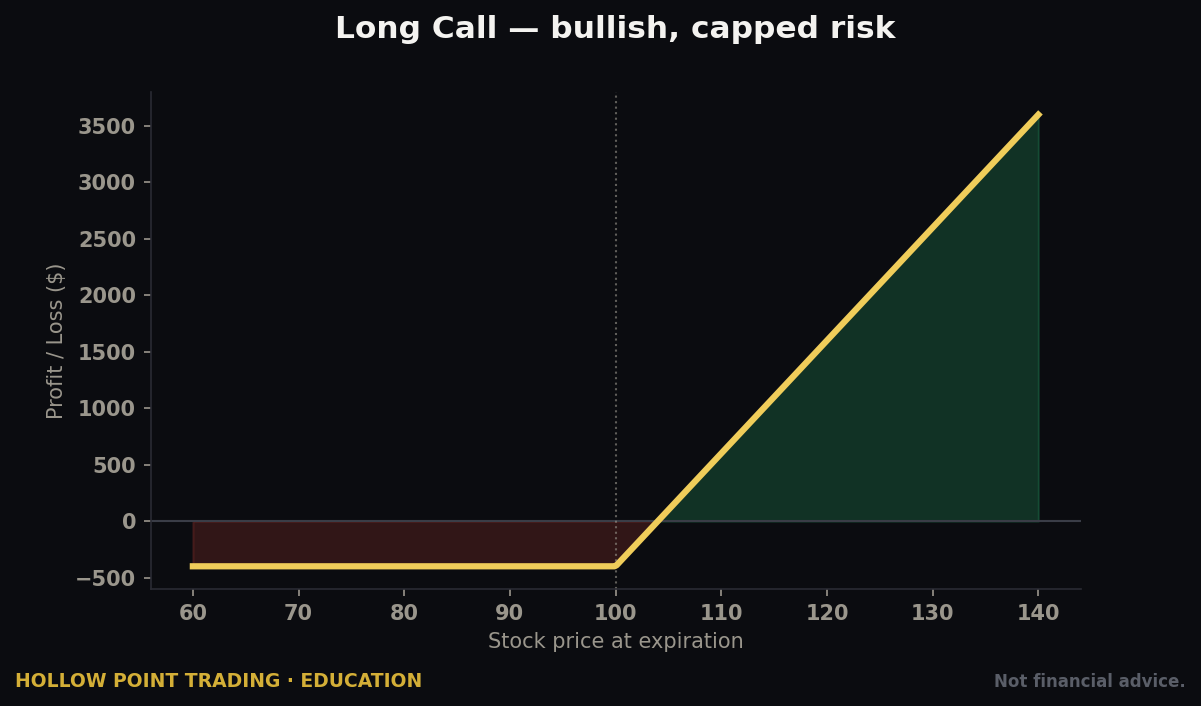
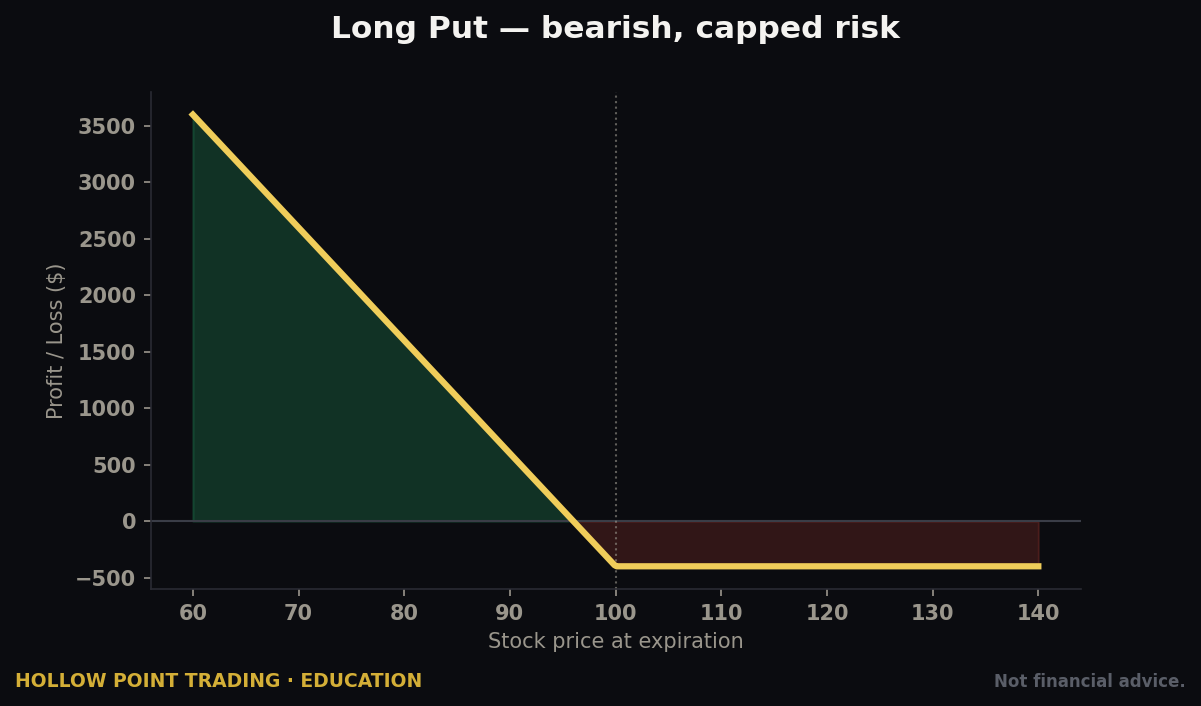
For puts, the whole thing flips like a mirror, because puts profit when price falls:
- ITM put = strike above the current price (a $110 put on a $100 stock already has $10 of built-in value).
- ATM put = strike at the current price.
- OTM put = strike below the current price (a $90 put on a $100 stock — pure hope the stock drops).
A quick memory hook: "In-The-Money" means the option already has money in it — real, intrinsic value you could cash in on today. "Out-Of-The-Money" means there's no money in it yet — you're paying entirely for the possibility of future money.
The Two Ingredients Inside Every Option's Price
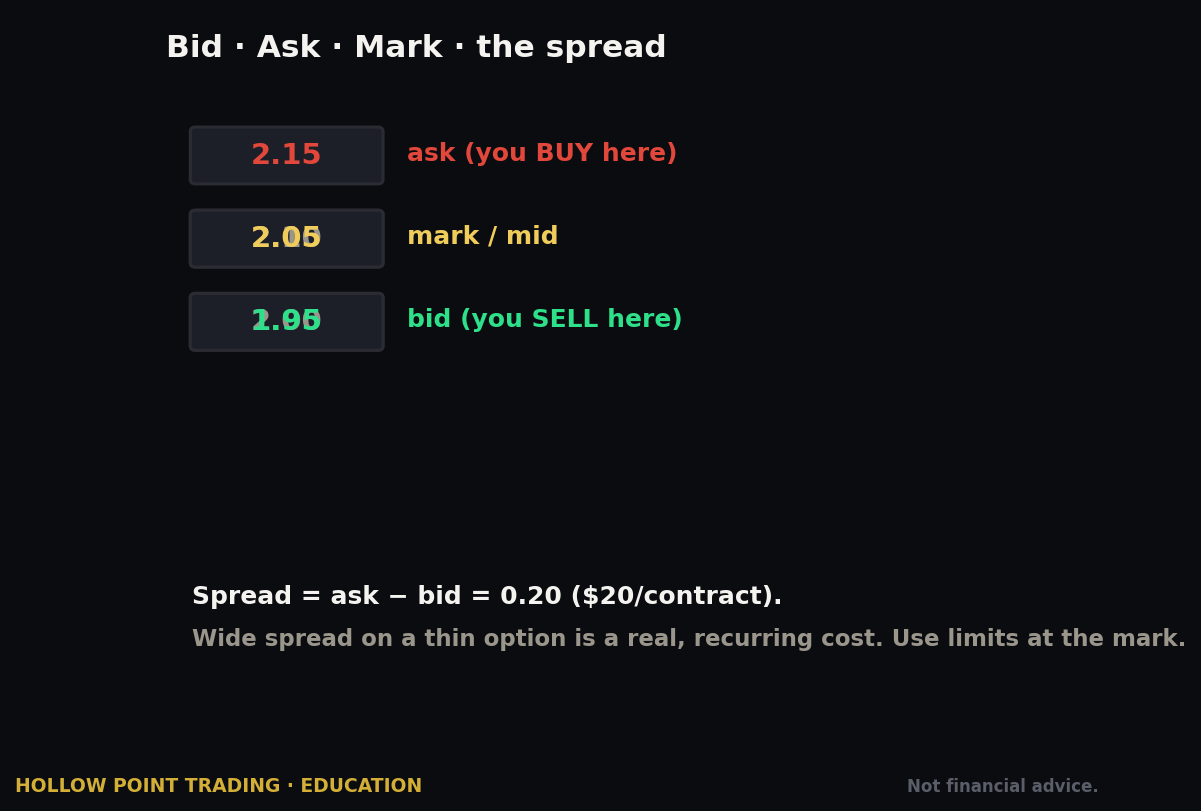
To choose a strike well, you have to know what you're actually paying for. The price of any option (called the premium — the cost of the coupon) is made of exactly two ingredients:
1. Intrinsic value — the "already-in-your-favor" amount we just described. For our $90 call on a $100 stock, that's $10. This part is real. It cannot evaporate unless the stock actually moves against you.
2. Extrinsic value (also called time value) — everything else in the price. This is what you pay for time and possibility. It's the market charging you for the chance the stock moves further your way before the coupon expires. This part is fragile. It leaks away a little every single day — a process called time decay (the fancy Greek name is theta, but you just need the idea). And on expiration day, all extrinsic value is gone. Zero. Only intrinsic value remains.
Here's why this matters so much for strike selection:
- An OTM option is 100% extrinsic value. It has zero intrinsic value by definition. Everything you paid is the fragile, decaying, hope portion. If the stock doesn't move enough, that value melts to nothing.
- A deep ITM option is mostly intrinsic value. Most of what you paid is the solid, real part that only moves when the stock moves.
- An *ATM option has the most extrinsic value of all* — it's the pure fence-sitter, so the market charges the most for its time-and-possibility.
This single fact — OTM is all hope, ITM is mostly substance — is the beating heart of the strike decision. Hold onto it.
Delta: Your Rough Chance-O-Meter
Now the most useful tool a beginner has for picking strikes: delta.
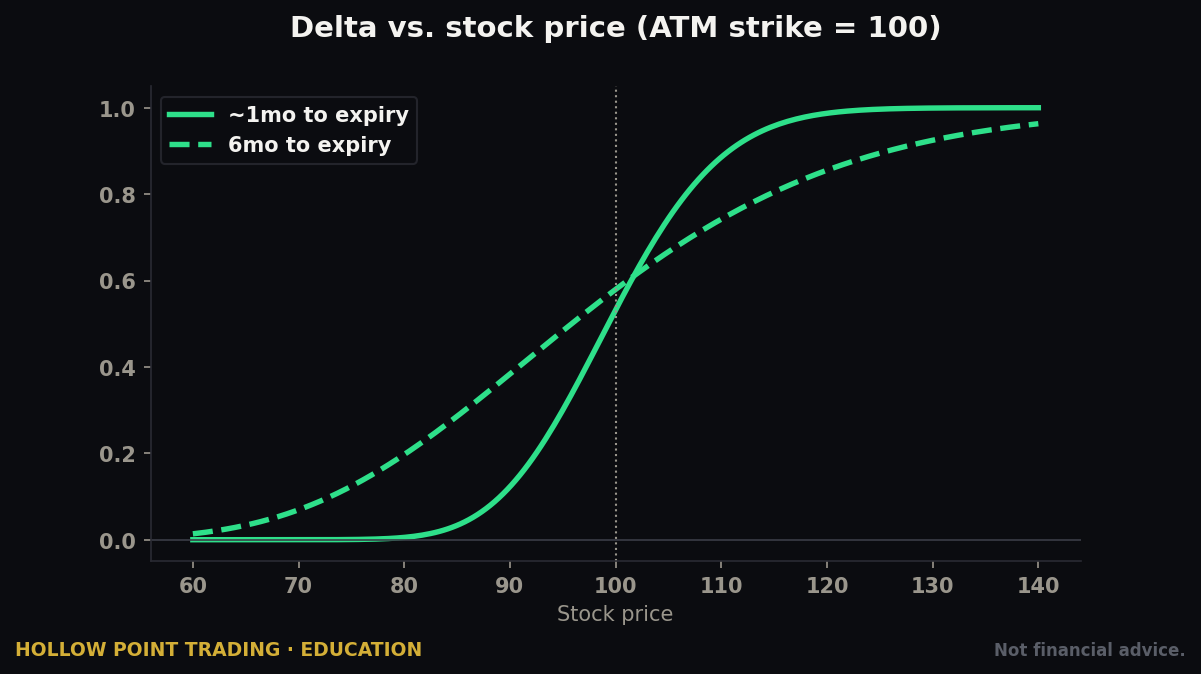
Delta is a number attached to every option, ranging from 0 to 1.00 (often written as 0 to 100). Officially, delta tells you how much the option's price moves when the stock moves $1. A delta of 0.50 means: if the stock goes up $1, this call gains about $0.50 in value.
But here's the beginner-friendly shortcut that makes delta magic: delta is also a rough estimate of the option's chance of finishing In-The-Money by expiration.
- A 0.70 delta call behaves roughly like a 70% chance of expiring In-The-Money.
- A 0.50 delta call — the classic ATM option — is roughly a coin flip, about 50/50.
- A 0.20 delta call is roughly a 20% chance. Long odds. A lottery-ish bet.
This is not a precise, guaranteed probability — it's an estimate the market bakes in, and it shifts as things change. But as a gut-level chance gauge, it's the best single number a beginner has. Say the two words together until they're one idea: delta ≈ chance.
Now connect it back to our three buckets:
- ITM options have high delta (0.60–0.95). Deeper in the money = higher delta = higher rough chance = behaves more like the stock itself.
- ATM options have ~0.50 delta. The coin flip.
- OTM options have low delta (0.05–0.40). Lower chance, cheaper, more lottery-like.
So delta quietly tells you three things at once for any strike: how much it'll move with the stock, roughly how likely it is to pay off, and — read in reverse — how much of a long shot you're taking. One number. Learn to glance at it before anything else.
The Trade-Off Nobody Can Escape: Cost vs. Probability
Every strike choice is the same fundamental trade, dressed in different clothes: cheaper options have lower probability; higher-probability options cost more. There is no free lunch, no clever strike that gives you both. Understanding this trade is understanding strike selection.
Let's put real-ish numbers on MPL (still at $100, one month until expiration). Remember: one option contract controls 100 shares, so you multiply the quoted premium by 100 to get the real dollar cost.
Deep ITM — the $90 call. Delta around 0.85. Premium maybe $11.00, so $1,100 for the contract. Of that, $10 is real intrinsic value (100 shares × $10) and only ~$1 is fragile time value. High cost, high rough chance (~85%), moves nearly dollar-for-dollar with the stock, decays slowly. This is the conservative, stock-like choice.
ATM — the $100 call. Delta around 0.50. Premium maybe $3.00, so $300 for the contract. Almost all of that $300 is time value — fragile, decaying. Coin-flip chance. Medium cost, medium probability, and the fastest time decay of the three.
OTM — the $110 call. Delta around 0.20. Premium maybe $0.80, so $80 for the contract. All $80 is hope — zero intrinsic value. Cheap, but ~20% rough chance. MPL has to climb more than 10% and do it before the coupon expires just for you to break even. This is the lottery ticket.
Notice the seductive trap staring at you: the OTM $110 call is so cheap. $80 versus $1,100! A beginner's brain screams "same direction, tiny price, huge upside — obviously the cheap one!" That instinct is exactly how beginners lose. Cheap is cheap for a reason: the market is telling you, through that low price and low delta, that it's a long shot. You're not getting a bargain. You're getting long odds.
Let's prove it with what happens next.
A Fully Worked Beginner Example: Same Bet, Three Outcomes
You believe MPL ($100) will rise to about $106 over the next month — a solid, realistic 6% move. You have $1,100 to risk. Watch how the same correct thesis pays out wildly differently depending on the strike.
Scenario A — You buy ONE deep ITM $90 call at $11.00 ($1,100). MPL rises to $106 as you predicted. Your $90 call is now worth at least its intrinsic value: $106 − $90 = $16 ($1,600). You paid $1,100. Profit ≈ $500, about a 45% gain. Solid. And critically — if MPL had gone nowhere and sat at $100, your call would still be worth ~$10 ($1,000). You'd lose only the ~$100 of time value. The floor is high. You're protected.
Scenario B — You buy roughly THREE ATM $100 calls at $3.00 each (~$900–$1,100). MPL rises to $106. Each $100 call is now worth about its $6 of intrinsic value plus scraps of time value — call it $6.20 ($620 each). Three contracts × $620 = $1,860 on your ~$900 outlay. Profit ≈ $960, more than doubling your money. Bigger reward than Scenario A. But — the catch — if MPL had stalled at $100, those ATM calls would decay toward zero. You could lose most or all of the $900. Higher reward, higher risk, and time is actively working against you.
Scenario C — You buy roughly THIRTEEN OTM $110 calls at $0.80 each (~$1,040). MPL rises to $106 — exactly as you correctly predicted. And your $110 calls? Still Out-Of-The-Money, because $106 never reached $110. Intrinsic value: zero. With little time left, these calls are now worth pennies. You were right about the direction, right about the size of the move — and you lost nearly your entire $1,040. This is the beginner heartbreak, and it happens constantly.
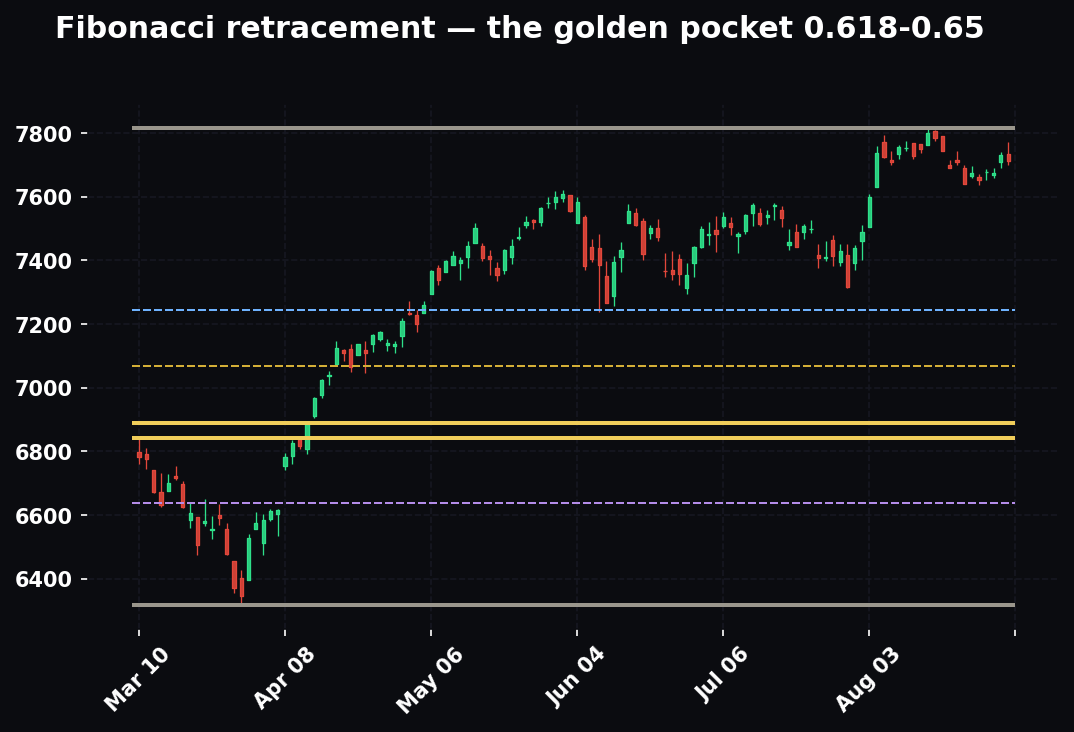
Let that Scenario C sink in. You predicted the future correctly and still went nearly to zero, purely because of strike choice. The stock did what you thought. The coupon just needed a bigger move than the stock delivered. That is the entire lesson of this guide compressed into one outcome: strike selection can override being right.
Now flip it — what if MPL rocketed to $115? Scenario C's thirteen $110 calls would each be worth ~$5 ($500), totaling ~$6,500 on a $1,040 bet. That's the OTM dream, and it's real — occasionally. But you needed a much bigger, faster move than your actual thesis called for. You'd have been betting on a scenario you didn't even believe in. Which brings us to the golden rule.
The Golden Rule: Match the Strike to the Thesis
Here's how a disciplined trader actually chooses, and it's beautifully simple: the strike should match what you genuinely believe will happen.
Your thesis is your specific, honest prediction: how far you think the stock moves, and how soon. Not "it'll go up" — that's a wish, not a thesis. A real thesis is "MPL grinds from $100 to about $106 over the next three to four weeks because [reason]."
Once you have that, the strike follows almost automatically:
- If you believe in a modest, likely move (a few percent, high confidence): lean ITM. High delta, high probability, mostly real value, slow decay. You want the option to behave like the stock and reward you for being right, not for being spectacularly right.
- If you believe in a solid, standard move to a specific target: ATM or slightly ITM is the balanced middle. Reasonable cost, ~50%+ rough chance, good bang-for-buck if your target hits, without needing a miracle.
- If you genuinely believe in a large, fast move (a catalyst you're confident detonates — and you accept you'll often be wrong): a small, defined OTM position can make sense. But size it as the lottery ticket it is: money you've fully accepted losing.
The mistake is backwards reasoning: starting from "what's cheap?" instead of "what do I believe?" Cheap options answer the wrong question. Start with the honest prediction, and the strike reveals itself.
There's a quiet second rule stacked on top: give yourself enough time. A strike that's perfect for the move is still a loser if the coupon expires before the move plays out. Time decay accelerates viciously in the final couple of weeks before expiration — an ATM or OTM option bleeds fastest right at the end. Beginners should generally buy more time than feels necessary (expirations weeks or months out, not days), so that being early doesn't automatically mean being wrong.
The Beginner Mistakes to Avoid
These are the specific ways new traders blow up on strike selection. Read them twice.
Mistake 1: Buying deep OTM options because they're cheap. Covered above, but it's the number-one killer, so it earns repeating. Low price = low probability. You are not finding a bargain; you are buying long odds. The "lottery ticket" feeling is a warning label, not a discount.
Mistake 2: Confusing "cheap per contract" with "low risk." An $80 OTM call feels safer than an $1,100 ITM call because it's less money. But the ITM call has an ~85% rough chance and a high floor of real value; the OTM call has an ~20% chance and a floor of zero. The "expensive" option is often the safer one. Price is not risk. Probability is risk.
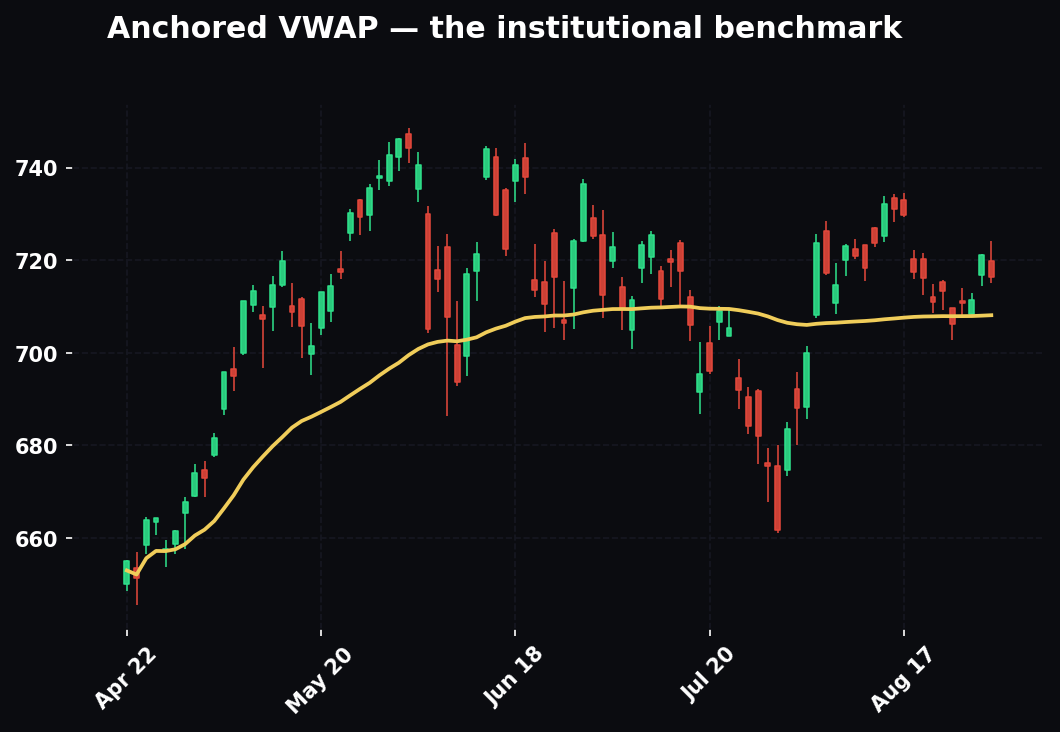
Mistake 3: Ignoring time decay. New traders buy an ATM or OTM option, the stock drifts sideways for two weeks, and they watch their option bleed value while nothing happens. They're stunned. Don't be — that's theta doing exactly what it always does. Every day you hold, the fragile time-value portion shrinks. The more OTM and the closer to expiration, the faster the bleed.
Mistake 4: Buying strikes that need a move you don't actually believe in. If your honest thesis is a 6% rise but your strike only pays off on a 12% rise, you've secretly changed your bet without noticing. The strike must match the prediction you'd defend out loud.
Mistake 5: Buying too little time. Picking the right strike but a next-week expiration turns a good idea into a stopwatch race. Being right eventually still loses if the coupon dies first. Buy time.
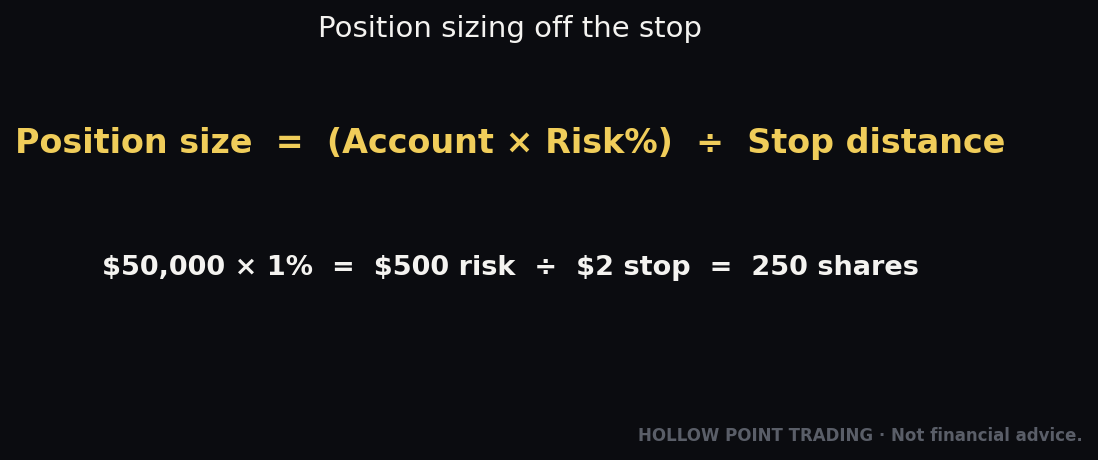
Mistake 6: Over-sizing. Even a perfect strike should never be your whole account. Options can go to zero — that's their nature. Position size is the seatbelt that lets a wrong trade stay survivable.
Mistake 7: Chasing the giant-percentage screenshots. The internet is full of "$500 into $40,000" OTM lottery wins. What you don't see are the hundred silent zeros behind each one. Those posts are survivorship bias. Don't build a strategy around the rare miracle.
The Strike-Selection Cheat-Sheet
Tape this next to your screen. It's the whole guide in a glance.
The three buckets (for calls; flip for puts):
| Bucket | Strike vs. price | Delta (≈ chance) | Cost | What it's made of | Beginner read |
|---|---|---|---|---|---|
| ITM | Below price | 0.60–0.95 | High | Mostly real value | Conservative, stock-like, high floor |
| ATM | At price | ~0.50 | Medium | Almost all time value | Balanced, coin flip, fastest decay |
| OTM | Above price | 0.05–0.40 | Cheap | 100% hope | Lottery ticket, low odds |
The five-step strike decision, every time:
- State your thesis out loud. Direction, target price, and timeframe. "MPL to $106 in 3–4 weeks." No target, no trade.
- Pick your direction instrument. Up = call. Down = put.
- Read the delta as your chance gauge. Want a likely payoff? Choose a strike with delta around 0.60–0.80 (leans ITM). Balanced? ~0.50 (ATM). Only going long-shot with money you've accepted losing? Below 0.30 (OTM).
- Give it more time than feels necessary. Push the expiration past your expected move, with buffer. Weeks-to-months, not days.
- Size it so a total loss is survivable. A small, fixed slice of your capital. Never the whole account.
The one-sentence gut check before you click buy: "Does this strike pay me for the move I actually believe in — or does it need a bigger, faster miracle than my thesis?" If it needs the miracle, move to a strike closer to the money.
How This Fits the Bigger Hollow Point Picture
Strike selection isn't a stand-alone trick — it's the last, precise step of a much bigger discipline, and it plugs directly into how we think at Hollow Point Trading.
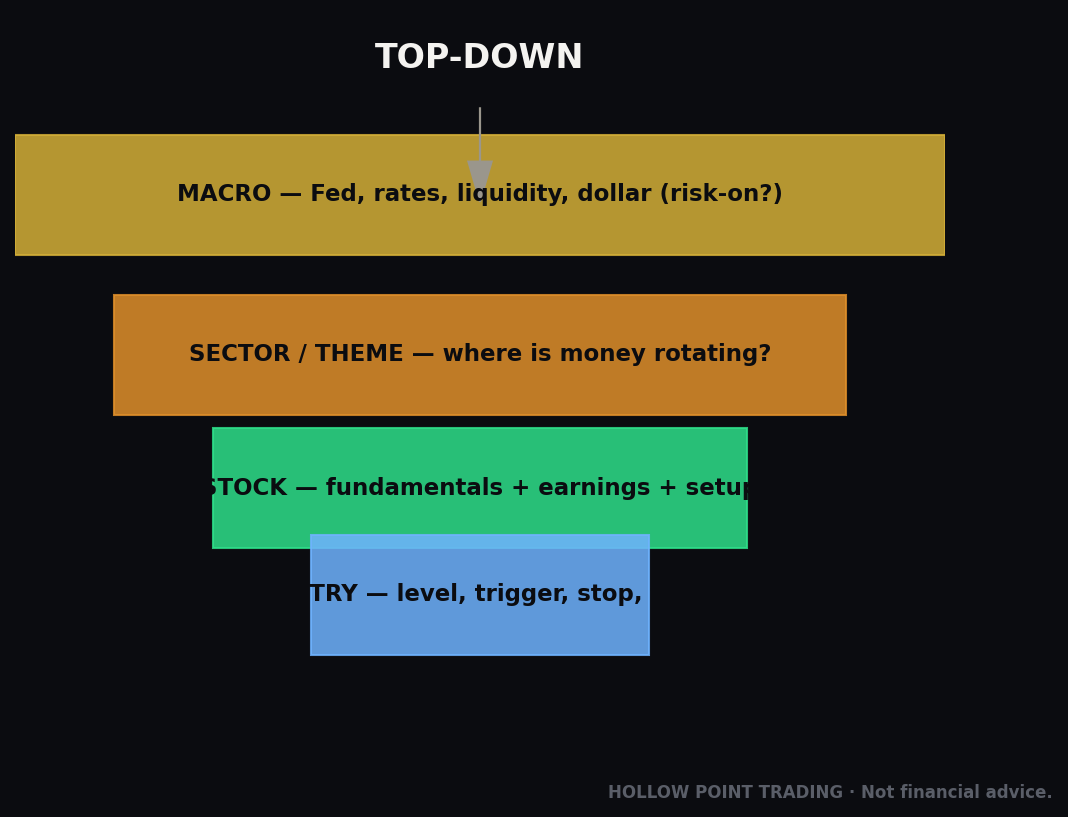
Everything starts far above the strike price. Macro → sector → stock. First you read the macro environment — is the broad market in a risk-on or risk-off mood, what's the tape doing, is there a Fed print or economic catalyst on deck? Then you narrow to the sector — is the group your stock lives in leading or lagging, strong or weak? Then, and only then, you get to the individual stock and its chart — the structure, the levels, the setup. The strike is the very tip of that funnel. You don't pick a strike in a vacuum; you pick it after the macro and sector have told you the wind is at your back.
That top-down read is what produces an honest thesis — the target and timeframe your strike has to match. This is why we hammer "discipline over prediction." Nobody, including us, knows the future. What separates traders who last from traders who don't isn't better prediction — it's better structure around the prediction. Strike selection is structure. Choosing a high-delta strike with plenty of time, sized small, is you admitting you might be wrong and building the trade so that being wrong doesn't end you.
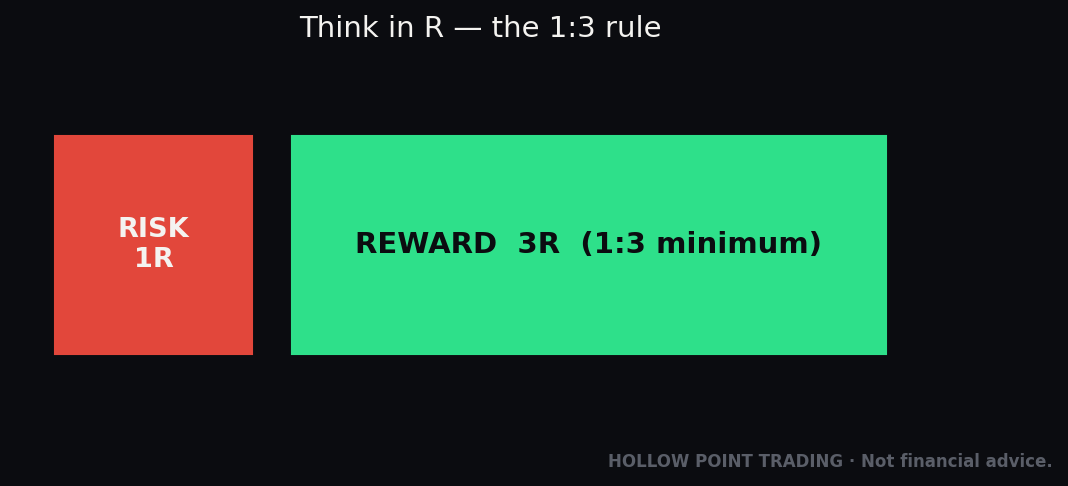
And it's where our 1:3 reward-to-risk rule earns its keep. The idea is simple: only take trades where the potential reward is at least three times what you're risking — risk one to make three. Strike choice is the lever that shapes that ratio. A deep ITM strike costs more, so the same dollar profit is a smaller percentage — you may need a tighter, higher-probability plan to hit 1:3. A far OTM strike offers huge potential multiples but at such low odds that the realistic expected value is terrible even if one winner looks like 1:10 on paper. The right strike is the one where a believable target produces at least a 1:3 payoff at a probability you can actually stomach. That's the sweet spot the whole framework is pointing you toward.
Underneath all of it is the first commandment: protect capital first. Options are powerful precisely because they can go to zero — that same feature that lets an OTM ticket 20x is the feature that quietly vaporizes accounts. Strike selection is one of your primary defenses. Leaning toward higher-probability strikes, buying enough time, and sizing small aren't the exciting parts of trading. They're the parts that keep you in the game long enough for your edge to show up. The trader still standing after a hundred trades beats the one who found a single 40-bagger and gave it all back — every time.
So when you sit down Monday and shop for a strike, don't ask "what's cheap?" Ask "what do I honestly believe, and which strike pays me fairly for that belief while protecting me if I'm wrong?" Answer that, and you're no longer gambling on coupons. You're trading with structure. That's the whole difference — and it's the whole point.
Bound by rules, feared by trade.