
If you have ever heard someone say an option is "in the money" and quietly nodded along while having no idea what they meant, this guide is for you. By the end, you will understand it better than most people who throw the phrase around. No finance degree required. No prior trading. Just plain English, a lot of simple examples, and a promise that we define every single word the first time we use it.
Let us start at the very beginning, because skipping the beginning is how beginners lose money.
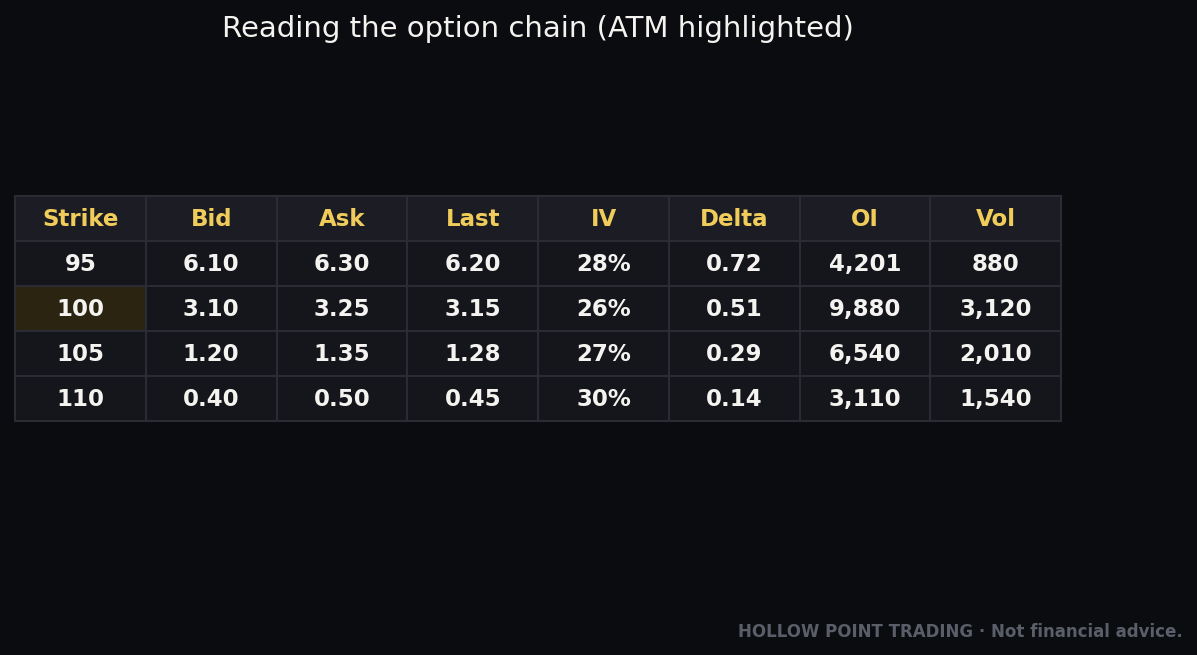
First, What Even Is an Option?
Before we can talk about "in the money," you need to know what an option is, in the simplest possible terms.
An option is a contract that gives you the right — but not the obligation — to buy or sell a stock at a specific price, on or before a specific date. That is it. You are buying a choice, not the stock itself.
There are two flavors:
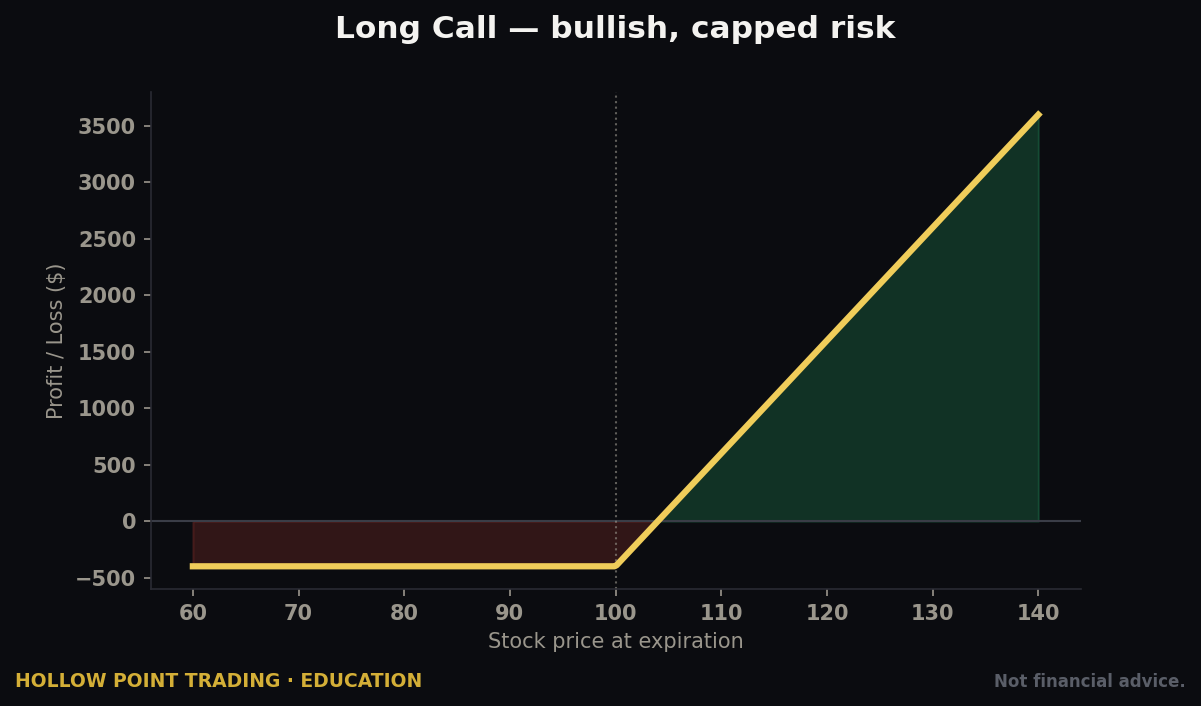
- A call option gives you the right to buy a stock at a set price. You buy calls when you think the price is going up.
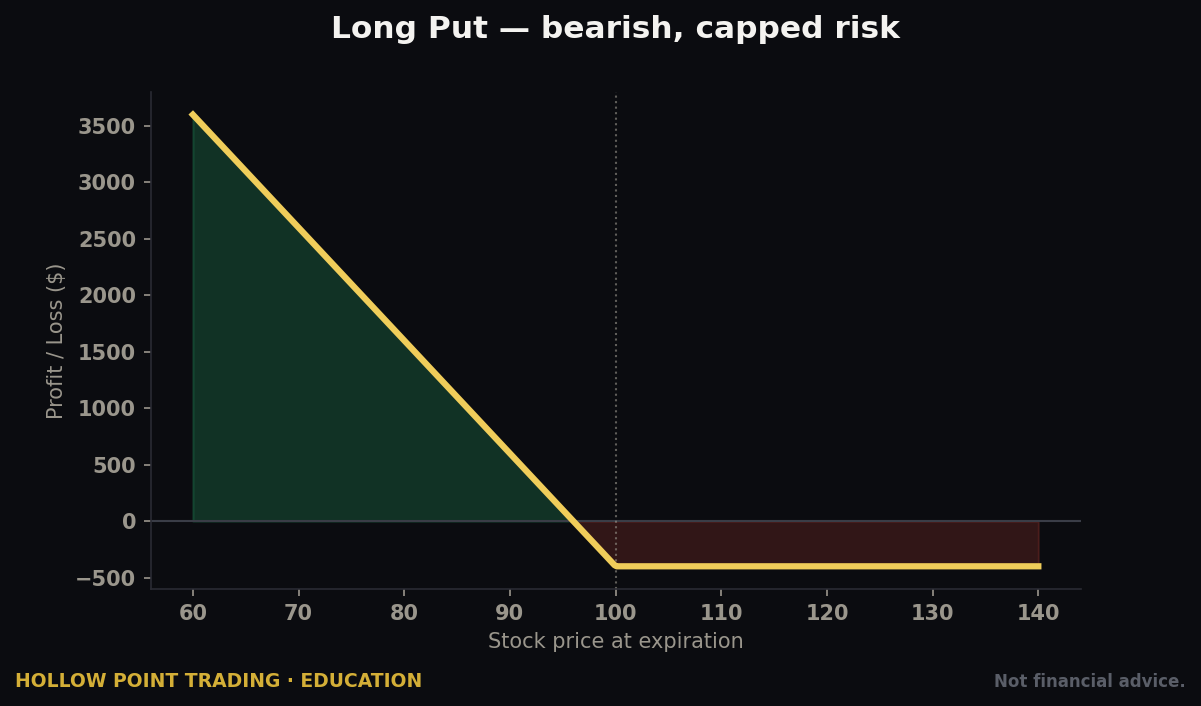
- A put option gives you the right to sell a stock at a set price. You buy puts when you think the price is going down.
Two numbers define every option:
- The strike price — the fixed price you are allowed to buy or sell at. Think of it as the price written on your coupon.
- The expiration date — the deadline. After this date, the option is over. Gone.
Here is the analogy I want you to hold onto for the whole article. Imagine a coupon for a pizza. The coupon says: "Buy one large pizza for $10, valid until Friday." That coupon is a call option. The $10 is your strike price. Friday is your expiration. If pizza normally costs $10, your coupon is not worth much. But if pizza suddenly costs $25 because of a shortage, your $10 coupon is worth a lot — you can buy something worth $25 for only $10. That gap is where all the value comes from, and it is exactly what "moneyness" measures.
What "Moneyness" Actually Means
Moneyness is just a fancy word for a simple question: If I could use this option right now, would it make me money?
The answer sorts every option into one of three buckets. These three buckets are the entire point of this article.
- In the Money (ITM) — the option has real, usable value right now. Your coupon beats the market.
- At the Money (ATM) — the strike price and the stock price are basically the same. Your coupon exactly matches the market.
- Out of the Money (OTM) — the option has no usable value right now. Your coupon is worse than just buying at the market.
That is the whole framework. Now let us slow down and make each one crystal clear, because the direction flips depending on whether you hold a call or a put, and that flip is where beginners get tangled.
In the Money (ITM): Your Coupon Beats the Market
An option is in the money when exercising it right now would put cash in your pocket (before we count what you paid for it).
For a call option (the right to buy), you are in the money when the stock price is ABOVE your strike price. You have the right to buy cheap and could immediately sell at the higher market price.
- Example: You own a call with a $100 strike. The stock is trading at $115. You can buy at $100 and the world will pay you $115. That $15 difference is real. Your call is in the money by $15.
For a put option (the right to sell), it is the mirror image. You are in the money when the stock price is BELOW your strike price. You have the right to sell high while the market is low.
- Example: You own a put with a $100 strike. The stock is trading at $85. You can sell at $100 something the market values at $85. That $15 difference is real. Your put is in the money by $15.
Notice the flip: calls want the stock higher, puts want the stock lower. Write that on a sticky note.
At the Money (ATM): A Dead Heat
An option is at the money when the stock price equals (or is extremely close to) the strike price.
If your strike is $100 and the stock is trading at exactly $100, you are at the money — for both calls and puts. Using the option right now gains you nothing, because buying at $100 when the market is $100 is a wash.
At-the-money options are interesting because they sit right on the fence. A tiny move in either direction flips them into in-the-money or out-of-the-money territory. Traders watch these closely, but as a beginner, the main thing to know is: at the money means the strike and the stock are shaking hands at the same number.
Out of the Money (OTM): Your Coupon Is Useless (For Now)
An option is out of the money when using it right now would make no sense, because the market already offers a better deal than your coupon.
For a call option, you are out of the money when the stock price is BELOW your strike price.
- Example: You own a call with a $100 strike. The stock is trading at $90. Why would you use your right to buy at $100 when anyone can buy at $90 in the open market? You would not. Your call is out of the money.
For a put option, you are out of the money when the stock price is ABOVE your strike price.
- Example: You own a put with a $100 strike. The stock is trading at $110. Why sell at $100 when the market will pay $110? You would not. Your put is out of the money.
Here is the part that surprises every beginner: people buy out-of-the-money options on purpose, all the time. They are cheap, and if the stock moves the right way, they can flip into the money and become very valuable. But — and this is the big warning we will build up to — they can also expire completely worthless. More on that soon.
Why a Beginner Should Care About This
You might be thinking, "This is just vocabulary. Why does it matter for actually trading?" Three reasons, and they are big ones.
Reason one: it tells you what you are actually paying for. When you buy an option, part of your money buys real, guaranteed value, and part buys pure hope. Moneyness is how you tell the two apart. Beginners who do not understand this routinely overpay for hope and wonder why they lose.
Reason two: it tells you your odds. An in-the-money option already has value and only needs the stock to hold. A far-out-of-the-money option needs a big, fast move just to break even. Same $200 spent, wildly different chances of success.
Reason three: it protects your capital. At Hollow Point Trading, the first rule is always protect your capital first. You cannot protect what you do not understand. Knowing moneyness is how you avoid the classic beginner trap of buying lottery-ticket options that look cheap but are quietly designed to expire at zero.
Now let us get to the heart of the matter — the concept that makes moneyness click.
Intrinsic vs. Extrinsic Value: The Two Halves of Every Price
Every option's price is made of exactly two ingredients. Learn to split any option price into these two pieces and you will understand options better than most.
Intrinsic Value — The "Real Right Now" Part
Intrinsic value is the amount an option is in the money. It is the guaranteed, right-now value. If you could exercise the option this second, intrinsic value is what you would gain.
- Call intrinsic value = Stock Price − Strike Price (never less than zero)
- Put intrinsic value = Strike Price − Stock Price (never less than zero)
The "never less than zero" part is crucial. An option can never have negative real value, because you are never forced to use it. If the math comes out negative, the intrinsic value is simply zero. Remember, an option is a right, not an obligation. You can just walk away.
Worked mini-examples:
- Call, $100 strike, stock at $115 → intrinsic value = 115 − 100 = $15.
- Call, $100 strike, stock at $90 → intrinsic value = 90 − 100 = −10, but we floor it at $0.
- Put, $100 strike, stock at $85 → intrinsic value = 100 − 85 = $15.
- Put, $100 strike, stock at $110 → intrinsic value = 100 − 110 = −10, floored at $0.
See the pattern? Out-of-the-money options have ZERO intrinsic value. Always. That single fact is the seed of why they can go to zero.
Extrinsic Value — The "Hope and Time" Part
Extrinsic value (also called time value) is everything in the price that is not intrinsic value. It is what buyers are willing to pay for the possibility that the option becomes more valuable before it expires.
- Extrinsic value = Option Price − Intrinsic Value
Extrinsic value is driven mainly by two things:
- Time until expiration. More time means more chances for the stock to move your way, so the option costs more. Less time means less hope, so it costs less.
- Volatility — a measure of how much the stock tends to swing around. A jumpy, fast-moving stock has more extrinsic value because big moves are more likely. A sleepy stock has less.
Here is the most important thing about extrinsic value: it melts away as expiration approaches, and it hits exactly zero the moment the option expires. This slow melt is called time decay (professionals call it "theta," but you do not need the Greek word today). Every single day, a little bit of the "hope" portion of your option price evaporates, whether the stock moves or not.
Putting the Two Halves Together
Let us take one real-ish example and split it fully.
- You own a call, $100 strike, expiring in 30 days.
- The stock is trading at $108.
- The option is priced at $11 (per share).
Split it:
- Intrinsic value = 108 − 100 = $8. This is real and guaranteed if you used it now.
- Extrinsic value = 11 − 8 = $3. This is the "hope and time" portion.
So of your $11, only $8 is backed by reality. The other $3 is a bet that the stock keeps climbing. If the stock never moves again and just sits at $108 all the way to expiration, that $3 slowly melts to zero, and the option is worth exactly $8 at the end. You would have lost $3 per share to time decay while being completely right about direction. That surprises a lot of beginners, and it is one of the most valuable lessons in this whole article.
Why an OTM Option Can Go All the Way to Zero
This is the section to read twice. It is the reason beginners blow up small accounts.
Recall two facts we established:
- An out-of-the-money option has zero intrinsic value. Its entire price is extrinsic — pure hope and time.
- Extrinsic value melts to zero at expiration.
Now connect them. If an option's whole value is extrinsic, and extrinsic value goes to zero at expiration, then an option that is still out of the money at expiration is worth exactly nothing. Not a little. Nothing. Zero. It vanishes, and every dollar you paid is gone.
Let us walk it step by step with numbers.
- You buy a call, $110 strike, expiring in 14 days.
- The stock is trading at $100 today, so the call is out of the money by $10.
- The option costs $1.50 per share. Because it is out of the money, all $1.50 is extrinsic value — zero intrinsic.
- Options are usually sold in contracts of 100 shares, so you pay $1.50 × 100 = $150 for one contract.
Now three ways this can end:
Ending A — the stock never gets there. Two weeks pass, the stock drifts between $98 and $103, and closes at $101 on expiration day. Your strike is $110. The stock never crossed it. The option is still out of the money. Intrinsic value is zero, extrinsic value has fully melted, and the option expires worthless. You lose the entire $150. You were not even badly wrong — the stock went up a dollar — but "up a little" was not enough.
Ending B — the stock moves, but too slowly. The stock climbs steadily and reaches $109 by expiration. So close! But $109 is still below your $110 strike. Still out of the money. Still zero. You lose the full $150. One dollar short is the same as ten dollars short when the clock hits zero.
Ending C — the stock makes the move in time. The stock jumps to $120 with a week to spare. Now your call is in the money by $10, worth at least $10 of intrinsic value — that is $1,000 per contract on a $150 cost. This is the dream that makes people buy OTM options, and it does happen. But notice how much had to go right: the correct direction, a big enough size, and fast enough to beat the clock. Direction alone was not enough. You needed all three.
This is the trap in a nutshell: out-of-the-money options are cheap because they are usually going to be worth nothing. The low price is not a bargain — it is the market's honest assessment of a low chance. A $150 option that expires worthless is a 100% loss, and it happens constantly. Cheap does not mean safe. Cheap often means unlikely.
A Fully Worked Beginner Example, Start to Finish
Let us tie everything together with one complete story, following the money the whole way.
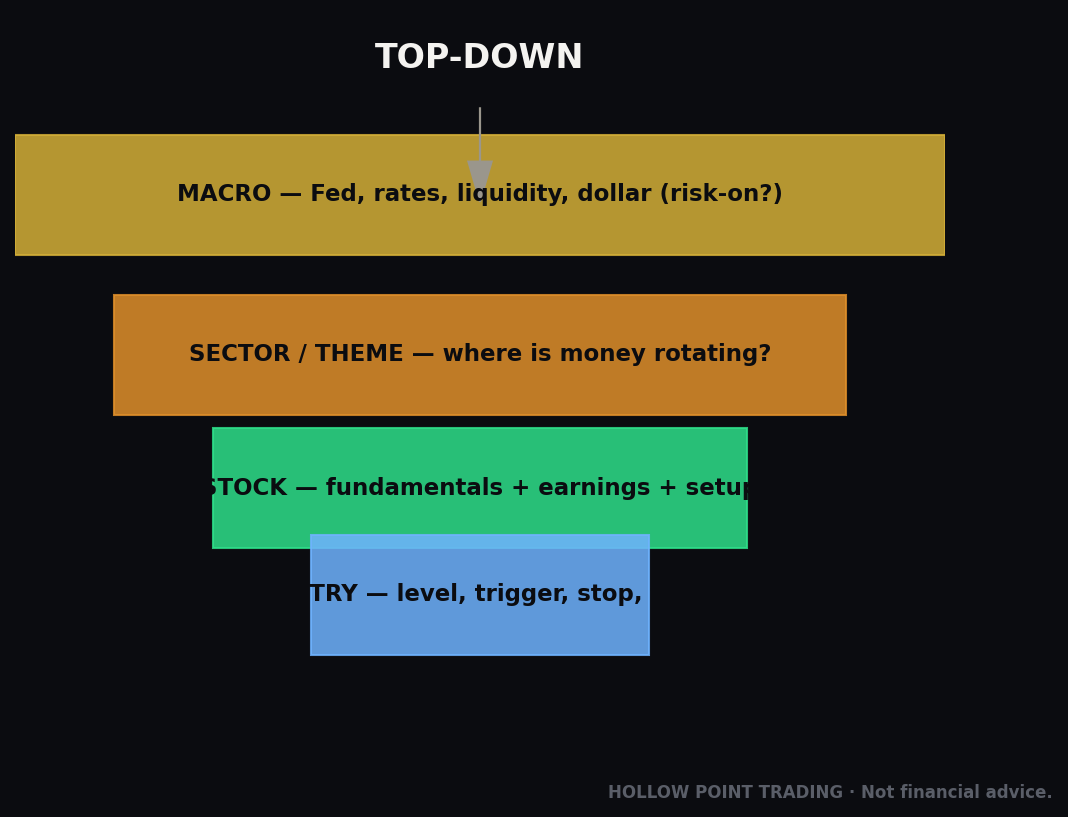
Meet a beginner we will call Sam. Sam has done some homework. Sam notices that a company — we will call it "Widget Co," trading at $50 — has been strong, its sector has been strong, and the overall market has been climbing. (That top-down flow, from the big market to the sector to the individual stock, is exactly the macro-to-sector-to-stock thinking we will come back to at the end.)
Sam is considering three different call options, all expiring in 30 days. Widget Co is at $50 right now.
Option 1 — the In-the-Money call. $45 strike, priced at $6.50.
- Intrinsic value = 50 − 45 = $5.00.
- Extrinsic value = 6.50 − 5.00 = $1.50.
- Cost for one contract (×100) = $650.
- Most of this option's value is real. Only $1.50 is "hope." If Widget Co goes nowhere, Sam loses at most the $1.50 of time value per share. This is the safest of the three, and also the most expensive.
Option 2 — the At-the-Money call. $50 strike, priced at $2.50.
- Intrinsic value = 50 − 50 = $0.
- Extrinsic value = 2.50 − 0 = $2.50. (All hope.)
- Cost for one contract = $250.
- Cheaper, but every penny is time value. It needs Widget Co to actually rise to make money, and it is fully exposed to time decay.
Option 3 — the Out-of-the-Money call. $55 strike, priced at $0.60.
- Intrinsic value = 50 − 55 = −5, floored at $0.
- Extrinsic value = 0.60 − 0 = $0.60. (All hope.)
- Cost for one contract = $60.
- Looks like a steal! Only $60! But Widget Co has to climb more than 10% and do it before the clock runs out just to reach break-even. This is the lottery ticket.
Now let us run the tape. Thirty days pass, and Widget Co rises modestly to $52.
- Option 1 (ITM, $45 strike): Now intrinsic value = 52 − 45 = $7.00. Sam paid $6.50. The option is worth about $7.00 at expiration. Sam made roughly $50 per contract — a small win, and Sam was protected the whole way by real value.
- Option 2 (ATM, $50 strike): Now intrinsic value = 52 − 50 = $2.00. Sam paid $2.50. The option is worth $2.00 at expiration. Sam lost about $50 per contract — even though the stock went up, the move was not big enough to cover the time value Sam paid.
- Option 3 (OTM, $55 strike): Widget Co reached $52, but the strike was $55. Still out of the money. Intrinsic value = zero. The option expires worthless. Sam loses the entire $60 — a 100% loss — despite being completely right that the stock would rise.
Read that outcome again. The stock did exactly what Sam predicted — it went up. Yet only the in-the-money option made money. The at-the-money one lost a little, and the out-of-the-money one lost everything. Being right about direction is not the same as making money. How far and how fast matter just as much, and moneyness is the tool that shows you the gap.
The Beginner Mistakes to Avoid
These are the specific, repeatable errors that moneyness confusion causes. Learn them here instead of paying tuition to the market.
Mistake 1: "It's only $60, I can't lose much." You can lose 100% of it, easily and often. A cheap out-of-the-money option is cheap because it usually expires worthless. Price is a measure of probability, not a discount.
Mistake 2: Buying only far-out-of-the-money options because they are cheap. Yes, the payoff can be huge. But you will be right so rarely that the steady stream of total losses drains your account faster than the occasional jackpot fills it. This is the single most common way beginners bleed out.
Mistake 3: Forgetting that time is working against you. Every day you hold an option, the extrinsic (hope) portion melts a little. If you buy an option and the stock just sits still, you lose money while nothing happens. Beginners expect to lose only when the stock moves against them. Time decay does not care.
Mistake 4: Confusing "in the money" with "profitable." An option can be in the money and you can still lose, if you paid more than its current intrinsic value plus whatever extrinsic value remains. In the money means it has real value, not that you are ahead. Your break-even always includes what you paid.
Mistake 5: Mixing up the call and put direction. Calls are in the money when the stock is above the strike; puts are in the money when the stock is below the strike. Flip these and you will misjudge every position. Keep the sticky note.
Mistake 6: Ignoring the deadline. "The stock will get there eventually" is not a plan when your option expires Friday. Every option has a hard stop date. Being right next month does nothing for an option that expired last week.
Your Moneyness Cheat-Sheet
Screenshot this. Tape it to your monitor. Come back to it before every trade until it is automatic.
The definitions:
- In the Money (ITM): has real value now. Call → stock ABOVE strike. Put → stock BELOW strike.
- At the Money (ATM): stock ≈ strike. On the fence, both calls and puts.
- Out of the Money (OTM): no real value now. Call → stock BELOW strike. Put → stock ABOVE strike.
The two halves of every price:
- Intrinsic value = how far in the money it is (never below zero). The real part.
- Extrinsic value = price minus intrinsic. The hope and time part. Melts to zero at expiration.
The formulas:
- Call intrinsic = Stock − Strike (floor at 0).
- Put intrinsic = Strike − Stock (floor at 0).
- Extrinsic = Option Price − Intrinsic.
The three questions before you buy any option:
- Is it in, at, or out of the money right now?
- How much of the price is real (intrinsic) versus hope (extrinsic)?
- Does the stock have to move to make me money — how far, and can it happen before expiration?
The one-line gut check: If the stock does nothing from now until expiration, what is this option worth? If the answer is "zero," you are holding pure hope, and hope has a deadline.
How This Fits the Bigger Hollow Point Picture
Moneyness is not just trivia. It plugs directly into the way we think and trade at Hollow Point Trading, and understanding it is a stepping stone to everything else.
It starts with the top-down flow. Our process runs macro → sector → stock: we look at the overall market first, then the strong or weak sectors inside it, then the individual stocks that fit. Only after that top-down work points to a direction do we ask "which option?" Moneyness is the language of that last step. A high-conviction setup where the macro, the sector, and the stock all agree might justify a more in-the-money option, where more of your money buys real value and less buys hope. A longer-shot idea keeps its size tiny precisely because you know it is mostly extrinsic value that can melt to nothing.
It enforces discipline over prediction. Notice how our Sam example proved that being right about direction was not enough. Markets are not a prediction contest; they are a risk-management contest. Understanding intrinsic versus extrinsic value forces you to stop asking only "will it go up?" and start asking "what am I paying, what has to happen, and what do I lose if I am wrong?" That shift — from predicting to managing — is the whole game.
It protects capital first. The number one job is to still be in the game tomorrow. Knowing that out-of-the-money options can and routinely do go to zero is a capital-protection tool. It stops you from turning your account into a stack of lottery tickets.
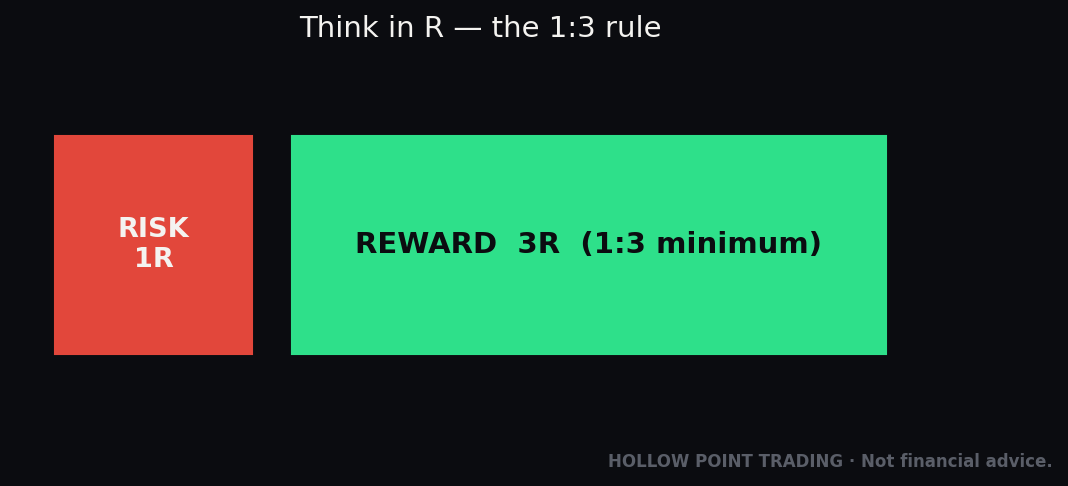
It sets up reward-to-risk thinking. We build trades around at least a 1:3 reward-to-risk ratio — meaning we want the potential reward to be at least three times what we are risking. You cannot calculate reward-to-risk until you can size up an option's real cost, its break-even, and its realistic payoff. Moneyness, intrinsic value, and extrinsic value are the raw materials of that calculation. Everything we teach later — spreads, position sizing, exits — assumes you already have this foundation solid.
Master this one concept and you have crossed the line from "someone who has heard of options" to "someone who understands what they are actually buying." That is a bigger step than it sounds. Most people trading options never make it. Take your time here. Re-read the worked example. Do the intrinsic-versus-extrinsic split on a few real options in a paper account before you ever risk a dollar. The market will still be there Monday, and so will you — which is exactly the point.
Bound by rules, feared by trade.