
Welcome. If you have never bought an option in your life, you are exactly who this guide is for. We are going to start from zero, define every single term the first time it shows up, and walk through the six mistakes that wipe out more beginner options accounts than anything else. Each one gets the full treatment: what it is in plain English, why it matters to you specifically, how it actually works step by step, a worked example with real-ish numbers, the traps to avoid, a quick checklist, and how it fits into the bigger Hollow Point Trading way of thinking.
First, the one-sentence definition that everything else hangs on. An option is a contract that gives you the right, but not the obligation, to buy or sell 100 shares of a stock at a fixed price, before a fixed date. That's it. You pay a small fee for that right. The fee is called the premium, and it is the money you put at risk.
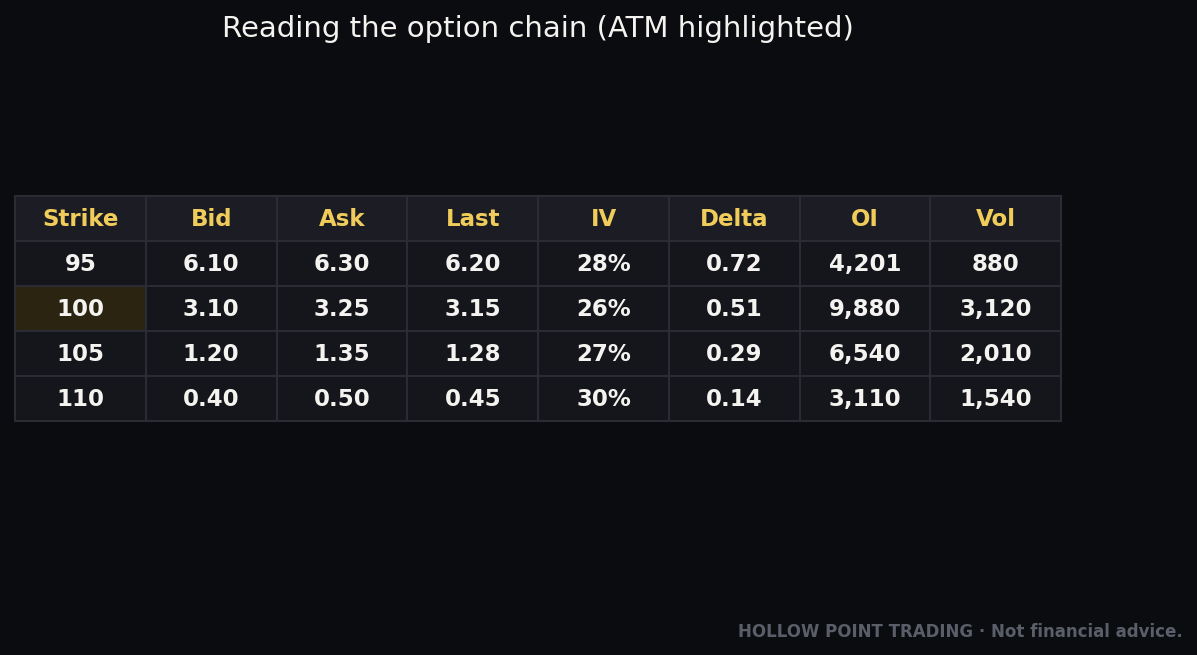
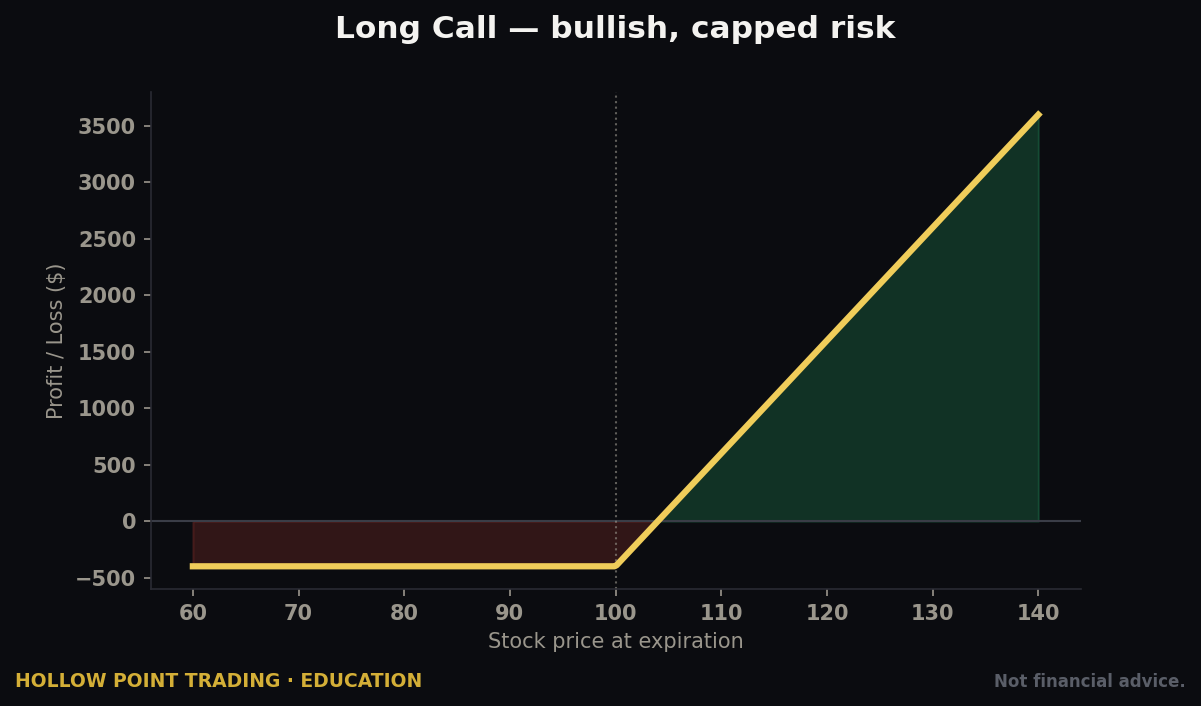
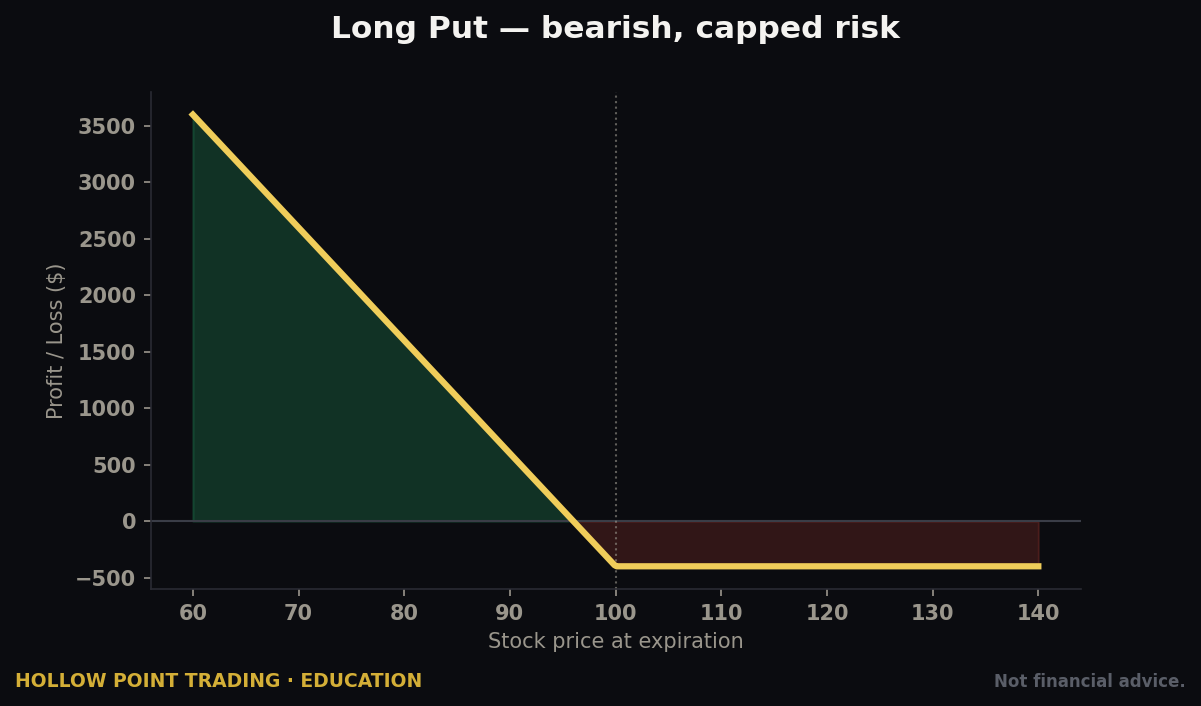
Two flavors. A call is the right to buy 100 shares at a set price — you buy calls when you think the stock is going up. A put is the right to sell 100 shares at a set price — you buy puts when you think the stock is going down. The set price is called the strike price (the price your contract locks in). The fixed date is the expiration date (the day the contract dies).
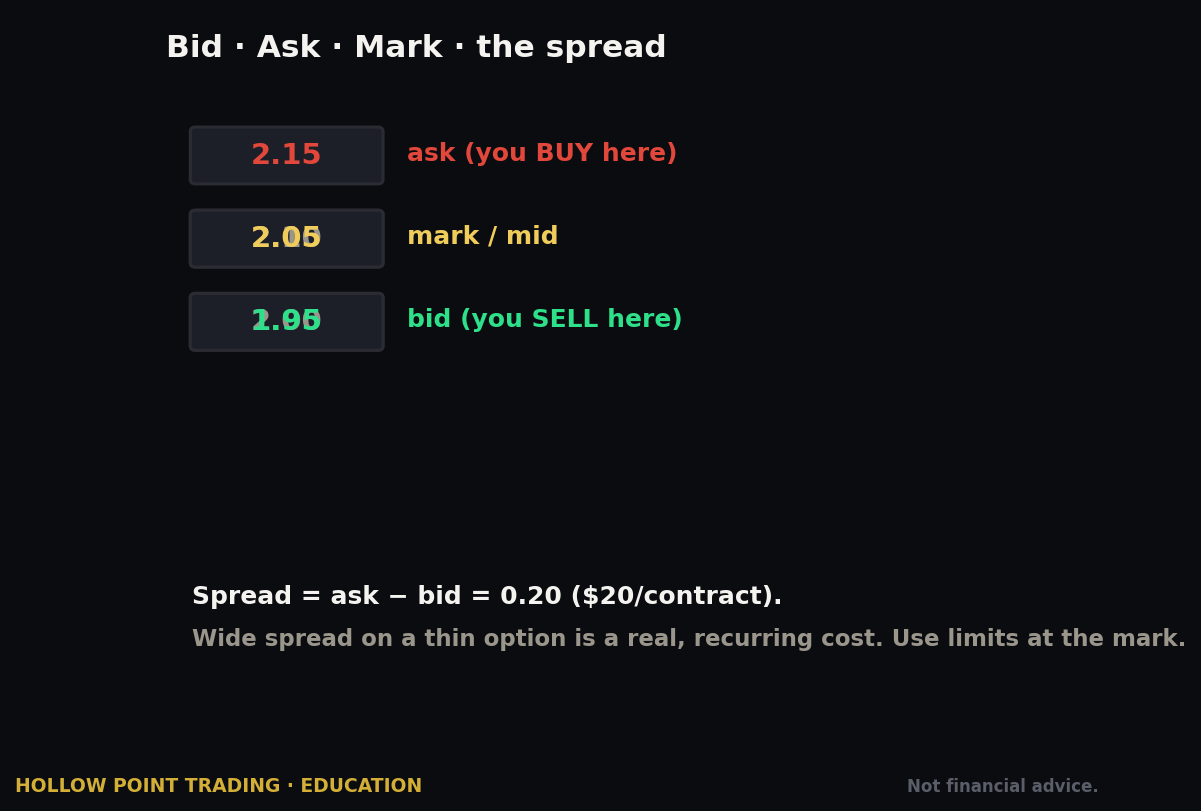
One more number that trips up every beginner: options are quoted per share, but each contract controls 100 shares. So an option priced at "$2.00" actually costs you $2.00 × 100 = $200. Always multiply by 100. Write that on a sticky note.
Now, the six mistakes.
Mistake #1 — Buying Far Out-of-the-Money "Lotto Tickets"
What it is, in plain English. First, two terms. An option is in-the-money (ITM) when it already has real value if you exercised it right now — for a call, that means the stock price is above your strike. It is out-of-the-money (OTM) when it has no built-in value yet — for a call, the stock is still below your strike. Far OTM means the strike is way above where the stock is now, so far away that the stock would have to make a huge, fast move for the option to pay off.
These far-OTM options are dirt cheap — sometimes $5 or $10 a contract — and that cheapness is exactly the trap. Beginners see a $7 option that "could 20x if the stock rips" and treat it like a lottery ticket. That is precisely what it is: a ticket with terrible odds that usually expires worthless.
Why a beginner should care. Because the low price fools your brain. Losing $7 feels like nothing, so you buy ten of them, then twenty. The market makers — the professional firms on the other side of your trade — price these options using probability. When something is priced at $7, the market is telling you it has maybe a 3-in-100 chance of paying off. You are not finding a hidden gem. You are volunteering to lose a coin flip that is rigged 97-to-3 against you.
How it works, step by step.
- A stock trades at $100.
- You want cheap, so you buy a call with a $130 strike expiring in one week. The stock has to jump 30% in five days for you to even break even.
- That option costs $0.08 per share → $8 per contract. Feels free.
- For that $8 to become $80, the stock doesn't just need to reach $130 — it needs to blow past it, fast, before the clock runs out.
- Nine times out of ten (really, closer to 97 times out of 100 here), the week ends with the stock at $102, and your option is worth $0.00. Gone.
A fully worked beginner example. Sarah has $500. She buys 50 of those $8 far-OTM calls — that's $400 committed. She's thinking, "If just one week goes crazy, I'm rich." The stock drifts from $100 to $103 over the week. Nice for shareholders. For Sarah, $130 was never in reach. All 50 contracts expire worthless. She is down $400 — 80% of her account — on a move that was actually in her favor. That's the cruelty of far-OTM: you can be right about direction and still lose everything because you needed a miracle-sized move on a stopwatch.
The beginner mistakes to avoid.
- Confusing "cheap" with "good value." Price and probability are two different things.
- Buying quantity because each one is cheap — you're just buying more losing tickets.
- Believing the one time it hits (and it will, occasionally) means the strategy works. One winner does not pay for the fifty losers.
The fix. Trade options that are at-the-money (ATM) — strike near the current price — or slightly ITM. Yes, they cost more (maybe $200–$400 instead of $8), so you'll own fewer contracts. Good. Fewer, higher-quality positions with a realistic path to profit beats a fistful of miracles. A simple rule: if the stock would need to move more than it typically moves in your timeframe just to break even, the strike is too far out.
Quick cheat-sheet.
- ✅ Strike at or slightly ITM
- ✅ Break-even is a normal move, not a record-breaking one
- ❌ Never buy a strike just because it's the cheapest on the screen
- ❌ Never size up on cheapness
How it fits the bigger HPT picture. Hollow Point's whole ethos is protect capital first, discipline over prediction. Lotto tickets are pure prediction — a bet on a specific, unlikely event by a specific date. Trading realistic strikes is how you stay in the game long enough for your edge to matter.
Mistake #2 — Ignoring Theta (The Melting Ice Cube)
What it is, in plain English. Every option has two kinds of value baked into its premium. Intrinsic value is the "real" part — how much it's already ITM. Extrinsic value (also called time value) is the "hope" part — what you're paying for the chance the stock moves your way before expiration. That hope portion decays a little every single day, and it decays faster as expiration approaches. The name for that daily bleed is theta.
Theta is a number, and it's negative for buyers. A theta of -0.05 means your option loses about $0.05 per share — $5 per contract — in time value every day, all else equal. Weekends included. The option is a melting ice cube, and theta is the temperature.
Why a beginner should care. Because you can be dead right about the stock and still lose money if you're too slow. Time is not neutral when you own options — it is actively working against you every day you hold. Beginners buy a call, watch the stock go up a little, and are baffled that their option is flat or down. The answer is almost always theta: the stock's gain got eaten by time decay.
How it works, step by step.
- You buy an ATM call for $3.00 ($300). Say $2.50 of that is time value and $0.50 is intrinsic.
- That option has, say, 30 days of life.
- Each day, theta shaves off a bit of the $2.50 hope-value. Early on, maybe $5/day. In the final week, decay accelerates — maybe $15–$25/day — because there's less and less time for a move to happen.
- If the stock just sits there, the whole $2.50 of time value melts to $0 by expiration. You'd be left with only whatever intrinsic value exists.
A fully worked beginner example. Marcus buys a 30-day ATM call on a $50 stock for $2.00 ($200). Theta is about -0.04 ($4/day). Over ten days, the stock creeps from $50 to $51 — a real gain. Marcus expects a profit. But: the $1 stock move added roughly $0.50 of value to his call, while ten days of theta stripped out about $0.40, and decay is speeding up. His option is worth maybe $2.10 — up a measly $10 despite being right. If the stock had gone nowhere, he'd be down about $50 on time decay alone. Being right slowly is how theta beats you.
The beginner mistakes to avoid.
- Buying options with only a few days left because they're cheap — that's when theta is most vicious.
- Holding a winning-direction trade too long and letting decay erase the gain.
- Not knowing your position's theta at all. If you can't say roughly how much you bleed per day, you're flying blind.
The fix. Two moves. First, buy more time than you think you need — give the trade 30–60 days so daily decay is gentle, not brutal. Second, *have a reason to be in the trade now, not "eventually." Options reward being right and on time.* If your thesis is "this'll work out over the next few months," options are the wrong tool — that's what shares are for.
Quick cheat-sheet.
- ✅ Know your theta before you enter ("I bleed ~$X/day")
- ✅ Prefer 30–60 days of life for directional beginner trades
- ✅ Exit when the reason plays out — don't marry the position
- ❌ Never hold near-dated options hoping decay "pauses" (it accelerates)
How it fits the bigger HPT picture. HPT teaches timing and confluence — you enter when the macro, the sector, and the individual stock line up, not on a hunch that maybe someday it works. Respecting theta forces exactly that discipline: it makes you enter only when you expect the move soon.
Mistake #3 — Oversizing (Betting the Farm on One Ticket)
What it is, in plain English. Position sizing means deciding how much money to put into a single trade. Oversizing is putting in too much — so much that one loss does serious damage to your account. Because options are cheap-looking and move fast, beginners routinely put 30%, 50%, even 100% of their account into a single position without realizing it.
Here's the sneaky part: with options, a "small" dollar amount can still be a huge risk, because the whole premium can go to zero. When you buy a stock, a bad day is -3%. When you buy an option, a bad day can be -50%, and expiration can be -100%. So the same dollar amount is far more dangerous in options.
Why a beginner should care. Because the math of recovery is merciless. Lose 50% of your account and you now need a 100% gain just to get back to even. Lose 80% and you need a 400% gain. Blow-ups aren't caused by being wrong once — everyone is wrong sometimes. They're caused by being wrong big. Sizing is the single most important skill, and it's the one beginners think about least.
How it works, step by step.
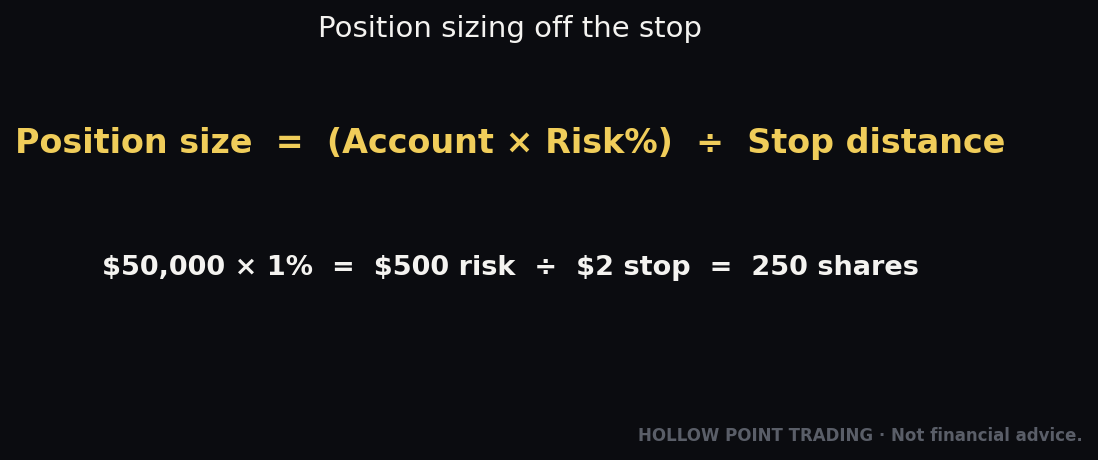
- You decide, before the trade, the most you're willing to lose on it — say, 1–2% of your account.
- Your account is $5,000. 2% is $100. That is your max risk for this trade.
- You find a trade where the realistic loss (premium at risk, or the distance to your exit) is about $100.
- You buy the number of contracts that keeps total risk at or under $100 — often that's just one contract.
- If it loses, you're down 2%. Annoying, survivable, forgettable. You live to trade 50 more times.
A fully worked beginner example. Two traders each start with $5,000.
Trader A (oversized): Buys $2,000 of options in one trade — 40% of the account. It goes to zero (options do that). Account: $3,000. To get back to $5,000, they need a 67% gain. They tilt, oversize again to catch up, lose again. Account: $1,500. Now they need 233%. This is the death spiral, and it started with one oversized trade.
Trader B (sized right): Risks $100 per trade (2%). Loses five in a row — a genuinely bad streak. Down $500, to $4,500. Barely a scratch. On the sixth trade — a clean setup — they make $300. Still in the game, still calm, still thinking clearly. The difference between A and B was never skill. It was size.
The beginner mistakes to avoid.
- Sizing by "how cheap is it" instead of "how much can I lose."
- "Going all in" on a trade you're sure about. Certainty is a feeling, not a fact, and the market doesn't care how sure you are.
- Adding to a loser to "average down" — that's oversizing in slow motion.
- Ignoring that ten small positions in correlated stocks (all tech, all the same direction) is secretly one big position.
The fix. Adopt a hard max-risk-per-trade rule: 1–2% of your account, period. Calculate the dollar amount before you look at the trade, then let it decide your contract count — not the other way around. If one contract already blows past your 2%, the trade is too big for your account. Skip it. There will be another.
Quick cheat-sheet.
- ✅ Risk 1–2% of the account per trade, max
- ✅ Do the dollar math before entering
- ✅ Let max-risk decide contract count
- ❌ Never "all in," never average down a loser
- ❌ Never let cheapness set your size
How it fits the bigger HPT picture. Protect capital first is the whole game, and it lives in position sizing. HPT's 1:3 reward-to-risk rule (we'll get to it) is meaningless if a single loss can cripple you. Sizing small is what lets the math of a good edge actually play out over dozens of trades.
Mistake #4 — Holding Into Expiration (Letting the Clock Run Out)
What it is, in plain English. Every option has that death date — expiration. Holding into expiration means keeping the option all the way to the final bell instead of selling it back earlier. Beginners assume you have to "use" an option or hold it to the end. You don't. You can sell to close any time the market is open, banking whatever it's worth right then. Most successful options traders never hold to expiration.
Two things get ugly at expiration. First, remember Mistake #2 — theta decay is fastest in the final days, so the ice cube is melting at max speed. Second, there's assignment risk and pin risk: if your option is even slightly ITM at the end, you can suddenly be forced to buy or sell 100 actual shares — which for a $50 stock means $5,000 of stock you may not have the money for. Beginners get blindsided by this constantly.
Why a beginner should care. Because the final days are where good trades turn into disasters. An option that was up nicely on Wednesday can be worthless by Friday's close if the stock ticks the wrong way — there's no time left to recover. And nobody wants a surprise margin call because a "cheap" option finished 10 cents ITM and got exercised into 100 shares.
How it works, step by step.
- You buy a call with two weeks to expiration.
- Days 1–7: gentle decay, trade develops.
- Days 8–12: decay accelerates hard. Every day of sideways action now hurts a lot.
- Final 1–2 days: the option is almost pure gamble — it lives or dies on the last tiny move.
- At expiration: if OTM, it's worth $0. If ITM, you may be auto-assigned 100 shares per contract, needing real cash or margin overnight.
A fully worked beginner example. Elena buys a call for $3.00 ($300) with 14 days left. By day 9, the stock's moved her way and the option is worth $5.00 ($500) — a $200 profit, up 67%. She thinks, "It's on a roll, I'll let it ride to expiration for more." Days 10–14, the stock stalls and dips slightly. Theta accelerates. By Friday the option is $0.40 ($40). Elena turns a $200 gain into a $260 loss — a $460 swing — because she didn't take the profit that was sitting right in front of her. Had she sold at day 9, she banks $200 and moves on.
The beginner mistakes to avoid.
- Thinking you must hold to expiration to "collect." You almost never should.
- Holding a winner out of greed until decay eats it.
- Holding a loser out of hope — "it just needs one more day." The clock doesn't do hope.
- Forgetting assignment: an ITM option left open can turn into 100 shares and a cash demand.
The fix. Set an exit-by rule. A common beginner-friendly one: close the trade (win or lose) with at least a week left — never enter the final days. And take profits when you have them — if you're up a healthy amount and your target's hit, sell. A profit isn't real until you close. Selling early "leaves money on the table" sometimes; it also saves your account constantly. That's a trade worth making.
Quick cheat-sheet.
- ✅ Sell to close early — you don't have to hold to expiry
- ✅ Exit with ~1 week left to avoid the worst decay + assignment
- ✅ Bank profits when your target hits
- ❌ Never let a winner round-trip back to a loss
- ❌ Never hold an ITM option into expiration unprepared for 100 shares
How it fits the bigger HPT picture. Discipline over prediction again. Holding into expiration is hoping the future rescues you. Taking a planned exit is executing a rule. HPT lives on rules — "Bound by rules" isn't a slogan, it's the exit discipline that keeps green trades green.
Mistake #5 — Chasing (Buying After the Move Already Happened)
What it is, in plain English. Chasing is jumping into a trade after the big move has already occurred, because you're afraid of missing out. The stock rips up 5%, you panic that you're missing the party, and you buy calls at the top — right as the move is exhausting itself. Fear of missing out has a nickname on trading floors: FOMO. It is the emotion that empties beginner accounts fastest.
Chasing is doubly punishing in options because of implied volatility, or IV — a measure of how much the market expects the stock to move. When a stock is spiking on news, IV spikes too, which makes options expensive. So you're buying an inflated option, at the top of a move, right before both the move and the IV deflate. Traders call that deflation an IV crush. You get squeezed from two directions at once.
Why a beginner should care. Because chasing feels like the smart, decisive move ("get in before it's gone!") and is almost always the worst one. The screen is loudest exactly when the opportunity is smallest. Learning to not chase — to let a trade go — is one of the highest-value skills you'll ever build, and it's free.
How it works, step by step.
- A stock sits quietly at $100. Its calls are reasonably priced; IV is normal.
- News hits. The stock rockets to $110 in an hour.
- You see green, feel FOMO, and buy calls — but now the stock is at $110 (you missed the move) and IV is jacked up (the calls are overpriced).
- The excitement fades. The stock settles back to $105. IV deflates — IV crush.
- Your call gets hit twice: the stock pulled back and the inflated premium collapsed. You lose even though the stock is still up on the day.
A fully worked beginner example. A stock jumps from $100 to $110 on an earnings surprise. Priya chases and buys the $110 call for $6.00 ($600) — pumped-up price, pumped-up IV. Next day the stock eases back to $106 and the hype cools. The stock is still up nicely from where it started — but Priya's call is worth $2.50 ($250). She's down $350 (58%) on a stock that went up. The move she chased was already spent, and the IV crush finished the job. Had she waited for the stock to calm and pull back to a support level, she'd have bought cheaper options into a fresh, lower-risk setup.
The beginner mistakes to avoid.
- Buying because it's "flying" — the move you see is the move you missed.
- Buying options right into an earnings spike without understanding IV crush.
- Confusing urgency with opportunity. Real setups don't require you to lunge.
- Revenge-buying to "catch the next leg" after you missed the first.
The fix. *Wait for the pullback, and plan the entry before the move. Professionals decide their entry price when things are calm, then let price come to them. If it runs without you — let it go. Missing a trade costs you $0. Chasing a trade costs you real money. When a stock is spiking on news, the disciplined move is often to do nothing* and wait for the dust (and the IV) to settle.
Quick cheat-sheet.
- ✅ Plan entries in advance, at calm moments
- ✅ Let price come to your level — buy pullbacks, not spikes
- ✅ Missing a trade is free; treat it that way
- ❌ Never buy just because it's ripping
- ❌ Never buy inflated-IV options at the top of a news spike
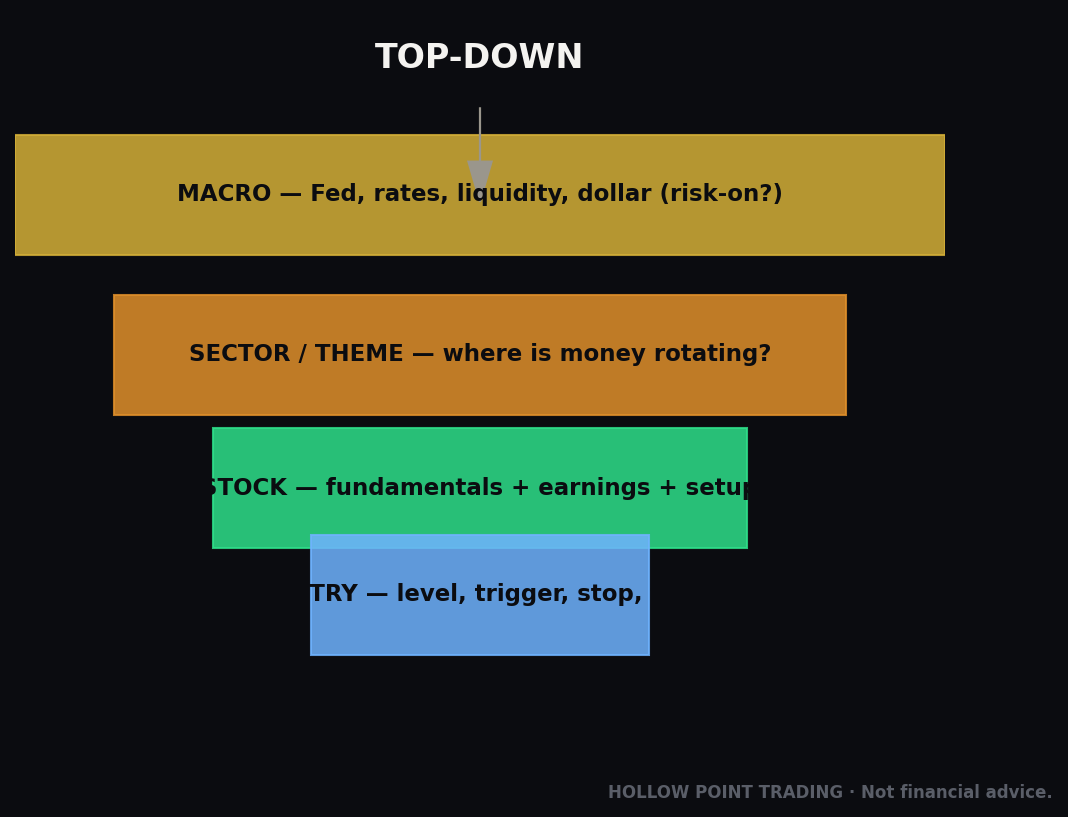
How it fits the bigger HPT picture. HPT's flow is macro → sector → stock, decided ahead of time — a plan, not a reaction. Chasing is the opposite: pure reaction to a screen. When you trade a pre-built plan, FOMO has nothing to grab onto, because you already know your level and it isn't "up here."
Mistake #6 — No Exit Plan (Trading Without a Map)
What it is, in plain English. An exit plan is deciding — before you enter — exactly when you'll get out, both if you're right and if you're wrong. Two numbers: a target (the price/profit where you take the win) and a stop (the price/loss where you cut it and leave). Trading with no exit plan means buying an option with zero idea what happens next — and that means your decisions get made by emotion, in the heat of the moment, which is the worst possible way to make them.
This is the mistake that contains all the others. No exit plan is how you hold into expiration, how you let a winner become a loser, how you oversize to "make it back." An exit plan is the frame that keeps the other five in check.
Why a beginner should care. Because without a plan, you will make your most important decisions while feeling your most intense emotions — greed at the top, fear at the bottom. That guarantees you sell winners too early and hold losers too long, the exact opposite of what works. A plan made calmly, in advance is worth more than any indicator.
How it works, step by step.
- Before entering, write down three prices: your entry, your stop (max loss exit), and your target (profit exit).
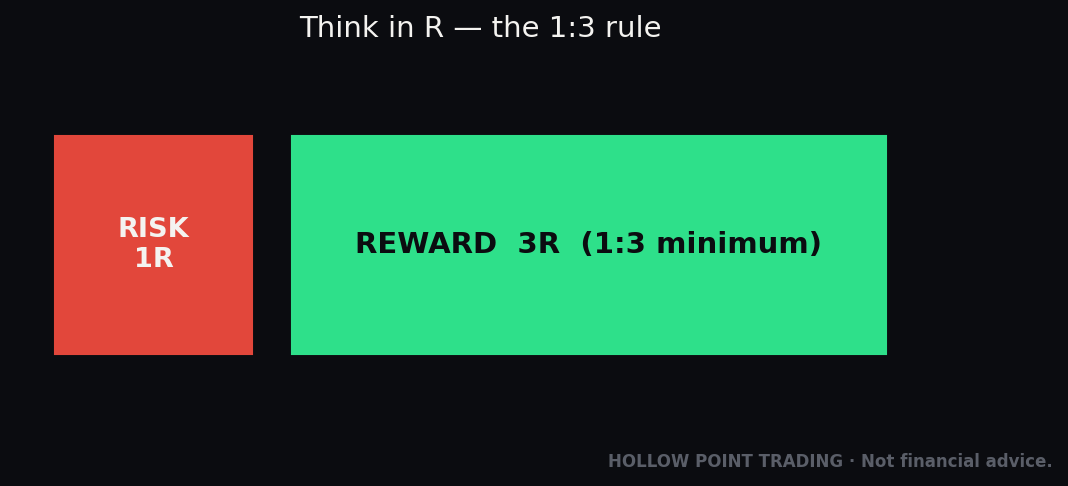
- Check the reward-to-risk ratio — how much you stand to make versus how much you'll lose if wrong. HPT's standard is 1:3: risk $1 to make $3.
- If the setup doesn't offer at least 1:3, you don't take it. No exception.
- Once in, you obey the plan. Hit the stop → out, no debate. Hit the target → take the win (or a partial, and trail the rest).
- You never "wait and see." The seeing was done before you entered.
A fully worked beginner example. David buys a call for $2.00 ($200) with a plan:
- Entry: $2.00
- Stop: $1.40 (he'll exit if it drops here → risking $0.60, i.e. $60)
- Target: $3.80 (he'll take profit here → gaining $1.80, i.e. $180)
- Reward-to-risk: $180 to $60 = 1:3. ✅
Now watch how the plan protects him in every branch:
- Stock drops, option hits $1.40 → he's out, down $60. Clean, small, survivable.
- Stock climbs, option hits $3.80 → he's out, up $180. Banked.
- Stock chops around → he still exits at stop or target, never on emotion.
Compare planless David: same trade, no exit written. Up to $3.50, he gets greedy ("more!"), doesn't sell. It falls to $1.80. Now he's anchored to the $3.50 he "should've" gotten, refuses to sell "at a loss from the high," rides it to $0.30. A $150 winner became a $170 loser — a $320 swing — purely from having no map.
The beginner mistakes to avoid.
- Entering with no stop and no target — "I'll figure it out."
- Moving your stop lower to avoid taking the loss (the cardinal sin — the loss just gets bigger).
- Taking trades that don't offer at least 1:3 reward-to-risk.
- Changing the plan mid-trade because of emotion. The plan exists precisely so emotion can't drive.
The fix. Never enter without all three numbers written down: entry, stop, target — and a reward-to-risk of at least 1:3. Put them on paper or in your journal before you click buy. Then be a robot about it. The whole point of a plan is that it was made by calm-you to protect emotional-you. Honor it.
Quick cheat-sheet — tape this to your monitor.
- ✅ Write entry, stop, and target before entering
- ✅ Demand at least 1:3 reward-to-risk
- ✅ Obey the stop, no negotiation
- ✅ Bank the target (or take partials and trail)
- ❌ Never widen a stop to avoid a loss
- ❌ Never enter "to see what happens"
How it fits the bigger HPT picture. This is Hollow Point Trading. The 1:3 reward-to-risk rule, the pre-planned entry, the non-negotiable stop — this is what "Bound by rules, feared by trade" means. The exit plan is where every HPT principle — protect capital, discipline over prediction, plan the trade — becomes a concrete action you take before you risk a dollar.
Putting It All Together — Your Monday Morning Checklist
Six mistakes, one page. Before any options trade, run this list. If you can't check every box, you don't take the trade. That's not being timid — that's being a professional.
The HPT Beginner Pre-Trade Checklist
- Strike: At-the-money or slightly in-the-money. Break-even is a normal move, not a miracle. (Beats Mistake #1)
- Time: 30–60 days to expiration. I know my theta — roughly $X/day of decay. (Beats Mistake #2)
- Size: Risking no more than 1–2% of my account. I did the dollar math first. (Beats Mistake #3)
- Exit timing: I will close with ~1 week left — never ride into expiration. (Beats Mistake #4)
- Entry quality: I planned this entry when calm. I'm buying a pullback to my level, not chasing a spike. (Beats Mistake #5)
- Exit plan: Entry, stop, and target are written down. Reward-to-risk is at least 1:3. (Beats Mistake #6)
Notice how they interlock. A good exit plan (#6) forces realistic strikes (#1) and enough time (#2). Proper sizing (#3) keeps any single mistake survivable. Not chasing (#5) and not holding to expiration (#4) are both just patience — the single most underrated skill in trading.
Here's the mindset shift that ties the whole guide together. Beginners think trading is about being right — predicting the next move. It isn't. Every one of these six fixes is about something else entirely: managing risk and controlling yourself. You will be wrong plenty. Everyone is. The traders who last aren't the ones who are right most often — they're the ones who lose small when wrong and let winners run when right, over and over, with the discipline to follow a plan they made before emotion showed up.
That's the entire Hollow Point Trading philosophy in one breath: macro → sector → stock for what to trade, 1:3 reward-to-risk for whether it's worth it, protect capital first for how much, and discipline over prediction for everything else. You don't need to be a genius. You need to be a rule-follower who protects their capital fiercely enough to still be here next year — because the traders who survive long enough are the ones who eventually win.
Start small. Trade one contract. Follow the checklist like your account depends on it — because it does. Master these six, and you'll have skipped the exact potholes that end most beginner careers in the first ninety days. Welcome to the seat. Now go be boring, be disciplined, and stay in the game.
Bound by rules, feared by trade.