
Most people meet options through a screenshot. Somebody turned $500 into $40,000 on a Friday afternoon, posted the ticket, and now the whole timeline thinks options are a lottery. The other half of the timeline is people who got liquidated on the same instrument and swore it off as a scam.
Both groups are missing the same thing: they never learned what the contract is. They learned to gamble on it before they understood it. That's like driving before you know which pedal is the brake — and then blaming the car when you hit the wall.
Here's the uncomfortable truth that both the lottery crowd and the scam crowd refuse to sit with: options are neither a slot machine nor a con. They are a precise, mathematically-defined, leveraged instrument. They do exactly what the math says they will do, every single time, with zero mercy for the person who didn't read the math. The winners and the wreckage come from the same contracts behaving the same way. The only variable is whether the person on the ticket understood the forces acting on their position.
This is the article that teaches you the pedals. By the end you'll understand what you're actually buying, how it's priced down to the two ingredients inside every premium, how to read an option chain line by line, how the same contract behaves completely differently in a trending market versus a choppy one, how professionals structure the exact same idea a beginner would fumble, and the two mechanical forces that quietly destroy beginners even when they pick the right direction. We go from zero. Nothing is assumed. Nothing is skipped.
Let's build it.
What An Option Actually Is
An option is a contract. It gives the buyer the right, but not the obligation, to buy or sell 100 shares of a stock at a fixed price, on or before a specific date.
Read that again, because every word carries weight.
A contract — it's an agreement between two parties. Someone buys it, someone sells it. Money changes hands the instant it's traded. This is not a share of something; it's a legally binding bet with defined terms that one party writes into existence and another party buys. Options don't come from the company (Apple doesn't issue Apple options). They are created the moment a buyer and a seller agree on a price. That's why open interest — the number of live contracts — can be larger or smaller tomorrow than today: contracts are born and destroyed by traders, not printed by a corporation.
The right, not the obligation — this is the whole soul of the thing. If you buy an option, you get to decide later whether to use it. If it works out, you use it. If it doesn't, you walk away and your loss is capped at what you paid. You are never forced to follow through. The seller — more on them later — takes on the obligation in exchange for getting paid upfront. Hold that asymmetry in your head: the buyer bought optionality (choice), the seller sold choice and kept cash. Every options trade is one person paying for the freedom to choose and another person selling that freedom for a premium.
100 shares per contract — this trips up every beginner at least once. One option contract controls 100 shares of the underlying stock. Always. So when you see an option quoted at "$2.50," the real cost is $2.50 × 100 = $250 per contract. That multiplier of 100 is why options move so fast and feel so violent. A stock that moves a dollar barely registers; an option that moves a dollar just doubled or halved your money. The multiplier is also why your position size math is completely different from stock — we'll hammer this later, because "I only bought 5 contracts" can quietly mean "I have $12,000 of directional exposure."
At a fixed price, before a specific date — those two variables are the strike and the expiration. We'll define them in a second.
That's the entire foundation. An option is a time-limited right to transact 100 shares at a locked price. Everything else is detail hanging off that skeleton.
Why leverage is the whole point — and the whole danger
Here's the reason anyone bothers with options instead of just buying stock: leverage. Control 100 shares of a $100 stock outright and you've committed $10,000. Buy one call for $2.00 and you've committed $200 to control the same 100 shares — for a limited time. If the stock moves $5, the stockholder made $500 on $10,000 (a 5% gain). The option holder might make $300+ on $200 (a 150% gain). That is the seduction.
But leverage is a mirror. It magnifies the win and the speed at which you go to zero. The stockholder who is wrong by $5 is down 5% and can wait a decade for recovery. The option holder who is wrong can be down 100% in a week with no recovery possible — the contract simply ceased to exist. Never think about options as "cheaper stock." Think about them as rented, time-limited, magnified exposure. You are renting a position, the rent is called theta, and the lease has a hard end date.
Calls vs. Puts: The Only Two Kinds
There are exactly two types of options. Learn these cold and half the vocabulary problem disappears.
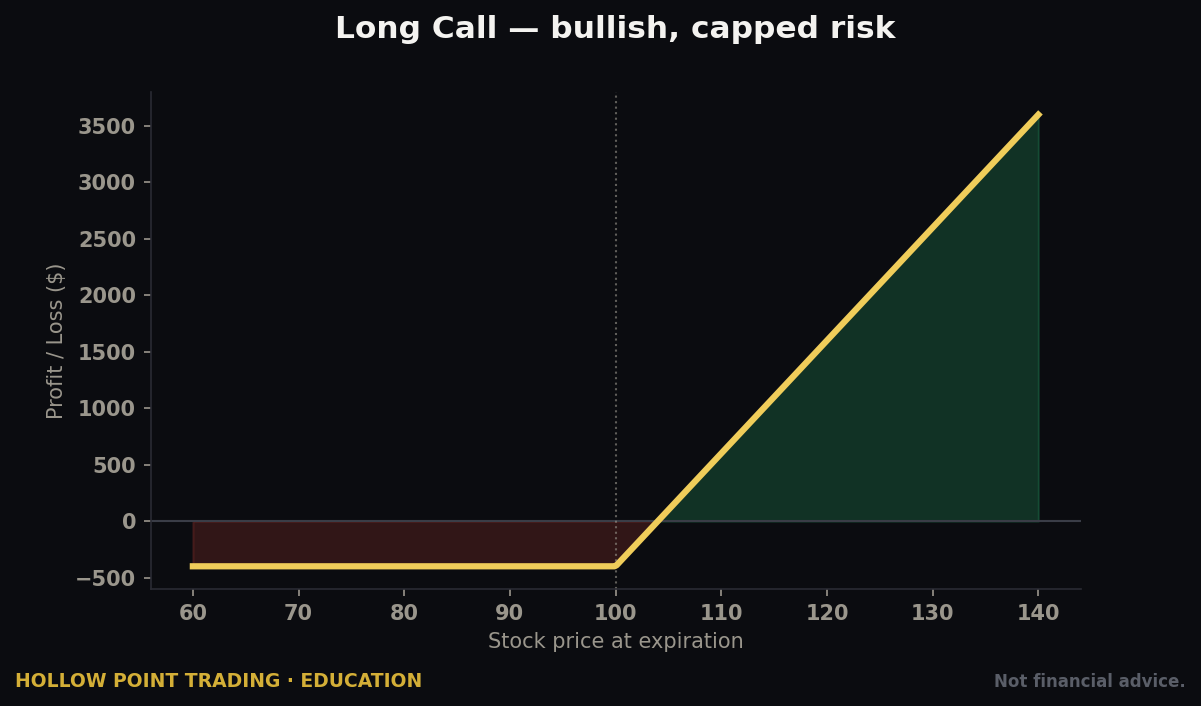
A CALL is the right to BUY 100 shares at the strike price. You buy calls when you think the stock is going up. A call locks in your purchase price. If the stock rips higher, you get to buy it cheap (at the strike) and it's worth more.
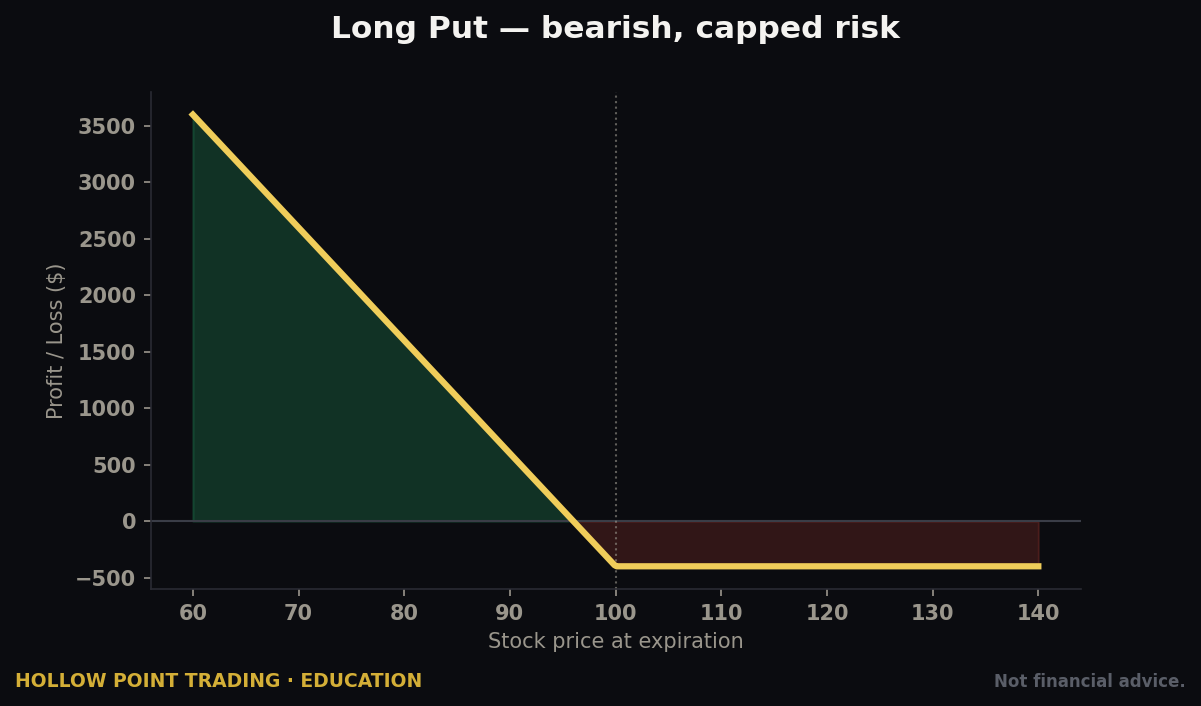
A PUT is the right to SELL 100 shares at the strike price. You buy puts when you think the stock is going down. A put locks in your selling price. If the stock craters, you get to sell it high (at the strike) while it's actually worth less.
A memory hook that sticks: you call something up, you put something down. Call = up, put = down. Crude, but it works and you'll never forget which is which.
Every option in existence is one of these four positions: you can buy a call, sell a call, buy a put, or sell a put. For your first months as a beginner, you'll almost certainly be a buyer — buying calls or buying puts — because buying is where your risk is capped and defined. Selling naked options carries unlimited or enormous risk and is not a beginner move. We'll cover what selling means so you understand the other side of your trade, but treat this guide as a buyer's education.
The four positions, and who's on the other side of you
Every time you buy a call, someone sold you that call. Understanding what they want tells you a lot about what you're up against.
- Buy a call (you): you want up, big and soon. Risk = premium. Reward = large, theoretically unlimited.
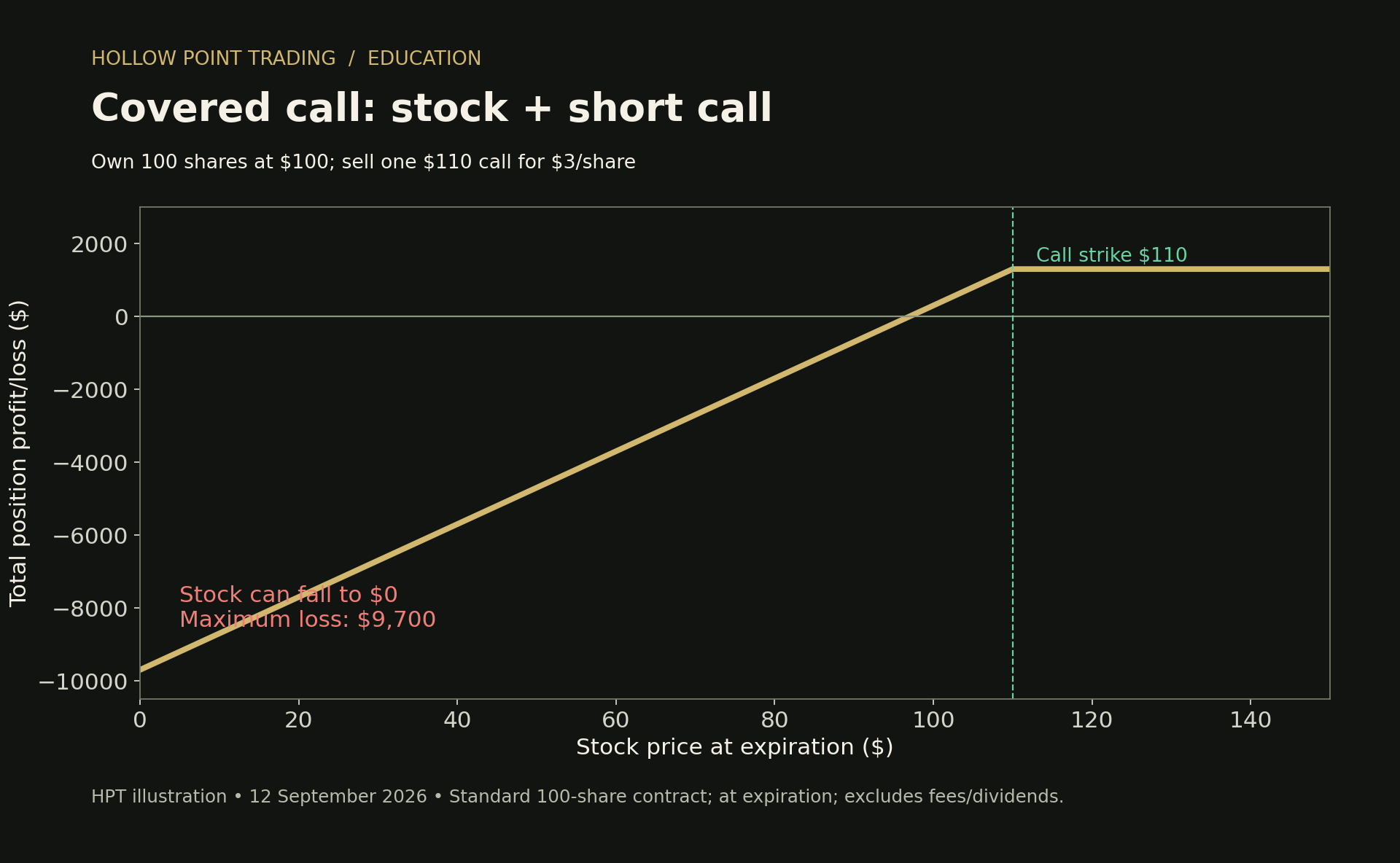
- Sell a call (your counterparty): they want the stock to stay below your strike so your call expires worthless and they keep the premium. Naked, their risk is unlimited (stock can run forever). Often they own the shares — a "covered call" — and are just harvesting income.
- Buy a put (you, bearish): you want down. Risk = premium. Reward = large (capped only because a stock can't go below zero).
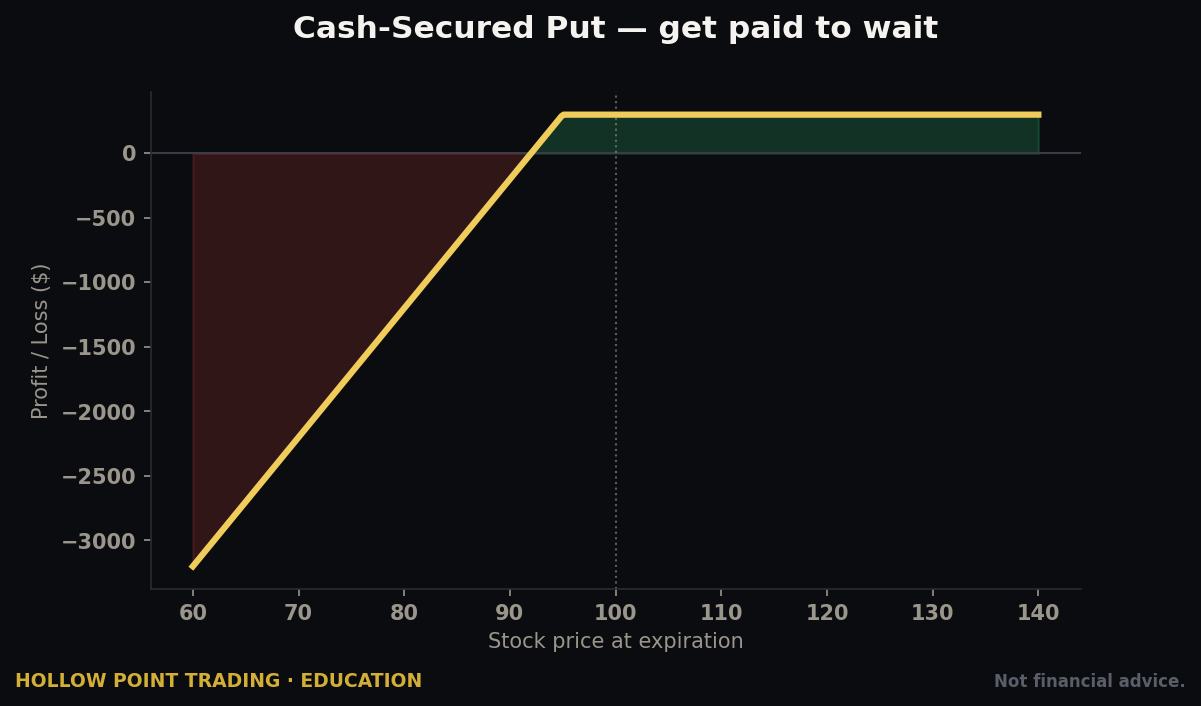
- Sell a put (your counterparty): they want the stock to stay above your strike. They keep the premium if it does. This is often how institutions get paid to buy stock they wanted anyway at a lower price.
Why does this matter to a beginner who only buys? Because the person selling to you is very frequently a sophisticated, well-capitalized desk that is systematically collecting premium and betting on time decay and IV crush — the exact two forces we'll name as your killers. When you buy a naked option, you are, by default, on the opposite side of people who get paid when your option melts. That doesn't mean you can't win. It means you'd better know why you're taking the trade, because the structure is quietly working against a lazy buyer.
Strike, Expiration, Premium: The Three Numbers On Every Contract
Every single option is fully described by three things. Once you can read these three numbers, you can read any option ticket on earth.
1. The strike price — the fixed price at which you can buy (call) or sell (put) the 100 shares. If you own a $150 call on a stock, 150 is your locked buy price no matter where the stock goes. Strikes come in preset increments — $1, $2.50, $5, sometimes wider — set by the exchange. The strike you choose is a probability decision in disguise: a strike far above the current price is cheap because it's unlikely to pay; a strike deep below is expensive because it's very likely to pay. You are not just picking a price. You are picking your odds.
2. The expiration date — the deadline. After this date the option ceases to exist. This is what makes options a decaying asset and separates them from stock. A share of stock can be held forever. An option is a melting ice cube with a hard expiration stamped on it. The expiration you choose decides how hard the clock (theta) presses on you every single day.
3. The premium — the price of the option itself. This is what you pay (as a buyer) or collect (as a seller) to enter the contract. Quoted per share, multiplied by 100 for the real dollar cost. The premium is not arbitrary — it is a calculated number built from where the strike sits, how much time is left, and how much the stock is expected to move. Learn to decompose the premium (next major section) and you stop being surprised by your own P&L.
Put them together and you get a full option name, the way it's actually written:
AAPL Jan 17 2025 $150 Call @ $4.20
That reads: an Apple call option, expiring January 17 2025, strike price $150, trading for $4.20 per share — meaning $420 to buy one contract. If you buy it, you've locked the right to buy 100 shares of Apple at $150 anytime before that January date, and it cost you $420 to hold that right.
Reading the ticket like a pro reads it
When a professional sees "AAPL Jan 17 2025 $150 Call @ $4.20," they don't just read the words. They instantly ask four things: Where is the stock right now relative to $150? (Is this ITM or a bet?) How many days to that January date? (How hard is theta pressing?) What's IV doing — is there an earnings report between now and then? (Am I about to eat a crush?) And how much of that $4.20 is real value versus pure time premium? You'll be able to answer all four by the end of this article. Those four questions are the difference between reading a ticket and understanding a position.
In The Money, At The Money, Out Of The Money
This describes where the strike sits relative to the current stock price. It tells you, right now, whether the option has real value or is pure bet.
Say the stock is trading at $100.
For calls (right to buy):
- In the money (ITM): strike is below the stock price. A $90 call is ITM — you can buy at $90 something worth $100. That right is worth at least $10.
- At the money (ATM): strike is at the stock price. A $100 call. Right on the line.
- Out of the money (OTM): strike is above the stock price. A $110 call — the right to buy at $110 something only worth $100 is currently worthless to exercise. It's a pure bet the stock climbs past $110.
For puts (right to sell), it flips:
- In the money: strike is above the stock price. A $110 put — you can sell at $110 something worth $100. Worth at least $10.
- At the money: a $100 put.
- Out of the money: strike below the stock. A $90 put is worthless to exercise while the stock sits at $100.
This matters because it determines how the premium is built — which is the single most important concept in this entire article.
The hidden meaning: moneyness is probability
Here's what almost no beginner is told. The "moneyness" of an option is a rough map of the probability that option finishes in the money. A deep ITM option behaves like it has a high chance of paying — because it does. An ATM option is roughly a coin flip. A far-OTM option is a low-probability lottery ticket, and its cheap price is not a bargain — it's the market telling you, precisely, how unlikely it is.
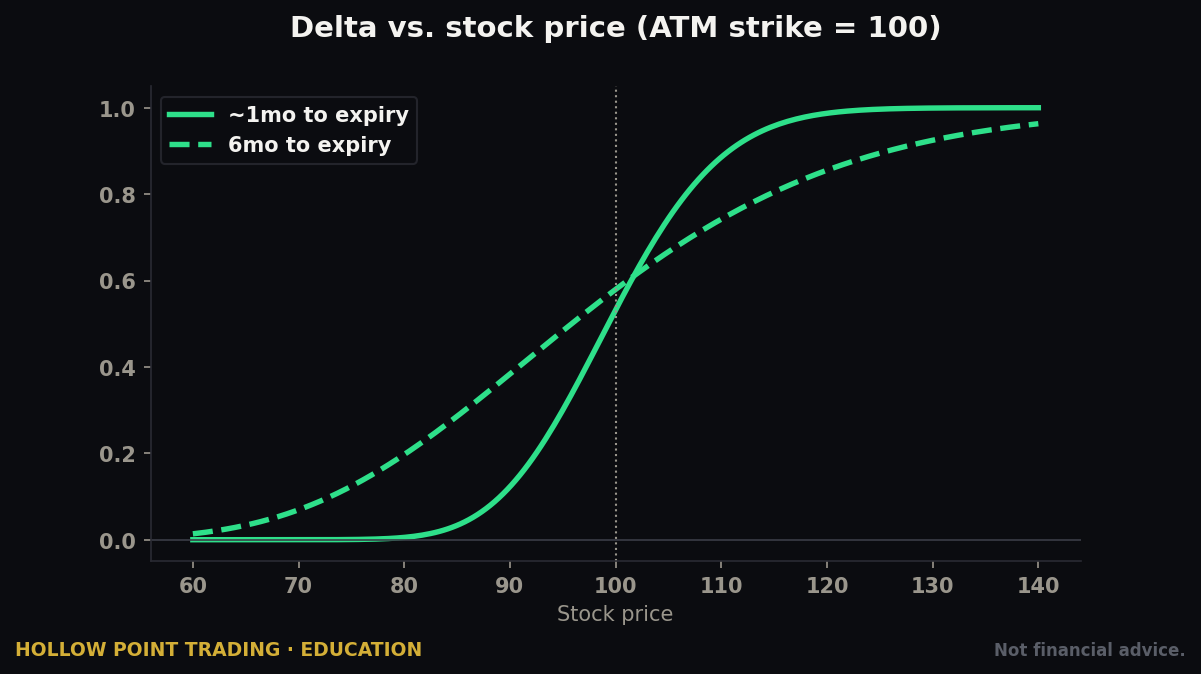
There's even a shortcut the pros use: an option's delta (we'll meet delta properly in a moment) roughly approximates its probability of finishing ITM. A 0.30-delta call has very approximately a 30% chance of expiring in the money. So when you buy that "cheap" $0.30 far-OTM call, you're not finding value the market missed — you're buying something the market has priced as roughly a 1-in-8 or 1-in-10 shot. Understanding this one idea inoculates you against the single most common beginner death: mistaking a low price for good odds.
Intrinsic vs. Extrinsic: What You're Actually Paying For
The premium of any option is made of exactly two ingredients:
Premium = Intrinsic Value + Extrinsic Value
Intrinsic value is the real, right-now value — the amount the option is already in the money. It's the part you could cash in immediately.
- Stock at $100. A $90 call has $10 of intrinsic value ($100 − $90). That's guaranteed, baked-in worth.
- Stock at $100. A $110 call has $0 intrinsic value — it's out of the money. Nothing to cash in yet.
Intrinsic value can never be negative. An out-of-the-money option simply has zero.
Extrinsic value (also called time value) is everything else in the premium — the part you're paying for possibility. It's the market's price on the chance the stock moves your way before expiration. Two forces drive it: how much time is left and how volatile the stock is.
Let's make it concrete. Stock at $100, and a $90 call is trading at $13.
- Intrinsic value: $100 − $90 = $10
- Extrinsic (time) value: $13 − $10 = $3
You're paying $10 for value that already exists, and $3 for the chance the stock climbs even higher before expiration. That $3 is the part that melts away as time passes.
Now an out-of-the-money option. Stock at $100, a $110 call trading at $2.
- Intrinsic value: $0 (it's OTM)
- Extrinsic value: $2 — the entire premium is time value.
This is the beginner's silent killer, previewed here: when you buy an out-of-the-money option, 100% of what you paid is time value, and time value decays to zero at expiration. If the stock doesn't move enough, that option doesn't lose some value — it goes to zero. You didn't buy an asset. You bought a countdown.
Why ITM options are "expensive" but often safer
Beginners gravitate to OTM options because the dollar price is low, and they recoil from ITM options because the dollar price is high. This instinct is exactly backwards from a risk standpoint, and here's why.
Take the same stock at $100. Compare:
- $90 call at $13 — $10 intrinsic, $3 extrinsic. Only $3 of that $13 (about 23%) can decay to zero. The $10 of intrinsic is real and stays real as long as the stock holds above $90. Its delta is high (say 0.85), so it tracks the stock closely — the stock moves $1, this option moves ~$0.85.
- $110 call at $2 — $0 intrinsic, $2 extrinsic. All $2 (100%) can decay to zero. Its delta is low (say 0.20), so the stock moves $1 and this option moves ~$0.20. You need a big, fast move just to overcome the time decay eating it alive.
The ITM option costs more dollars but risks a smaller fraction to decay and participates more in the move. The OTM option is cheap in dollars and catastrophic in probability. "Expensive" and "risky" are not the same word. Deep ITM is often the conservative directional play; far OTM is the reckless one wearing a cheap price tag as a disguise.
A quick word on the Greeks, in plain English
You'll hear "the Greeks" thrown around. They are just the labels for how the premium reacts to different forces. You don't need calculus. You need the intuition:
- Delta — how much the option moves per $1 move in the stock (and, roughly, the probability of finishing ITM). Deep ITM ≈ 0.80–1.00. ATM ≈ 0.50. Far OTM ≈ 0.05–0.20.
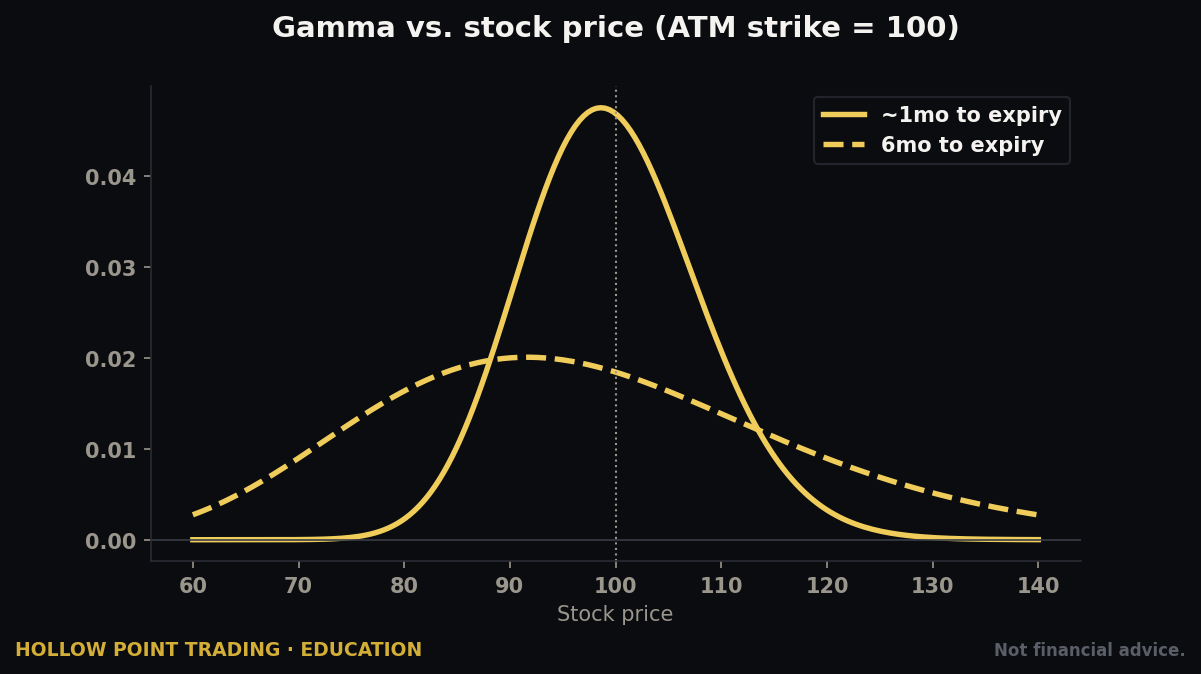
- Gamma — how fast delta itself changes. Highest for ATM options near expiration. High gamma = the option's sensitivity is whipping around fast. This is why 0DTE is so violent.
- Theta — how much value decays per day. Your enemy as a buyer.
- Vega — how much the premium moves when implied volatility changes. The reason IV crush exists.
That's it. Four sensitivities. Everything that happens to your option's price is some combination of these four reacting to the stock moving, time passing, and fear rising or falling.
How Time and Volatility Price the Premium
Two engines set the extrinsic value. Understand these and you understand why an option you bought can lose money while the stock goes your direction.
Theta — the clock
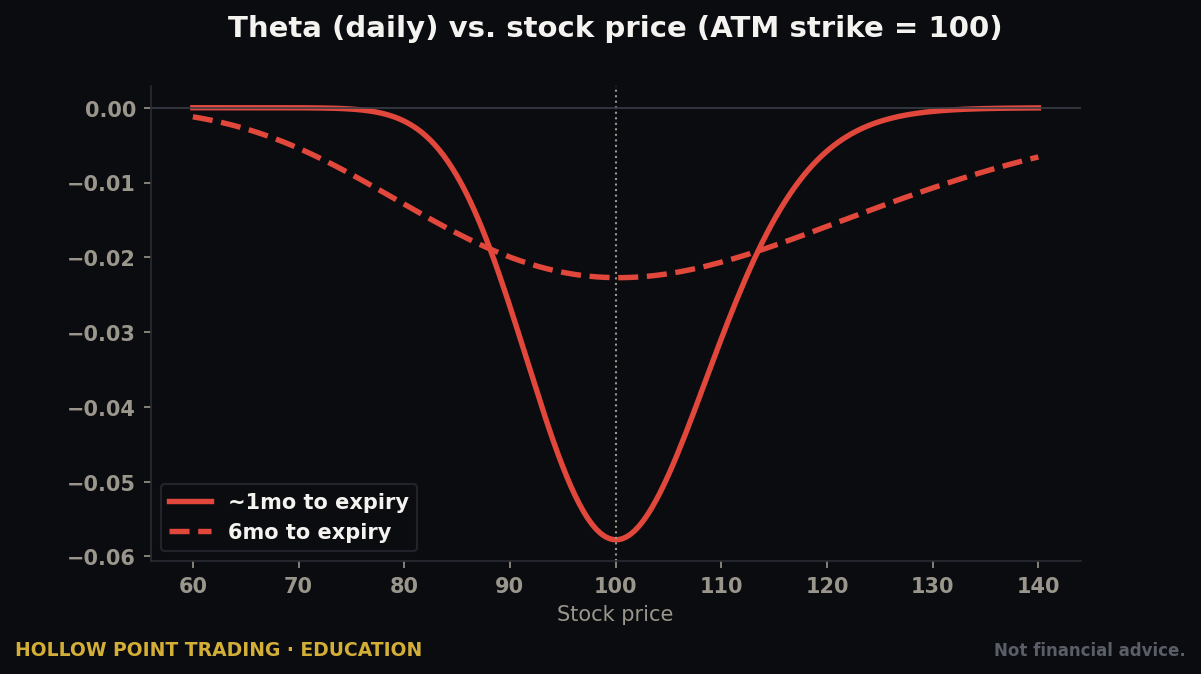
Theta is time decay. Every day that passes, an option loses a little extrinsic value, because there's less time left for the stock to move. All else equal, an option is worth less tomorrow than today.
And it doesn't decay evenly. Time decay accelerates as expiration approaches. An option loses time value slowly when there are 90 days left, faster at 30 days, and it falls off a cliff in the final week. Picture the ice cube melting faster the closer it gets to noon.
Worked example. You buy an ATM call for $5.00 ($500) with 30 days to expiration, and the stock doesn't move at all.
- 30 days out: worth ~$5.00
- 20 days out: worth ~$4.00
- 10 days out: worth ~$2.60
- 3 days out: worth ~$1.30
- Expiration, still at the money: worth $0
The stock never dropped. You were "right" that it wouldn't fall. And you lost 100% of your money to theta. This is what people mean when they say options are a wasting asset.
Notice the shape of that decay. From 30 to 20 days you lost $1.00. From 3 days to zero you lost $1.30 in the final stretch. The curve isn't a slope — it's a ski jump. This is why the pros say time decay is "non-linear," and why the last two weeks of an option's life are a different, more dangerous animal than the first month. The theta math is the same math that makes sellers of near-dated options rich when nothing happens.
Theta and the weekend tax
Here's a subtlety that costs beginners real money: theta doesn't take weekends off. The pricing models decay the option across calendar time, not trading time. So when you buy an option on Friday afternoon and the market reopens Monday, three days of time value are gone — but you only got zero trading days to be right. Buying short-dated options into a weekend, hoping for a Monday move, means paying two extra days of rent for a closed market. Sophisticated traders account for this; beginners get quietly nickel-and-dimed by the calendar.
Vega / implied volatility — the fear gauge
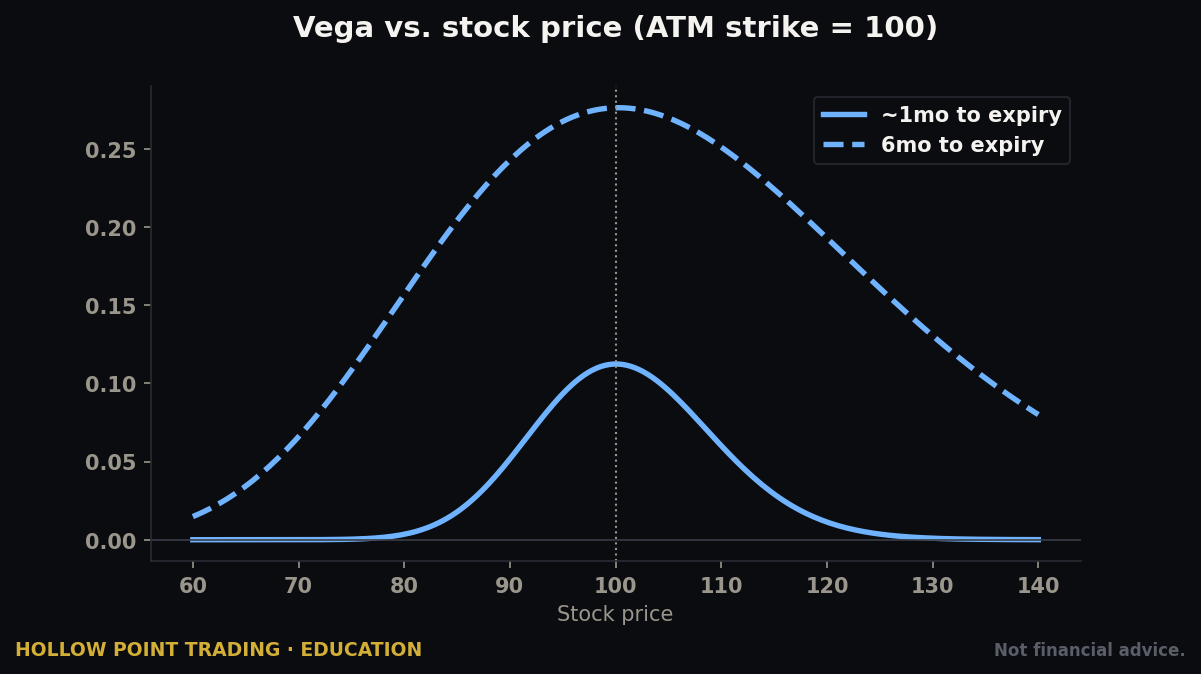
Implied volatility (IV) is the market's expectation of how much the stock will move going forward. Higher expected movement = more valuable options = fatter premiums, because a bigger expected swing means a better chance your option pays. Vega measures how much the premium changes when IV changes.
When IV is high, options are expensive. When IV is low, they're cheap. And here's the trap: IV spikes before big scheduled events — earnings reports, FDA decisions, Fed meetings — because everyone knows a large move is coming and demand for options surges. Then, the moment the event passes and the uncertainty is gone, IV collapses. This is IV crush, and it's the second silent killer. More on it at the end, because it deserves its own gravestone.
IV is relative — the concept of IV Rank
A single IV number ("this option has 45% IV") means nothing in isolation. The question is: 45% compared to what? A stock that normally runs at 30% IV is expensive at 45%. A stock that normally runs at 80% IV is dirt cheap at 45%. This is why pros look at IV Rank or IV Percentile — where today's IV sits relative to that stock's own range over the past year.
The practical rule that falls out of this: you want to buy options when IV is low (cheap time value) and you want to avoid buying when IV is high (you're overpaying for the same bet). Beginners do the exact opposite — they get excited and buy right before earnings when IV is at its annual peak, then wonder why being right didn't pay. Buying high IV is buying at a premium to the premium. When in doubt, check whether the option is historically cheap or expensive before you fall in love with the direction.
The Option Chain, Read Line By Line
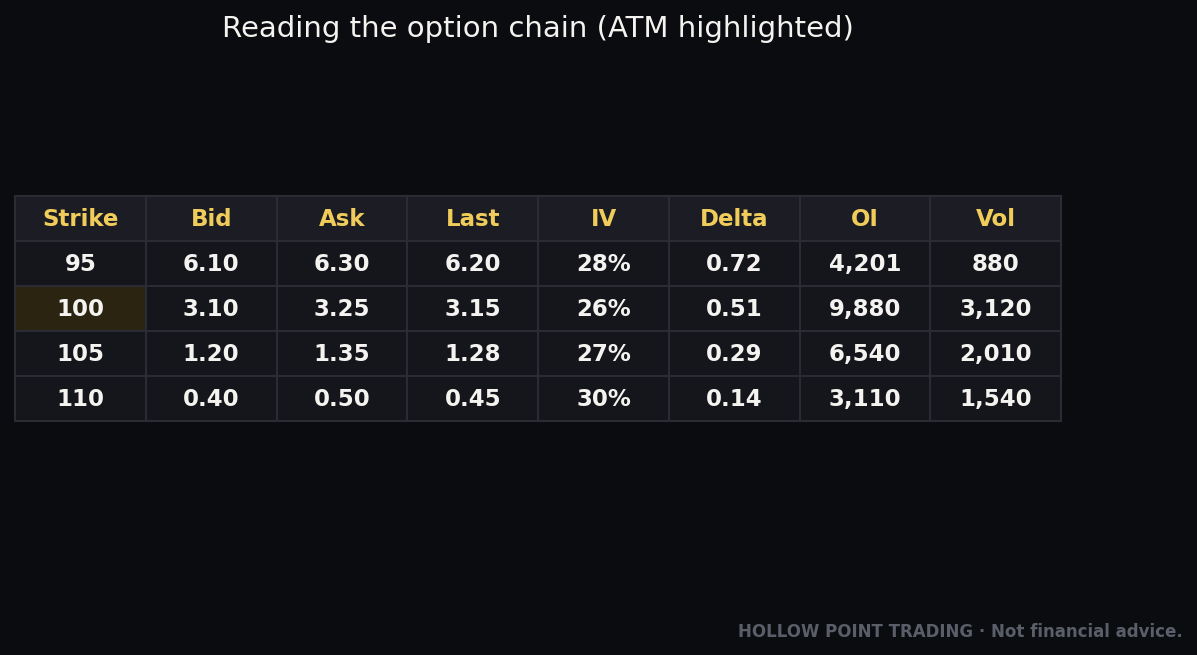
The option chain is the menu — every available strike and expiration for a stock, with live prices. It looks like a wall of numbers the first time. It isn't. It's a spreadsheet, and here's every column.
Chains are almost always laid out with calls on the left, puts on the right, and the strike prices running down the middle. You pick an expiration date at the top, then read across a strike row.
Here's a slice for a stock trading at $100, expiration 30 days out:
        CALLS                              PUTS
 Bid    Ask   Vol   OI  | STRIKE |  Bid   Ask   Vol   OI
10.20  10.40  1.2k  8k  |   90   | 0.35  0.45   400   3k
 5.80   5.95  4.5k 22k  |   95   | 0.95  1.05  1.1k   9k
 2.55   2.65  9.8k 41k  |  100   | 2.50  2.60  8.9k  38k   <- at the money
 0.90   0.98  6.2k 18k  |  105   | 5.75  5.90   900   7k
 0.30   0.36  2.1k 11k  |  110   |10.15 10.35   210   4k
Now every field:
STRIKE — the locked buy/sell price, running down the center. Above the stock price ($100) the calls are OTM and the puts are ITM; below it, flipped.
BID — the highest price a buyer is currently willing to pay for that option. If you're selling, this is roughly what you get.
ASK (or offer) — the lowest price a seller will accept. If you're buying, this is roughly what you pay.
The SPREAD — the gap between bid and ask. On the ATM $100 call above, bid $2.55 / ask $2.65 = a $0.10 spread. That gap is a cost you eat: buy at the ask, and the instant you own it the position is "worth" the lower bid — you're down the spread before the stock moves a penny. Tight spreads (pennies) mean a liquid, healthy option. Wide spreads (e.g., $0.90 / $1.40) mean thin, illiquid, hard to get out of — a beginner trap. Notice the far-OTM $110 put has a wider relative spread and tiny volume. That's the danger zone.
VOLUME (Vol) — how many contracts of that specific option traded today. It resets to zero every morning. High volume = active, liquid, easy to enter and exit.
OPEN INTEREST (OI) — how many contracts of that option are currently open and outstanding — held by someone, not yet closed or expired. It's the total pool of live bets on that strike. High OI (like the 41k on the ATM call) means deep liquidity and lots of participants. Low OI means you might be the only one there, and getting out could be ugly.
The quick health read on any option: tight spread + high volume + high open interest = liquid, tradeable. Wide spread + thin volume + low OI = leave it alone, no matter how cheap it looks.
Doing the spread math so it actually stings
Let's price out why the spread matters with real numbers. Say you buy 10 contracts of that far-OTM $110 call. Ask is $0.36, bid is $0.30 — a $0.06 spread, which sounds tiny.
- You buy 10 at the ask: 10 × $0.36 × 100 = $360 out.
- The instant you own them, they're worth the bid: 10 × $0.30 × 100 = $300.
- You are down $60 (16.7%) before the stock has moved a single cent.
For the stock to just get you back to break-even, the option has to gain $0.06 — and on a 0.20-delta option, that requires the stock to move about $0.30 in your favor just to pay the toll. On the liquid ATM $100 call with its $0.10 spread on a $2.60 premium, the toll is under 4% and the delta is ~0.50, so a ~$0.20 stock move covers it. Illiquid options tax you coming and going. The wider the spread relative to the premium, the more the market is charging you rent just for the privilege of being in and out of the room.
A pro's read of that chain in five seconds
An experienced trader glances at that chain and instantly notes: the money is at the ATM strikes (40k+ OI, thousands of volume, penny spreads — trade freely here). The far wings ($110 call, $90 put) are thin — playable only in tiny size or not at all. The put OI is heaviest at and below the money, which can hint at hedging or support/resistance zones (large OI strikes often act like magnets and walls into expiration — a topic for a later guide). None of this required a calculator. It's pattern recognition built on knowing what each column means.
Exercise and Assignment: What Happens At The Finish Line
Exercise is when the buyer uses their right — actually buying (call) or selling (put) the 100 shares at the strike.
Assignment is the flip side — the seller gets "assigned" and is forced to fulfill their obligation: to sell you the shares (if they sold you a call) or buy your shares (if they sold you a put).
Here's the part most beginners don't realize: you almost never need to exercise. The vast majority of options traders simply sell the option back before expiration to close the position and pocket the gain or loss. You buy a call for $2, it rises to $5, you sell it for $5 — done. You never touched the shares, never needed $15,000 to buy 100 of them. Exercising is the exception; trading the contract itself is the norm.
If you do hold to expiration:
- An option that's in the money at expiration is typically auto-exercised by your broker. An ITM call means you'll suddenly own 100 shares (and owe the cash for them) Monday morning. An ITM put means 100 shares get sold. If you don't have the capital or the shares, this creates a mess — which is exactly why you close ITM options before expiration unless you truly want the stock.
- An option that's out of the money at expiration simply expires worthless. It vanishes. You lose 100% of the premium and nothing else happens.
That "nothing else" is the good news for buyers: your maximum loss is the premium you paid. Full stop. You cannot lose more than you put in. That defined, capped risk is the single best feature of being an option buyer, and it's why buyers, not sellers, is where beginners belong.
The pin-risk and after-hours trap
Two finish-line hazards that ambush beginners who hold too long. First, pin risk: if the stock closes right at your strike at expiration, you genuinely don't know if you'll be assigned/exercised or not, and the stock can move after the close. Second, and more dangerous: stocks keep moving after the 4:00 PM close, but options stop trading. You might hold a call that's ITM by $0.50 at the close (looks like a win, auto-exercises), then bad news hits at 4:30 PM and the stock gaps down 3% in after-hours. Monday you own 100 shares underwater and there was nothing you could do. The lesson pros live by: don't hold options into expiration day unless you have a specific reason and the capital to take the shares. Close the position, take your P&L, sleep fine. Letting winners ride to the literal last minute to squeeze the final nickel is how a win becomes a Monday-morning margin call.
The "I got assigned and I don't have the money" nightmare
This mostly bites people who sell options, but a buyer holding a deep-ITM long call into expiration can trigger it too via auto-exercise. Say you hold a $50 call on a $60 stock and forget to close it. Friday it auto-exercises. Monday you own 100 shares at $50 — a $5,000 debit your account must cover. If you only had $300 in the account (the premium you paid), you're now in a margin call, and the broker can liquidate at whatever price Monday opens at. The fix is boring and total: close your options before they expire. The contract was worth its full value on Friday afternoon — there was never a reason to let it convert into a stock position you can't finance.
American vs. European, Cash vs. Physical
Two settlement distinctions that sound academic until they bite you.
American-style options can be exercised any time before expiration. European-style options can only be exercised at expiration. Nearly all options on individual stocks (AAPL, TSLA, NVDA) are American. Most index options (like SPX, the S&P 500 index) are European. As a buyer who plans to sell the contract back anyway, this mostly matters because if you sell American options, you can be assigned early.
Physical settlement means real shares change hands on exercise — standard for stock options. Exercise an AAPL call, you receive actual Apple shares.
Cash settlement means no shares move; the difference is just paid in cash. Index options (SPX) settle in cash — there's no "500 shares of the S&P index" to deliver, so the account is simply credited the intrinsic value. This is why some traders prefer index options: no surprise pile of shares, no assignment headaches, and often cleaner tax treatment. For your first steps, know the difference exists; trade liquid single-stock or ETF options and it rarely surprises you.
Early assignment and the dividend trap
One concrete way American-style matters even a little to beginners: dividends. If you're short a call (you sold it) on a stock about to pay a dividend, and your call is ITM, the person who's long it may exercise early to capture the dividend — assigning you unexpectedly the day before the ex-dividend date. This is a "known season" for early assignment. Again, as a pure buyer this works for you or is irrelevant, but the moment you graduate to covered calls or spreads, dividend dates go on your calendar next to earnings dates. The broad lesson: settlement style and corporate events (dividends, splits, mergers) can reach into an options position and rearrange it. Know the calendar.
The Expiration Menu: 0DTE, Weeklies, Monthlies, LEAPS
Options come in every duration from hours to years, and the timeframe you pick changes the entire character of the trade.
0DTE ("zero days to expiration") — options expiring that same day. Maximum theta, maximum gamma, maximum violence. They can 10x or go to zero in minutes. They are the closest thing to pure gambling in the options world and are marketed hardest to beginners for exactly that reason. Avoid these until you genuinely know what you're doing. The time decay on a 0DTE is not a slope; it's a cliff you're standing on.
Weeklies — expire at the end of the current week. Popular, liquid, still fast-decaying. Days, not hours, but theta is heavy.
Monthlies — the traditional standard, expiring the third Friday of each month. These carry the deepest liquidity and open interest and are generally the most beginner-appropriate duration for directional trades — enough time to be right, deep enough markets to get out.
LEAPS ("Long-term Equity AnticiPation Securities") — options expiring a year or more out. Because they have so much time, theta barely touches them day to day, which makes them behave more like a slow, leveraged proxy for owning the stock. They're expensive in dollar terms (lots of time value) but forgiving on timing. Many patient traders use LEAPS calls as a lower-cost stand-in for buying shares.
The rule of thumb: the shorter the expiration, the more you're fighting theta, and the more precisely right you have to be about timing. Beginners consistently underestimate how much time they need to be right.
Matching duration to your actual thesis
Here's the discipline the menu is trying to teach you: your expiration should match the timeframe of your idea, plus a buffer. Ask yourself, honestly, how long do I think this move takes to play out? Then buy roughly double that in time.
- Think the breakout resolves in 2–3 days? Don't buy a weekly with 4 days left — buy 3–4 weeks out so a one-day delay doesn't gut you. Theta on the near-dated contract will punish a move that arrives Wednesday instead of Monday.
- Think a swing plays out over 2–3 weeks? Buy 45–60 days out.
- Think it's a multi-month thesis (a turnaround, a trend)? LEAPS or several-month expirations, where theta is a whisper.
The beginner error is always buying too little time because the near-dated option is cheaper. You're not saving money — you're buying a shorter fuse. A pro would rather pay more premium for a contract that survives being early, because being early is the same as being wrong if the option expires before the thesis pays.
How The Same Contract Behaves In Different Market Regimes
This is the section that separates people who understand options from people who memorized definitions. The identical option behaves like a completely different instrument depending on what the market is doing. Read the regime wrong and even correct mechanics lose.
Trending market (a clean directional move)
In a strong, orderly trend, directional option buying works best — this is the environment options were made to exploit. The stock grinds your way, delta accrues, and if you gave yourself enough time, theta is outrun by the move. In a trend, buying slightly ITM or ATM calls (uptrend) or puts (downtrend) with 30–60 days out is the bread-and-butter play. The move pays faster than the clock decays, IV is usually moderate (not inflated), and you're being rewarded for the one thing options reward: a real, sustained directional move.
Choppy / range-bound market (grind sideways)
This is where naked option buyers go to die, and most beginners never diagnose it. In a chop, the stock oscillates in a range, going nowhere. Every day you hold a long option, theta bleeds you, and the stock keeps snapping back into the middle of the range before your option can pay. You'll be "right" repeatedly — the stock touches your target intraday — and still lose, because it never closes the move and theta grinds on overnight. In chop, long premium is a slow leak. The pros flip sides here: in range-bound, low-directional conditions, the edge belongs to sellers of premium (spreads, iron condors — advanced topics), who get paid by the same theta that's killing the buyer. As a beginner, the correct move in obvious chop is often not to buy options at all. Sit out. Cash is a position.
High-volatility market (fear, big ranges, spiking VIX)
When volatility explodes — market panic, crash, huge daily ranges — two things happen at once, and they fight each other. Good: big moves mean your directional option can pay huge and fast (gamma is your friend). Bad: IV is sky-high, so you're overpaying massively for every option, and if volatility even normalizes while you hold, vega works against you (a mini IV crush). Buying puts after a crash has already spiked IV is a classic trap: the stock keeps falling, you're right, and your puts barely gain because the IV you overpaid for is deflating as fast as the stock drops. In high-vol regimes, the pros either buy less premium, use spreads to offset the inflated IV, or wait for the IV spike to cool. The blunt beginner lesson: high VIX means options are on sale for sellers and marked up for buyers. Buying naked options into a volatility spike is buying at the top of the price of time and fear itself.
Low-volatility market (quiet, drifting, complacent)
Quiet markets make options cheap — low IV means low extrinsic value. This is the best environment to be an option buyer, because you're acquiring time value at a discount, and if volatility ever wakes up (it eventually does), vega works for you on top of the directional move. The catch: quiet markets are quiet precisely because nothing is moving, so you need patience and a real catalyst thesis. But structurally, buy premium when it's cheap (low IV), sell premium when it's expensive (high IV) — and low-vol regimes are when premium is cheap.
The meta-lesson across all four: an option is not a fixed thing. It's a bet on movement, and whether movement is coming, already priced in, or absent entirely changes everything. Diagnose the regime before you pick the contract.
Multi-Timeframe: Reading The Same Setup Across Charts
At Hollow Point Trading the read is never one chart — it's the whole ladder, and options selection should honor that. Here's how timeframe stacking translates into contract selection.
The higher timeframes set the bias and the size of the move you can expect. If the daily and weekly charts are in a clean uptrend with room to a target eight dollars away, that's a multi-week move — it justifies a 45-day call and a wider target. If only the 5-minute chart looks bullish while the daily is rolling over, you're playing a scalp against the larger trend, which argues for a much smaller position, a tighter time window, and no illusions about holding it for a week.
The principle is timeframe-weighted confluence: the higher timeframes carry more weight than the noise on the 1-minute. When the monthly, weekly, and daily all point the same way and the hourly gives you a clean entry trigger, that's the high-conviction, appropriately-sized directional option trade. When the timeframes disagree — daily up, hourly down — the honest answer is often a smaller position or no trade, because you don't actually have confluence; you have a coin flip with extra steps.
Concretely: use the higher timeframe to choose your expiration and target (how big, how long), and the lower timeframe to choose your entry and your invalidation (where you get in, where you're wrong). A daily-chart thesis with an hourly-chart entry and a clearly-defined hourly invalidation is a structured trade. A 1-minute impulse with no higher-timeframe backing is a lottery ticket wearing a chart.
Confluence: Combining Options With Other Tools
Options selection gets dramatically better when you fold in a few other reads. Here are three that stack cleanly with everything above.
1. IV Rank + the chart together
The chart tells you direction and timing; IV Rank tells you whether the option is cheap or expensive. The best long-premium trades are when the chart says "move coming" AND IV Rank is low (you're buying cheap time value before the move). The worst are when the chart looks great but IV Rank is at its annual high — you can be completely right and have the IV deflation eat your gains. Before every buy: check the chart, then check whether you're buying premium on sale or at a markup. Two green lights, not one.
2. Support/resistance + strike selection
Your strikes and targets should be drawn from actual chart levels, not round numbers you like. If resistance sits at $108, don't set a $115 target and buy a $110 call hoping — recognize the stock has to break $108 first, and that's where the move either accelerates or rejects. Pros place their target strike beyond a level the chart says will break, and their invalidation below a level the chart says should hold. The option chain and the price chart are the same conversation: strikes are just prices, and prices have meaning on the chart.
3. The earnings/event calendar + expiration choice
Before choosing an expiration, always check whether earnings or a major event falls inside its window. If you want a pure directional trade and there's an earnings report in three weeks, either (a) choose an expiration before earnings to avoid the IV-crush lottery, or (b) go well past it with eyes open, knowing you're taking event risk. What you never do is accidentally hold a naked option through earnings because you didn't check the calendar. The calendar is a five-second check that prevents the single most expensive beginner mistake.
Put together, the confluence read sounds like this: "Daily uptrend intact, entering off hourly support at $100, resistance to break at $108 then open air to $114, IV Rank is low so premium is cheap, and there's no earnings before my 45-day expiration. Buy the $105 call, target $113, invalidation on an hourly close below $97." That's a thesis, not a bet. Every piece is checkable.
How A Real Trader Actually Uses This
Here's the discipline layer — the part the screenshot-chasers skip.
At Hollow Point Trading the process is top-down: macro first (what's the broad market doing, what's the Fed doing), then the sector (is this stock's group in favor or out), then the individual stock and its chart. You don't buy a call because a ticker is trending on social media. You buy it because the market backdrop, the sector, and the chart all point the same way — timeframe-weighted confluence, where the higher timeframes carry more weight than the noise on the 1-minute.
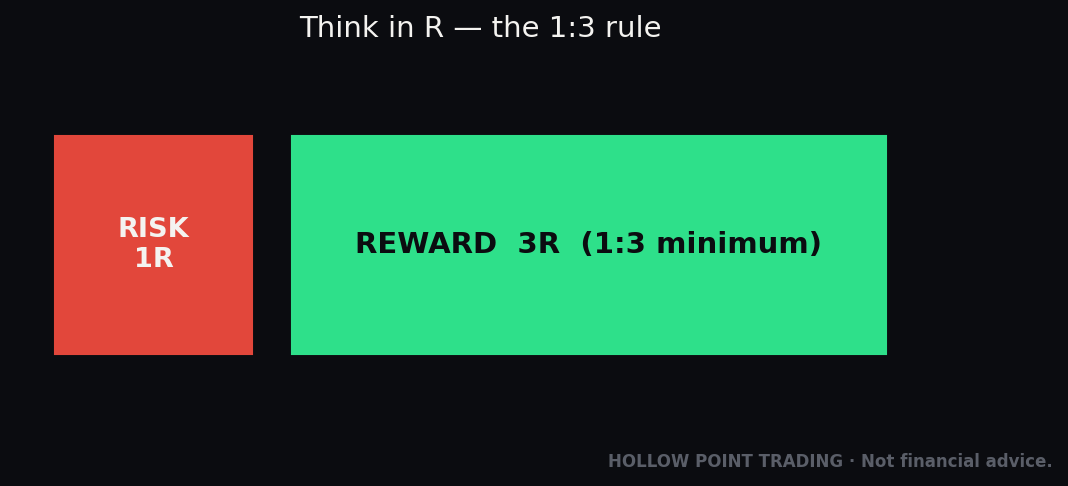
Then the structure. HPT's non-negotiable is a minimum 1:3 risk/reward — you don't take a trade risking $100 to make $100. You want to risk $100 to make $300, so that even being right less than half the time still nets you a profit. Options are a leveraged tool; without a hard R/R rule, leverage just accelerates the account to zero.
A clean beginner-appropriate example, start to finish:
- Macro constructive, sector strong, stock at $100 breaking out on the chart.
- You buy the $105 call, 45 days out (monthly, not a 0DTE — you want time to be right), paying $2.00 = $200 total. That $200 is your maximum loss, defined and capped.
- Your plan: if the stock hits $110 the option should roughly triple; if the setup breaks and the stock loses $97, you sell the option to cut the loss rather than ride it to zero.
- Stock runs to $112 over three weeks. The $105 call is now deep ITM, worth ~$8.50. You sell the contract for $850. Risked $200 to make $650 — better than 1:3, achieved by picking direction and giving yourself enough time.
Notice what did the work: enough expiration to survive theta, a defined risk, a target set before entry, and an exit plan for being wrong. That's trading. The screenshot is just the outcome of doing this a hundred times with discipline.
Position sizing: the math beginners skip and pros obsess over
Let's make the 1:3 rule and sizing concrete, because "risk $100 to make $300" is meaningless until you attach it to an account.
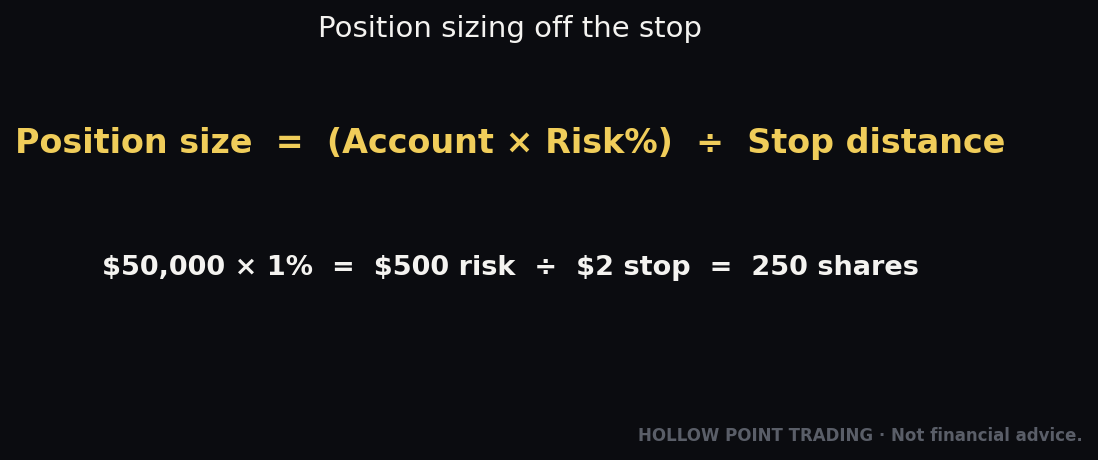
Say you have a $10,000 account and your rule is to risk no more than 2% ($200) on any single trade. With options, because your max loss as a buyer is the whole premium, sizing is refreshingly clean: the total premium you spend should not exceed your per-trade risk — unless you have a hard stop that cuts before max loss.
- That $2.00 call = $200 per contract. One contract puts exactly 2% at risk. Not five contracts because they're "only $200 each" — one.
- If you do have a stop (say you'll exit at a 50% loss), you could size to two contracts ($400 total, but only $200 at risk to the stop). This is more advanced and requires the discipline to actually honor the stop.
The beginner blowup is always the same story: they see a $0.30 option, think "it's cheap, I'll buy 30 of them for $900," the stock ticks the wrong way, the option halves, and they've lost $450 on a "cheap" trade. The premium price is irrelevant. Total dollars at risk is the only number that matters, and it should be a small, fixed fraction of the account, decided before you look at the price.
A losing trade, done right
Winning examples are easy. Here's the more important one — a loss handled with discipline. Same setup: $105 call, 45 days out, $200 in. But this time the breakout fails. The stock stalls at $101, then closes below your $97 invalidation on the daily. The option is now worth $1.10 — you're down $90.
The disciplined trader sells it right there for $110, taking the $90 loss (45% of the position), and moves on. The undisciplined trader "gives it room," tells themselves the thesis is still alive, and holds. Two weeks later the stock is at $94 and the option is worth $0.20 — a $180 loss (90%). Same entry, same information. The only difference was honoring the invalidation. The exit plan you set before entry is the entire game. Being wrong is not the problem; staying wrong is. Your max loss being capped at the premium is a backstop, not a plan — a trader who routinely rides options to zero is just using the cap as an excuse to never manage risk.
The Mistakes That Kill Beginners
1. Buying cheap far-OTM lottery tickets. That $0.30 call looks affordable, but it's 100% time value with a low probability of paying. You'll be right on direction sometimes and still lose because the move wasn't big enough, fast enough. Cheap in premium ≠ cheap in odds. Remember: that low price is the market telling you the exact low probability, not offering you a bargain.
2. Ignoring theta. Being "right eventually" is worthless if the option expired first. You can nail the direction and lose everything to the clock. Give yourself more time than you think you need — a good rule is double the time you expect the move to take.
3. Walking into earnings long a single option. This is where IV crush lives (next section). The most expensive lesson in beginner options, and the most avoidable — it's a five-second calendar check.
4. Trading illiquid options. Wide spreads and thin open interest mean you overpay to get in and get gutted trying to get out. Check volume and OI every time. A "great setup" on an untradeable option is not a great setup.
5. Position sizing like it's stock. The 100x multiplier means options move violently. A "small" 10-contract position can be a huge dollar swing. Size to total dollars at risk as a fixed fraction of your account, not to the ticket price.
6. No exit plan. Beginners buy with a dream and no stop. Decide your target and your invalidation before you click buy, and write them down so you can't renegotiate with yourself mid-trade.
7. Buying high IV without knowing it. Getting excited and buying options when IV Rank is at its annual peak means overpaying for the same bet. Check whether premium is cheap or expensive before you buy, not after you're confused about your P&L.
8. Holding into expiration to squeeze the last nickel. Auto-exercise, pin risk, and after-hours gaps turn wins into Monday-morning disasters. Close before expiration unless you specifically want the shares and have the capital.
9. Averaging down on a losing option. "It's cheaper now, I'll buy more" on a decaying, wrong-way option is compounding a mistake with a countdown attached. Averaging down works on stock you'll hold for years; on an option it just increases your bet on a thesis the market is actively rejecting, with theta accelerating.
10. Confusing a good stock read with a good option trade. You can be completely right about the stock and lose money on the option because of theta, IV crush, wrong strike, or wrong expiration. The stock read is necessary but not sufficient. The option is a separate decision with its own math.
11. Revenge trading after a loss. Options move fast and losses sting. Beginners immediately size up on the next trade to "make it back," abandoning their sizing rules. This is how a bad day becomes a blown account. The market doesn't know or care that you're down; the next trade has to earn its size on its own merits.
12. Not accounting for the weekend and holidays. Buying short-dated options Friday afternoon means paying theta for a closed market. Time decay runs on the calendar, not the trading session. Factor the days-off tax into short-dated trades.
How The Pros Use This Differently From Beginners
Same instrument, opposite relationship to it. Here's the contrast, point by point, because seeing the gap is how you close it.
Beginners buy dollars-cheap options; pros buy probability-cheap ones. The beginner scans for the lowest ticket price. The pro scans for the best risk-adjusted odds — often a slightly ITM option that costs more but risks less to decay and participates more in the move. The pro would rather pay $8 for a high-probability, high-delta position than $0.40 for a lottery ticket.
Beginners think about direction; pros think about direction, time, AND volatility. The beginner asks one question: "up or down?" The pro asks three: "which way, over what timeframe, and is IV cheap or expensive right now?" All three have to line up. Getting one of three right is how you lose while being "right."
Beginners buy naked options and hope; pros structure risk. As traders advance, they use spreads (buying one option, selling another) to offset theta and IV, define both max loss AND max gain, and lower the cost of being wrong. This guide is a buyer's education, but know that the naked long option is the starting line, not the finish — it's the highest-theta, highest-IV-exposure way to express a view.
Beginners react; pros pre-plan. The pro's target and invalidation exist before entry, in writing, and don't move. The beginner decides what to do while watching the P&L flicker — which means fear and greed make the decisions. A plan made in calm is worth ten decisions made in the heat.
Beginners size by excitement; pros size by rule. The pro's position is a fixed, small fraction of the account, every time, regardless of how "sure" they feel. The beginner sizes up on conviction — which is exactly when overconfidence is highest and the blowup is largest. Conviction is not a risk-management input.
Beginners hold to zero; pros cut and recycle. The pro takes the 40% loss at invalidation and keeps the capital to deploy on the next setup. The beginner rides it to zero "because it's already down." Capital preserved is capital that compounds; capital ridden to zero is gone, and so is every future trade it could have funded.
Beginners trade constantly; pros wait for confluence. The pro sits out chop and low-conviction setups, sometimes for days, because forcing trades in the wrong regime is negative expectancy. The beginner feels like not trading is losing. Cash is a position, and patience is an edge. Most of the pro's edge is in the trades they don't take.
Beginners chase the screenshot; pros run a process. The 4,000% winner on the timeline is survivorship bias — the 40 people who lost on the same ticket didn't post. The pro knows their edge is a repeatable process applied a hundred times with discipline, where any single trade is just one sample. Outcomes are noisy; process is signal.
The Two Silent Killers, Named On The Grave
Everything above funnels into these two. If you remember nothing else, remember these.
Killer #1 — Theta (the clock never stops)
Options decay. Every day, every weekend, whether the market is open or not, time value bleeds out — and it accelerates into expiration. You can be directionally correct and still lose 100% because the move didn't happen fast enough. Theta is why the shorter-dated, cheaper-looking option is usually the worse bet, not the better one. Respect the clock: buy more time than feels necessary, and never confuse "the stock will get there" with "the stock will get there before this option expires."
The deeper point: theta is not a bug, it's the price of the optionality you bought. You paid for the right to be wrong for a while and still profit if the move comes. That right has a rental cost, charged daily, accelerating as the lease runs out. The way to fight theta isn't to avoid it — you can't — it's to buy enough runway that the move has time to arrive, and to buy it when it's cheap (low IV) rather than expensive.
Killer #2 — IV Crush (the fear discount)
Before a known event — earnings especially — implied volatility inflates the premium. Everyone's bracing for a move, so options get expensive. You buy a call the day before earnings for $5.00 with IV sky-high. The company reports, the stock jumps 4% your direction — and your option drops to $3.50. What happened? The uncertainty is gone, IV collapses, and the extrinsic value it was propping up evaporates. You were right and still lost money.
Worked example. Stock at $100, earnings tomorrow. The ATM call is $6.00 — juiced by high IV. After the report the stock gaps to $104. In a normal IV environment a $100 call with the stock at $104 might be worth around $4.50 (mostly intrinsic now). But you paid $6.00 into inflated IV. The stock went up four dollars and your option lost $1.50. That's IV crush, and it ambushes more beginners than any single directional mistake. The move has to exceed what was already priced in just for you to break even.
How much was priced in? There's a shortcut. The expected move implied by the options is roughly the price of the ATM call plus the ATM put. If the $100 call is $6 and the $100 put is $6, the options are pricing a ~$12, or 12%, move by expiration. For your long call to win, the stock doesn't just need to go up — it needs to go up more than about 12%, or the IV crush eats the gain. When you hear "the stock beat earnings but the option lost," this is why: the move was real but smaller than the one already baked into the premium you paid.
The defense: know when earnings and major events are (check the calendar before every trade), understand that pre-event premiums are inflated, and don't buy naked options into an event expecting the obvious direction to pay. The market already priced the obvious. If you must trade an event, either use defined-risk structures that account for the crush (advanced) or accept that you're making a bet on the move exceeding the expected move — a much higher bar than just "up."
Frequently Asked Questions
"How much money do I need to start trading options?" Less than you'd think in dollars, more than you'd think in caution. You can buy a single contract for $50–$300 on many liquid names. But the honest answer is: enough that a total loss on one position is 1–2% of your account, and enough total that you can take twenty trades and let your process play out. Starting with $500 and betting it all on one 0DTE is not "starting to trade options" — it's one spin. A few thousand dollars, traded in tiny fractions, is a real education.
"Should I ever buy options right before earnings?" As a beginner learning the mechanics: no. It's the single fastest way to experience IV crush. Once you deeply understand expected moves, IV Rank, and defined-risk structures, there are ways to trade events — but a naked long call or put into earnings is a bet that the move exceeds an already-inflated expectation, which is a bad bet dressed up as a "sure thing."
"What's the best strike to buy?" There's no universal answer, but a beginner-friendly default is slightly in-the-money or at-the-money, because you get real delta (participation in the move) and a smaller fraction of your premium is pure decay. Far-OTM strikes are cheaper and far more likely to expire worthless. Let the chart set the direction and the level to break, then pick a strike near or just beyond it.
"How far out should I buy?" Roughly double the time you think the move needs. Expecting a move in a week? Buy 2–3 weeks. Expecting a multi-week swing? Buy 45–60 days. Beginners systematically buy too little time. When unsure, buy more time — theta is gentler far from expiration.
"Why did my option lose money when the stock went my way?" Three usual suspects: (1) theta — time decay outran a slow move; (2) IV crush — you bought inflated volatility that deflated; (3) the move was smaller than the spread + decay required to profit. All three are in this article. Diagnose which one hit you, and it won't be a mystery next time.
"Is it better to buy options or sell them?" Buying = defined, capped risk (the premium) with theta and IV working against you. Selling = theta and IV working for you, but with large or unlimited risk that is not a beginner's game. Start as a buyer to learn the mechanics with capped downside. Graduate to defined-risk selling (spreads) only once the mechanics are second nature.
"What happens if I just don't sell and let it expire?" If OTM at expiration: it expires worthless, you lose the premium, done. If ITM: it auto-exercises and you get (or must deliver) 100 shares, which requires capital you may not have — a mess. The safe default: close before expiration. Don't let the finish line make decisions for you.
"Can I lose more than I put in as a buyer?" No. A buyer's maximum loss is the premium paid — as long as you don't let an ITM option auto-exercise into a stock position you can't finance. That capped risk is the best feature of buying and the reason beginners belong on the buy side.
"What's the difference between volume and open interest again?" Volume = contracts traded today (resets each morning). Open interest = total contracts currently alive (accumulates and drains over time). High volume = active right now. High OI = deep pool of participants. You want both high for the options you trade.
"Why do people say 0DTE is gambling?" Because with zero days left, there's almost no time for a thesis to play out and theta is a vertical cliff — the option's value is dominated by tiny, fast price swings (gamma) and can go to zero in minutes. It's the highest-variance, lowest-forgiveness corner of the options world. It's not that pros never touch it — it's that they touch it with rules and experience beginners don't have yet.
The Cheat Sheet
Screenshot this. It's the whole article in one card.
The contract
- 1 contract = 100 shares. A "$2.50" option costs $250. Total dollars at risk is the only size that matters.
- Call = right to buy = bet up. Put = right to sell = bet down.
- Three numbers define any option: strike (locked price), expiration (deadline), premium (cost).
- Buyer's max loss = the premium paid. That capped risk is why beginners buy, not sell.
Pricing
- ITM = has intrinsic value now. ATM = strike at price. OTM = pure time value, pure bet.
- Premium = Intrinsic + Extrinsic. Extrinsic (time value) decays to zero at expiration.
- Moneyness ≈ probability. Delta ≈ odds of finishing ITM. Cheap price = low odds, not a bargain.
- The Greeks in one line: Delta = move per $1. Gamma = how fast delta changes. Theta = daily decay. Vega = IV sensitivity.
The two killers
- Theta = daily time decay, accelerates into expiration, runs on weekends too. Buy more time than you think you need — roughly double your expected move duration.
- IV / Vega = premium inflates before events (earnings), then IV crush deflates it after. Expected move ≈ ATM call + ATM put; you must beat it to win. Being right on direction won't save you.
The chain
- Bid = you sell here. Ask = you buy here. Spread = your cost. Volume = today's activity. Open Interest = total live contracts. Want tight spread + high volume + high OI.
Finish line
- Exercise/assignment: you rarely need it — sell the contract back to close. ITM at expiration auto-exercises (needs capital); OTM expires worthless. Close before expiration unless you want the shares.
- American = exercise anytime (most stocks). European = only at expiration (indexes). Cash-settled (SPX) vs physical (shares).
Duration
- 0DTE = avoid (a cliff). Weeklies = fast decay. Monthlies = beginner standard, best liquidity. LEAPS = year-plus, theta-light, stock proxy. Match expiration to your thesis, plus a buffer.
Regime
- Trend = buy ATM/slightly-ITM directional. Chop = don't buy naked premium (theta bleed) — often sit out. High vol = options marked up for buyers; use less premium or wait. Low vol = premium on sale, best time to buy.
The process
- macro → sector → stock. Timeframe-weighted confluence (higher TFs set bias/target, lower TFs set entry/invalidation). Minimum 1:3 R/R. Check IV Rank AND the calendar. Target and invalidation set — in writing — before entry. Size by fixed % of account, not by ticket price. Cut at invalidation; never ride to zero on hope.
Learn the pedals before you learn the highway. Options aren't a lottery and they aren't a scam — they're a precise, leveraged tool that punishes ignorance and rewards discipline. The math is neutral. It pays the trader who understood the two ingredients in every premium, matched their expiration to their thesis, checked whether volatility was cheap or expensive, sized by rule, and planned the exit before the entry. It takes from everyone else. Now you know what the contract is, how it's priced, how it behaves in every regime, and exactly which two forces are trying to kill you. That already puts you ahead of the screenshot — and the screenshot was never the lesson anyway. The process behind it was.
Bound by rules, feared by trade.