
Every options strategy you will ever hear about — vertical spreads, iron condors, butterflies, calendars, diagonals, ratio spreads, the exotic-sounding stuff people flash on social media with a screenshot of a five-figure win — is built out of two Lego bricks: the long call and the long put. Master these two and you can read the whole board. Skip them and everything downstream is memorization without understanding, a house built on a slab of sand.
So we're going to go slow and go deep. By the end of this you'll know exactly what you're wagering when you buy a call or a put, why the "cheap" contract is usually the most expensive mistake in the chain, how delta hands you leverage and gamma takes it away, how theta charges you rent while you sleep, why you can be dead right on direction and still lose, and how to pick a strike and an expiration like someone who plans to still have an account twelve months from now. We'll run real numbers the whole way — dozens of worked examples, step by step, with the arithmetic shown. Nothing here is hand-wavy. Nothing here is "trust me."
This is the longest, most complete version of this lesson we publish. Read it once for the shape, then come back to it as a reference — the cheat sheet at the very end is built to be screenshotted and kept.
Let's build it from the ground.
The Core Concept: A Call and a Put in Plain English
An option is a contract. One contract controls 100 shares of the underlying stock. That "100" multiplier is the single most important number in options and beginners forget it constantly — every price you see quoted on the options chain is per share, and you multiply by 100 to get real dollars. A call quoted at $2.35 costs you $235. A put quoted at $0.60 costs you $60. Burn this in now, because every other number in this guide runs through that ×100.
A long call gives you the right, but not the obligation, to buy 100 shares at a fixed price (the strike) any time before the contract expires. You buy a call when you think the stock is going up.
A long put gives you the right, but not the obligation, to sell 100 shares at the strike before expiration. You buy a put when you think the stock is going down.
"Long" just means you bought it and you own it. You paid money out, up front. That money is the premium — the price of the contract. (The opposite, "short," means you sold the contract to someone else and collected the premium — that's a different lesson with a very different risk profile. Here we are strictly buyers.)
Here's the mental model that makes it click. A call is a coupon. Imagine a coupon that lets you buy a stock at $100 no matter how high it climbs. If the stock rips to $130, your coupon to buy at $100 is obviously worth something — about $30 per share, because you can buy at 100 and instantly it's worth 130. If the stock sits at $95, nobody wants a coupon to pay $100 for something they can grab for $95 in the open market, so the coupon expires worthless. A put is the same coupon in reverse: the right to sell at a set price, which gets valuable when the stock falls. A put with a $100 strike while the stock trades at $70 lets you sell at 100 what's only worth 70 — that right is worth about $30.
That's the whole concept. A call is the right to buy; a put is the right to sell; the premium is what that right costs; the strike is the price the right locks in; expiration is the deadline. Everything else in this entire guide is detail — but the detail is where the money lives and where the accounts die.
Two words that trip everyone: exercise and assignment
You will hear "exercise" and "assignment" and they scare beginners. Relax. As a buyer, you almost never need to exercise. Exercising means actually using the coupon — buying (or selling) the 100 shares at the strike. In practice, retail directional traders sell the contract back to the market to close the trade and collect the profit, rather than exercising and dealing with 100 shares of stock. You buy a call for $2, it goes to $6, you sell it for $6 and pocket the difference. You never touch a share. Exercise matters for a handful of edge cases (deep-ITM contracts near expiry, dividend plays, cash-vs-stock settlement), but 95% of the time your entire life as an option buyer is: buy the contract, sell the contract. "Assignment" is the seller's problem, not yours. Don't let the vocabulary intimidate you out of understanding the mechanics.
The Mechanism: Strike, Premium, Expiration, and the Two Kinds of Value
Four numbers define every option:
- Strike — the fixed price where your right kicks in.
- Premium — what you pay for the contract, quoted per share (×100 for dollars).
- Expiration — the deadline. After it, the contract is gone, settled, done.
- The multiplier — always 100.
The premium is made of two pieces, and separating them is what turns a gambler into a trader. If you learn one structural idea in this whole guide, make it this one.
Intrinsic value — the part that's real right now
Intrinsic value is the "already in the money" part — the real, baked-in worth if the option expired this instant. For a call with a $100 strike while the stock trades at $107, intrinsic value is $7 (the right to buy at 100 something worth 107). For a put with a $100 strike while the stock trades at $93, intrinsic value is $7 (the right to sell at 100 something worth 93).
The vocabulary that hangs off this:
- If an option has intrinsic value, it's in the money (ITM).
- If the strike sits exactly at the stock price, it's at the money (ATM).
- If it has zero intrinsic value — the coupon nobody would use yet — it's out of the money (OTM).
Intrinsic value can never be negative. A $100 call with the stock at $95 doesn't have "−$5" of intrinsic value; it has zero, because you'd simply choose not to use a coupon that's worse than the open market. That floor of zero is the entire reason a long option's loss is capped — you throw the coupon away rather than use it at a loss.
Extrinsic value — the part you're renting
Extrinsic value (also called time value) is everything you pay above intrinsic. It's the market pricing the possibility that the stock moves your way before expiration. Go back to that $100 call with the stock at $107: if the contract is trading at $9.50, then $7.00 is intrinsic and the other $2.50 is extrinsic — the market charging you for the chance the stock keeps climbing past 107 before the clock runs out.
An OTM option is made of nothing but extrinsic value. A $110 call on a $100 stock has zero intrinsic value — you are paying purely for "what if." Every dollar of that premium is a bet on movement that hasn't happened yet, and it is scheduled to evaporate. This matters enormously, and we'll hammer it in a minute.
Here's the crucial asymmetry that beginners never see coming: at expiration, extrinsic value is always exactly zero. Every scrap of that time premium you paid gets refunded to nobody. It doesn't transfer to you; it doesn't roll over; it decays to nothing on a schedule. On expiration day, an option is worth its intrinsic value and not one cent more. So the day you buy, you are automatically underwater by the amount of extrinsic value you paid, and the market spends the whole contract life clawing it back. That's not a bug you can avoid — it's the built-in headwind every option buyer fights. The job is to make a big enough directional move to overwhelm it.
The two forces working the extrinsic value: theta and IV
Two forces are constantly draining or inflating that extrinsic value. Learn their names because they will be in the room on every trade you ever make.
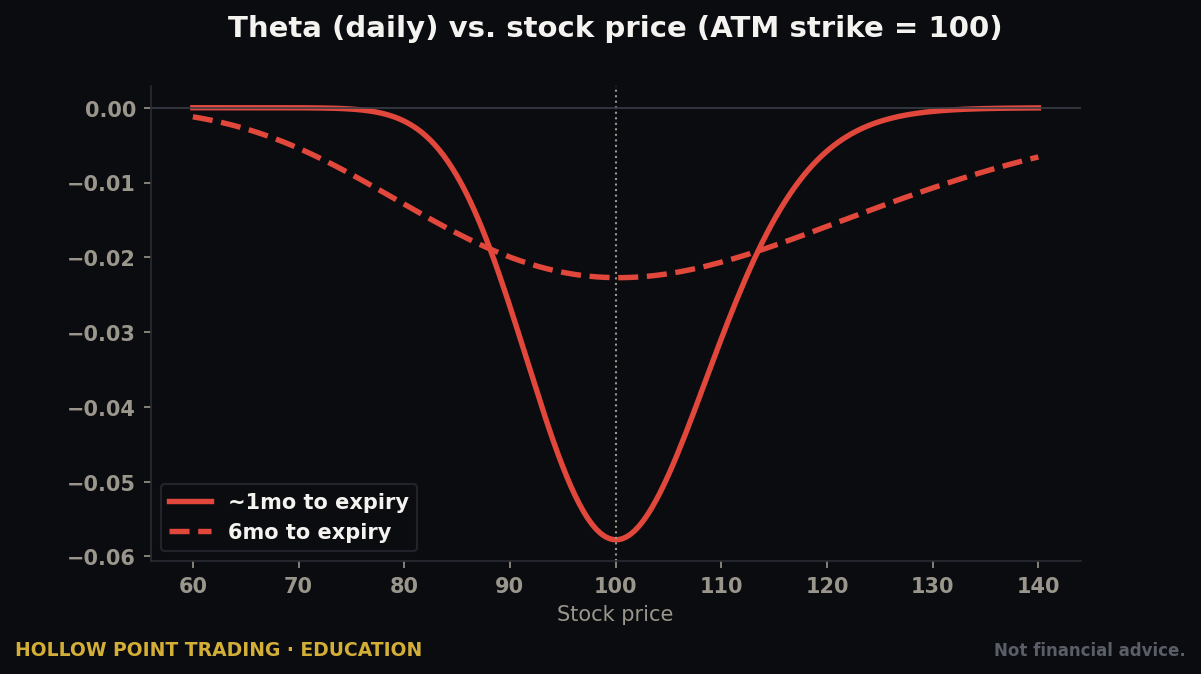
Theta is time decay. Every day that passes, an option loses a little extrinsic value, because there's less time left for the "what if" to happen. Theta is quoted as a negative number — say −0.05 — meaning the option loses about $5 of value per day (that ×100 again) from the passage of time alone, all else equal. Theta is not linear. It's a curve that accelerates as expiration approaches, and it eats fastest in the final two weeks — the decay of a 45-day option is a gentle slope; the decay of a 5-day option is a cliff. Theta is the rent you pay for holding a long option, and the landlord collects every single day, including weekends and holidays — the market prices in the calendar days you can't trade through. Hold a contract over a three-day weekend and you'll often watch it open Tuesday worth less even though nothing happened.
Implied volatility (IV) is the market's estimate of how much the stock will swing. High IV means fatter premiums, because a wilder stock is more likely to make a big move in your favor — so the "what if" is worth more, and every option on that name costs more. Low IV means thin premiums. Here's the part that mugs people: IV moves on its own, independent of the stock's actual direction. When IV rises, your option gains value even if the stock doesn't budge. When IV falls — which reliably happens right after an earnings report or any big scheduled event, once the uncertainty is resolved — your option loses value even if the stock doesn't budge. This is the infamous IV crush, and it is precisely how a trader buys a call, watches the stock go up the next morning, and still loses money. The stock delivered; the volatility premium they overpaid for evaporated faster than the move could earn it back.
Hold those two — theta and IV — in your head for the rest of this guide. They are the reason most naive option buyers lose, and neither of them has anything to do with whether you picked the right direction.
A quick word on the other Greeks
You'll meet the full family, but for a directional buyer only four matter day to day:
- Delta — how much your option moves per $1 stock move; also ≈ probability of finishing ITM. (Full section below — this is your most useful number.)
- Gamma — how fast delta itself changes as the stock moves. High near ATM, low deep ITM/OTM.
- Theta — daily time decay, above.
- Vega — how much your option's value changes for each 1-point move in IV. High-vega positions (longer-dated, ATM) swing hard when volatility reprices; that's the lever behind IV crush.
You don't need to calculate any of these by hand — your platform shows them. You need to understand what they do to you, which is the whole point of this guide.
Step by Step: A Long Call, With Real Numbers
Let's trade one start to finish, slowly, showing every number.
Stock XYZ trades at $100. You're bullish — you think it runs to $110 over the next month on a catalyst you've identified. You buy:
- 1 XYZ $105 call, 35 days to expiration, premium $2.00
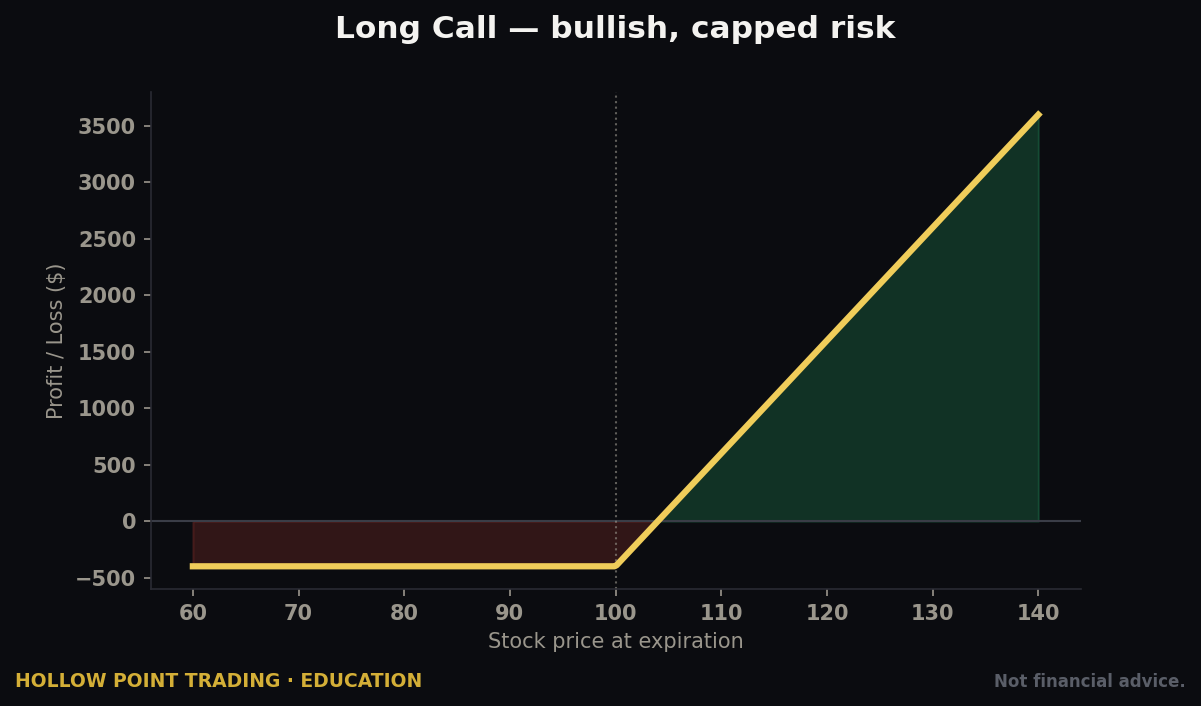
Cost to you: $2.00 × 100 = $200. That $200 is the most you can ever lose on this trade. Circle it, underline it, tattoo it. Max loss on a long option is always the premium paid, full stop. No margin call. No getting run over past your stake. No waking up owing money because the stock gapped against you overnight. You know your worst case before you enter — that hard, knowable floor is a genuine feature, and it's the reason defined-risk long options are a legitimate professional tool rather than a pure casino. The casino part is what you do with that tool.
Now the number that beginners skip and pros lead with: breakeven.
Long call breakeven = strike + premium paid
Here: $105 + $2.00 = $107.00.
Read that carefully and let it sting a little. The stock is at $100. For you to break even at expiration, XYZ has to climb to $107 — up 7%. Just getting to your $105 strike isn't enough; at the strike the option is worth exactly zero intrinsic and you've lost the whole premium. You also have to earn back the $2 you spent. This is the tax nobody warns beginners about: *you don't profit when you're right about direction — you profit when you're right about direction by enough to cover the premium.* Being right and being profitable are two different events separated by the width of the premium you paid.
Let's map the payoff at expiration — the payoff diagram, in words, dollar by dollar:
- XYZ at $103: Your $105 call is OTM. Worthless. You lose the full $200 (−100%).
- XYZ at $105: Right at the strike. Still worthless — why would anyone pay $105 for the right to buy at $105? Lose $200 (−100%).
- XYZ at $107: Intrinsic value $2.00. Contract worth $200. You get your money back and break even ($0).
- XYZ at $110: Intrinsic value $5.00. Contract worth $500. Profit $300 — a 150% return on your $200.
- XYZ at $115: Intrinsic value $10.00. Contract worth $1,000. Profit $800 — 400%.
- XYZ at $120: Intrinsic value $15.00. Contract worth $1,500. Profit $1,300 — 650%.
See the shape? Below $105 your loss is flat — a floor bolted at −$200, no matter how far the stock craters. XYZ can go to $60 and you lose the same $200 you'd lose at $104. Above $107 your gain rises dollar for dollar with the stock, and it doesn't stop. That's the long call's signature: capped, known loss; theoretically unlimited gain. Draw it and it's a hockey stick — flat along the bottom, then a 45-degree line up and to the right, with the bend at the strike ($105) and the break-even point sitting one premium to the right of the strike ($107).
The same trade, but you don't hold to expiration
Real traders rarely hold to the last bell. Here's the version that actually happens. Say three days after you buy, XYZ jumps from $100 to $104 on the catalyst. Your $105 call is still OTM — but it is not worthless, because there are still 32 days of "what if" left. It might now be trading around $3.20: the stock moved toward you (delta did its work) and you still own a month of time value. You bought at $2.00; you could sell at $3.20 right now for a $120 profit (60%) without XYZ ever crossing your breakeven. This is the key practical fact: before expiration, an option's price is intrinsic + remaining extrinsic, so you can win on a favorable move well before the stock reaches your breakeven. Breakeven is the expiration-day math; the trade lives and dies on the chart before then.
The flip side, so you're not lulled: if XYZ instead does nothing — sits at $100 for two weeks — your $2.00 call might bleed to $1.20 on theta alone. You were neither right nor wrong on direction, and you're down 40%. The clock doesn't care that your thesis is "still valid."
The Long Put: The Mirror Image, With Real Numbers
A long put is the same machine flipped upside down.
Stock XYZ at $100, you're bearish, targeting $90 on a breakdown you've charted. You buy:
- 1 XYZ $95 put, 35 days out, premium $2.00 → cost $200
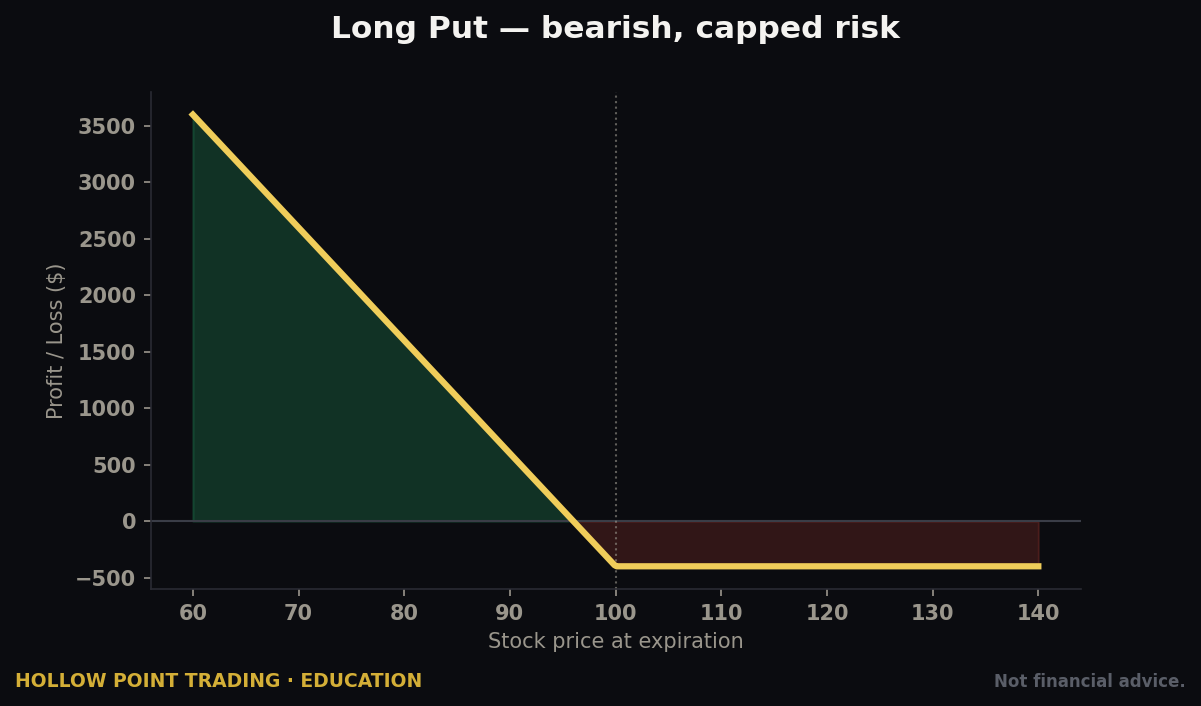
Long put breakeven = strike − premium paid
Here: $95 − $2.00 = $93.00. The stock has to fall to $93 — down 7% — for you to break even at expiration. Same 7% tax, opposite direction.
- XYZ at $97: OTM, worthless, lose $200 (−100%).
- XYZ at $95: At the strike, worthless, lose $200 (−100%).
- XYZ at $93: Intrinsic $2.00, worth $200, break even ($0).
- XYZ at $90: Intrinsic $5.00, worth $500, profit $300 (+150%).
- XYZ at $85: Intrinsic $10.00, worth $1,000, profit $800 (+400%).
- XYZ at $80: Intrinsic $15.00, worth $1,500, profit $1,300 (+650%).
Same hockey stick, mirror-flipped: a flat loss floor above the strike, rising profit as the stock falls. The one asymmetry versus the call: a put's max gain is capped — a stock can only fall to zero. A $95 put's absolute ceiling is $95 of intrinsic (stock at $0), or $9,300 profit after the premium. In practice that ceiling never matters; stocks rarely go to zero on your timeline. Max loss is again just the $200 premium.
Why puts often cost more than the equivalent call
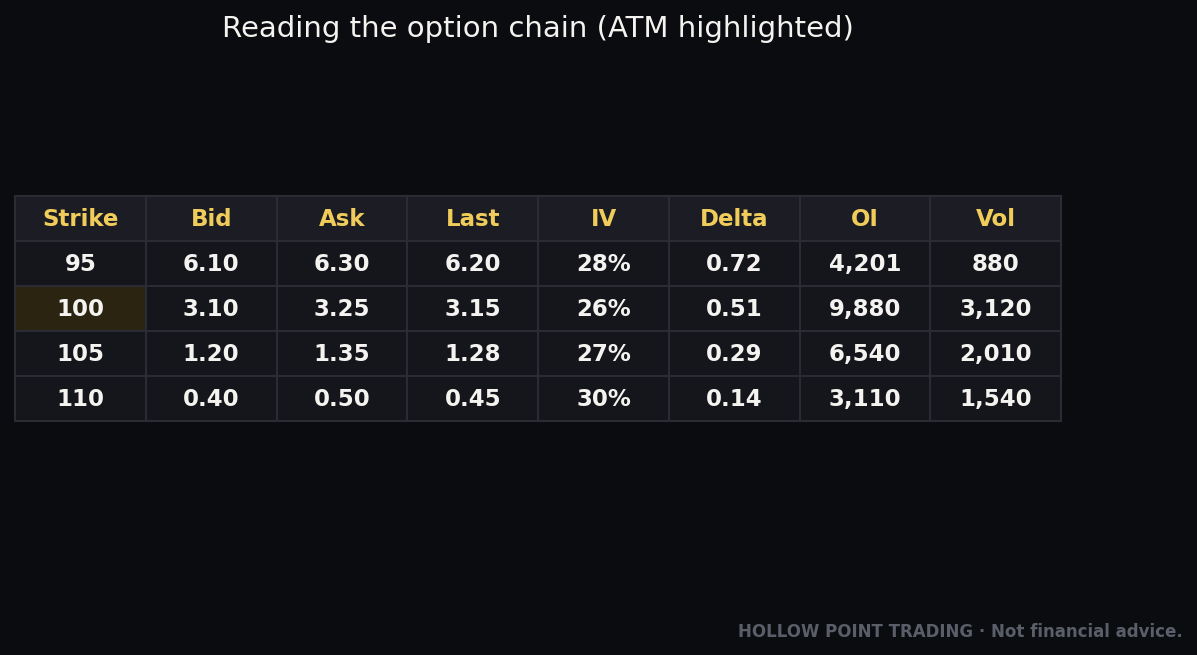
A subtle thing you'll notice on the chain: on many stocks and index products, the OTM puts are pricier than the equally-OTM calls. That's the volatility skew — the market pays up for downside protection because crashes are faster and scarier than rallies, so put IV runs hotter. It's not a glitch and it's not an opportunity you're the first to spot. It just means the "insurance" side of the board is structurally a bit more expensive, and your put breakevens sometimes need a slightly bigger move to clear. Factor it in; don't fight it.
Why Cheap OTM Lottery Tickets Usually Lose
Now the lesson that saves accounts. If you take nothing else operational from this guide, take this.
New traders see a $0.10 call — ten bucks a contract — and think, "If it hits, I 10x or 50x. Cheap shot, why not throw fifty bucks at it?" Here's why not, and it's three compounding reasons that stack on top of each other.
1. Probability. That contract is cheap because the market has priced it as unlikely. Option pricing is not vibes; it's math run continuously by firms with better models, faster data, and more capital than you will ever have. A far-OTM contract's price is, roughly, the market's estimate of its probability of finishing in the money. A $0.10 call on a $100 stock might be pricing a 3–5% chance of paying off. You are not finding a bargain the market overlooked — you are buying the market's own carefully computed assessment that this almost certainly expires worthless. Buy a hundred of those over a year and the math grinds you down at exactly the rate it was designed to.
2. Theta. An OTM option is 100% extrinsic value — pure time premium — and time premium decays to zero at expiration with certainty. For a far-OTM lottery ticket, the stock doing nothing is not neutral; it's a loss every day, accelerating into expiration. This is the single most theta-exposed thing you can buy. You're holding an ice cube in your fist and betting on a heat wave that has to arrive before it melts.
3. IV. People love buying cheap calls right before earnings or a Fed day or a product launch, when everyone "knows" a move is coming. But that expectation is already in the price — IV is jacked sky-high, so the cheap-looking call is actually expensive relative to a normal day. Then the event passes, the uncertainty resolves, IV collapses, and the contract sheds a third or half of its value on the volatility crush alone — frequently before the stock has moved enough to matter, and sometimes even when it moved the right way.
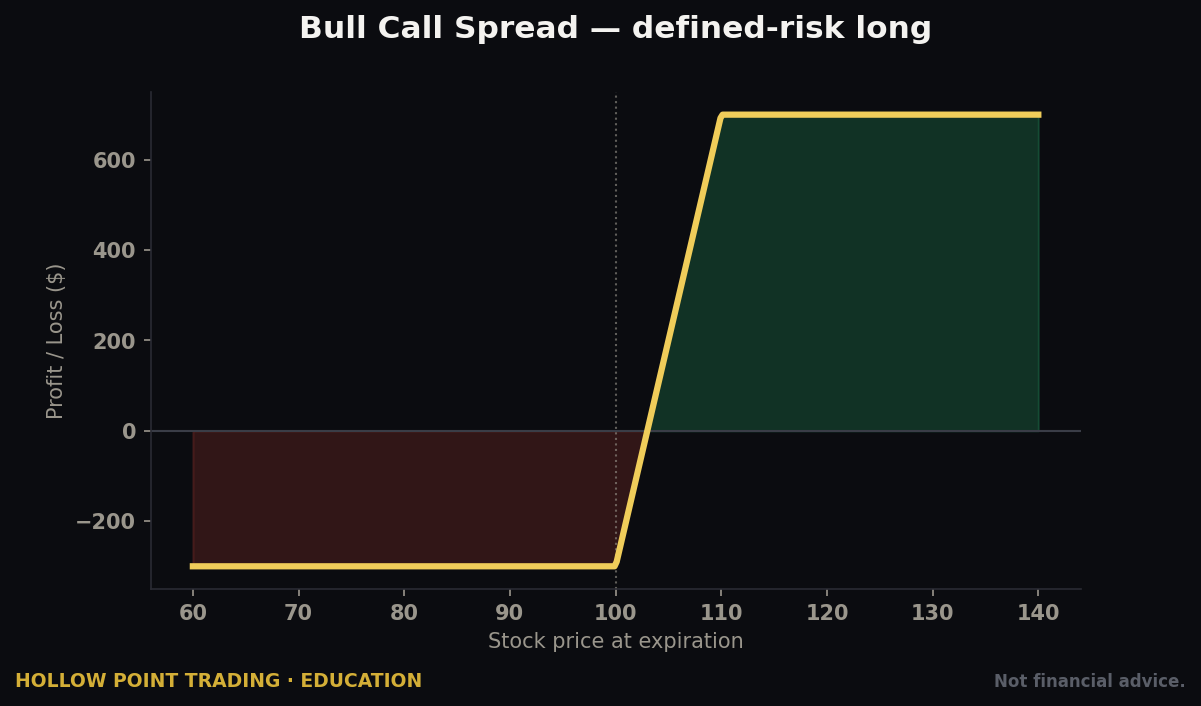
Stack those three and the far-OTM lottery ticket isn't a high-upside bet — it's a low-probability wager, decaying daily, purchased at an inflated price. The occasional 10x you screenshot and post does not come close to paying for the ninety-five tickets that quietly went to zero in between. This is the number-one destroyer of small options accounts, full stop. It feels like smart aggressive trading and it functions like feeding a slot machine. Don't buy hope. Buy probability with room to be right.
The worked comparison: lottery ticket vs. a real strike
Make it concrete. XYZ at $100, you're bullish over the next month, and you have $300 to risk.
- The lottery play: ten $115 calls at $0.30 each = $300, each maybe 8-delta. For any of these to pay, XYZ needs to blow past $115 (up 15%) fast. If XYZ rallies a healthy 6% to $106 — a genuinely good month — these are still miles OTM, theta has gutted them, and they're worth maybe $0.08. You're down ~73% on a correct and strong bullish call.
- The disciplined play: one $100 call at ~$3.00, roughly 55-delta, but sized to your $300 risk. Same 6% move to $106: that call is now worth roughly $6.50 — you're up over 100% on the exact same market move.
Same thesis. Same direction. Same magnitude. One structure printed; one bled out. The difference wasn't prediction — it was strike selection.
How Delta Gives You Leverage
Delta is the most useful Greek for a directional buyer, and it does two jobs at once.
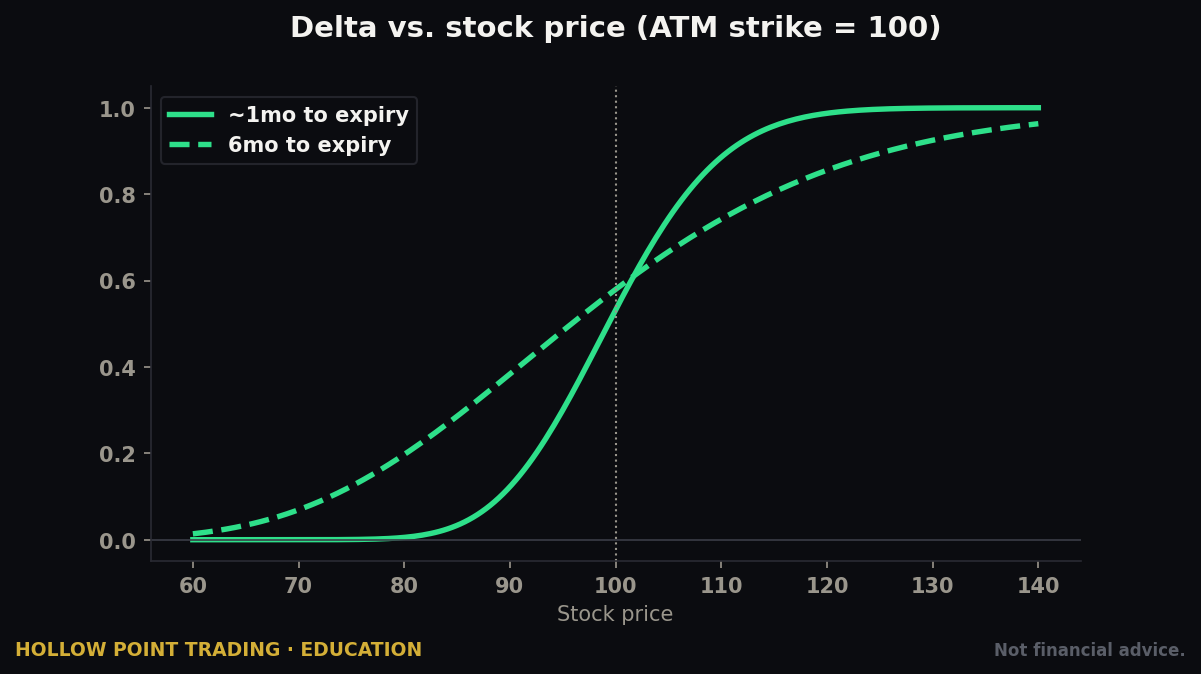
First, delta is how much your option moves per $1 move in the stock. A call with 0.50 delta gains about $0.50 per share — that's $50 per contract — when the stock rises $1. A call with 0.30 delta gains about $0.30 ($30). Puts have negative delta — a −0.40 put gains $0.40 when the stock falls $1 (the negative just encodes the inverse relationship; don't overthink it).
Second — and this is the practical shortcut that changes how you pick trades — delta approximates the probability the option finishes in the money. A 0.30-delta call is, loosely, a 30%-chance-of-paying-off bet. A 0.70-delta call is roughly 70%. An ATM call sits near 0.50 — a coin flip. This single fact lets you choose strikes by how aggressive you want to be, expressed in plain probability, without any modeling. When you read the chain, you're reading a probability menu.
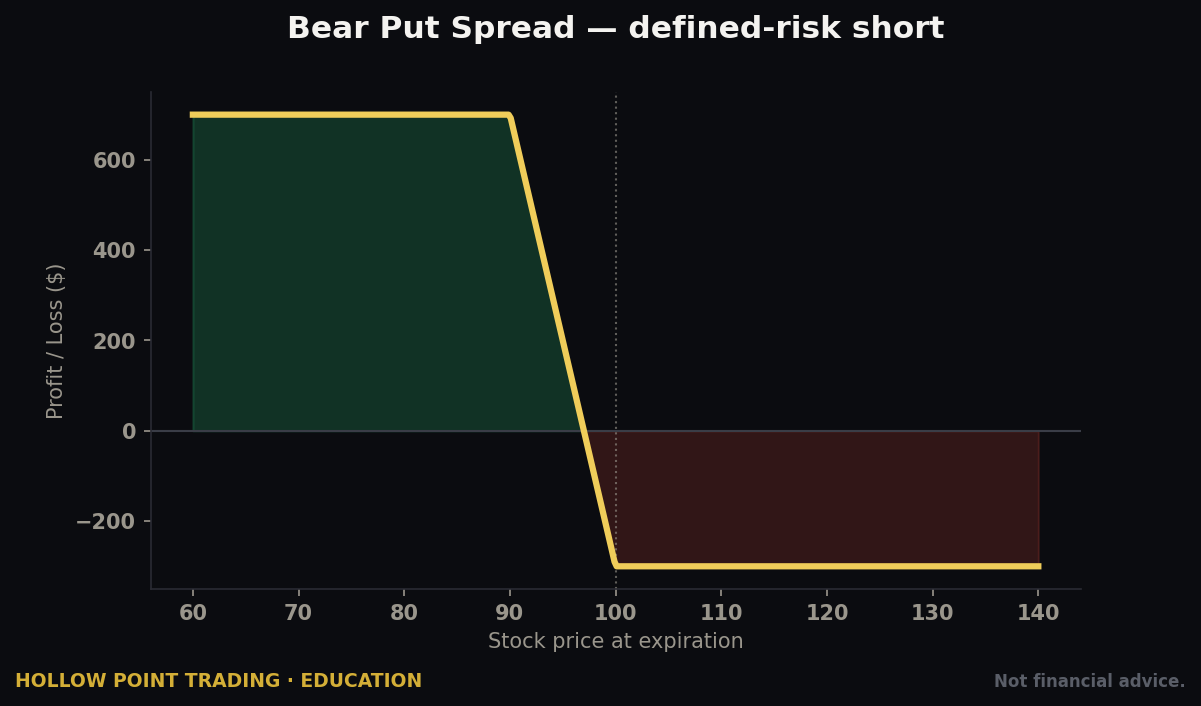
Now the leverage, shown with numbers. Say XYZ is $100 and you have $10,000 of buying power.
- Buy 100 shares: costs the full $10,000. Stock goes to $105 — you make $500, a 5% return on your capital.
- Buy one ATM call at 0.50 delta for $3.00 ($300 committed): that same $5 stock move earns roughly $5 × 0.50 × 100 = $250 on a $300 stake — about an 83% return. (Roughly — as the stock climbs, delta climbs too, so the real number is often better; more on that in a second.) And your total risk was capped at $300, not $10,000. The other $9,700 stayed in your account.
That's the leverage delta gives you: a fraction of the capital, a multiple of the percentage return, with a hard floor on the downside. But leverage cuts both ways. The same $5 move against you wipes a huge percentage of that small premium, and theta charges rent the entire time you wait for your move to show up. Leverage is a tool, not a free lunch — it amplifies your edge if you have one and amplifies your carelessness if you don't. Respect it or it removes you from the game with startling speed.
Gamma: why delta won't sit still
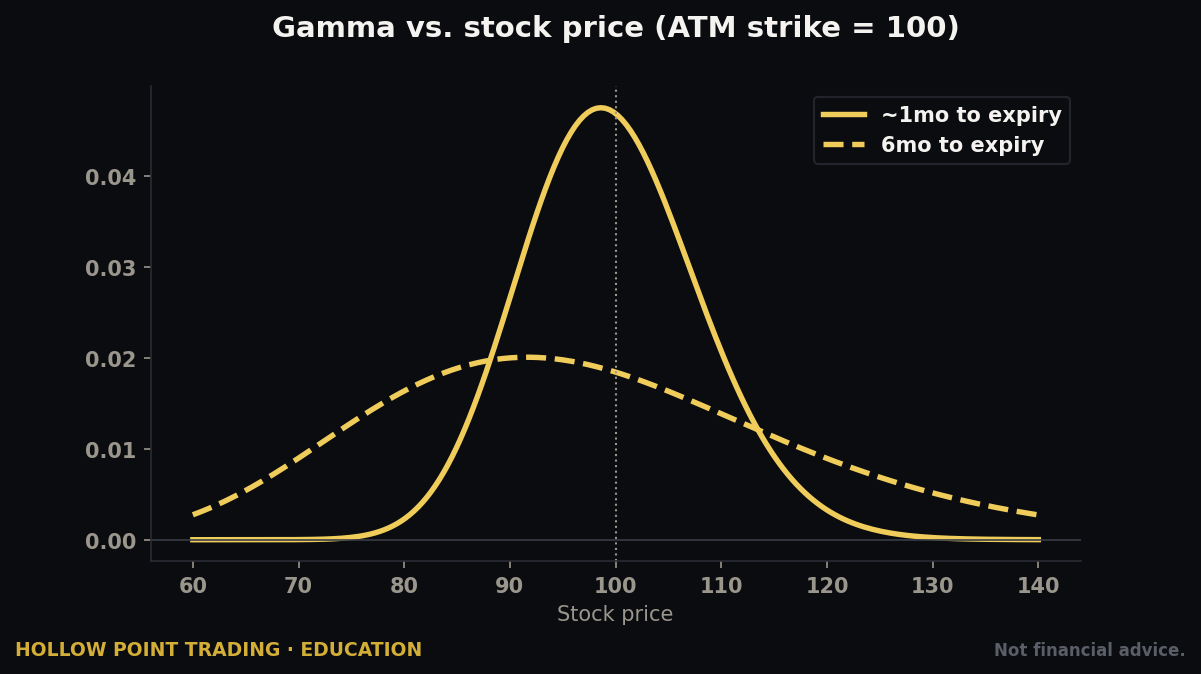
One more nuance that separates people who understand this from people who memorized it. Delta itself changes as the stock moves, and the rate of that change is gamma. As your call goes deeper ITM, its delta climbs toward 1.00 and the option starts behaving almost exactly like 100 shares of stock — the gains accelerate, because each additional dollar of stock move now transmits nearly fully into the option. As your call goes OTM, delta falls toward zero and the option goes numb — the stock can move and your contract barely twitches.
This is why an ATM option, sitting near 0.50 delta with the most gamma of any strike, gives you the biggest "pop" per dollar of stock movement — your delta is expanding fastest right where you are. It's also, not coincidentally, why the ATM option decays fastest: maximum gamma and maximum theta live at the same address. High reward-sensitivity and high time-cost are the same coin. There's no strike that gives you the pop without the bleed; you're always choosing where on that trade-off to stand.
Choosing Strike and Expiration Like an Adult
This is where discipline separates winners from donators. Two decisions on every trade: which strike, and how much time.
Strike — pick by delta, not by round numbers
Instead of eyeballing pretty round strikes or reaching for whatever's cheapest, choose your strike by its delta, because delta encodes probability and leverage in one number:
- Deep ITM, ~0.70–0.85 delta: Expensive in absolute dollars, mostly intrinsic value, low theta, moves nearly one-for-one with the stock. This is the stock-replacement trade — high probability, less percentage leverage, small time decay, minimal IV sensitivity. Reach for it when you have real conviction and want the position to behave like shares with a defined floor.
- ATM, ~0.50 delta: Balanced. Roughly coin-flip probability, maximum gamma (biggest bang per stock move), but the fattest theta and highest vega. The classic swing-trade strike when you want responsiveness and can watch it.
- OTM, ~0.30 delta: Cheaper, more percentage leverage if it works, ~30% base odds, high theta. Legitimate as a deliberate lower-probability/higher-payoff bet — not as your default just because the ticket is cheap.
- Far OTM, <0.15 delta: The lottery ticket. Now you know exactly why it usually loses. Size it like the coin toss it is — if at all.
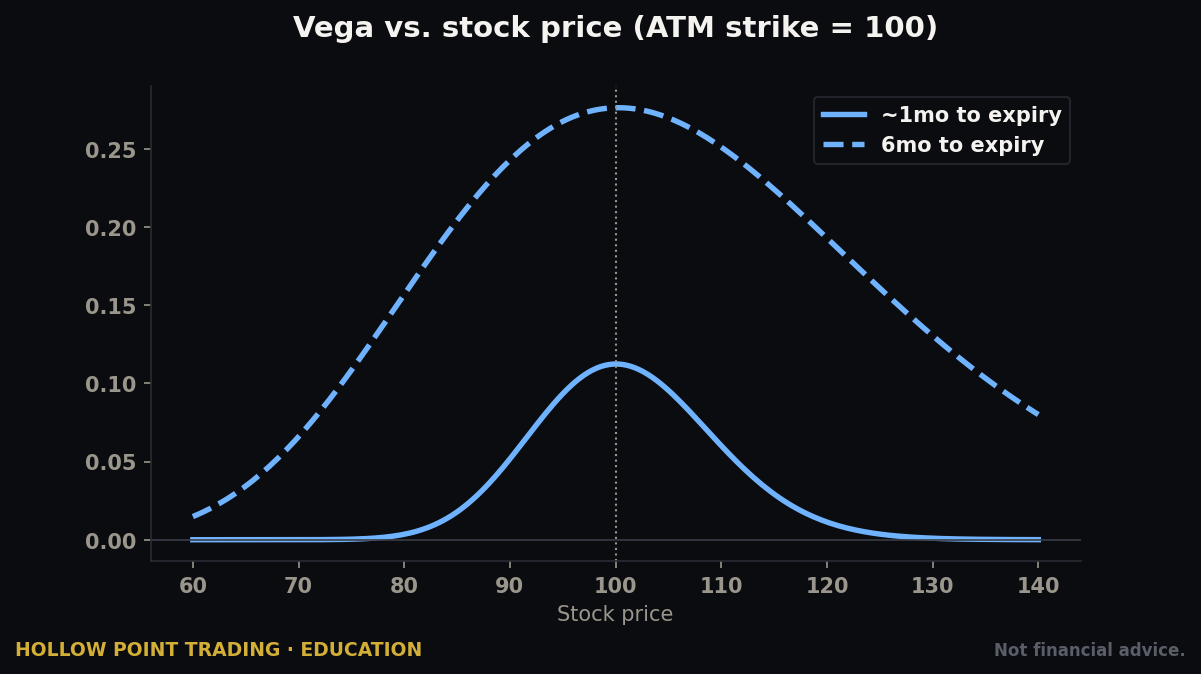
A sane default for directional swing trades: buy the ~0.60–0.70 delta call or put. You capture most of the stock's move, you keep probability on your side, and you shed most of the theta bleed and IV exposure that the ATM/OTM crowd is fighting over. You'll pay more per contract than the lottery buyers — and you'll still be here next quarter, which they mostly won't be.
Expiration — give it far more time than feels necessary
The single most common self-inflicted wound in directional options trading is buying too little time. You buy a weekly, you nail the direction, and the move shows up three days after your contract expired worthless. You were right and you got paid nothing. There is no more demoralizing way to lose, and it happens constantly.
Theta is brutal in the final two weeks — that steep part of the decay curve — and the cheap short-dated contract lives entirely inside that danger zone. A 5-day option is almost pure gamble on the next few sessions; there's no cushion for being early, no room for the thesis to breathe, no forgiveness for a one-day pullback before the real move.
Rule of thumb: buy at least 2–3x the time you think you need. If your thesis is a one-week move, buy 3–4 weeks minimum. If it's a two-week swing, buy 45–60 days. Longer-dated options cost more in absolute dollars, yes — but they decay far more slowly per day, they're far less sensitive to a single bad session, and they give your thesis room to be right on a delay. For most retail swing trades, 30–60 days to expiration (DTE) is the sweet spot: enough runway that theta isn't a house fire, cheap enough that you're not overpaying for a LEAP you don't need. Time is the one input you cannot buy back once the clock has run out. Buy more of it than feels necessary — every experienced trader has learned this the expensive way.
Multi-Timeframe Treatment: Aligning the Contract to the Chart
Options don't get traded in a vacuum — they get traded against a chart, and the chart has timeframes that must agree with the contract you chose.
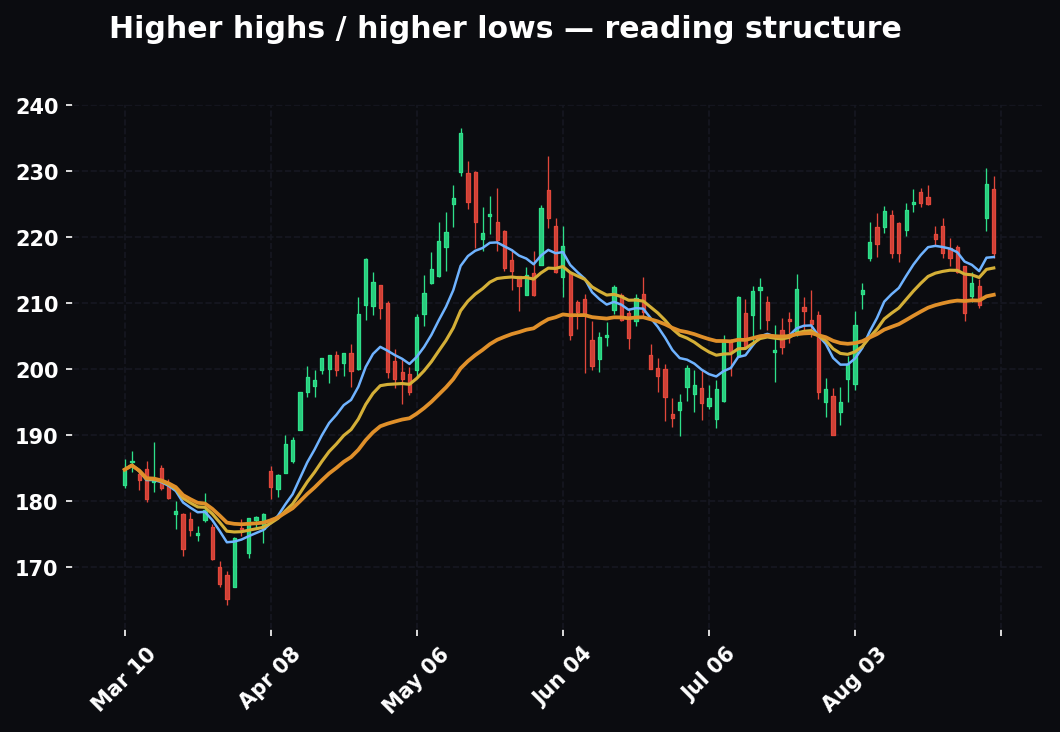
Here's the discipline. The higher timeframe sets the bias; the lower timeframe sets the trigger; the expiration must outlast the setup. If the daily and 4-hour are in an uptrend (higher highs, higher lows, price above the key EMAs) and you're taking a long call off a lower-timeframe reclaim, your directional bias is confirmed top-down. But now match the clock: if the daily setup is a swing that historically takes one to three weeks to play out, a 7-DTE call is a category error — the timeframe of your instrument doesn't match the timeframe of your thesis. Buy 45+ DTE so the contract can survive the full arc of the daily move.
The inverse mistake is just as common: a clean 5-minute scalp setup does not justify buying 60-DTE contracts and sitting for weeks — you'll have paid up for vega and time you don't use, and you've quietly turned a scalp into an investment because you didn't want to admit the scalp failed. Match the DTE to the timeframe of the setup, and match the direction to the higher timeframe. When the daily, the 4-hour, and your entry timeframe all point the same way and your expiration comfortably outlasts the expected move, you have timeframe confluence — and that's when option buying stops fighting itself.
A practical multi-timeframe checklist before you buy:
- Weekly/Daily: What's the dominant trend? Are you trading with it or against it? (With it is easier; against it needs a tighter stop and a better reason.)
- 4-hour/1-hour: Where's the nearest structure — support, resistance, the level your thesis hinges on?
- Entry timeframe (15m/5m): What's the actual trigger, and where does it invalidate?
- The clock: How long does the daily/4H move realistically take, and did you buy 2–3x that in DTE?
If any of those four is a shrug, the trade isn't ready.
Confluence: Stacking the Long Call/Put With Other Tools
A long option is a directional bet with a deadline. That makes it exactly the wrong instrument to fire on a hunch and exactly the right instrument to fire when several independent tools agree. Here's how the brick combines with a few others.
Confluence tool #1: Support/resistance and the reclaim
The cleanest long-call setups fire off a reclaimed level — price breaks back above a former resistance (now support) with the higher timeframe trend behind it. The level does two jobs: it's your directional trigger, and it's your stop reference (if price loses the level, the thesis is dead). A long put mirrors it off a rejected resistance or a broken support. The level isn't decoration — it's what tells you where you're wrong, and "where you're wrong" is what sizes the whole trade.
Confluence tool #2: The golden pocket and Fibonacci
Fibonacci retracement gives you a high-probability reaction zone — the golden pocket, the 0.618–0.65 retracement of the prior leg. In an uptrend, a pullback into the golden pocket that holds and reclaims is a textbook long-call trigger: you're buying strength off a pre-defined support with a tight, obvious invalidation (a clean break below the 0.65 kills it). The Fib gives you the entry zone and the stop; the option gives you the leveraged expression.
Confluence tool #3: Momentum — RSI and MACD
Momentum tools keep you from buying a call into exhaustion. A long call is far safer when RSI is turning up out of a healthy zone (not already pinned at 80) and MACD is crossing up or its histogram is expanding. Bullish RSI divergence — price making a lower low while RSI makes a higher low — into a support level is a high-quality put-to-call reversal signal. The mirror for puts: RSI rolling down from overbought, MACD crossing down, bearish divergence into resistance. When the level, the Fib, and the momentum all point the same way, you have real confluence — and that's the setup worth paying premium and fighting theta for.
The principle underneath all three: no single tool triggers an option buy. One reclaim, one Fib tap, one RSI turn — each alone is a coin flip dressed up as a signal. Two or three of them agreeing, top-down across timeframes, is the asymmetric edge that makes leveraged, decaying, deadline-bound instruments worth touching.
How Calls and Puts Behave in Different Market Regimes
The exact same $105 call behaves like three completely different trades depending on the weather. Read the regime before you read the chain.
Trending regime
In a clean, persistent trend, directional option buying is at its best. Moves extend, pullbacks are shallow, and a with-trend call (or, in a downtrend, put) gets to ride delta and gamma while the trend does the heavy lifting. In a strong trend, buy with-trend, buy the pullback into support, and give it time. Slightly OTM strikes can outperform here because the sustained move eventually pushes them ITM and gamma kicks in. The risk in a trend isn't direction — it's paying up when IV spikes on a climax, or buying so far OTM that even a good trend can't reach you before expiry.
Choppy / range-bound regime
Chop is the option buyer's graveyard. Price oscillates, goes nowhere net, and theta grinds every long option to powder while IV often bleeds lower too. In a range, the buy-and-hold-a-call approach dies by a thousand cuts. If you must trade a range with long options, you have to be nimble and mean-reversion-minded: buy calls only at the bottom of the range with a tight stop, buy puts only at the top, take profits fast into the opposite side of the range, and never hold hoping for a breakout that the chart is actively telling you isn't coming. Honestly, in dead chop the correct number of long options to own is often zero — the regime is charging you rent to be wrong about which day the move comes.
High-volatility regime
When IV is elevated — post-crash, mid-panic, around a macro event — every premium is fat. Long options cost more, so your breakevens sit further away (you need a bigger move just to clear the inflated premium), and you carry serious vega risk: if volatility mean-reverts back down while you hold, you lose on the IV drop even if you're right on direction. In high-vol regimes, favor deeper-ITM strikes (less extrinsic value, so less to crush), shorter holding periods, and extra respect for the possibility that the "obvious" move is already priced in. This is also where the earnings/IV-crush trap lives: buying rich premium into a known event is buying the top of the volatility, and the resolution almost always deflates it.
Low-volatility regime
When IV is crushed low and the tape is quiet, premiums are cheap and vega is a tailwind waiting to happen — if volatility expands while you hold, you gain on the IV rise on top of any directional move. This is the friendliest regime to buy options in, and it's the mirror of the high-vol trap: cheap IV is often the better time to be long premium, provided you have a directional thesis and a catalyst on the horizon. The danger is complacency — low IV can stay low, and cheap theta is still theta.
The meta-lesson: before you pick a strike, ask what regime you're in and whether IV is high or low. Same brick, radically different trade.
When a Call/Put Is the Right Tool vs. Buying Shares
Options aren't automatically better than stock. They're a different tool for a different job. Reach for a long call or put when:
- You want defined, capped risk on a volatile name. A $200 call risks $200, period; 100 shares of a $100 stock risks real money on an overnight gap-down. Around binary events and jumpy tickers, that hard floor is worth paying for.
- You want leverage without margin. Control 100 shares' worth of exposure for a fraction of the capital, freeing the rest for other uses — with no margin call possible on a long option, ever. Your worst case is the premium, even if the stock does something insane.
- You have a specific catalyst and a timeframe. A defined move by a defined date is exactly what an option expresses. An open-ended "I like this company for the next five years" is a shares thesis — don't pay theta for half a decade.
- You want to bet on a decline cleanly. A long put is simpler, cheaper to finance, and far lower-stress than shorting stock outright (which carries theoretically unlimited risk, borrow fees, and buy-in risk). The put's defined loss is a genuine edge on the short side.
Reach for shares instead when: you have no time deadline, you want to hold through drawdowns without a ticking clock, you want dividends and voting, or you simply cannot stomach a total loss of premium. If time and volatility are working against your thesis, own the stock. If a defined move by a defined date is the bet, buy the option. The tool follows the thesis, not the other way around.
How a Real Trader Actually Uses This — The HPT Discipline
Here's the part that turns mechanics into a method. At Hollow Point Trading the rule is blunt: scalp it, set stops, take profits. Options are leveraged, decaying instruments — you do not marry them, you do not "hold and hope," and you do not let a winner round-trip back to zero because you got greedy or fell asleep at the wheel.
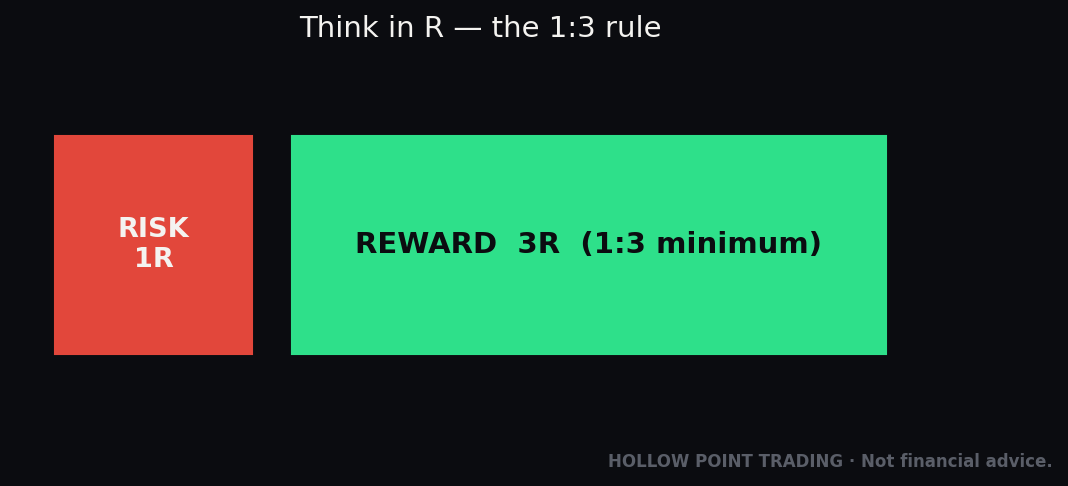
Every trade earns its way in on structure and confluence, top-down. Macro backdrop first, then the sector, then the individual stock, then the timeframe-weighted setup. No confluence, no trade. And the entry only counts if the math clears the 1:3 minimum reward-to-risk — risk one to make three. If the setup doesn't offer that, it's a pass, no matter how much you "feel" it. This is non-negotiable because option buying has a built-in headwind (theta plus the premium tax on breakeven); you need a genuinely asymmetric payoff to overcome that headwind across a series of trades. A 1:1 bet on an instrument that bleeds while you hold it is a slow, guaranteed way to lose.
Worked example, long call, HPT style. XYZ at $100 reclaims a key level, the higher-timeframe trend is up, the sector is leading, and momentum has turned — confluence is present across timeframes. The plan gets written before entry:
- Entry: $105 call, 40 DTE, ~0.60 delta, premium $3.00 ($300 committed).
- Stop: the thesis breaks if XYZ loses the $98 reclaim level. If that level goes, the option is worth roughly $2.00 — so you're risking about $1.00 of premium ($100), not the whole $300. You define the exit on the chart, and the stop lives on the underlying's structural level, not on some arbitrary "I'll cut it at −50%" dollar figure.
- Target: XYZ into the $110 measured-move resistance. There the call is worth roughly $6.00 — a $3.00 gain ($300) on $100 of real risk. 1:3 achieved.
- Execution: scale — take half off at $110 to bank the win and remove risk, then trail the rest with a stop under the new structure in case it extends. Take profits. A leveraged winner you don't harvest is a loser you haven't met yet.
Notice what just happened with risk: the premium committed was $300, but the risk was $100, because the stop was defined on the chart before entry. That distinction — committed capital vs. planned risk — is invisible to beginners and fundamental to pros.
The put side is identical logic flipped: bearish confluence top-down, a put bought with real time (40+ DTE), a stop on the underlying level that invalidates the thesis, a target that clears 1:3, and profits taken into the move rather than round-tripped while you pray.
Three habits make the whole thing work:
- Plan the entire trade before you click buy — entry, stop, target, and size, all four, written down.
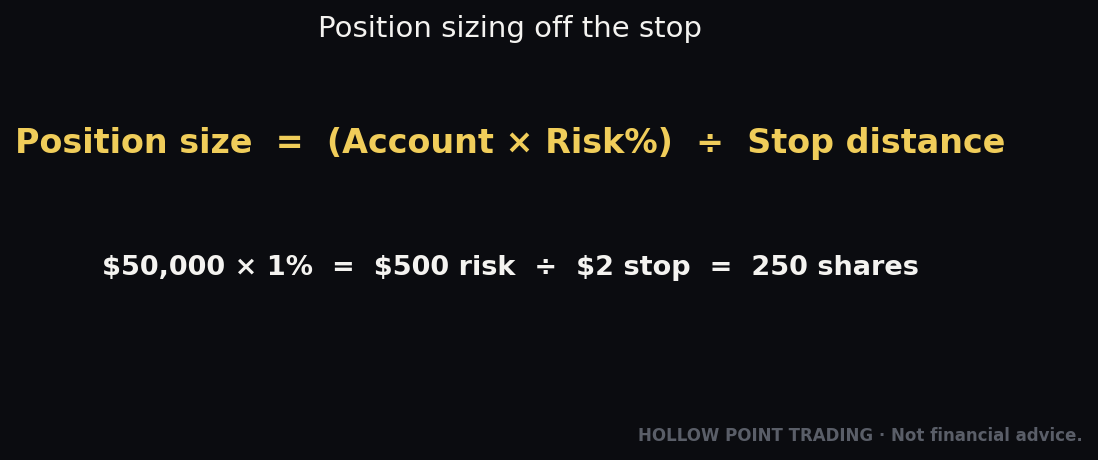
- Risk a fixed small slice of the account per trade — typically well under 2% — so a string of losers (and there will be strings of losers) mathematically cannot end you.
- Cut it when the chart says the thesis is wrong — at the level, not when the option is down 80% and you've gone numb and started negotiating with yourself.
Discipline over prediction. You will be wrong plenty — everyone is. The rules are the entire reason being wrong stays survivable.
How the Pros Use This Differently From Beginners
Same two bricks, completely different game. The gap isn't knowledge of what a call is — it's how the two groups actually behave.
Beginners buy by price; pros buy by delta and probability. A beginner scans for the cheapest contract that could 10x. A pro scans for the delta that matches the probability and leverage they want, and pays what that costs.
Beginners buy too little time; pros buy too much on purpose. The beginner buys the weekly to save money and gets timed out. The pro buys 2–3x the runway, accepts the higher ticket, and never loses a right thesis to the calendar.
Beginners ignore IV; pros check it first. Before anything else, a pro asks: is IV high or low here, and is there an event that will crush it? Beginners buy fat premium into earnings and call it bad luck when the crush eats them.
Beginners think being right = making money; pros know it's four separate bets. Direction, timing, magnitude, and volatility all have to cooperate. Pros structure the trade so they can win on three of four; beginners assume direction is the whole game.
Beginners hold and hope; pros scale and take profits. The pro takes half off at target, trails the rest, and books the win. The beginner watches a +120% winner round-trip to −40% because "it could go higher," and learns nothing except a new flavor of pain.
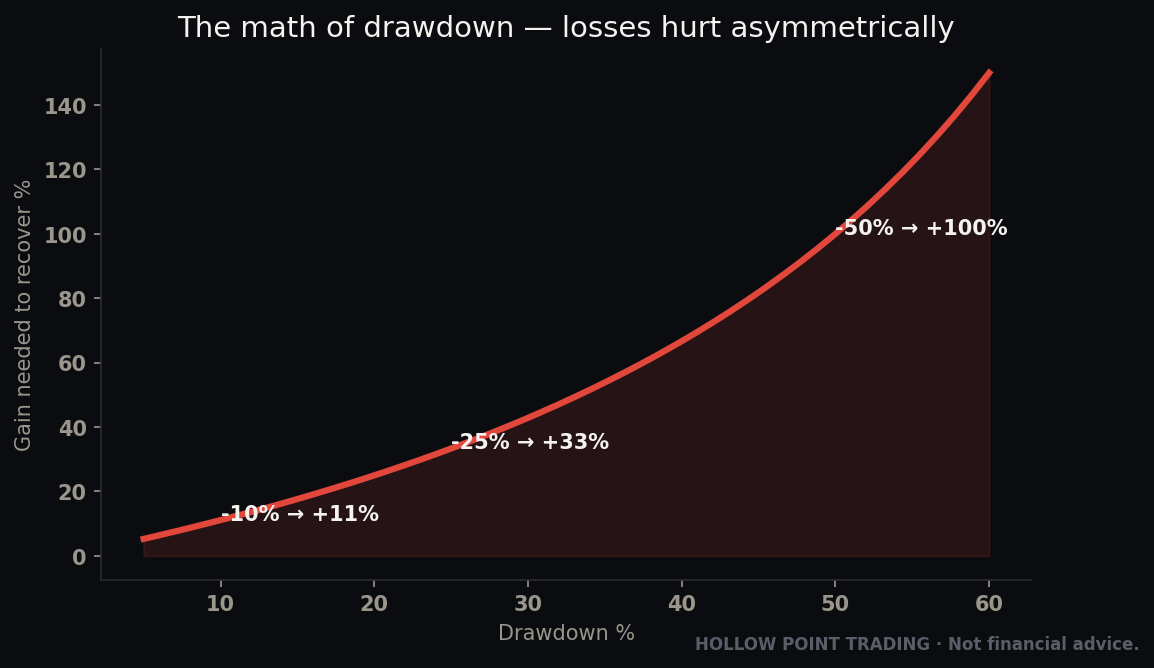
Beginners size by excitement; pros size by risk. "It's only $200" — ten times a week — is the account. Pros risk a fixed small fraction and let the law of large numbers reward their edge instead of blowing up on variance.
Beginners cut winners and hold losers; pros do the reverse. Leverage punishes the backwards instinct hardest, and the backwards instinct is the default human wiring. The entire job of the rules is to override it.
Beginners trade every idea; pros pass constantly. The pro's edge is as much in the trades they don't take — no confluence, no 1:3, wrong regime, IV too rich — as in the ones they do. Most setups are a pass. Sitting on your hands is a position.
The Mistakes That Blow Up Beginners
A longer, blunter list — each of these has personally ended accounts.
- Buying too little time. Right thesis, dead contract, move arrives after expiry. Buy 2–3x the runway you think you need. This is the most common fatal error, bar none.
- Chasing far-OTM lottery tickets because they're "cheap." Low probability, maximum theta, frequently IV-inflated. The market priced them cheap for a reason, and that reason is math. Cheap is a symptom, not a bargain.
- Ignoring earnings and IV crush. Buying inflated premium into a scheduled event, then getting crushed on the volatility collapse even when dead right on direction. Always know when IV is elevated and why before you buy.
- Forgetting the ×100 and the breakeven tax. "The stock got to my strike" is not profit — you must clear strike ± premium. Getting to the strike just means you lost the whole premium instead of a little of it.
- No stop, no target, no plan. A leveraged instrument plus no exit rules equals a round-trip to zero on autopilot. Plan all four — entry, stop, target, size — before you click buy.
- Oversizing. "It's only $200" times ten trades a week is your month, and variance guarantees a bad week is coming. Fix a small risk per trade and never freelance the size because a setup "feels different."
- Holding losers and cutting winners. The exact backwards instinct that leverage punishes hardest. Scalp it, take profits into strength, cut the thesis-break — override the wiring with rules.
- Confusing being right with making money. Direction, timing, magnitude, and volatility all have to cooperate. Respect all four or one of them quietly takes your premium.
- Averaging down on a losing long option. "It's cheaper now, I'll double up" — on a decaying instrument whose thesis is already breaking — is how a small loss becomes a large one. You're not buying a dip; you're feeding a fire. If the level's gone, the trade's gone.
- Trading illiquid contracts with wide bid-ask spreads. A contract quoted $1.00 / $1.40 costs you 20%+ round-trip just to enter and exit. Stick to liquid names and strikes with tight spreads and real open interest, or the market maker earns more on your trade than you do.
- Not taking profits — letting a winner become a loser. Related to #7 but its own killer. A +150% option that you don't harvest is money you had and gave back. Have a target; scale into it; book it.
- Fighting the regime and the higher timeframe. Buying calls in dead chop, or buying counter-trend into a strong downtrend with no tight stop and no reason. The tape is telling you the odds; trading against it needs a much better justification than "it's due."
Frequently Asked Questions
Do I have to exercise my option to make money? No. In almost every case you simply sell the contract back to the market to close, collecting the difference between what you paid and what it's now worth. Exercising (actually buying/selling the 100 shares) is a special-case action; retail directional traders rarely do it.
What happens if my option expires ITM and I did nothing? Most brokers auto-exercise an ITM option at expiration, which can hand you 100 shares (or a short 100-share position for a put) you may not have the capital to hold. Don't fall asleep on expiration day — close ITM contracts you don't intend to exercise before the bell.
What's a good delta for a beginner? For directional swing trades, ~0.60–0.70. High enough probability to keep you on the right side of the odds, deep enough to shed most of the theta and IV pain that wrecks the OTM crowd. Learn on those before you touch anything cheaper.
How many days to expiration should I buy? For most retail swings, 30–60 DTE, and buy 2–3x the time your thesis needs. Weeklies are for experienced, fast, disciplined scalpers with tight rules — not for learning.
Why did my call lose money when the stock went up? Almost always IV crush (you bought rich premium into an event that then deflated) or theta (the move was too small or too slow to outrun the daily decay), or both. Direction alone doesn't pay; you also need magnitude, timing, and stable-or-rising volatility.
Calls or puts for a beginner — which first? Mechanically identical, just mirrored. Most people find calls more intuitive because "buy low, sell high" is native wiring. Learn the call cold, then flip every rule for the put. Do not neglect puts — being able to profit cleanly on the downside is half the game.
Is buying options gambling? It can be — a random far-OTM lottery ticket with no plan is a slot machine. It can also be a disciplined, defined-risk, positive-expectancy tool when you buy probability with time, demand confluence and 1:3, size small, and take profits. The instrument is neutral; your process decides which one you're running.
How much of my account should one option trade risk? A fixed small fraction — for most, well under 2% of the account per trade — measured as planned risk to your stop, not premium committed. This is what lets you survive the inevitable losing streaks that variance guarantees.
What is IV rank / IV percentile and should I care? It's where current IV sits versus its own past year — high rank means options are expensive relative to normal, low rank means cheap. Yes, care: it tells you whether you're buying premium on sale or at a markup, and whether vega is a tailwind or a trap.
Can I lose more than I paid on a long call or put? No. Never. The premium is your absolute maximum loss on a long option — no margin call, no owing money, no getting run over past your stake. That hard floor is the instrument's best feature; the flip side is that "only losing the premium" still means losing 100% of it, which happens often, which is why sizing matters.
The Cheat Sheet — Quick Reference
The two bricks
- Long call — bet: stock UP. Cost: premium (= max loss). Breakeven: strike + premium. Max gain: unlimited.
- Long put — bet: stock DOWN. Cost: premium (= max loss). Breakeven: strike − premium. Max gain: strike − premium (stock to zero).
The multiplier
- 1 contract = 100 shares. Quoted price × 100 = real dollars. A $2.35 quote costs $235.
Two kinds of value
- Intrinsic = real ITM value right now (never negative). Extrinsic = time + volatility premium; decays to exactly zero at expiration. OTM options are 100% extrinsic.
The Greeks that matter
- Delta = $ move per $1 stock move ≈ probability of finishing ITM. ~0.50 ATM, ~0.70 ITM (stock-like), ~0.30 OTM (leveraged bet). Puts are negative.
- Gamma = how fast delta changes; highest ATM — the "pop." Same address as max theta.
- Theta = daily time decay; accelerates in the last 2 weeks; charges rent every day including weekends; works against every buyer.
- Vega = sensitivity to IV. High IV = fat premium + far breakevens + crush risk. Don't buy inflated premium into earnings.
Strike & expiration defaults
- Strike: default ~0.60–0.70 delta for swings; pick by delta, not by cheapness.
- Expiration: 30–60 DTE; buy 2–3x the time you think you need. Match DTE to the timeframe of the setup.
Regime read (before you buy)
- Trend: with-trend, buy the pullback, give it time. Best regime for buyers.
- Chop: theta graveyard — often the right number of long options is zero.
- High IV: far breakevens, vega risk, favor deeper ITM, shorter holds; beware event crush.
- Low IV: cheapest premium, vega tailwind — friendliest regime to be long.
Multi-timeframe
- Higher timeframe sets the bias; lower timeframe sets the trigger; the expiration must outlast the setup.
Confluence (no single tool triggers a buy)
- Reclaimed/rejected level (also your stop) · golden pocket 0.618–0.65 · RSI/MACD momentum & divergence. Two or three agreeing, top-down = the setup worth paying premium for.
Options vs. shares
- Options for defined risk, leverage without margin, a catalyst by a date, clean downside bets.
- Shares for open-ended holds, no clock, dividends, and when you can't stomach a total premium loss.
HPT rules
- Confluence top-down or no trade · 1:3 R/R minimum · stop on the underlying level that breaks the thesis (not an arbitrary dollar) · scale out, take profits · fixed small risk per trade · plan the whole trade before you buy.
The one-line summary
- You don't get paid for being right — you get paid for being right by enough, in time, while volatility holds. Buy probability with room to be right, and take the money when the chart hands it to you.
Learn these two bricks cold and you're not memorizing strategies anymore — you're reading the market's own pricing of probability, time, and fear, and calmly choosing your spots inside it. Every spread and condor and calendar you'll ever build is just these two pieces rearranged, and you'll understand each of them the moment you meet it because you understood the bricks first. That's the entire game.
Bound by rules, feared by trade.