
You passed the evaluation. Or you're about to attempt one. Either way, a truth nobody prints on the sales page is waiting for you: the platform is not a detail. In the futures and prop-firm world, the platform is the seat you trade from, and if you don't understand the order ticket, the DOM, the bracket, and the trailing-drawdown math wired underneath all of it, the account will bury you before your strategy ever gets a vote.
This is the Hollow Point guide to the machinery. Not "buy this firm" — the machinery. How evaluations are structured, how the platforms that run them work, how the plumbing beneath them routes your order, and how to sit in that seat without blowing it in the first hour. The people who wash out of funded trading rarely do so because their read was wrong. They wash out because they never learned the machine.
One accuracy note before we start, and it matters for everything below: this space moves fast, and the exact screens, button labels, fee tables, and menu paths change without notice. Every number here was verified as of August 2026, but treat every fee, margin figure, rule threshold, and menu location as "check the current screen." Firms revise rules monthly. Platforms reskin their web apps quarterly. Exchange margins move with volatility. Confirm before you risk a dollar — the discipline of verifying is itself part of the job.
What This World Is & Who It's Best For
Let's define the terms once, cleanly, because half the confusion in prop trading comes from people using words they've never had explained to them.
Futures, in plain English
Futures are standardized contracts to buy or sell something — an index, oil, gold, bonds — at a set date. You are not buying the S&P 500. You are trading a contract whose price tracks the S&P 500, with leverage baked in. The most-traded retail futures are the E-mini and Micro E-mini stock-index contracts: ES and MES (S&P 500), NQ and MNQ (Nasdaq-100), plus YM/MYM (Dow) and RTY/M2K (Russell). Beyond the indices you'll find CL (crude oil), GC (gold), and the interest-rate complex, but the overwhelming majority of prop-firm evaluations are passed on the index micros, and that's where a new funded trader should live.
The word "micro" is the beginner's best friend. A Micro E-mini is exactly one-tenth the size of its full E-mini sibling. Every tick, every point, every dollar of profit and loss is scaled down by ten. That single fact is the difference between a survivable learning curve and a smoking crater.
What a prop firm actually sells
A prop firm (proprietary trading firm, in the modern retail sense) does not hand you a stock account. It sells you an evaluation — a simulated account with rules. Pass the rules, and the firm gives you a funded account where you trade their capital and split the profits, typically keeping 80–90%. You never risk more than the evaluation fee. That's the trade: limited downside, a gauntlet of rules, and a payout split if you survive.
The economics are worth understanding so you're not naive about them. The firm makes money two ways: from evaluation fees paid by the large majority who never get funded or never withdraw, and from a share of the profits of the minority who do. That's not a scam — it's an incentive structure. It means the firm profits when you fail the eval, and profits when you succeed and pay them a split. Your job is to be squarely in the second group, and the rules are the filter that sorts you.
Who it's best for
Who this is best for: disciplined intraday traders who want leverage and defined risk without a five-figure account. A trader with rules and patience but a small bankroll. It is genuinely well-suited to the Hollow Point approach — 1:3 reward-to-risk, timeframe-weighted confluence, discipline over prediction — because the entire prop structure rewards discipline and punishes prediction. The trailing drawdown is, functionally, a rule engine that forces you to trade the way we already say you should.
Who this is wrong for: anyone treating the eval fee as a lottery ticket, anyone who can't take a stop, and anyone who thinks leverage is free money. The washout rate is brutal and it is almost never about strategy. It's about the machine below and the discipline above.
There's also a middle case worth naming: the profitable swing trader who wants to hold positions for days. Most evaluations are intraday-only and force a flat close every session, so a swing-style edge simply cannot express itself inside the rulebook. If your edge lives on the daily and weekly, prop-firm intraday accounts may fight your natural game. Know your own timeframe before you buy the eval.
How Prop-Firm Evaluations Actually Work
Before the platforms, understand the rules the platforms enforce, because you will be trading against these constraints every second. Every modern futures evaluation is built from six rule categories. Learn all six or one of them will end you.
The six rule categories
1. Profit target. The amount you must earn to pass. In 2026 the common range sits around 6–8% of account size — roughly $3,000 on a $50K account, $6,000–$9,000 on a $100K account, verify per firm. It is deliberately reachable; the target is rarely what defeats people. The other five rules are.
2. Trailing drawdown (the max loss limit / MLL). This is the one that kills people, so we'll spend the most time here. Your maximum loss line is not fixed — it trails your account's high-water mark upward as you make money, then locks. The industry has moved decisively to End-of-Day (EOD) trailing drawdown, meaning the line only updates once per day at session close, based on your highest closing balance. The older, nastier version — intraday trailing — moves the line up against your unrealized peak, so an open trade that ran +$800 and gave it back can trip your drawdown even though you never booked the profit. Know which one your firm uses. It changes everything about how you manage a winner.
3. Daily loss limit (DLL). A hard stop on how much you can lose in a single day. Common 2026 range: 4–5% of account. Some firms (Take Profit Trader's Test, for example) run no daily loss limit at all, verify. Where it exists, the platform will often auto-liquidate and lock you out the instant you touch it, so it's not a suggestion — it's a wall.
4. Minimum trading days. You usually must trade on at least 5 separate days — no one-lucky-scalp passes. Some firms count a "trading day" as any day with at least one filled contract; others require meaningful activity. This rule exists to force a sample size, so a single fluke can't buy you a funded account.
5. Consistency rule. Caps how much of your total profit can come from a single day. A 50% consistency rule (common at Topstep and on funded accounts at Apex) means no single day can be more than half your total profit. It exists to stop one gambling home-run from qualifying you. As of 2026, consistency rules increasingly live only on the evaluation stage or at payout request — the funded stage is trending consistency-free, verify per firm.
6. Contract/scaling limits & payout conditions. How many contracts you may hold, how that scales with account size, activation fees on the funded account (Apex ~$99, Topstep ~$149, several firms $0 — verify), and how and when you can withdraw.
The trailing drawdown, worked out in real numbers
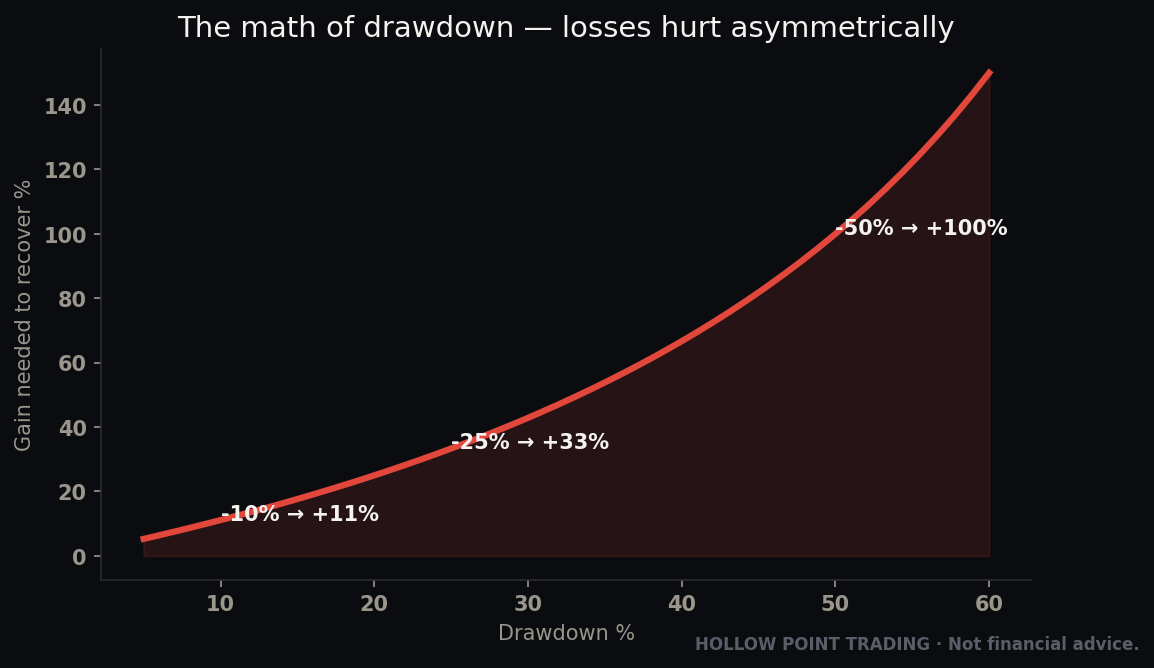
Reading the definition isn't enough. Let's run a concrete ledger on a common $50,000 evaluation with a $2,500 trailing drawdown and a $3,000 profit target. Start of day one, your balance is $50,000, so your maximum-loss line (MLL) sits at $47,500 ($50,000 − $2,500). If your balance ever touches $47,500, the account is dead.
- Day 1. You trade well and close the session at $50,800. That's a new high-water closing balance. Under EOD trailing, your MLL ratchets up to $48,300 ($50,800 − $2,500). Notice: you now have less room below you in absolute terms — but you're also $800 into your target.
- Day 2. Mid-session you're up to +$1,500 unrealized (balance would be $52,300 if you booked it), but the trade fades and you close flat at $50,800. Under EOD trailing, the MLL does not move on that unrealized spike — it only cares about your closing balance, still $50,800, so MLL stays $48,300. Under the old intraday trailing, that $52,300 peak would have dragged the MLL up to $49,800, permanently, even though you never kept the money. Same trading, wildly different survival room. This is why the EOD-vs-intraday question is the single most important thing to confirm before you buy an eval.
- Day 3. A rough day. You lose $1,200 and close at $49,600. No new high, so the MLL stays put at $48,300. You're still $1,300 above the line and $1,600 into a $3,000 target.
- Day 4. Strong session, close at $52,900. New high-water close, MLL ratchets to $50,400.
- Day 5. You close at $53,100 — target hit. In many firms, once you pass, the drawdown locks at your starting balance plus a small buffer (or simply stops trailing), so on the funded account the line stops chasing you upward.
The lesson buried in that ledger: the trailing line rewards booking profit and punishes giving it back. A trader who scalps +$300 and keeps it raises the floor safely. A trader who lets +$1,500 melt to flat under an intraday-trailing account has donated survival room for nothing. The Hollow Point 1:3 bracket, which takes profit at a defined target rather than "letting it ride," is mechanically aligned with staying alive under this rule.
The daily loss limit in action
Say your $50K account carries a $2,000 daily loss limit. You start the day at $52,000. The DLL for the day is $50,000. You take two losers for −$1,400, then a third for −$700. You're now at −$2,100 on the day — the platform liquidates your open position and locks you out until the next session, and depending on the firm you may have failed outright. The DLL is why revenge trading is fatal: the third trade wasn't a strategy, it was an emotional swing, and it walked you straight into the wall. The DLL doesn't negotiate, and it doesn't care that your read was "about to work."
The mental model for all six rules: the eval is not a test of whether you can make money. It's a test of whether you can make money without breaking a single line. That distinction is the whole game.
The Platforms & The Data Backbone
Here is the piece almost every beginner gets wrong. The platform, the broker, and the data feed are three different layers, and prop firms mix and match them.
- The platform is the software you look at — Tradovate, NinjaTrader, Quantower, TradingView, Bookmap.
- The data feed / execution backbone is the plumbing that carries quotes and routes orders — primarily Rithmic and CQG.
- The broker/FCM is the regulated entity clearing the trades.
Rithmic vs. CQG — the plumbing that decides your front-end
Rithmic streams ultra-low-latency, order-by-order data (roughly 1–2 ms under normal conditions) and is the dominant feed across the prop-evaluation space. Most futures prop firms route through Rithmic. It's natively supported by NinjaTrader, Quantower, and Bookmap, and it's the order-flow scalper's default because order-by-order granularity is what makes a DOM's tape read truthfully.
CQG streams market-by-price data with smart compression across 75+ global exchanges (roughly 3–5 ms), favored for stability and breadth. Critically: Tradovate and TradingView run exclusively on CQG. Rithmic is not an option inside Tradovate.
NinjaTrader is the flexible one — it supports both Rithmic and CQG. That single fact drives a lot of platform choice: if your firm is Rithmic-only and you want a cloud/web experience, you have a problem, because Tradovate can't speak Rithmic. Check which feed your firm provides before you pick a front-end. This is the trap that sends people back to buy a second platform subscription they didn't need.
The practical difference between "order-by-order" and "market-by-price" matters most to scalpers reading the ladder. Order-by-order (Rithmic) shows you individual orders joining and leaving each price level; market-by-price (CQG) shows you the net size at each level. For a swing or trend trader taking a handful of confluence entries a day, the difference is invisible. For a tape reader trying to see a large order refresh on the bid, it's the whole game.
The ownership twist
Here's the ownership fact that surprises people: since 2022, Tradovate and NinjaTrader are the same company. NinjaTrader acquired Tradovate for $115M, and as of 2026 both sit inside the CFTC-registered NinjaTrader Group FCM (itself in the process of being acquired by Kraken in a ~$1.5B deal — verify current status). Identical commissions, identical margins. When you choose between them you are choosing a front-end — cloud vs. desktop — not a broker. Your fills, your fees, and your clearing are the same either way. This is genuinely liberating once you internalize it: platform choice becomes an ergonomics decision, not a life-or-death one.
Opening & Funding an Account — The Two Paths
There are two entirely different ways you'll end up with a live seat, and confusing them is a classic beginner error.
Path A — Direct brokerage account (your own money)
You open a real futures account directly with Tradovate/NinjaTrader (or another FCM) and fund it with your own capital.
Rough steps (verify the current onboarding flow, it changes):
- Choose the platform's brokerage sign-up, not just a free chart login.
- Complete the application — identity, employment, net worth, trading experience, and a futures/options risk disclosure acknowledgment. Futures accounts require you to attest you understand leverage risk.
- Pass the standard identity/KYC verification.
- Choose your plan tier (see fees below) — this sets your commission rate.
- Fund via ACH, wire, or transfer. Futures accounts often have modest minimums but you need enough to cover margin on whatever you trade.
Path A gives you total freedom — no consistency rule, no trailing drawdown, hold overnight if you like — but every dollar of loss is your own. For a trader still learning the platform, that's a fast way to lose real capital while paying tuition to the market.
Path B — Prop-firm evaluation (their money, the more common retail route)
You don't open a broker account at all — the firm does. You:
- Buy an evaluation from the prop firm's site (pick account size — $25K/$50K/$100K/$150K).
- Receive platform credentials — the firm tells you which platforms are supported (almost always including at least one of the ones in this guide) and which data feed.
- Download/log in and connect using the firm's credentials, not a broker login you created.
- Trade the sim eval under the rules. Pass, get funded, pay any activation fee, start splitting profits.
Most people reading this are on Path B. If so, the firm's rules override everything — the platform is just the window. A common point of confusion: your eval "account" and your later "funded" account are two different logins with two different rule sets. The eval might carry a consistency rule the funded account drops; the funded account adds an activation fee and a payout schedule. Read both rulebooks, not just the one you're staring at today.
The Interface — Web (Tradovate), Desktop (NinjaTrader), Mobile
The two platforms feel genuinely different, and that difference is the whole reason both still exist under one roof.
Tradovate — cloud-native
Runs in a browser and in full mobile apps — nothing to install, your layout follows you to any machine you log in from. It's clean, modern, and forgiving for beginners. Core surfaces:
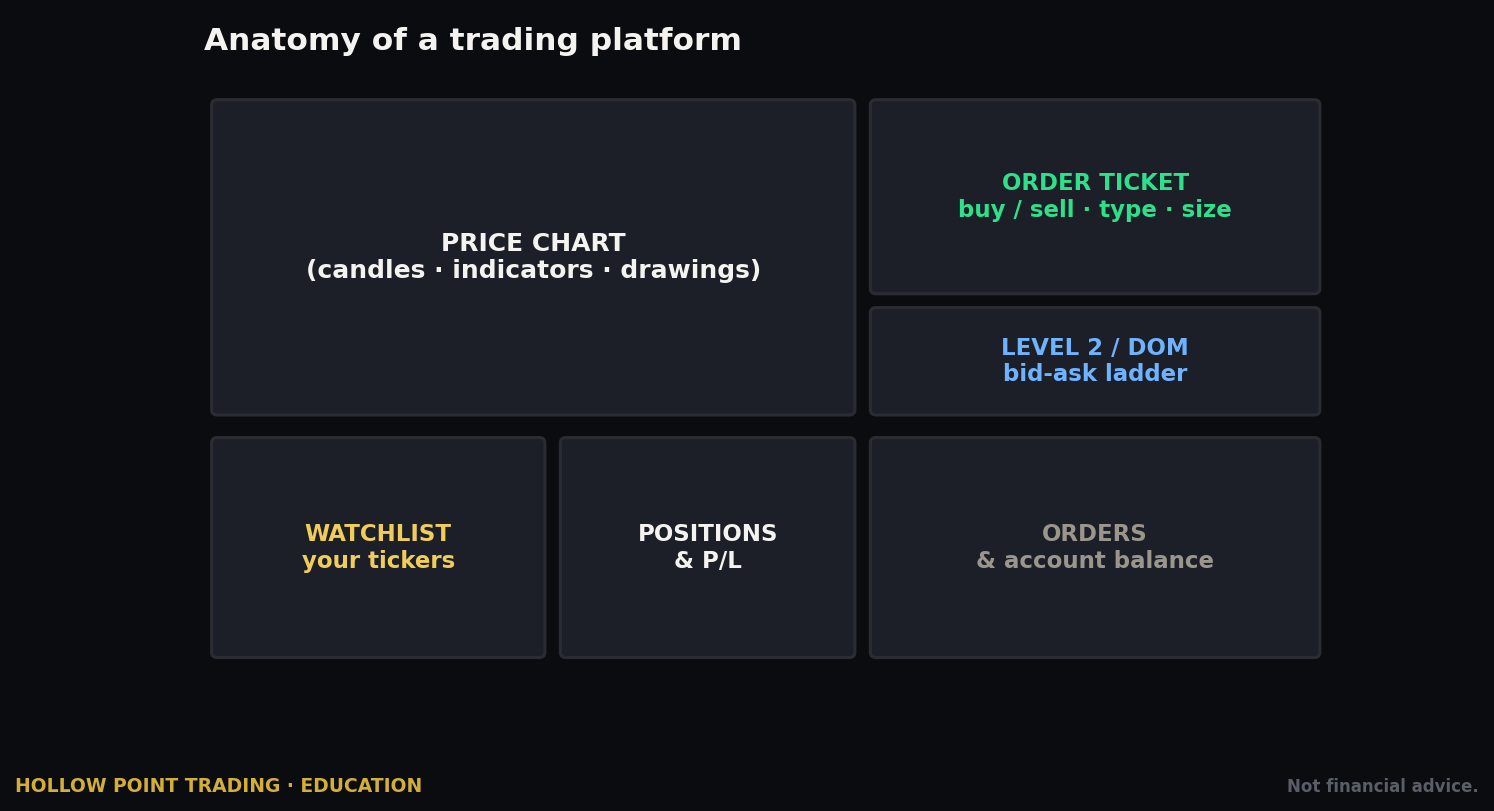
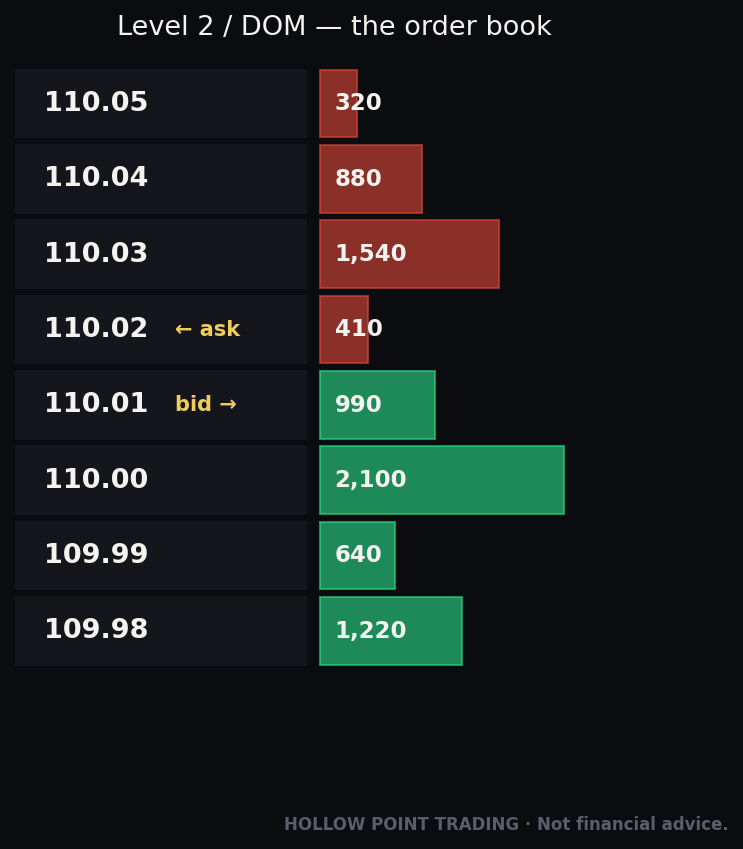
- The DOM (Depth of Market, also called the "ladder") — a vertical price column showing resting bids and offers at each price, where you click to trade.
- Chart with drawing tools and a solid set of studies.
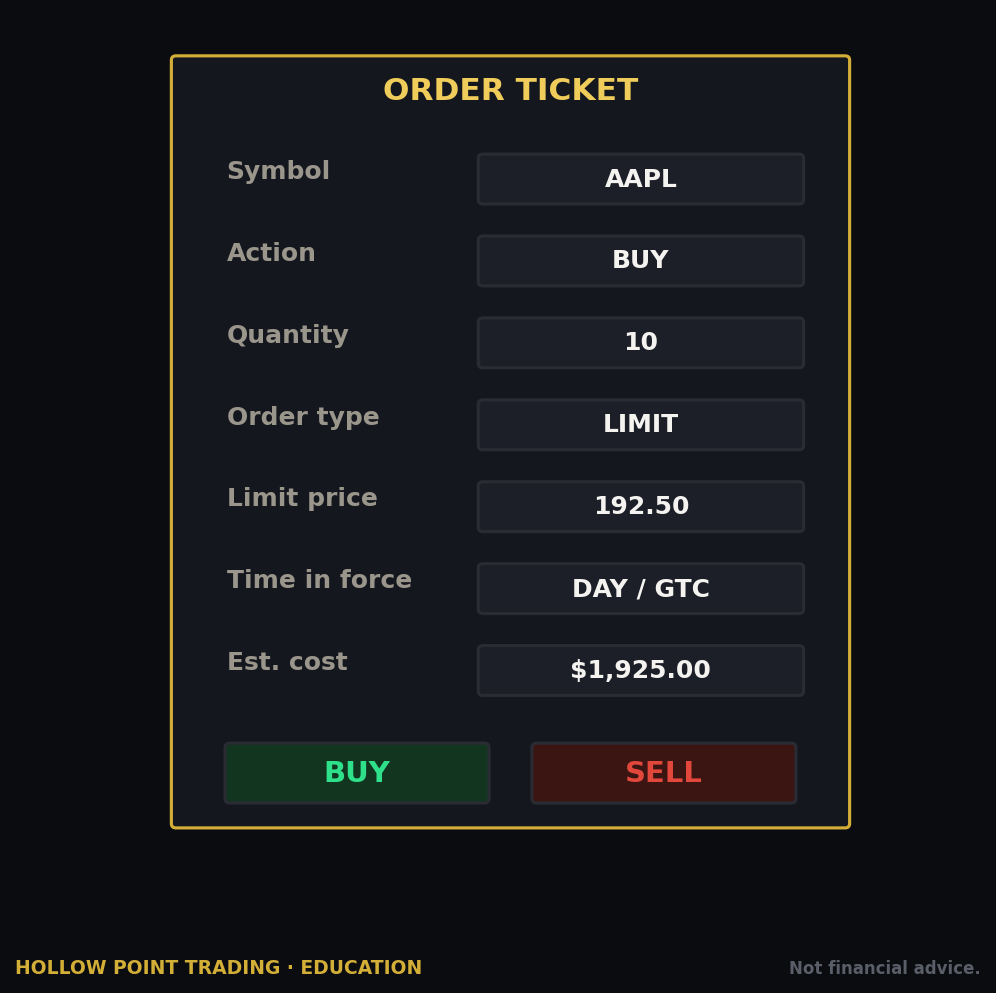
- Order ticket for typing out orders manually.
- Positions / orders / P&L panels.
Because it's cloud-rendered, the DOM can feel a hair less instantaneous than a local install under heavy tape, but for most intraday traders it's more than fast enough, and the zero-install, cross-device nature is a real advantage. If you trade from a laptop at home and want to glance at a position from a hotel, Tradovate's follow-you-anywhere design is hard to beat.
NinjaTrader — Windows desktop
A C#-native Windows install. It processes the order ladder locally, which gives it a famously fast, responsive DOM — the reason order-flow scalpers love it. It's deeper, more customizable, and more programmable (its NinjaScript language lets you build indicators and automated strategies), but that depth is also a steeper learning curve. Its signature feature is the SuperDOM and its ATM strategies (more on those below). Mac users need a workaround (virtual machine, Boot Camp on older Intel Macs, or the cloud sibling), since it's Windows-native.
Mobile
Tradovate's mobile apps are full-featured for a phone — quotes, charts, the ladder, order management. Treat mobile as a management tool (adjust a stop, flatten a position), not a primary trading tool. Fat-fingering a market order on a leveraged contract from a phone on the subway is exactly how accounts die. The screen is small, the confirmation dialogs are easy to blow past, and the tape moves faster than your thumb. Manage on mobile; execute on a real screen.
The Hollow Point read: beginners and cross-device traders → Tradovate. Order-flow scalpers on Windows who want local speed and automation → NinjaTrader. Same broker, same fills, different cockpit.
Placing Your First Futures Trade — Step by Step
We'll walk a first trade on the DOM, because the ladder is the heart of futures execution and you should learn it from day one. Do this in simulation first — both platforms give you free sim. Menu labels change; verify against the current screen.
- Pick a micro contract. Start with MES or MNQ — one-tenth the size of the full E-mini, so a mistake costs a tenth as much. Load the symbol (e.g., MNQ for the front-month Micro Nasdaq).
- Open the DOM/ladder for that symbol. You'll see a vertical price column: offers (asks) stacked above the current price, bids stacked below, with resting size at each level.
- Set your quantity — the number of contracts. Start with 1.
- Attach your bracket first (do this before you enter). Configure a stop-loss and a profit target so they submit automatically the instant you're filled. On NinjaTrader this is an ATM strategy; on Tradovate it's the bracket/OCO settings on the ticket. The point here is the bracket goes on before the entry, never after.
- Enter. To buy at market, click the ask side; to buy with a limit, click a bid price where you want to rest an order. Watch the confirmation — futures fills are fast and final.
- Confirm your protective orders are live. After the fill, your stop and target should appear as working orders on the ladder. Verify this with your own eyes every single time. An entry without a live stop on a leveraged contract is not a trade, it's a bet.
- Manage or let it work. Your target and stop are already in the market as an OCO pair — one cancels the other. Let the trade resolve, or manage it per your plan.
- Flatten when done. "Flatten" closes the position and cancels working orders in one action. Learn where the flatten button is before you need it in a hurry.
A fully worked entry with numbers
Let's make step four concrete. You're long MNQ. The chart says your invalidation is 20 points below entry and your read is worth 1:3. You enter at 20,150.00. Your stop goes at 20,130.00 (20 points = $40 of risk per contract on MNQ at $2/point). Your target sits at 20,210.00 (60 points = $120 of reward per contract). With 3 contracts, that's $120 risked to make $360 — a clean 1:3 with position size chosen by the stop distance, not by gut. The bracket enforces it: if price hits 20,130, the OCO fills your stop and instantly cancels the target; if it hits 20,210, the reverse. Your hands never touch the exit. That's the whole loop. The skill isn't clicking — it's having the bracket defined before the click and honoring it after.
"Options Approval" & the Options Chain — The Honest Answer for This World
Every stock-broker guide has an options-approval section. Here's the honest futures-world version, because pretending otherwise would fail you.
Tradovate and NinjaTrader are futures-first platforms. There is no stock-options approval tier system (Level 1–4, covered calls, spreads) the way there is at an equities broker. You don't apply for "options level 2" here. What does exist is *options on futures — contracts giving the right to a futures position (e.g., options on ES). Availability and the interface for trading them varies and is not the core use case these platforms — or prop firms — are built around. Most prop-firm evaluations restrict you to outright futures; many do not permit options on futures at all.* Verify with your specific firm and platform; do not assume.
The practical takeaways:
- If your plan is stock options, these are the wrong platforms — you want an equities broker.
- If you trade futures through a prop firm, assume outright futures only unless your firm's rulebook explicitly says otherwise.
- Where options on futures are available in a direct account, you'd load the options chain for the underlying future (calls and puts laddered by strike and expiration, with bid/ask and greeks). Read it the same way you'd read any chain: strike, expiration, bid/ask spread, open interest, implied volatility. But confirm the feature exists on your current account before planning around it.
Don't let a generic "get options approval" checklist push you into a product your platform and your firm weren't built for. The honest answer for 95% of prop traders is: outright futures, one instrument, learned deeply.
The Order Ticket & Every Order Type
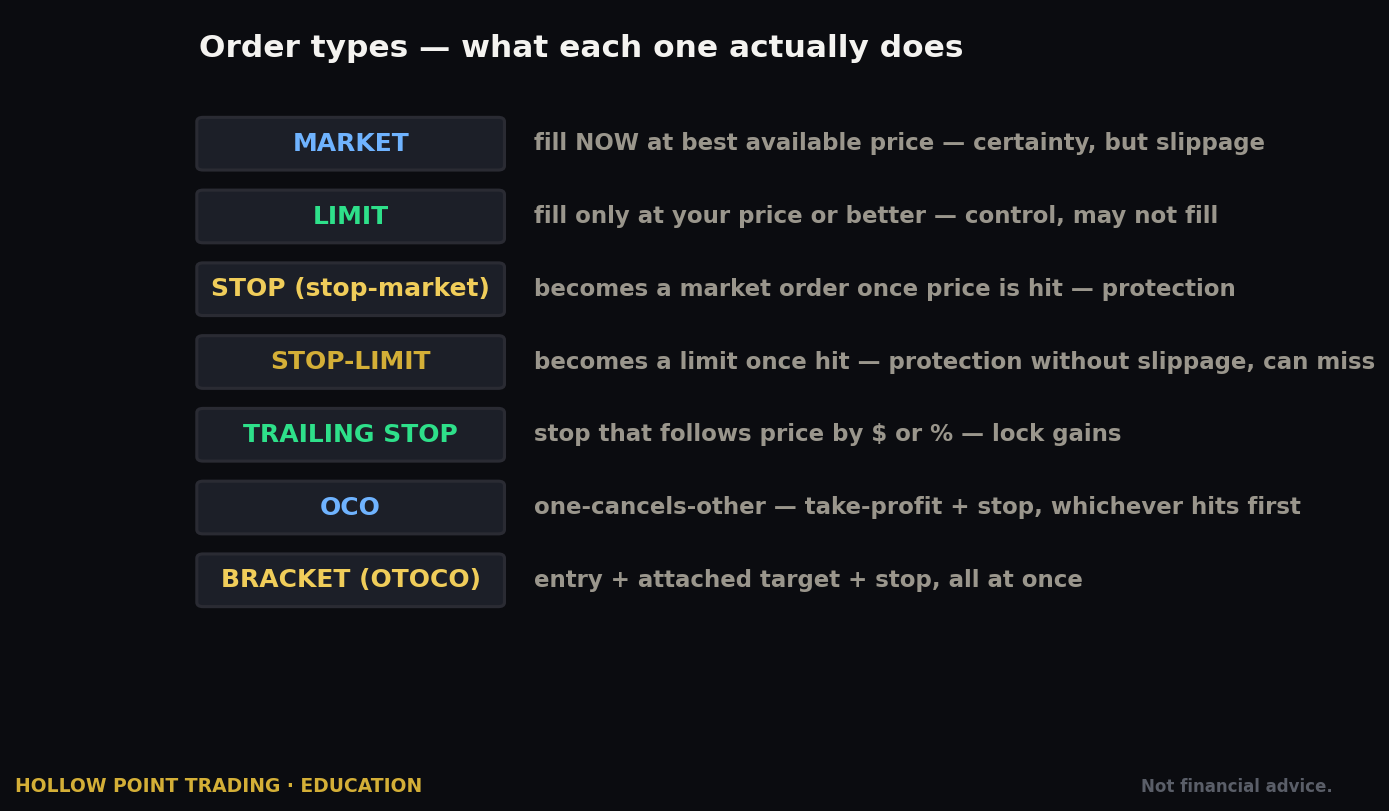
This is the part to actually memorize. On the DOM and the order ticket, here are the order types these platforms support and what each does. Labels vary between Tradovate and NinjaTrader and change over time — verify.
- Market order — executes immediately at the best available price. Guarantees a fill, not a price. In a fast market you'll get slippage.
- Limit order — executes only at your price or better. Guarantees price, not a fill. Rests on the book until touched.
- Stop market order — becomes a market order when price trades to your stop level. Guarantees you exit on a move against you; exposes you to slippage. The standard protective stop.
- Stop limit order — becomes a limit order at your stop level. Gives you price control but risks not filling in a fast move — meaning your stop could be skipped and your loss run past it. Powerful and dangerous; understand the tradeoff.
- MIT (Market If Touched) — like a stop but used to enter in the direction you want, firing a market order when a price is touched.
- Trailing stop — a stop that automatically follows price in your favor by a set distance, locking in gains as the trade runs and never moving backward. On NinjaTrader, configured via Auto Trail.
When to reach for each
The right order type depends on what you're protecting. Use a stop market for your protective stop — you want out, guaranteed, when your read is wrong; slippage is the price of certainty. Use a limit for entries where you can be patient and want price control — say, buying a retest of the golden pocket. Reach for a stop limit only when you understand that a violent move can leave your limit unfilled and your loss running: many experienced traders avoid stop-limits for protective stops precisely for this reason. On a fast NQ flush, a stop-limit stop can be jumped, and now you're holding a much bigger loss than you signed up for — a disaster under a daily loss limit.
Bracket / OCO orders — the core of disciplined futures trading
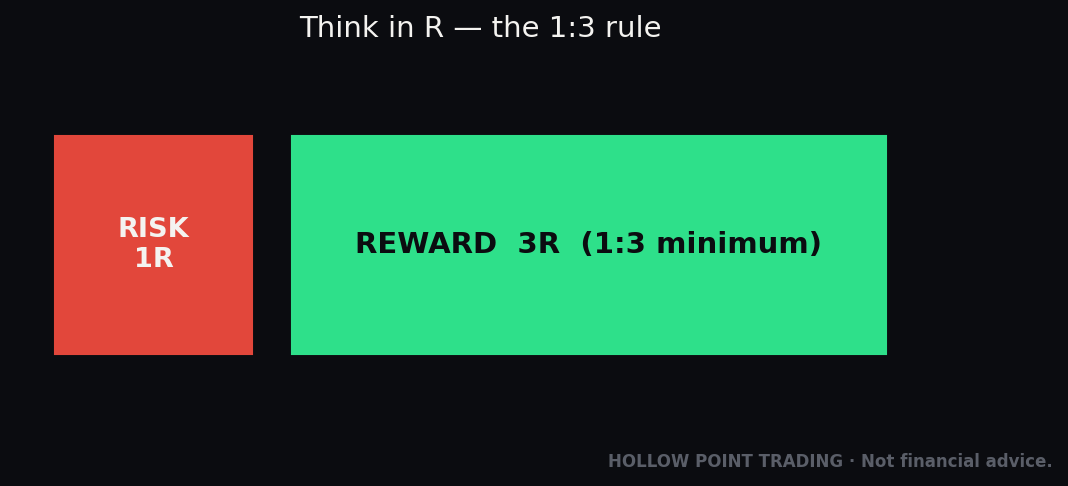
A bracket wraps an open position in both a stop-loss and a profit target simultaneously. They're linked as OCO ("one cancels the other") — when one fills, the platform automatically cancels the other. This is how you define your 1:3 reward-to-risk before the trade and let the machine enforce it. The bracket is the mechanical embodiment of "plan the trade, trade the plan."
ATM strategies (NinjaTrader)
Advanced Trade Management — presets that automatically submit your stop and target the instant you're filled, with rules for how the stop moves (e.g., to break-even after a target hits, then trails). You build the ATM once, name it, and every entry inherits perfect, emotion-free trade management. Tradovate offers equivalent bracket automation on its ticket. This is the single most important feature for a trailing-drawdown account — it removes the moment of human hesitation where discipline usually dies.
A useful ATM template for a 1:3 trader: stop at your full risk distance, two or three profit targets, and an auto-move of the stop to break-even once the first target fills. On a three-contract MNQ position, you might scale one off at +1R to bank profit and raise the trailing floor, move the stop to break-even, and let two run to the +3R target. That structure books enough to ratchet the trailing drawdown safely upward while leaving a runner for the home stretch.
The Hollow Point rule: no entry without a bracket. The order ticket should never see a naked market buy from you. Stop and target go on with the entry, automatically, every time.
Fees, Commissions & the PFOF Reality
Futures fee structures are refreshingly transparent compared to stocks, and one piece of stock-world baggage simply doesn't apply.
Commissions are per-side — charged on the entry and again on the exit. A "round turn" is both sides, so double every quoted rate to get your true cost per trade. Since Tradovate and NinjaTrader are the same broker, their commission tiers are identical (verified August 2026, confirm current):
| Plan | Monthly cost | Standard (per side) | Micro (per side) |
|---|---|---|---|
| Free | $0 | $1.29 | $0.39 |
| Monthly | $99/mo | $0.99 | $0.29 |
| Lifetime | $1,499 one-time (or 4×$499) | $0.59 | $0.09 |
The Monthly plan roughly breaks even around 165 standard round-turns or ~495 micro round-turns per month — below that, the Free plan is cheaper. Run your own volume math before upgrading.
Round-turn math, worked
Say you trade 10 MNQ round-turns a day, 20 days a month — 200 round-turns. On the Free plan at $0.39/side, that's $0.78/round-turn × 200 = $156/month in commission. On the Monthly plan at $0.29/side, that's $0.58 × 200 = $116, plus the $99 fee = $215/month. At this volume, the Free plan is cheaper by $59. You'd need to roughly double your micro volume before the Monthly plan pays for itself. The lesson: most new traders should stay on the Free plan until their volume genuinely justifies the upgrade. Paying $99/month for commission savings you don't trade enough to earn is a silent drain.
On top of commissions, exchange + clearing + NFA fees apply — roughly $0.19–$0.44 per contract depending on product. These are pass-through fees charged by the exchange (CME) and regulators, not a platform markup, and they exist at every regulated U.S. futures broker. Nobody escapes them.
The PFOF reality — and it's good news
Payment for order flow — the practice where a stock broker sells your order to a market maker and "pays" for it with commission-free trades — is primarily a securities-market phenomenon and does not operate the way it does in stocks. Futures trade on centralized exchanges (CME) with transparent, public order books; your order is routed to the exchange, not sold to an internalizer. You pay explicit commissions and exchange fees, and in return you get a transparent central limit order book where everyone sees the same bids and offers. This is one of the genuinely cleaner corners of the trading world — you know exactly what you're paying and where your order goes. When the sales pitch of a stock app is "commission-free," remember you're the product; in futures, you're the customer, and the pricing is on the table.
Margin, Account Types & the PDT Question
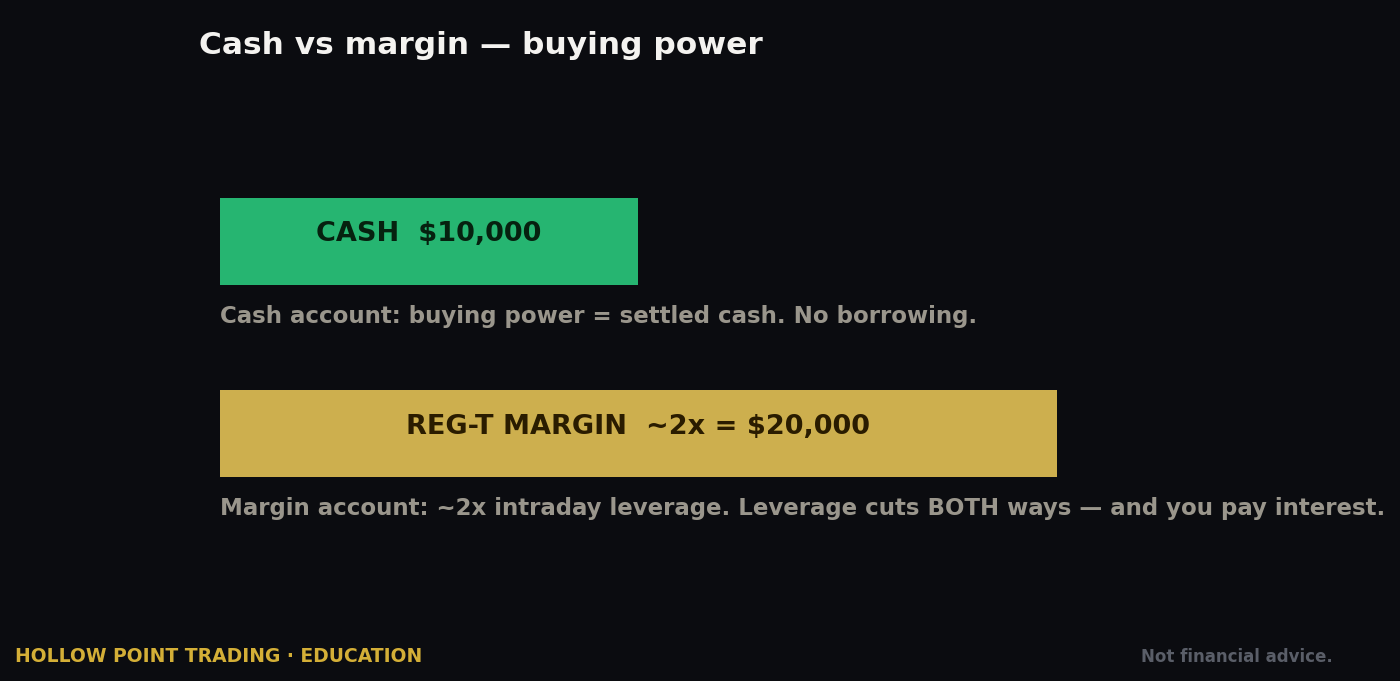
Margin in futures is a performance bond, not a loan. It's the good-faith deposit the exchange requires to hold a contract, not money you borrowed. Two numbers matter:
- Initial / maintenance margin — the overnight requirement. For context (CME figures move constantly, verify): ES around $26,700 initial / $24,300 maintenance; NQ around $40,500 / $36,900.
- Day-trade (intraday) margin — dramatically lower, set by your broker, for positions closed before session end. Prop firms and brokers commonly offer intraday margins around $50 per micro contract (MES, MNQ).
That gap is the leverage — and the danger. A ~$50 intraday margin controls a contract whose price swings can be many multiples of that in a single session. Leverage cuts both ways with equal enthusiasm. The intraday margin tells you what you're allowed to hold; it says nothing about what you should risk. Those are two different questions, and confusing them is how people over-lever.
Contract specs you must know cold (verify current):
| Contract | Tick size | Tick value | Per point |
|---|---|---|---|
| ES (E-mini S&P) | 0.25 | $12.50 | $50 |
| MES (Micro S&P) | 0.25 | $1.25 | $5 |
| NQ (E-mini Nasdaq) | 0.25 | $5.00 | $20 |
| MNQ (Micro Nasdaq) | 0.25 | $0.50 | $2 |
Know these before you click. If you don't know that a single point on MNQ is $2 (and on NQ, $20), you cannot size a trade or read your risk. A worked example makes it vivid: a 30-point move on NQ is $600 per contract; the identical 30-point move on MNQ is $60 per contract. Same chart, same points, ten-times the dollars. New traders who "graduate" from MNQ to NQ without re-doing their position math get a brutal surprise on their first losing trade.
PDT — the pattern day trader rule
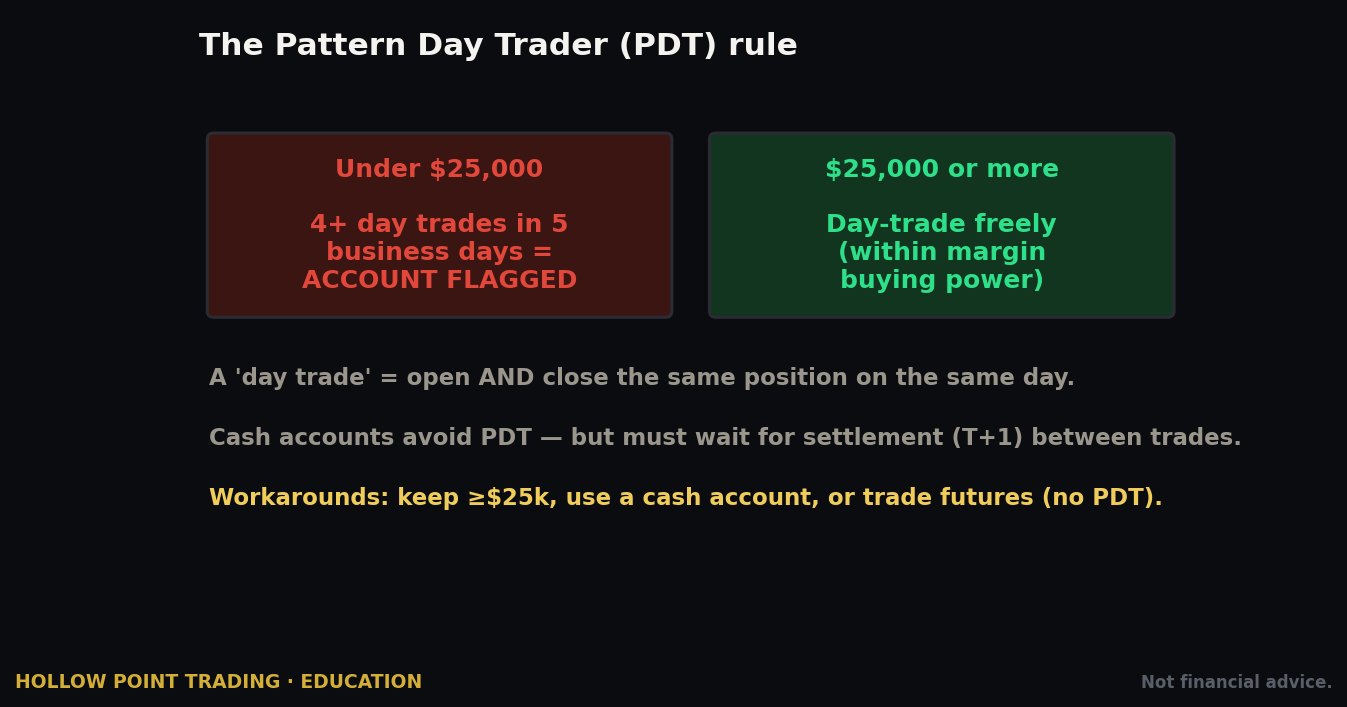
In stocks, the PDT rule blocks accounts under $25,000 from making more than three day-trades in five business days. This rule does not apply to futures. Futures are regulated by the CFTC, not the SEC's securities framework, and there is no PDT restriction — you can day-trade as often as you like regardless of account size. This is a major reason small-account traders migrate to futures. What does constrain you instead are your prop firm's rules — daily loss limits, trailing drawdown, contract caps. The government isn't your governor here; the firm is. And most prop evaluations are intraday-only anyway — the vast majority require you to flatten before session close and forbid holding overnight or over the weekend (a rare exception like Phidias notwithstanding — verify per firm).
How the Account Behaves in Different Market Regimes
The same rulebook feels completely different depending on what the market is doing. A trailing-drawdown account is not regime-neutral, and pretending it is gets people killed. This section did not exist in the shorter version of this guide, and it's one of the most important.
Trending days
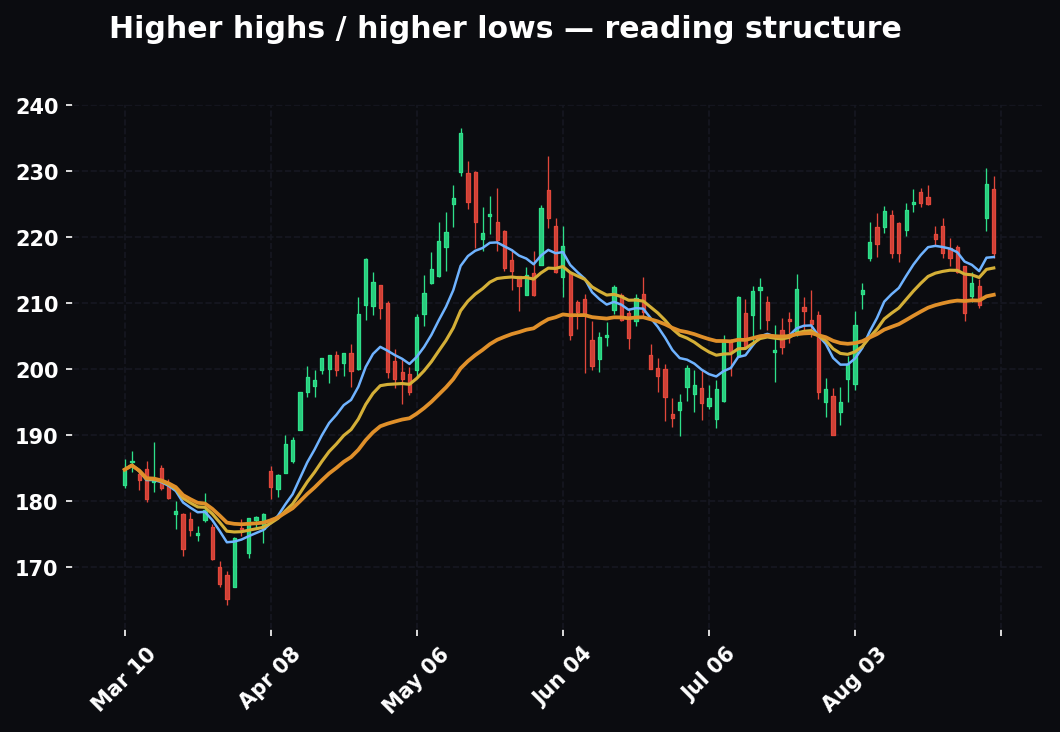
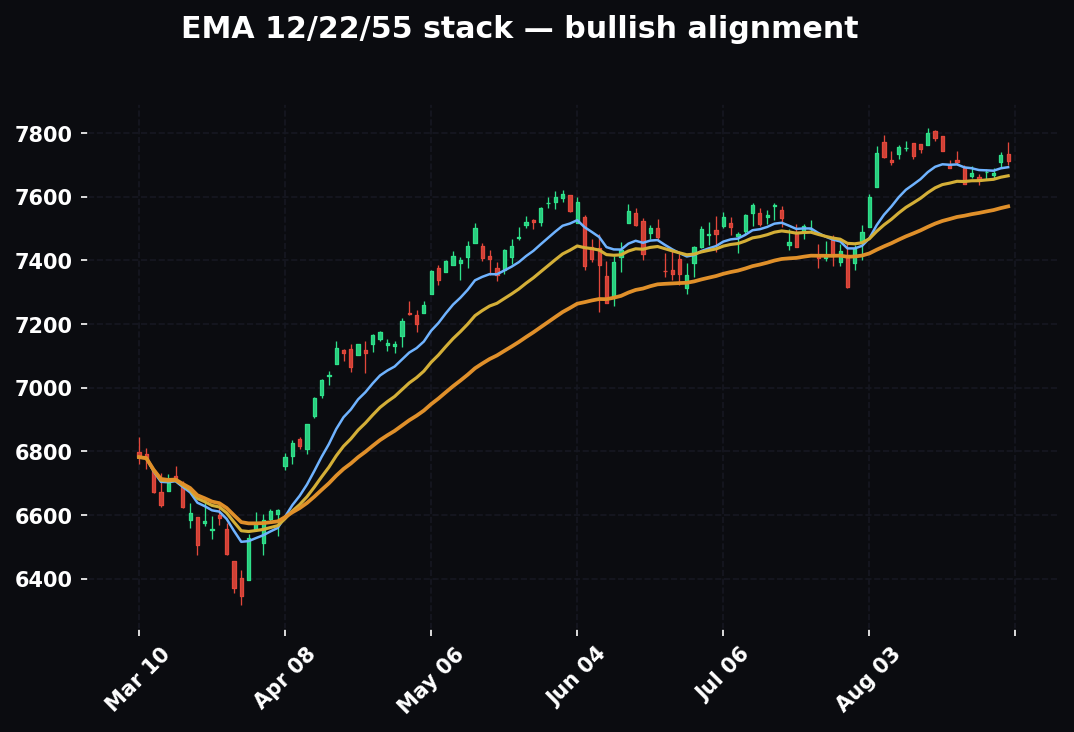
A clean trend day — price stair-stepping up along the EMA 12/22/55 stack, pulling back to the fast EMAs and continuing — is the friendliest regime for a funded account. Your 1:3 targets get hit, your trailing line ratchets up on strong closes, and confluence entries in the direction of the daily 55 EMA carry high win rates. The mistake to avoid on trend days is under-participating — taking a quick scalp and sitting out the rest of a move that would have paid three or four times as much. On a confirmed trend, let the runner in your ATM do its job.
Chop / range days
A range-bound, low-conviction session is where evals go to die. Price whips through the middle of a range, triggering breakout entries that immediately reverse, and every false start nibbles at your daily loss limit. In chop, the trailing drawdown grinds you down through a thousand small cuts. The defense is fewer, better trades: fade the edges of a defined range with tight stops, or simply stand down. On a low-conviction day, the best trade is often no trade — and the funded structure rewards that patience because you keep your survival room intact for the next trend day. A trader who takes two clean setups a week and passes the eval beats one who forces ten a day and trips the DLL.
High-volatility days
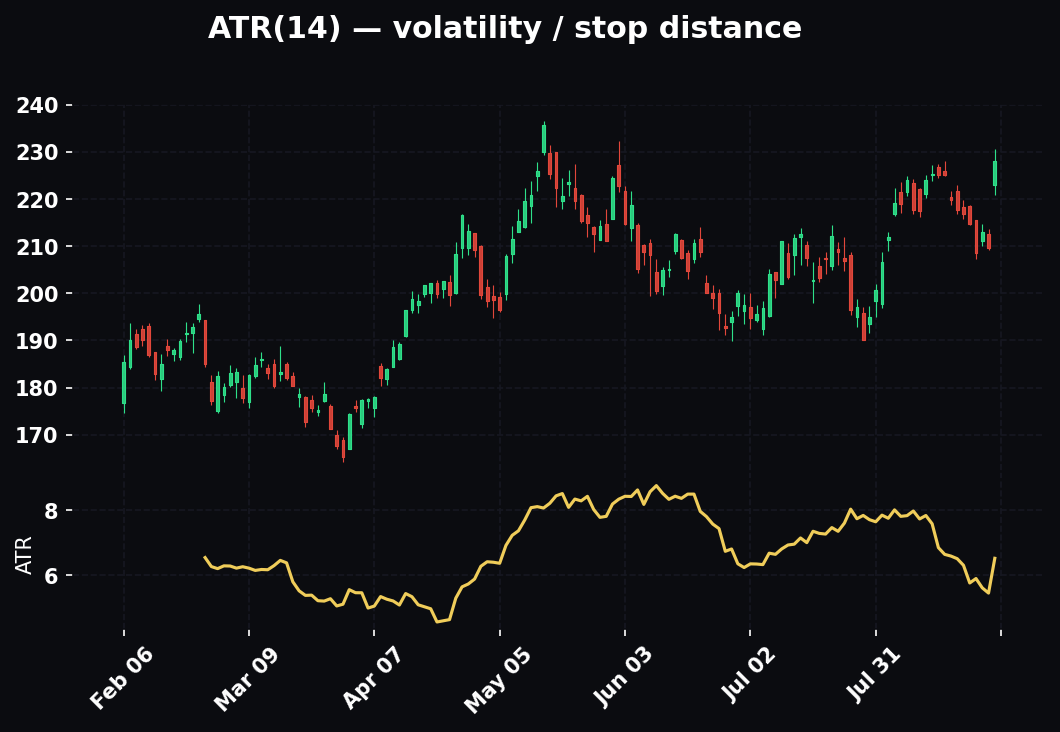
CPI prints, FOMC, NFP, and major earnings-driven index moves turn the index micros into a different animal. Spreads widen, slippage on market orders balloons, and stops get run by design. A 20-point MNQ stop that's comfortable on a normal Tuesday can be noise on an FOMC afternoon. Three adjustments: size down (fewer contracts so the same dollar risk survives a wider stop), widen stops to the real invalidation rather than getting wicked out, and respect the DLL harder than ever because one bad fill can eat your whole daily allowance. Many funded traders simply avoid the first few minutes after a top-tier econ release — the tape is a slot machine, and slot machines don't respect brackets. Know your firm's rules around news, too; some prohibit trading through certain releases entirely.
Multi-Timeframe Treatment
The platform shows you whatever timeframe you load, but a funded trader reads several at once and lets the higher ones set the terms for the lower ones. This is the Hollow Point top-down method applied to the seat.
Use the higher timeframe for bias, the middle for setup, and the lower for timing. A workable stack for index micros:
- Daily / 4H — bias. Where is price relative to the daily 55 EMA? Above and rising = long bias; below and falling = short bias. This decides which direction of trade you're even allowed to take today.
- 1H / 15m — setup. Is there a structure that lines up with the bias — a pullback into the golden pocket, a reclaim of a key level, an EMA retest? This is where the trade idea forms.
- 5m / 1m — timing / trigger. The entry candle, the bracket placement, the exact stop. You drop to the fast chart only to execute an idea the higher timeframes already approved.
The discipline is directional: information flows down the timeframes, never up. A 1-minute breakout that fights the daily 55 bias is a counter-trend scalp at best and a trap at worst. When all three agree — daily bias up, 15m pullback into confluence, 5m trigger firing — that's the timeframe-weighted confluence that keeps the equity curve climbing and the trailing line rising safely beneath it. A single-bar impulse with no higher-timeframe backing is exactly the trade the trailing drawdown was built to punish.
Confluence — Combining the Platform with Other Tools
Order execution is only half the job. The other half is deciding where to place the bracket, and that decision improves dramatically when independent tools agree. Here's how the platform's execution pairs with two or three reads you'd bring to it.
EMA 55 bias + golden pocket + VWAP
Stack three independent signals and take the trade only where they overlap:
- EMA 12/22/55 trend sets direction. Say the daily 55 is rising and price is above it — long bias confirmed.
- Golden pocket (0.618–0.65 Fibonacci retracement) of the last impulse leg gives you a precise entry zone. Price pulls back into the pocket rather than chasing the high.
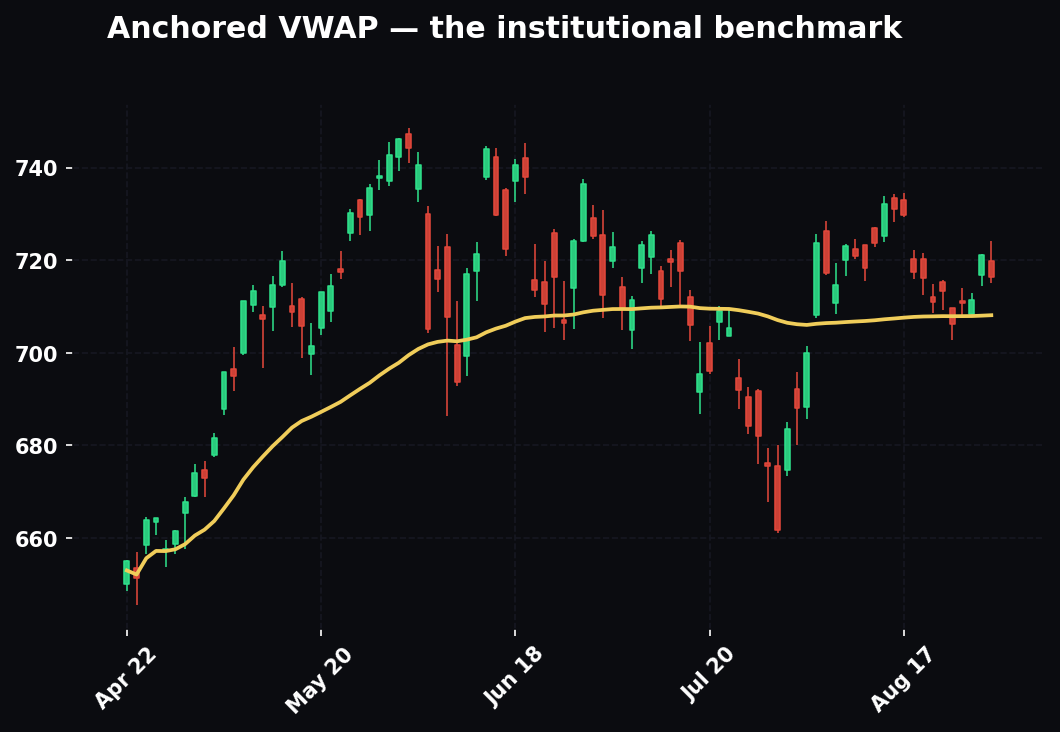
- VWAP (or anchored VWAP from the session open or a key swing) confirms you're buying at or below fair value, not into extension.
When all three line up — bias long, price tapping the golden pocket, sitting on rising VWAP — you have a high-conviction long. Your bracket goes on: stop just below the pocket's invalidation, target at 1:3. That's not three signals stacked for comfort; it's three independent confirmations that each fail differently, so their agreement is meaningful.
Adding order-flow / DOM confirmation
For the scalper on NinjaTrader or Bookmap, a fourth layer: watch the DOM as price enters your confluence zone. A large resting bid absorbing sellers at the golden pocket, or aggressive buying lifting the offer as VWAP holds, is real-time confirmation that the level is being defended. This is where the low-latency Rithmic feed earns its keep — you're reading intent, not just price. Beginners should not rely on this alone; tape reading is a skill built over thousands of hours. But layered on top of chart confluence, it sharpens entry timing and helps you skip levels that look good on the chart but show no defense on the ladder.
Structure + session levels
A third, simpler confluence any trader can run: prior-day high/low, overnight range, and round numbers. If your golden-pocket long also sits right at the prior-day low and a round 20,000 level, you're stacking magnet levels where liquidity clusters. Those are the spots where stops rest and reversals ignite. The platform's drawing tools make marking them a two-minute pre-market ritual — do it before the open, every day, and trade toward and from those levels rather than in the empty space between them.
Common Mistakes on These Platforms
The washout rate isn't a strategy problem. It's these, over and over. Here are the ones that end accounts, each with the fix.
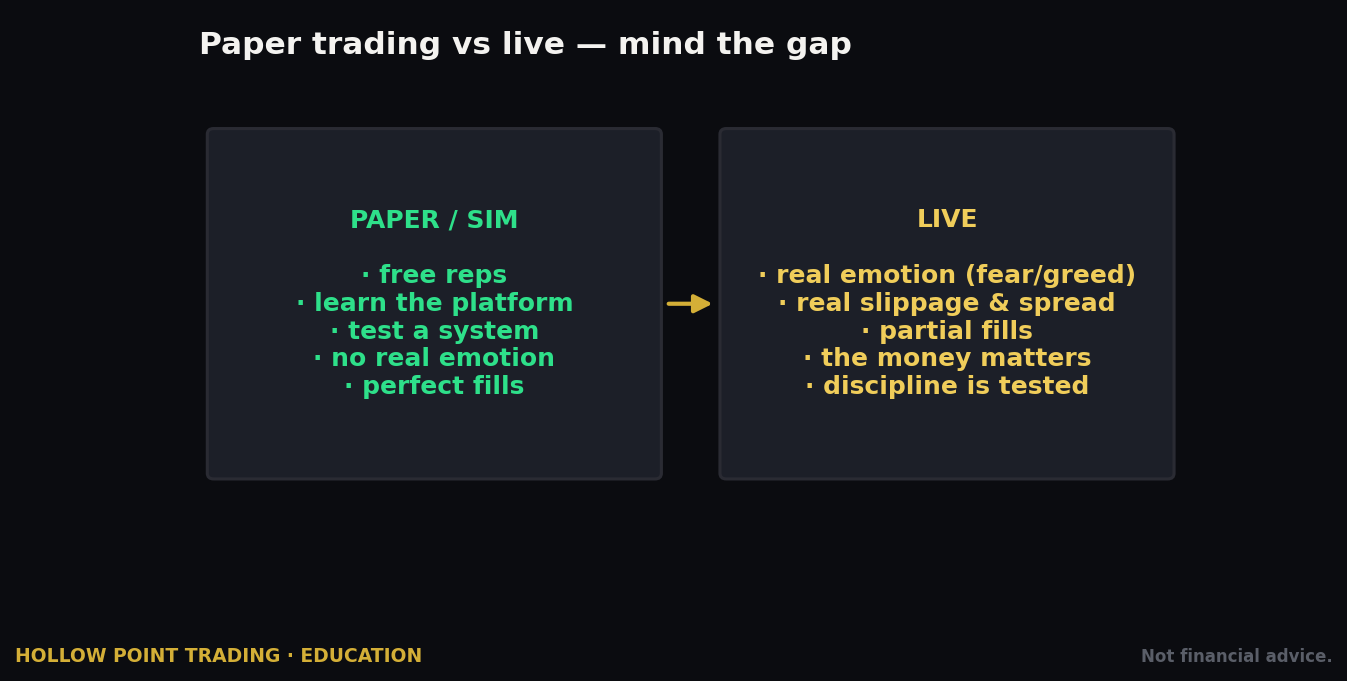
1. Trading live before mastering sim. Both platforms give free simulation. Skipping it to "feel real pressure" is how you donate your eval fee. Fix: sim until the order flow — bracket on, entry, confirm stop, flatten — is pure muscle memory, then sim some more.
2. Confusing sim and live accounts. Placing a real order thinking you're in sim — or the reverse — is a genuine and costly platform mistake. Fix: check the account selector at the top of the ticket every single session, and color-code your workspaces if the platform allows it.
3. Entering without a bracket. The naked market order with a "mental stop" is the number-one killer. A mental stop is a suggestion; the market ignores suggestions. Fix: build the ATM/bracket first; make "no entry without a bracket" a non-negotiable rule.
4. Fat-fingering contract size. Typing 10 when you meant 1 on a leveraged contract. Fix: confirm quantity on every ticket, set a max-size guardrail if the platform offers one, and start on micros where the mistake costs a tenth as much.
5. Not knowing tick values. Trading NQ thinking in MNQ dollars — a 10× risk error that turns a $60 loss into $600. Fix: memorize the spec table cold before you ever load the full-size contract.
6. Misreading the trailing drawdown. Not knowing whether it's intraday or EOD, then letting a winner give back gains until the trailing line trips. Fix: confirm the drawdown type before you buy the eval, and book profit into targets rather than "letting it ride" — the 1:3 bracket does this for you.
7. Revenge trading into the daily loss limit. Two losers, then an oversized third "to get it back," straight into the DLL wall. Fix: set a personal daily-loss stop below the firm's DLL and walk away when you hit it. The firm's wall should never be the thing that stops you — your own rule should.
8. Picking the wrong feed/platform combo. Choosing Tradovate for a Rithmic-only firm and discovering it can't connect. Fix: confirm the data feed before choosing the front-end. Tradovate = CQG only; NinjaTrader = both.
9. Over-upgrading plans. Paying $99/month for commission savings your volume doesn't justify. Fix: do the round-turn breakeven math (shown above) and stay on Free until you genuinely cross it.
10. Holding into the close on an intraday-only eval. An automatic rule violation that ends the account regardless of P&L. Fix: know your firm's exact flatten deadline and set an alarm five minutes before it.
11. Over-trading in chop. Forcing breakout entries on a range-bound day and getting chopped into the DLL by a hundred small cuts. Fix: read the regime first; on low-conviction days, take fewer trades or stand down entirely.
12. Platform-hopping instead of mastering one. Endlessly switching between Tradovate, NinjaTrader, Quantower, and Bookmap looking for the "edge" in the software. Fix: pick one platform, learn it deeply, and put your energy into the read. Platform-hopping is usually procrastination wearing a productivity costume.
How the Pros Use It Differently from Beginners
The gap between a funded veteran and a first-week eval buyer isn't screen count or a secret indicator. It's a handful of habits.
Pros trade the rules first, the chart second. A beginner asks "is this a good setup?" A pro asks "is this a good setup and do I have the drawdown room, the daily-loss room, and the consistency headroom to take it?" The rulebook is a live constraint they're always solving inside, not a thing they read once at signup.
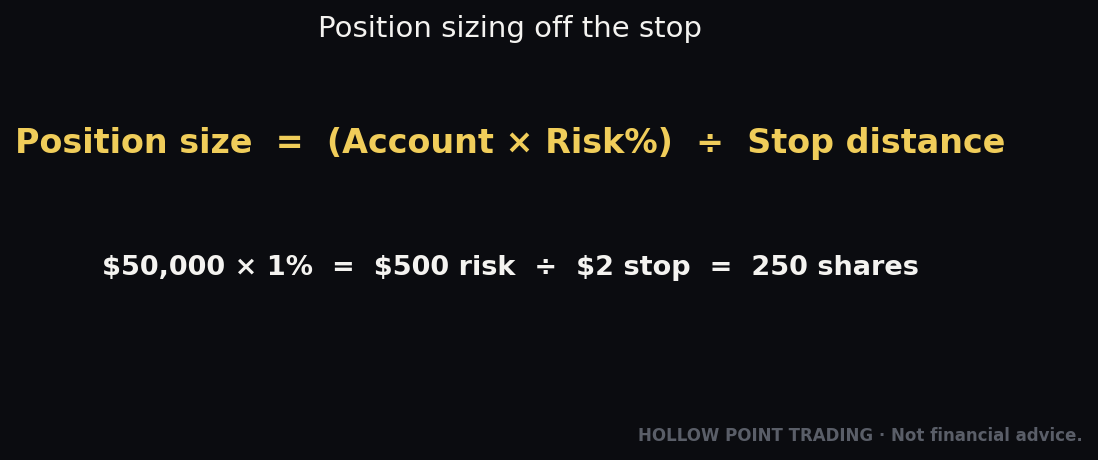
Pros size by the stop, not by the margin. A beginner sees ~$50 intraday margin and asks how many contracts they can hold. A pro decides the dollar risk first, measures the stop distance the chart demands, and lets those two numbers dictate the contract count. Size is an output of risk, never an input.
Pros automate discipline. Beginners rely on willpower at the moment of the trade — exactly when willpower is weakest. Pros build the ATM once, in a calm moment, so the stop and target fire automatically and the emotional decision is already made. They remove their own hands from the exit.
Pros protect the trailing line like a rail. A beginner watches P&L; a pro watches distance to the drawdown line and distance to the daily loss limit. They know at all times how much room they have, and they scale their aggression to that room — pressing on strong days when the floor has ratcheted up, standing down when they're close to a wall.
Pros do less on bad days. The beginner's instinct in chop is to trade more to "make something happen." The veteran's instinct is to trade less, protect the account, and wait for the regime to turn. Survival is the strategy; the profits come from a small number of clean trending sessions, not from grinding a dead tape.
Pros treat consistency as a feature, not a cage. A beginner resents the 50% consistency rule; a pro realizes it's just describing what a durable equity curve looks like anyway — steady days, no single lottery win carrying the account. They'd trade that way even if no rule required it.
The through-line: pros have internalized that the trailing-drawdown account is a discipline engine, and their job is to feed it disciplined trades. Beginners fight the machine; pros let the machine enforce the behavior they already want.
FAQ
Do I need both platforms? No. Pick the one that fits your style — Tradovate for cloud/cross-device and beginners, NinjaTrader for Windows order-flow and automation — and learn it deeply. They're the same broker underneath, so you gain nothing from running both except split attention.
Is my prop firm the same as my broker? No. The prop firm sells you the evaluation and sets the rules; the broker/FCM (here, NinjaTrader Group) clears the trades; the data feed (Rithmic or CQG) carries the quotes and orders. Three separate layers.
Which data feed is better, Rithmic or CQG? For a scalper reading the tape, Rithmic's order-by-order, ultra-low-latency feed is the default. For most intraday confluence traders, CQG is plenty fast and more broadly connected. More important than "better" is which one your firm provides — that constrains your platform choice.
Can I hold a futures position overnight in an eval? Usually no. Most evaluations are intraday-only and require you to flatten before session close, forbidding overnight and weekend holds. A few firms allow it — verify your specific rulebook before assuming.
Does the PDT rule apply? No. Futures fall under the CFTC, not the SEC's PDT framework, so you can day-trade freely regardless of account size. Your prop firm's rules — daily loss limit, trailing drawdown, contract caps — are what govern you instead.
What's a round turn? Both sides of a trade — the entry commission plus the exit commission. Quoted rates are per-side, so double them for your true cost per trade.
Should I trade the E-mini or the Micro? Start on the Micro (MES, MNQ) — one-tenth the size, one-tenth the dollar risk per point. Move to the full E-mini only when you're consistently profitable and have re-done your position-size math for the 10× larger dollar values.
What happens the instant I hit the daily loss limit? Typically the platform liquidates your open position and locks you out until the next session; depending on the firm, you may fail the account outright. It's an automatic wall, not a warning.
Is there payment for order flow in futures? No, not the way there is in stocks. Futures route to a centralized exchange with a transparent public order book. You pay explicit commissions and exchange fees, and everyone sees the same bids and offers.
Can I use a Mac? Tradovate is browser-based and runs anywhere, including Mac and mobile. NinjaTrader is Windows-native, so Mac users need a virtual machine or the cloud sibling. If you're on a Mac and want zero friction, Tradovate is the natural fit.
Why did my winner trip the drawdown even though I closed green? Almost certainly an intraday trailing drawdown that ratcheted up against an unrealized peak you later gave back. Under EOD trailing this doesn't happen — the line only moves on your closing balance. Confirm which type your firm uses.
How many contracts can I trade? Whatever your firm's contract/scaling limit allows for your account size — but should is a different question, answered by your stop distance and dollar risk, not the cap.
Quick-Start Cheat-Sheet
Before you fund or buy an eval
- Confirm the data feed your prop firm uses (Rithmic vs. CQG) before picking a platform. Tradovate = CQG only. NinjaTrader = both.
- Beginner/cross-device → Tradovate. Windows order-flow scalper → NinjaTrader. Same broker underneath.
- Know your firm's six rules: profit target, trailing drawdown (EOD or intraday?), daily loss limit, min days, consistency, contract cap.
- Read both rulebooks — evaluation and funded — because they differ.
Fees (verify current — August 2026)
- Per-side commission, double it for a round turn.
- Free $1.29/$0.39 · Monthly $99 → $0.99/$0.29 · Lifetime $1,499 → $0.59/$0.09 (standard/micro).
- Plus ~$0.19–$0.44/contract exchange+clearing+NFA. No PFOF — transparent exchange routing.
- Do the breakeven math before upgrading; most new traders belong on Free.
Specs to memorize
- MNQ: $0.50/tick, $2/pt · NQ: $5/tick, $20/pt · MES: $1.25/tick, $5/pt · ES: $12.50/tick, $50/pt.
- Intraday margin ~$50/micro sets what you can hold; your stop sets what you should risk.
- No PDT rule in futures — firm rules govern instead.
Order types at a glance
- Market = fill guaranteed, price not. Limit = price guaranteed, fill not.
- Stop market = your protective stop (accepts slippage for certainty). Stop limit = price control but can be skipped in a fast move — dangerous for stops.
- Bracket/OCO = stop + target linked, one cancels the other. ATM = auto-submit the whole bracket on fill.
Every trade
- Sim first. Check sim-vs-live selector. Start on micros, 1 contract.
- Bracket/ATM before entry — stop + target as OCO, 1:3 R/R. No naked orders.
- Confirm the working stop with your eyes after the fill.
- Size by the stop distance, not by the margin.
- Know the flatten deadline; set an alarm. Most evals are intraday-only.
Regime read
- Trend day → participate, let the runner work. Chop → fewer trades or stand down. High-vol/news → size down, widen to real invalidation, respect the DLL hard.
Multi-timeframe
- Higher TF = bias (daily 55 EMA). Middle = setup. Lower = timing. Information flows down the timeframes, never up.
The mindset
- Trailing drawdown = discipline engine. Trade with the EMA 55 bias, take confluence not impulse, watch your distance to the line, honor the wall with your own rule set inside it.
Verify every fee, margin, rule, and menu path against the current live screen before you risk a dollar — this world reskins and re-prices constantly. The traders who last aren't the ones with the fastest platform or the cleverest indicator. They're the ones who learned the machine, respected the line, and let the rule engine enforce the discipline their process already demanded.
Bound by rules, feared by trade.