
Now I'll write the expanded article. Returning it directly as my output.
The full-service giant where thirty-year retirement money and a Tuesday-morning breakout scalp live under one login — why its execution is genuinely elite, why its options tooling makes you work for every read, and how to run the whole machine like a professional
You can hold a target-date fund for thirty years and scalp a breakout on the same login, in the same session, with the same cash. That is the entire pitch of Fidelity, and it is worth sitting with for a second because almost no other broker actually delivers it. Fidelity is not a trading app that grew up and learned to hold retirement money. It is not a mutual-fund company that bolted a chart onto the side and called it a platform. It is both things, built seriously, maintained by a firm that custodies trillions of dollars — and for the specific person who is building real long-term wealth while simultaneously learning to trade actively, that combination is very hard to beat.
This guide walks the entire machine end to end. Opening and funding an account. Choosing the account type that determines everything downstream. Placing your first stock trade click by click. Getting options approval and actually reading a chain. Mastering the order types — especially the conditional orders — that separate a serious platform from a phone app. We will be relentlessly honest about where Fidelity shines (execution quality that is measurably best-in-class, and no payment for order flow on stocks) and where it lags a full generation behind (options analytics that feel a decade older than thinkorswim). Everything here is workflow and where-things-live and how-to-think, not hype. One standing warning that applies to every single screen below: Fidelity ships interface updates constantly, and 2026 brings live regulatory rule changes — wherever a menu path or a specific number matters, verify the current screen before you click and the current rule before you rely on it.
What Fidelity Is & Who It's Actually Built For
Fidelity is one of the largest brokerages in the United States, custodying trillions in client assets across brokerage accounts, retirement accounts, workplace 401(k) plans, cash management, and wealth advisory. It is "full-service" in the truest, oldest sense of the word: brokerage and retirement accounts, a checking-account replacement with a debit card, its own money market funds, index funds with rock-bottom and in several cases literally zero expense ratios, professional research, and a legitimately capable active-trading desktop platform called Active Trader Pro.
Here is the mental model that makes the rest of this guide click. Most retail brokers pick one lane and optimize hard for it. Robinhood is a beautifully frictionless trading app with paper-thin research and a business model built on order flow. Schwab is a research-heavy institutional giant that acquired thinkorswim specifically to own the serious-options-trader segment. Interactive Brokers is the global-access, low-margin-rate machine for professionals who will tolerate a steep interface. Fidelity's lane is different from all of them, and naming it precisely is the key: Fidelity optimizes for quality of ownership. The experience of holding money at Fidelity is excellent. The execution on your trades is measurably better than most competitors. The idle cash works for you automatically. And the active-trading desktop, while unglamorous, is genuinely capable.
The Core Distinction: Investing Home vs Trading Cockpit
Think of any active trader's life as having two halves that most people wrongly try to serve with one tool. There is the investor half — your retirement contributions, your index-fund core, your dividend compounders, your long-term macro and sector-rotation bets that you hold for months or years. And there is the trader half — your active setups, your breakout entries, your options plays, your fast-money positions you hold for hours or days. Fidelity is arguably the single best home in America for the investor half, and it is a capable, honest, better-than-adequate home for the equities-and-ETF portion of the trader half. Where you feel the ceiling is the deep options-analytics portion and, absolutely, the futures portion — because Fidelity does not offer futures at all.
Fidelity is the right home for you if:
- You are building a long-term core — retirement, index funds, dividend stocks — and you also want to trade actively without opening and funding a second account somewhere else.
- You care about execution quality and price improvement, meaning where your order actually fills relative to the quoted bid/ask, not just whether the commission says "$0."
- You want idle cash to earn a real competitive yield automatically, swept the moment it lands, without you manually buying a money fund.
- You trade stocks and ETFs primarily, with options as a growing but not dominant part of your toolkit.
- You value research depth — third-party analyst reports, screeners, fundamental data — for top-down and macro work.
Fidelity is a weaker fit if:
- You are an options-first trader who lives inside analytics — probability cones, spread P/L modeling, options backtesting, an options-native charting experience. That is thinkorswim's home turf, and Fidelity does not come close to matching it.
- You trade futures. Fidelity does not offer futures or futures options at all, full stop. For the HPT crowd trading NQ, ES, or any contract, this is a hard architectural stop — you keep a separate futures broker no matter how much you love the rest of Fidelity.
- You borrow large sums on margin routinely and want the cheapest possible rate — Fidelity's margin rates are among its least competitive features.
Run it through the HPT top-down lens and the fit becomes obvious. Your macro read, your sector-rotation thesis, your long-term core — that money belongs somewhere stable, cheap, deeply researched, and well-executed. Fidelity is a natural home for the investor half of a trader-investor's life, and it is good enough at the equities trader half to keep most people from ever needing a second platform. The one honest exception is options-heavy or futures-based active trading, where you feel the ceiling and, in the futures case, hit a wall.
Opening & Funding an Account (Click by Click)
Opening a Fidelity account is free, carries no minimum to open a standard brokerage account, and takes roughly ten minutes online. The exact screens rotate — verify the live flow — but the shape is stable and has been for years.
Step 1 — Pick the account type before you touch anything else. This is the single decision that matters most, because it cascades into your tax treatment, your options approval ceiling, and your day-trading rules. The big three for most people:
- The Fidelity Account (individual brokerage) — a standard taxable trading account. This is where active trading lives. It can be opened as a cash account or a margin account, a choice with real consequences we cover in depth below.
- Roth IRA / Traditional IRA — retirement accounts with tax advantages. Excellent for long-term core holdings and, notably, for running certain options strategies inside a tax-advantaged wrapper where gains compound untaxed (Roth) or tax-deferred (Traditional).
- Cash Management Account (CMA) — Fidelity's checking-account replacement, with a debit card and ATM-fee reimbursements. Not a trading account per se, but it pairs cleanly with a brokerage account so your spending cash and your trading cash live one transfer apart.
Most serious traders end up with at least two: a taxable Fidelity Account for active trading, and a Roth IRA for tax-free long-term compounding. Many add a CMA to replace their bank entirely.
Step 2 — The application. You provide Social Security number, employment information, and answer regulatory questions — are you a control person of a public company, are you affiliated with a broker-dealer, are you a senior political figure. For any account where you intend to trade actively, you also answer suitability questions about annual income, net worth, liquid net worth, investment objective, and trading experience. Read this carefully: these answers directly determine your options approval level later. They are not a formality. Answer them thoughtfully and honestly, because overstating your experience to unlock a higher tier is exactly how a beginner gets handed enough rope to blow up an account.
Step 3 — Margin election (optional). During or after opening a taxable brokerage account, you may apply to add margin. You do not have to, and as a beginner you probably should not on day one. A cash account is the simpler, safer default. You can always add margin later when you understand precisely what it does and why you want it. Adding margin turns your cash account into a margin account, which changes your day-trading rules — again, covered below.
Step 4 — Fund the account. Your options, ordered fastest to slowest:
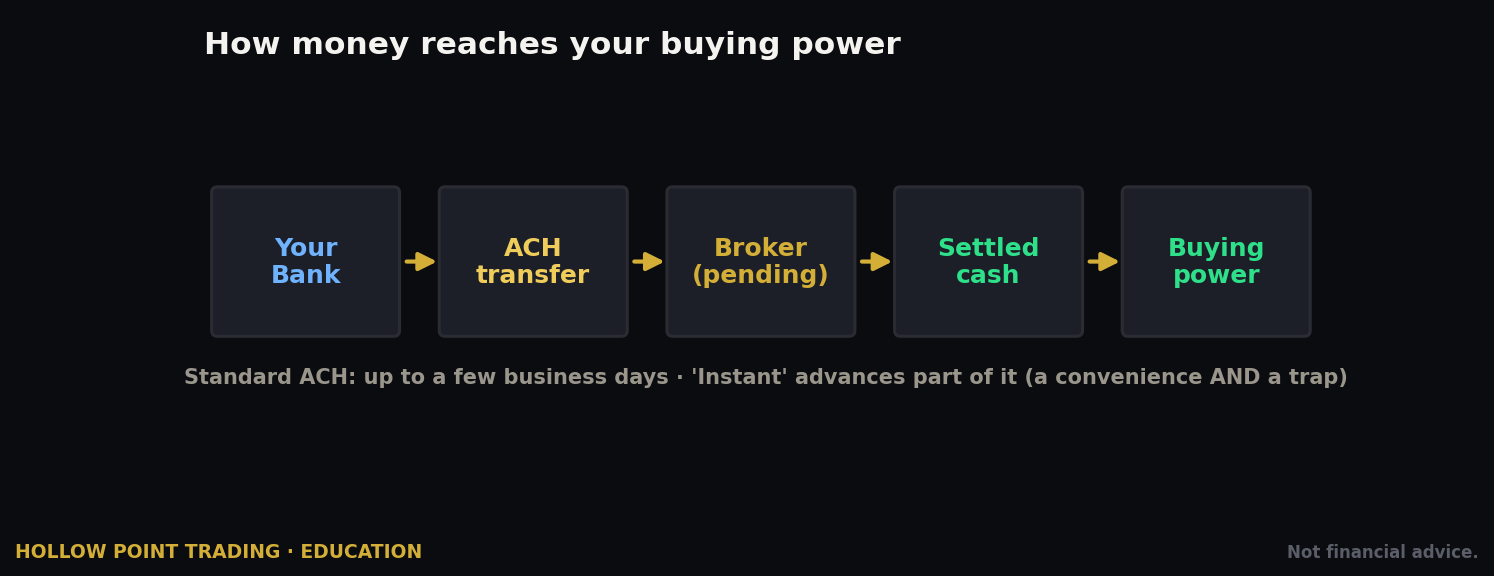
- Electronic funds transfer (EFT / ACH) from a linked bank — the standard method. Link your bank once via account-and-routing number or an instant-verification login. Transfers typically clear in one to three business days, though Fidelity frequently makes a portion (often several thousand dollars) available to trade almost immediately as a courtesy.
- Wire transfer — same-day availability, but your sending bank usually charges a fee (commonly $15–$35). Use wires for large or time-sensitive deposits where the fee is trivial relative to the amount.
- Account transfer (ACATS) — moving an existing brokerage account in from another firm, positions and all, without selling anything and triggering taxes. Takes roughly a week. Fidelity frequently reimburses the transfer-out fee your old broker charges (often $75) if you ask.
- Direct deposit or check — slower, but supported. Some traders route part of a paycheck straight into the brokerage via direct deposit to automate contributions.
Step 5 — Choose your core position. When cash lands, it does not sit idle. Fidelity automatically sweeps uninvested cash into a "core position" that you select. You typically choose between SPAXX (the Fidelity Government Money Market Fund) and an FDIC-Insured Deposit Sweep. This choice is one of Fidelity's quiet superpowers and most beginners ignore it entirely — we devote a full section to it below.
A funded cash account can trade immediately with settled cash. Watch carefully for good-faith violations in a cash account: if you buy a security using unsettled proceeds from a prior sale, and then sell that new security before the original sale has settled, you get flagged. Stock settlement in the U.S. moved to T+1 in 2024 (trade date plus one business day), which makes good-faith violations far less painful than they were under the old T+2 regime — but it is still a live, enforceable rule in a cash account, and three violations in a rolling twelve months typically restricts you to trading with settled cash only for ninety days.
The Three Interfaces: Web, Desktop, and Mobile
Fidelity gives you three distinct surfaces, and using the right one for the right job is the difference between fighting the platform and flying it.
Fidelity.com (Web) — The Hub
The website is home base. Your Positions, Balances, Activity & Orders, account statements, tax documents, research reports, stock and ETF screeners, and every account setting live here. For a pure long-term investor, the website is frequently all you will ever need. Fidelity has been rolling out Trader+ Web, a newer, more trade-focused web experience with streaming quotes and a faster ticket — you may see it alongside or replacing older screens, so verify what your specific login presents.
The web trade ticket is clean and fully capable: market, limit, stop, stop-limit, trailing stops, and access to the full conditional-order builder. For a considered trade — where you already have your thesis, your entry, your stop, and your target defined before you sit down — the web ticket is entirely sufficient. Nothing about a planned swing trade requires the desktop.
Active Trader Pro (Desktop) — The Cockpit
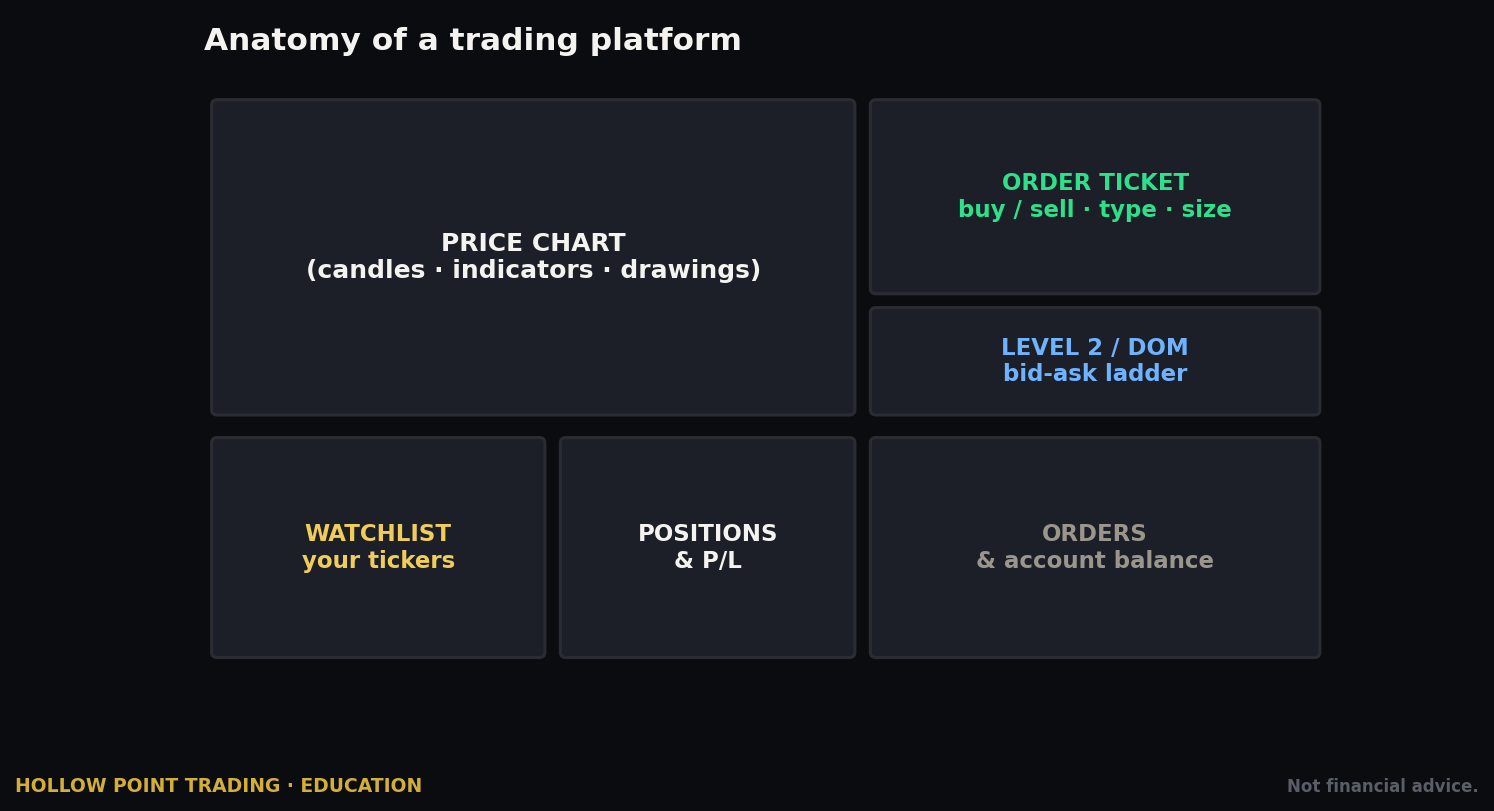
Active Trader Pro (ATP) is Fidelity's downloadable desktop platform for Windows and Mac, free to customers (historically gated behind a trade-count minimum, now broadly available — verify eligibility on your account). This is the trader surface: streaming real-time quotes, fully customizable multi-monitor layouts, Level II order-book depth, directed order routing, keyboard hotkeys, a rich alerting engine, and the complete menu of conditional orders running in a faster, more responsive interface than the browser.
ATP is built around windows you arrange yourself. A watchlist docked left, a chart center, a trade ticket pinned bottom-right, an options chain floating on a second monitor. You save these arrangements as named layouts and recall them instantly. The charting is competent — a full indicator library, drawing tools, multiple timeframes, and alert-from-chart — though it is emphatically not a TradingView replacement. The genuine strength of ATP is speed and order control: multi-leg option tickets, directed orders to specific market centers, real-time streaming that does not lag, and the conditional-order builder all feel meaningfully snappier than the web.
The honest knock on ATP is its aesthetic. It is dense, gray, packed with small text, and it looks its age. It rewards setup time the way a cockpit rewards a pilot who learns the panel. Spend a focused afternoon arranging a layout you like, save it, and it becomes a serious trading environment. It will never feel as modern as a newer platform, and that is the recurring Fidelity trade-off in one sentence: substance over polish.
Mobile App — The Road Tool
The Fidelity mobile app handles the full lifecycle — research, trade, monitor, deposit checks by photo, manage cash, move money. It supports options and conditional orders. For an active trader, the mobile app is the "manage a position from away from the desk" tool, not the primary cockpit. It is good enough that you are never caught off guard by a market move while you are out; it is not where you build a layout or scan for setups.
The workflow nearly every active Fidelity user settles into: research and long-term portfolio management on the web, active trading and order management in Active Trader Pro, and quick position checks and emergency exits on mobile. Learn all three, but pick the surface that matches the task instead of forcing everything through one.
Placing Your First Stock Trade, Click by Click
Let us buy 10 shares of a stock. This is the web flow; ATP is nearly identical with more real-time feedback and faster confirmation.
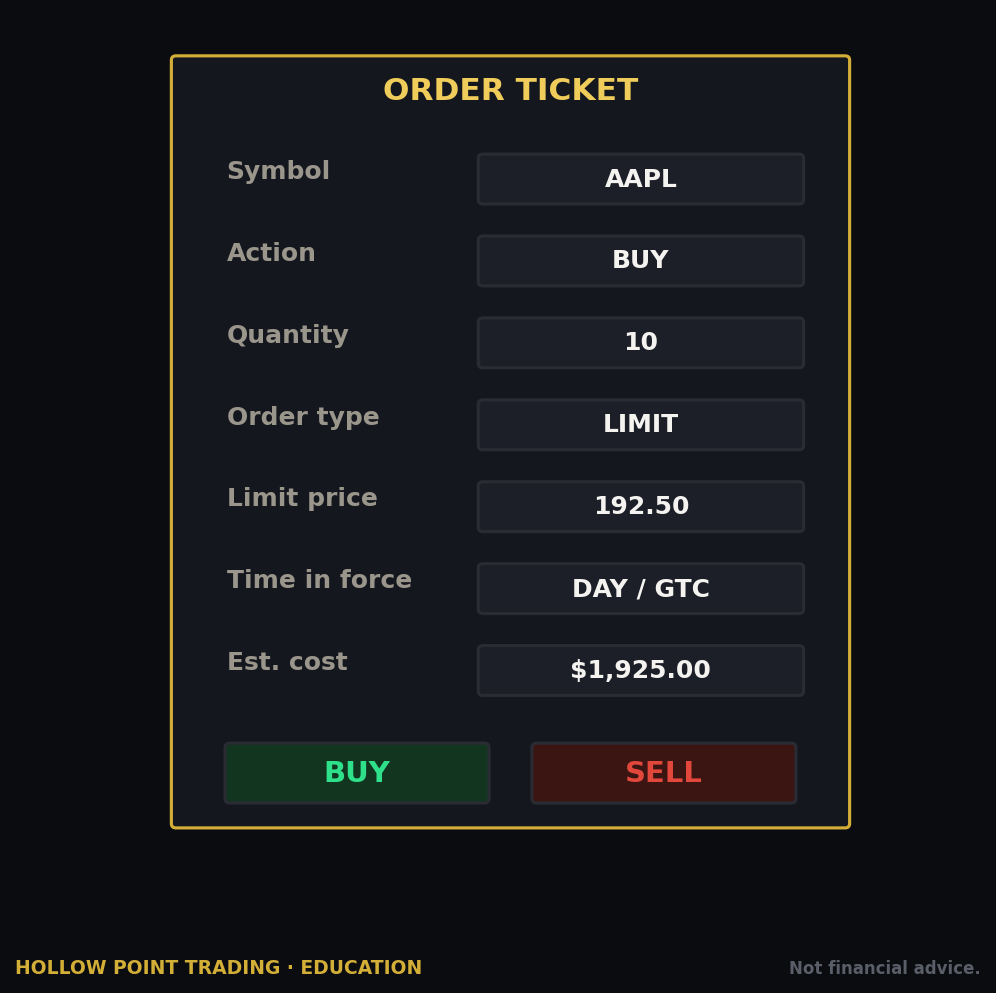
Step 1 — Open the trade ticket. From the website, click Trade at the top of the screen, or click into an existing position and hit Trade there. A ticket panel opens on the right.
Step 2 — Confirm the account. If you hold multiple accounts, make certain the ticket shows the exact account you intend to trade in. This is the single most common beginner mistake on Fidelity, full stop — buying in the Roth IRA when you meant the taxable brokerage, or the reverse. In an IRA the tax consequences of the wrong trade can be genuinely hard to unwind. Look at the account field first, every single time, before you look at anything else.
Step 3 — Enter the symbol. Type the ticker, say AAPL. A live quote populates: last price, bid, ask, the day's range, and often the day's percent change. Read the bid/ask spread here — on a liquid large-cap it will be a penny or two; on a thin small-cap it might be a dime or more, which tells you immediately how careful you need to be with order type.
Step 4 — Action. Choose Buy (or Sell, Buy to Cover, Sell Short). For your first trade, Buy.
Step 5 — Quantity. Enter the number of shares. Or — and this is a genuine Fidelity strength — switch the quantity field from shares to dollars and enter a dollar amount to buy fractional shares. Want exactly $500 of a stock trading at $187.43? Type 500 in dollars and Fidelity buys 2.667 shares, commission-free. More on fractional shares below.
Step 6 — Order type. For a beginner, two types carry almost all the weight:
- Market order — fills immediately at the best available price. Use it for liquid stocks when you want in or out now and you are not fussy about a few cents. The risk: on a fast-moving or thin stock, a market order can fill materially worse than the quote you saw, because by the time your order reaches the market the price has moved.
- Limit order — fills only at your specified price or better. This is your default discipline. You name the maximum you will pay to buy, or the minimum you will accept to sell. It might not fill if price never reaches you, but you control the price completely.
The HPT discipline answer is unambiguous: default to limit orders. You defined your entry at a specific price for a specific reason grounded in your read. A market order throws that reason away and says "any price is fine," which is almost never what your plan actually said. The only time a market order earns its place is when getting filled at all matters more than the exact price — an emergency exit on a liquid name, for instance.
Step 7 — Time in force (TIF). Choose Day (the order expires unfilled at market close) or Good 'til Canceled / GTC (the order stays working across sessions, up to a firm-set limit, until it fills or you cancel it). Fidelity also supports a custom TIF on eligible securities, letting you set a specific expiration date and time up to 180 days out — useful for a resting limit order at a level you expect price to reach eventually but not today.
Step 8 — Preview. Click Preview Order. Fidelity presents a summary — symbol, action, quantity, estimated total cost, buying-power impact, and any commissions or fees. Read it. This is your last checkpoint before real money moves. Ninety percent of "fat-finger" disasters are caught here by someone who actually read the preview instead of reflexively clicking through.
Step 9 — Place. Confirm. You receive an order confirmation number. The order now appears under Orders with a live status: working, filled, or partially filled.
Step 10 — Verify the fill. Once filled, check Positions. For a limit order, note the price where you actually filled versus your limit — Fidelity's price improvement routing frequently gets you a slightly better price than your stated limit, and watching that happen a few times teaches you why execution quality is not a marketing abstraction. It is real money landing in your account that a worse broker would have kept in the spread.
Getting Options Approval + Finding & Reading the Chain
Options trading requires a separate approval on top of your brokerage account. You apply on the web — under the account's Features menu or the dedicated options-application flow — and Fidelity reviews the suitability answers you gave (income, net worth, liquid net worth, experience, and objective) and assigns you an approval level that gates which strategies you may run.
The Approval Tiers, In Plain English
Fidelity's approval structure differs by account type, and the firm updates these periodically, so verify the current tiers. The shape, historically:
Taxable brokerage accounts use a multi-level structure, roughly:
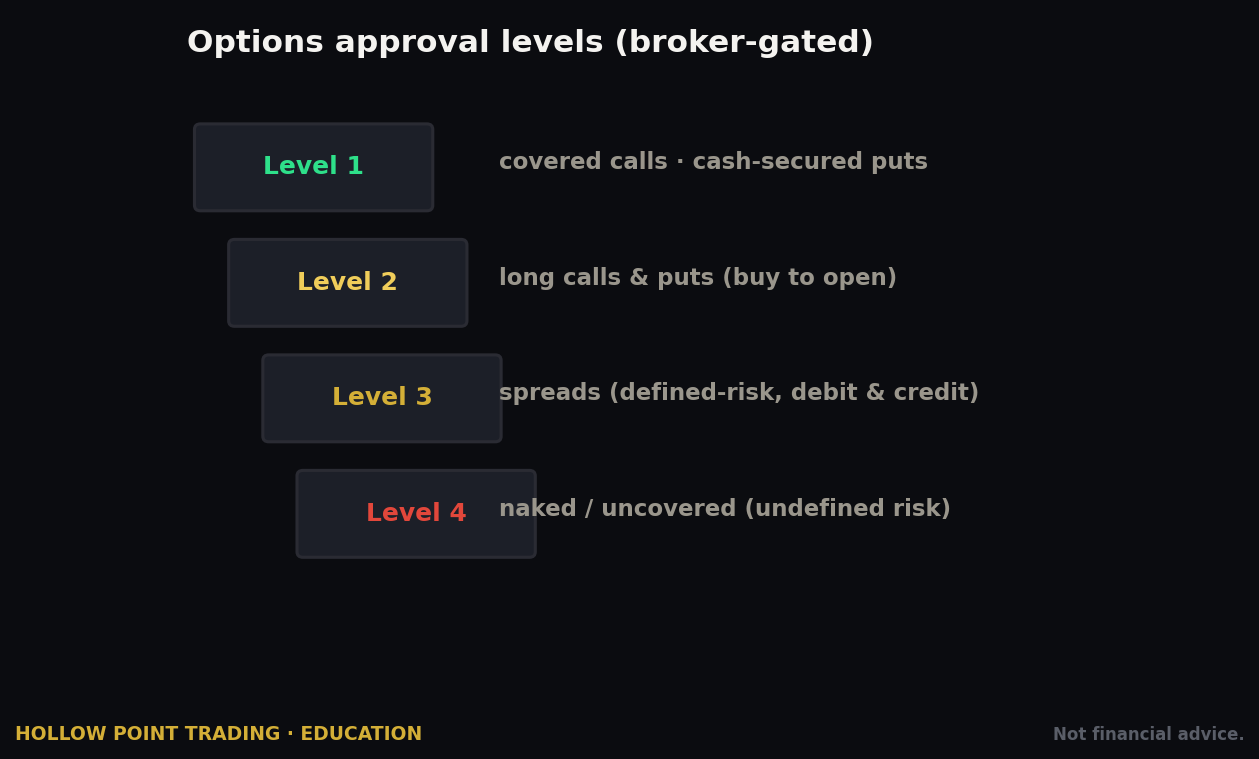
- Level 1 — Covered call writing. Selling calls against stock you already own. The lowest-risk options strategy; you are collecting premium on shares you hold.
- Level 2 — Adds long calls and long puts, cash-secured put writing, and long straddles/strangles. This is where the overwhelming majority of retail traders want to be, because it unlocks buying calls and puts — the directional bets most people mean when they say "trading options." Defined, capped risk: the most you lose on a long option is what you paid for it.
- Level 3 — Adds equity spreads and covered put writing. Verticals, calendars, diagonals — defined-risk multi-leg structures, plus some strategies that use margin.
- Level 4 — Adds uncovered (naked) writing of equity options. Selling calls or puts you are not covered on, with theoretically large or (for naked calls) unlimited risk. This tier demands substantial account equity and experience.
- Level 5 — Adds uncovered index options and index spreads. The highest risk, hardest to get, and unnecessary for the vast majority of traders.
IRA accounts use a narrower, more conservative structure — retirement accounts are prohibited from naked/undefined-risk writing by rule, so the ladder is shorter:
- Level 1 — Covered calls and buying protective puts.
- Level 2 — Adds buying calls and puts, and cash-secured put writing.
- Level 3 — Adds spreads (vertical, calendar, diagonal), collars, and iron condors — defined-risk strategies only.
Note a terminology quirk: some Fidelity materials describe "three tiers" (the IRA framing) and others the five-level brokerage scale, which confuses beginners into thinking something changed. Do not overthink it. Apply for the level that matches the strategies you actually intend to trade in the next year, and be scrupulously honest on the application. The person most hurt by overstating experience to grab Level 4 is you, six weeks later, discovering what a naked call does when the underlying gaps up on an earnings surprise.
Finding the Options Chain
On the web, pull up any optionable stock and look for Option Chain, or navigate Research → the symbol → Options. In ATP, open the dedicated Option Chain window and type a symbol. Both present the same fundamental object.
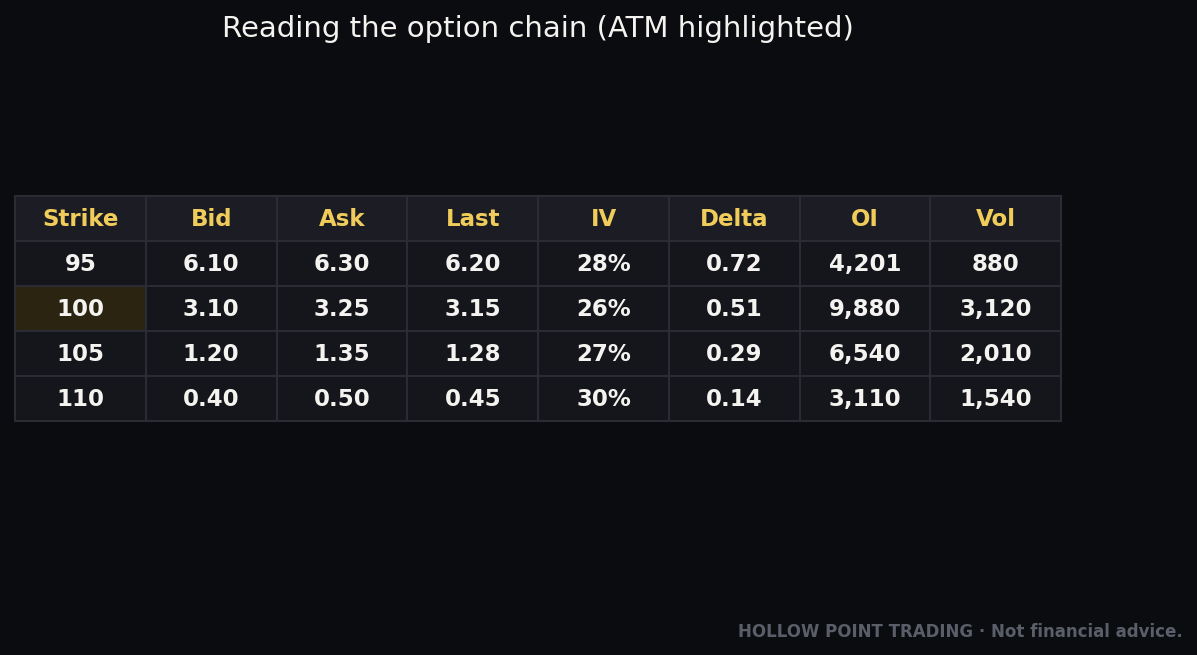
An options chain is a table. First you pick an expiration date from the tabs or dropdown across the top — weekly expirations, monthly expirations, and longer-dated LEAPS may all be available. Once you select an expiration, the chain lists every available strike price in a column running down the center, with calls on one side and puts on the other.
Reading the Chain — What Every Column Means
For each contract you will see:
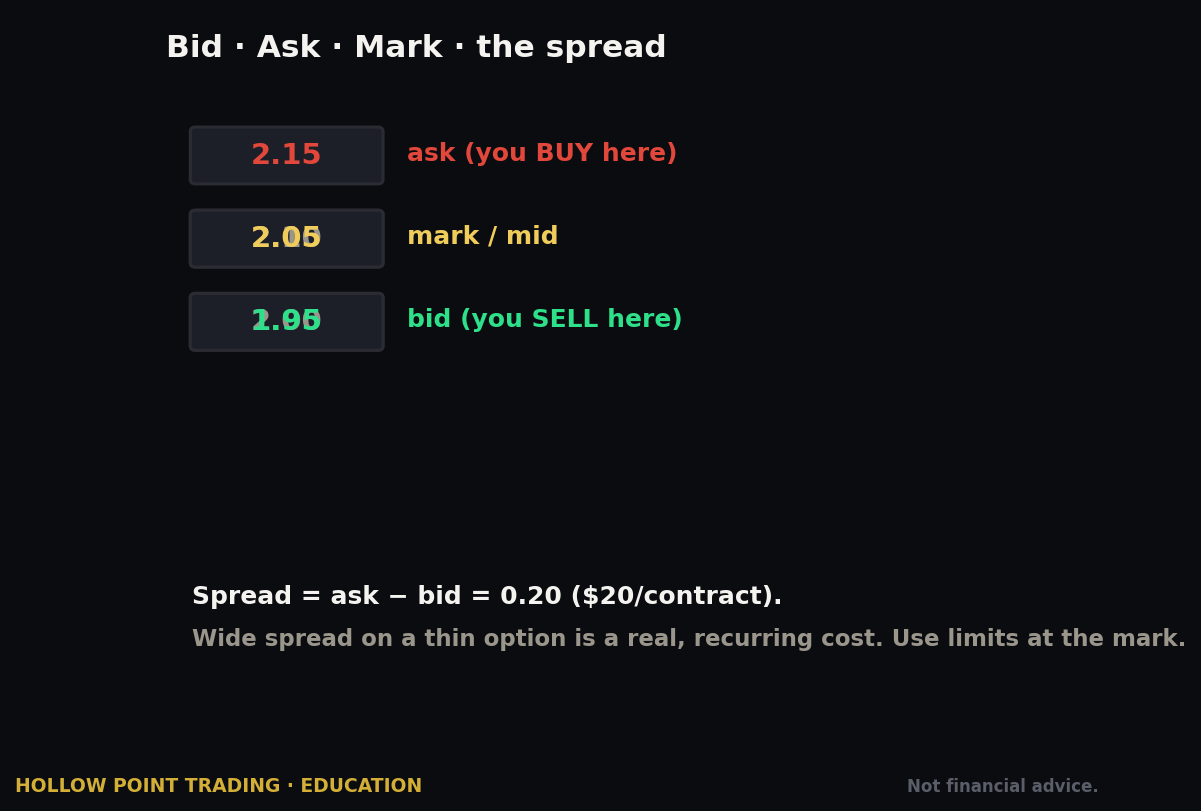
- Bid / Ask — the price you can sell at (bid) and the price you can buy at (ask). The gap between them is the spread. A tight spread (a few cents) means a liquid contract that is easy to enter and exit near fair value. A wide spread (dimes or dollars) means an illiquid contract where you bleed value the instant you enter, because you buy at the ask and can only immediately sell at the lower bid. Spread is the first thing a professional looks at, before price.
- Last — the last traded price. Useful, but on an illiquid contract the "last" trade might be hours old and meaningless; trust the bid/ask over a stale last.
- Volume — contracts traded today. High volume means active, current interest.
- Open Interest — the total number of contracts currently open at that strike. This is the deeper liquidity signal — high open interest means a crowded, liquid strike you can get in and out of.
- Implied Volatility (IV) — the market's priced-in expectation of future movement. High IV means expensive options (you pay up for the anticipated move); low IV means cheap options. IV is the variable that trips up beginners: you can be right on direction and still lose because you bought when IV was inflated and it collapsed after the event ("IV crush" after earnings is the classic).
- The Greeks — Delta (how much the option's price moves per $1 move in the underlying, and a rough proxy for the probability the option finishes in the money — a 0.30 delta call is loosely a 30% chance), Gamma (how fast delta itself changes as the underlying moves), Theta (daily time decay — the dollar value the option bleeds every day just from time passing), and Vega (sensitivity to a 1-point change in implied volatility).
Fidelity's chain displays the Greeks and lets you customize which columns appear, so you can build a view showing exactly bid, ask, open interest, IV, delta, and theta and nothing else. Where Fidelity genuinely lags is the analytical layer built on top of the data — visualizing probability of profit, modeling a multi-leg spread's profit-and-loss curve across price and time, comparing two candidate trades side by side, or backtesting a strategy. The raw data is all present and accurate; the "help me actually think about whether this is a good trade" tooling is thinner than a dedicated options platform. You can read the chain here perfectly well. You simply do more of the analytical thinking in your own head, or in a second tool, than a thinkorswim user does.
The Order Ticket & Every Order Type Fidelity Supports
This is where Fidelity firmly earns its "serious platform" label. Beyond market and limit, both ATP and the web support a deep menu of order types, and the conditional orders in particular are where a disciplined trader builds an edge that has nothing to do with market prediction and everything to do with removing emotion from execution.
Core Order Types
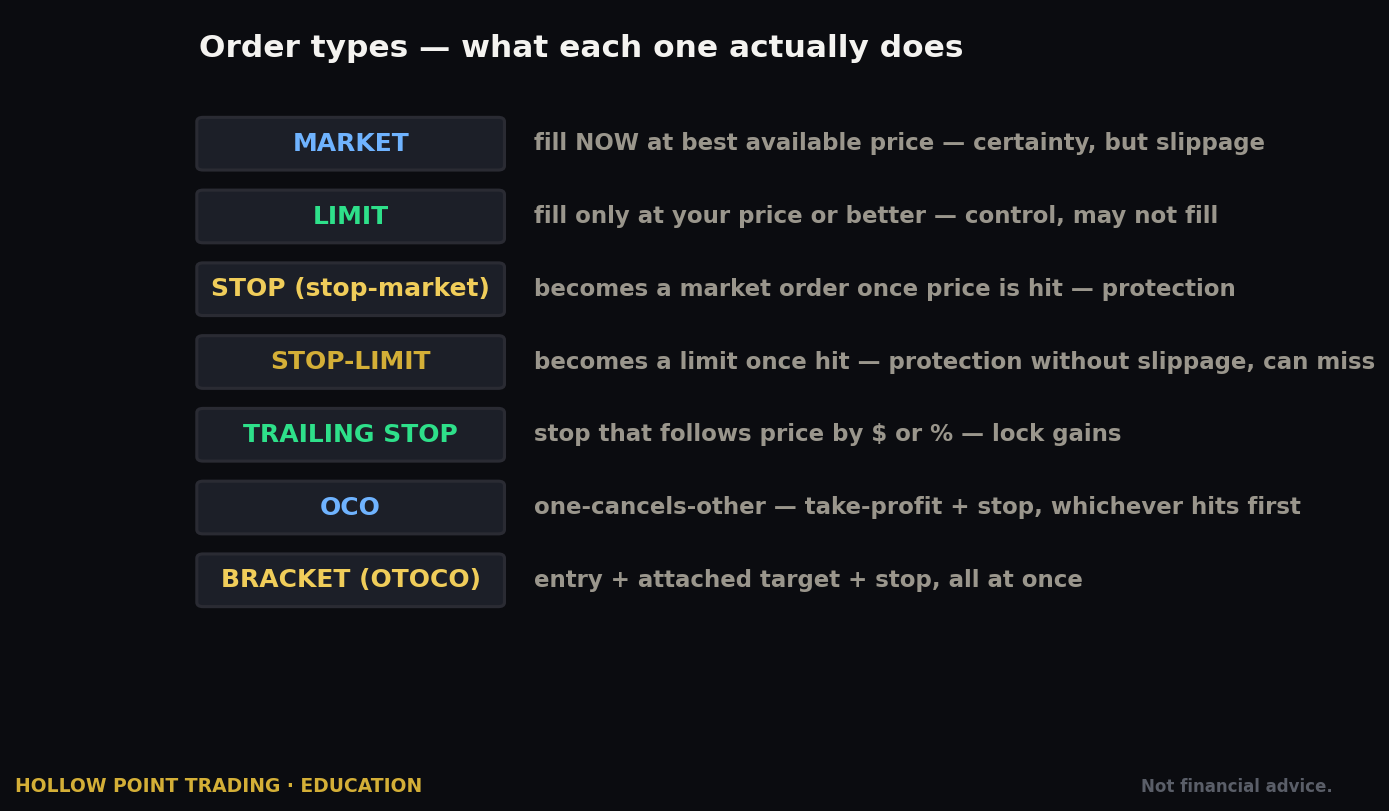
- Market — immediate fill at the best available price.
- Limit — fills only at your price or better.
- Stop loss (a "stop") — a trigger price that, once touched, converts your order into a market order. It protects a position, but it fills at whatever price the market offers the moment it triggers. In a fast drop or a gap-down open, that fill can be well below your stop price — the stop guarantees you get out, not the price you get out at.
- Stop limit — a trigger price that converts into a limit order instead of a market order. This protects you against a terrible fill, but it introduces the opposite risk: if price gaps straight past your limit, the order sits unfilled and you are still holding a position you meant to exit. Stop-limits protect price at the cost of certainty; plain stops protect certainty at the cost of price.
- Trailing stop loss — a stop that automatically follows the price by a fixed dollar amount or a percentage, ratcheting up as the stock rises and locking in gains, then triggering (as a market order) if price reverses by your trail amount. Set a $2 trailing stop on a stock at $50; as it climbs to $60 the stop trails up to $58; if it then drops $2 to $58, you are out with the gain protected.
- Trailing stop limit — identical trailing behavior, but converts to a limit order when triggered, inheriting the same "might not fill on a gap" caveat.
Time in Force and Special Instructions
Day, GTC, and custom TIF (up to 180 days on eligible securities). Certain order types also support fill-or-kill (fill the entire order instantly or cancel it), immediate-or-cancel (fill what you can instantly, cancel the rest), and all-or-none (fill the entire quantity or none of it) on eligible orders. Verify which special instructions are available on your specific ticket, as they depend on order type and security.
Conditional (Advanced) Orders — The Real Power Tools
Fidelity offers four conditional order types on the active platforms, and these are what make it a discipline machine rather than a mere order-entry form.
1. Contingent — triggers an order when a condition you define is met. The condition can be based on the security itself or on up to 40 selected indexes, using any of eight trigger values: last trade, bid, ask, volume, percent change up, percent change down, 52-week high, or 52-week low. When the trigger fires, it places a market, limit, stop, or trailing-stop order that you pre-specified. Worked example: you hold a semiconductor stock but you know it trades with the broad tape. You set a contingent order: "If the S&P 500 index falls 1.5% intraday, sell my 200 shares at market." Your exit is now tied to a macro condition you cannot watch every second, and it executes without you.
2. One-Triggers-the-Other (OTO) — a primary order that, once it executes, automatically activates a secondary order. Worked example: you place a limit order to buy 100 shares at $48. Attached as the secondary is a stop-loss at $46. The stop does not exist in the market until your buy fills — the instant you are filled at $48, the $46 stop goes live automatically. You never hold an unprotected position, and you never forget to place the stop in the adrenaline of a fill.
3. One-Cancels-the-Other (OCO) — two live orders where filling either one automatically cancels the other. Worked example: you already own 100 shares from $48. You place two orders as an OCO pair: a profit-target limit to sell at $54, and a protective stop to sell at $46. Both sit live. Whichever hits first executes and instantly kills the other, so you are never accidentally left with a naked stop after your target fills or vice versa. This is a bracket exit on an existing position.
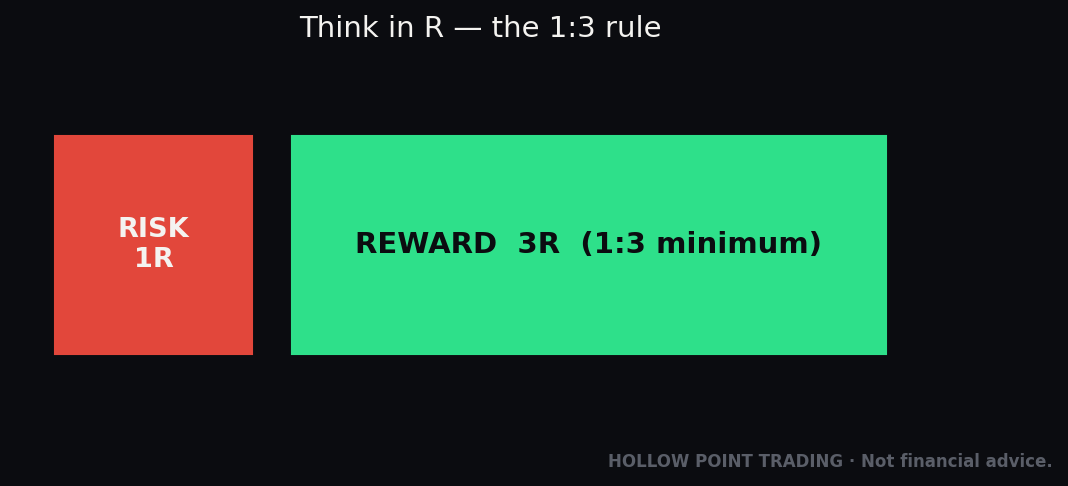
4. One-Triggers-a-One-Cancels-the-Other (OTOCO) — combines OTO and OCO into a single ticket. A primary entry order that, when filled, automatically launches a bracket — a profit-target and a protective stop — where filling one cancels the other. Worked example: the complete trade in one ticket. Buy limit at $48. On fill, a sell limit at $54 (your 1:3 target) and a sell stop at $46 (your risk) both go live as an OCO pair. Enter here, target there, stop below, every leg automated at the moment you commit — before a single tick of price action has a chance to talk you out of your own plan.
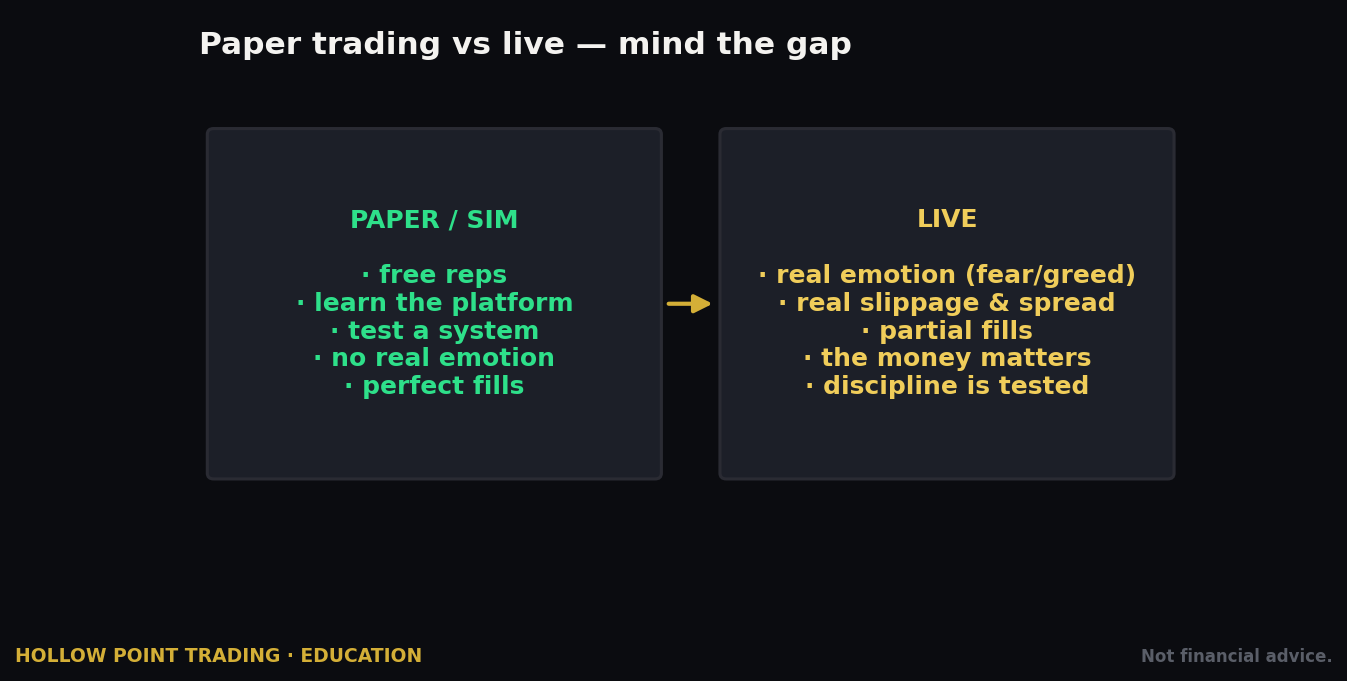
For an HPT-style trader, OTOCO is the discipline machine, and building the habit of trading in brackets is one of the highest-leverage things Fidelity's order menu makes possible. Your entry, your 1:3 reward-to-risk target, and your stop all go in as a single order at the exact moment of the trade — before emotion, before the P&L starts ticking, before your brain starts inventing reasons the loser will come back. The plan then executes itself. This is the direct antidote to the single biggest failure mode in all of active trading: moving your stop lower because you "feel" the trade is about to reverse in your favor. When the stop is a live OCO leg placed at entry, moving it requires a deliberate, conscious act of sabotage — which is exactly the friction you want between yourself and your worst instinct.
Fidelity also supports directed trading in ATP — manually routing an order to a specific market center rather than letting the smart router choose — and conditional orders on options, not only stocks. The multi-leg conditional-options experience is, once again, where you feel that Fidelity is not built options-first; it works, but it is clunkier than doing the same thing on a dedicated options platform.
Fees, Commissions & the Payment-for-Order-Flow Reality
This is Fidelity's strongest chapter, so let us be precise rather than promotional.
Stocks and ETFs: $0 commission on online U.S. stock and ETF trades. A small number of ETFs carry a transaction-based service fee — verify per fund, but for the household-name ETFs it is zero.
Options: $0 base commission plus $0.65 per contract. A 5-contract order costs $3.25 total. There is a genuinely nice touch: if you place a buy-to-close order at $0.65 or less per contract, the per-contract fee is waived, so closing out near-worthless short options to clear risk off your book costs you nothing. Standard regulatory fees — the Options Regulatory Fee, and on all sales a small activity assessment fee — apply on top. These are pennies, but they exist and you will see them on the confirmation.
Mutual funds: Fidelity offers its own funds, including several zero-expense-ratio index funds — the FZROX (total U.S. market) and FZILX (international) family — with no transaction fee and, literally, no annual expense ratio. Non-Fidelity funds may carry transaction fees; verify per fund.
No account fees, no inactivity fee, and no minimum on standard brokerage accounts. You can open one, fund it with $50, trade twice a year, and pay nothing for the privilege of the account existing.
The Payment-for-Order-Flow Story — Why This Actually Matters
Here is the part that genuinely separates Fidelity from the pack, and that every serious trader should understand mechanically rather than as a slogan.
Payment for order flow (PFOF) is the practice where a broker sells your order to a wholesale market maker, who pays the broker for the right to fill it. That market maker then profits on the spread between what it pays to buy and what it sells for. The structural concern is a misaligned incentive: your broker gets paid based on who pays the most for your flow, which is not necessarily who fills you at the best price. A "$0 commission" broker that sells all its flow may be quietly earning more from your order than a commission ever would have cost you, and you would never see it, because the cost is hidden inside a slightly worse fill.
Fidelity does not accept payment for order flow on stock and ETF orders. This is rare among major retail brokers, and it is not marketing — it changes how your orders are physically routed. Instead of selling your flow to the highest bidder, Fidelity routes across as many as roughly 50 market centers seeking the best available price, and it competes on price improvement — actively filling you better than the quoted national best bid or offer.
The results are publicly reported and auditable, not self-graded. Fidelity has cited billions of dollars in aggregate price improvement delivered to clients, and on the order of roughly $26 of average improvement on a representative 1,000-share equity order versus the national best bid/offer. On any single small trade, that improvement is lunch money and easy to dismiss. Across thousands of trades over a full trading career, it is real, compounding edge — and it is edge you capture for free, purely by virtue of where you chose to route. You did not have to predict anything or time anything. You just picked the broker that fills you well.
The honest caveat, stated plainly: the no-PFOF policy applies to equities — stocks and ETFs — not to options. Fidelity does accept payment for order flow on options orders, as nearly all brokers do. So the "cleanest execution in the industry" claim is specifically a stock-and-ETF claim, and you should not extend it in your head to your options fills. For an equity-and-ETF trader, though, this is a legitimate, measurable, publicly documented reason to prefer Fidelity: on your stock trades, you are not the product.
Margin, Account Types & the Pattern Day Trader Rule
Margin, Two Ways
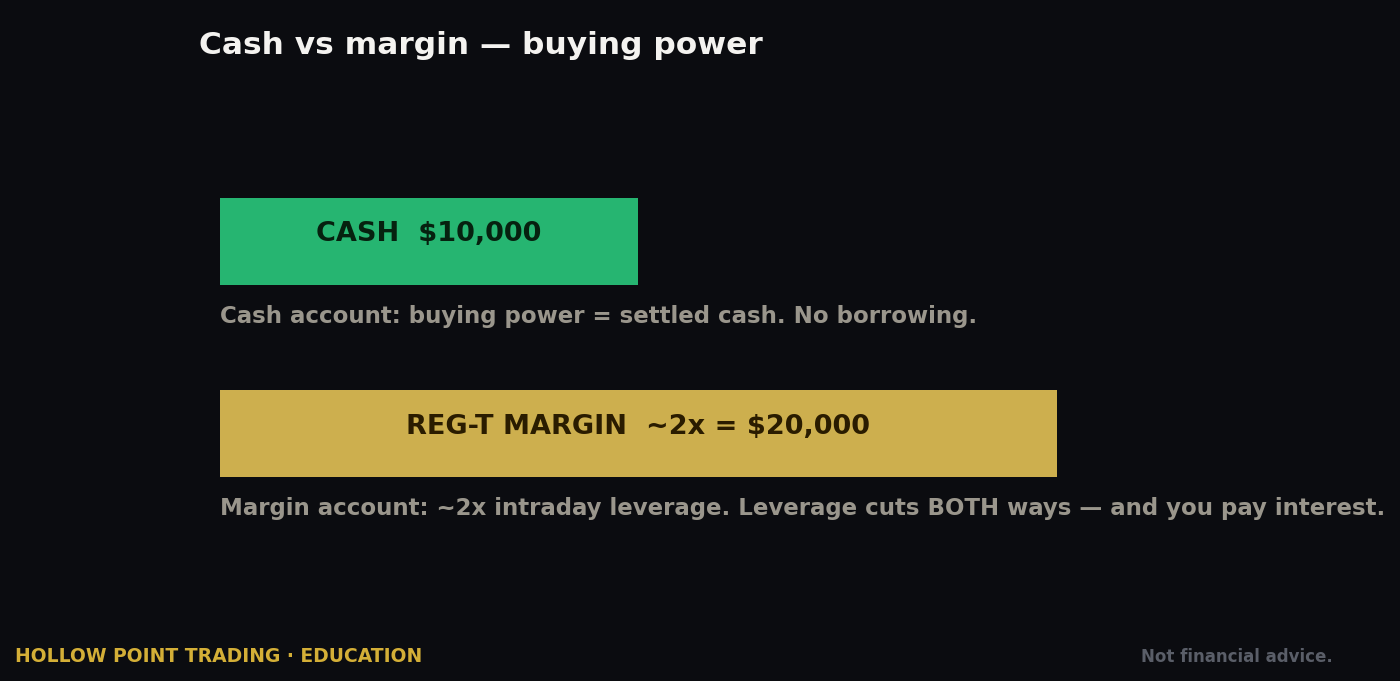
A margin account lets you borrow against your securities — to buy more than your cash allows, or simply to trade without waiting for cash to settle. Fidelity's margin is standard in its mechanics: you need $2,000 minimum equity to borrow, and interest accrues daily on the borrowed balance. Fidelity's margin rates are tiered by the size of your borrow and float with a base rate that itself moves with the Fed — the base rate has recently sat around ~10.5%, with the effective rate you pay stepping down as your balance grows; verify the current published schedule. Margin rates are Fidelity's least competitive area, and if you routinely borrow large amounts, several competitors undercut them meaningfully.
The crucial conceptual split, and the one beginners miss: margin is two different tools wearing one name.
First, margin is a leverage tool. You borrow to control a larger position than your cash supports, which amplifies gains and — identically, symmetrically, without mercy — amplifies losses. Leverage also introduces the margin call: if your account equity drops below the maintenance requirement (commonly 25–30% of the position value, higher on volatile names), Fidelity can require you to add cash or can force-liquidate your positions to cover, sometimes without advance warning and usually at the worst possible moment. Leverage is an advanced tool that has ended more accounts than any single bad trade ever has.
Second, margin is a settlement convenience. In a margin account you can trade with unsettled proceeds and avoid the good-faith-violation problem entirely, because you are not constrained by cash settlement. You can sell a stock and immediately redeploy the proceeds into a new trade without waiting for T+1.
For a beginner, the honest guidance is to treat margin's settlement convenience as the genuinely useful, low-risk part — it just makes an active account trade smoothly — and to treat leverage as an advanced capability you deliberately keep switched off in your head until you have real experience and a real reason to use it.
IRA "Limited Margin"
IRAs cannot use traditional margin, because borrowing inside a tax-advantaged retirement account is prohibited. But Fidelity offers limited margin in IRAs, which is a clever, narrower thing: it lets you trade with unsettled proceeds and sidestep cash-account settlement restrictions without actually borrowing any money. It captures the settlement-convenience half of margin without the leverage half. It requires maintaining $25,000 or more in the account. This is precisely how active traders run options and stocks nimbly inside an IRA — recycling capital fast across intraday and multi-day trades — without constantly tripping good-faith violations.
The Pattern Day Trader (PDT) Rule
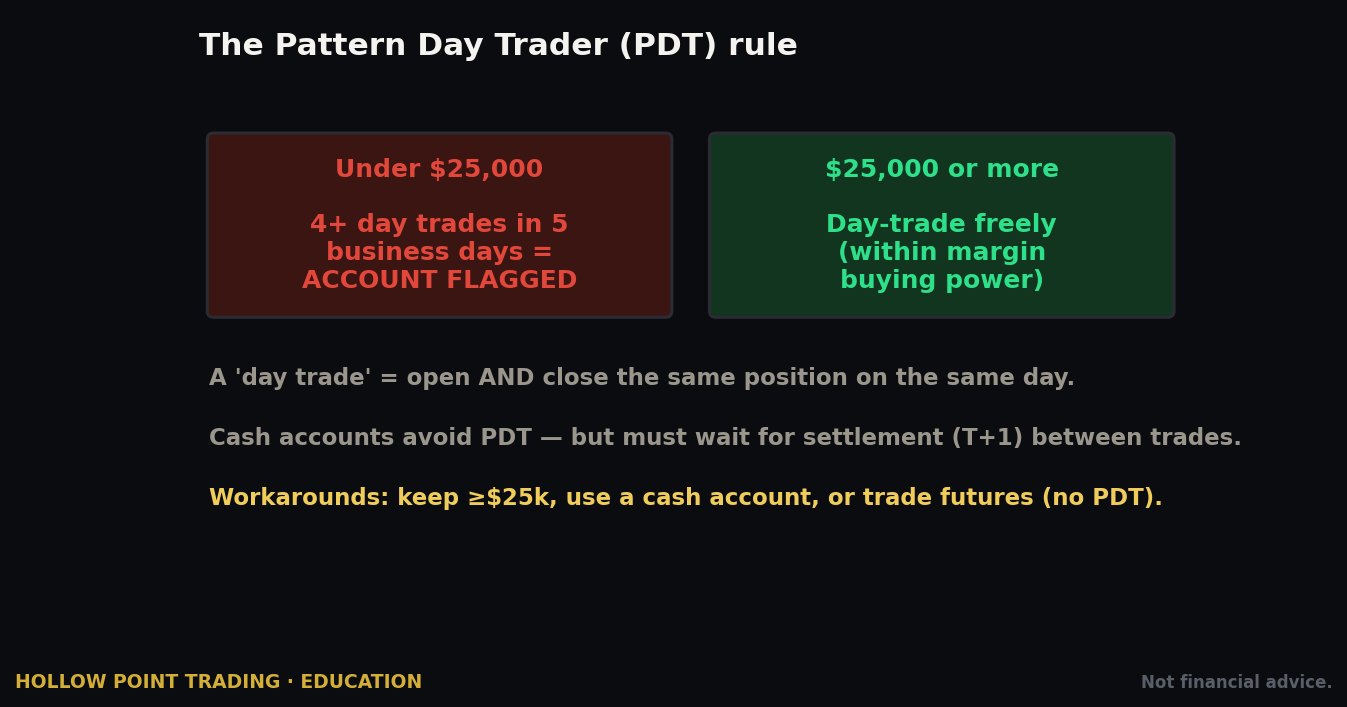
First, the most important clarification: the PDT rule is a FINRA rule, not a Fidelity rule. It applies identically at every U.S. broker, so you cannot escape it by switching brokers. The classic version: if you execute four or more day trades (opening and closing the same security within the same trading day) within any rolling five-business-day window in a margin account, and those day trades represent more than 6% of your total trading activity in that window, you are flagged a Pattern Day Trader and must maintain $25,000 in minimum equity. Drop below $25,000 and your day-trading ability is restricted until you top the account back up.
The important 2026 development: FINRA and the SEC approved changes to the intraday-margin framework, with new rules phasing in around June 2026 and firms given up to roughly 18 months to fully implement. The headline change is that the flat $25,000 PDT minimum is being modernized — under the new approach there is no automatic $25,000 gate to day-trade on margin (a $2,000 minimum still applies), replaced by a more risk-based framework that ties your intraday buying power to your actual account risk rather than a single blunt number. Because this is mid-rollout as of this writing, do not assume Fidelity has implemented it yet — verify the current day-trading rules on your specific account before you rely on them. The safe planning assumption today remains the classic $25k rule until Fidelity explicitly confirms otherwise for your account.
The workaround that is not really a workaround: a cash account is not subject to the PDT rule at all, because there is no margin and therefore no day-trade counting. But you are then constrained by settlement — you can only trade with settled funds, and under T+1 that caps how fast you can recycle the same capital. For a small account under $25,000, a cash account sidesteps PDT entirely at the cost of settlement speed: you can effectively make roughly as many round trips as you have separate tranches of settled cash. Many small-account active traders deliberately run a cash account for exactly this reason.
How Fidelity Behaves Across Market Regimes
A broker is not a static thing you evaluate once. Its strengths and weaknesses become more or less relevant depending on what the market is actually doing, and thinking about it regime by regime is how a professional decides which platform to route which trade through.
In a Calm, Trending Market
When volatility is low and the tape trends smoothly, execution quality matters least in absolute dollars — spreads are tight everywhere, so even a mediocre router fills you close to fair value. But this is exactly the regime where Fidelity's other strengths shine and where you should be leaning into the platform's core. Idle cash sitting in SPAXX earns steadily. Fractional shares let you dollar-cost-average precise amounts into your core positions. OTOCO brackets let you set trend-following trades and walk away, trailing your stop up as the trend carries. A calm trend is the regime where Fidelity feels effortless and where the "investing home" identity does its best work.
In Choppy, Range-Bound Conditions
Chop is where discipline matters more than firepower. You are getting whipsawed, false breakouts abound, and the temptation to overtrade and move stops is at its peak. Fidelity's conditional orders earn their keep here: OCO brackets on existing positions let you define both edges of the range and let the market pick your exit, rather than you emotionally guessing. The limit-order discipline the platform quietly encourages keeps you from chasing the fake breakouts a market order would happily fill you on at the worst price. Chop is where the tooling philosophy of Fidelity — plan the trade, bracket it, let it execute — protects you from yourself.
In High-Volatility, Fast Markets
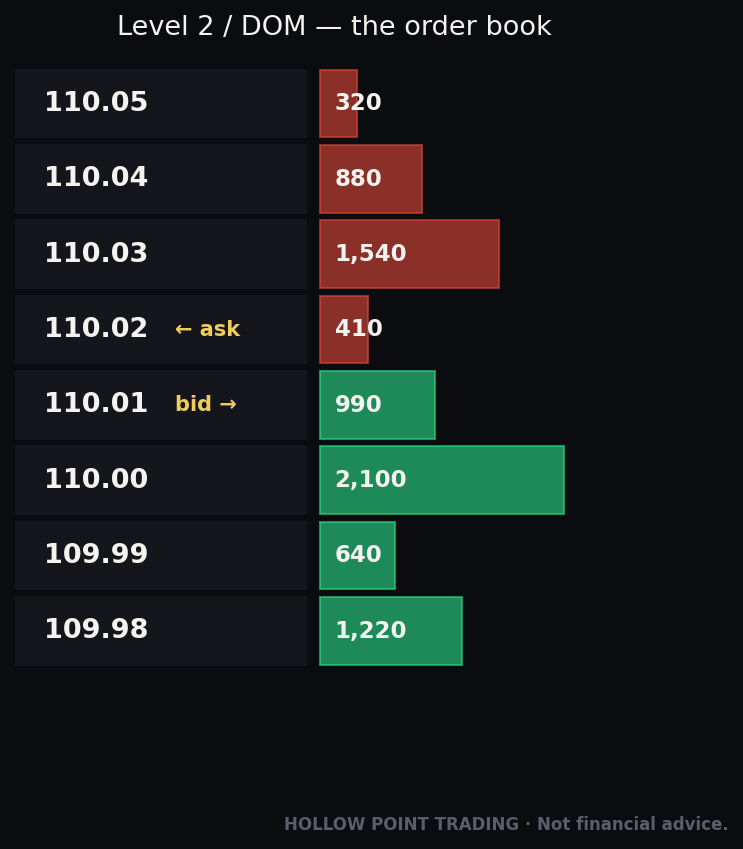
This is where execution quality stops being lunch money and starts being real. When spreads blow out and price is moving fast, the difference between a broker that sells your flow and a broker that fights for price improvement across 50 market centers can be many cents per share on a single fill. Fidelity's no-PFOF equity routing is most valuable precisely when the market is chaotic and every basis point of fill quality is under pressure. Two cautions in this regime, though: first, plain stop orders convert to market orders and can fill far below your stop on a violent drop — in genuinely fast conditions, understand that a stop protects your exit, not your price. Second, this is the regime where margin calls happen and where leverage destroys accounts, so if you carry margin, high-vol is when you most want it switched off.
Multi-Timeframe / Multi-Horizon: One Login, Every Time Horizon
Most brokers force you to pick a time horizon and live there. Fidelity's genuine architectural advantage is that it serves every horizon of your trading life from a single login, and using it well means matching the account, surface, and order type to the horizon of the trade.
The decades horizon — retirement and long-term compounding — lives in your Roth and Traditional IRAs, held in zero-expense-ratio index funds and dividend compounders, managed on the web, rebalanced a few times a year. You barely touch it. It quietly benefits from Fidelity's cheap fund lineup and clean execution on the occasional rebalance.
The months-to-years horizon — your macro and sector-rotation swing positions, the core of the "investor half" — lives in your taxable brokerage account, built with limit orders and often OTO stops, monitored on the web, tuned as your top-down thesis evolves.
The days-to-weeks horizon — your active swing trades — lives in the same taxable account but managed in Active Trader Pro, entered with OTOCO brackets so entry, target, and stop are all defined at commitment, and watched on mobile when you are away from the desk.
The intraday horizon — day trades and scalps — is where Fidelity's ceiling shows. It is fully capable for equity day trading in ATP, subject to the PDT rule if you are on margin, but for the fastest, most tooling-dependent intraday work (especially options and, of course, futures) you will feel the platform's limits. The right move is not to fight it — it is to run intraday equity trades here and route the tooling-hungry intraday options and all futures elsewhere.
The professional skill is not loyalty to one surface; it is fluency in matching horizon to tool, all under one roof for the equities and funds, and knowing precisely where the roof ends.
Confluence: How Fidelity Combines With Other Tools
No serious trader uses one tool for everything, and Fidelity's honest weaknesses are best solved not by leaving Fidelity but by pairing it deliberately with two or three complementary tools. This is the "confluence" idea applied to your toolkit rather than to a chart.
Fidelity + TradingView (the charting layer)
ATP's charting is competent but not elite, and serious chart work — the multi-timeframe HPT ladder, custom Pine indicators, precise drawing — belongs in TradingView. The clean workflow: analyze and mark up in TradingView, decide your entry/stop/target on the chart, then execute the trade in Fidelity where the fill quality is superior. You are using each tool for the thing it is best at — TradingView for the read, Fidelity for the fill. The two do not talk to each other automatically, so this is a manual hand-off, but it is the standard professional stack for a chart-driven equities trader who wants Fidelity's execution.
Fidelity + thinkorswim (the options-analytics layer)
For a trader who runs meaningful options complexity, the honest confluence is to do your analysis in thinkorswim — its probability modeling, spread P/L visualization, and options-native charting are a generation ahead — while keeping your long-term core and your equity trading at Fidelity. Some traders even keep a small funded Schwab account purely as an options-analytics workbench, then decide whether to execute the option at Fidelity (accepting thinner tools but keeping everything under one roof) or at Schwab (better options tooling, options PFOF at both anyway). The point is to stop demanding that Fidelity be an options-analytics powerhouse it was never built to be, and to pair it with the tool that is.
Fidelity + a dedicated futures broker (the hard requirement)
This is not optional confluence; it is a structural necessity for anyone trading futures. Fidelity offers no futures at all, so an NQ or ES trader must keep a separate futures broker. The healthy way to frame it: let Fidelity be the home for your long-term wealth, your cash management, and your equity/ETF trading, and let a purpose-built futures platform (with a real futures charting and DOM environment) handle the futures edge. Trying to force Fidelity to be your one-and-only broker is the mistake; using it for exactly what it is elite at, alongside specialists for the rest, is the professional configuration.
Strengths & Weaknesses vs Peers
Where Fidelity clearly wins:
- Execution quality and no PFOF on stocks/ETFs. Measurable, publicly reported price improvement across ~50 market centers. This is the flagship advantage and it is genuinely real, not marketing.
- Cash management. Idle cash auto-earns a money-market yield via SPAXX as the core position — you do not lift a finger. Most brokers pay near-nothing on default cash and quietly keep the yield. (Detailed below.)
- Cost of ownership. Zero-expense-ratio index funds, no account fees, no inactivity fee, cheap everything for a buy-and-hold core.
- Fractional shares across thousands of stocks and ETFs, dollar-based, $1 minimum.
- Research. Deep third-party research reports, robust screeners, analyst estimates and data — strong for fundamental and top-down macro work.
- One roof. Long-term investing and active equities trading genuinely coexist under one login. Most people never need a second account for the equity and fund side of their life.
Where Fidelity clearly lags:
- Options analytics. The chain and Greeks are all present, but the analytical and visualization layer trails thinkorswim badly — probability modeling, spread P/L curves, options backtesting are thin or absent. Options-first traders feel this every day.
- No futures. None whatsoever. If you trade NQ, ES, CL, or any futures, Fidelity simply cannot host it. This is a hard stop and the single biggest reason an HPT-style NQ trader keeps a separate broker.
- Charting. ATP's charting is competent but no TradingView; serious chart work still happens elsewhere.
- Margin rates. Among the higher rates for smaller borrow balances.
- Interface polish on ATP. Powerful but dated and dense, with a real learning curve, and it visibly looks its age.
The clean one-line summary: Fidelity is the best home for the investor-half and the equities-trader-half of your life, a capable-but-not-elite home for the options-trader-half, and no home at all for futures.
Fractional Shares, Cash Sweep & Interest
Two features deserve their own spotlight because they quietly and continuously improve the experience of keeping money at Fidelity.
Fractional Shares ("Stocks by the Slice")
Fidelity lets you buy dollar amounts rather than whole shares across thousands of U.S. stocks and ETFs, with a $1 minimum. On the trade ticket, switch the quantity field from shares to dollars, enter $50, and Fidelity buys $50 worth — the fraction included — commission-free.
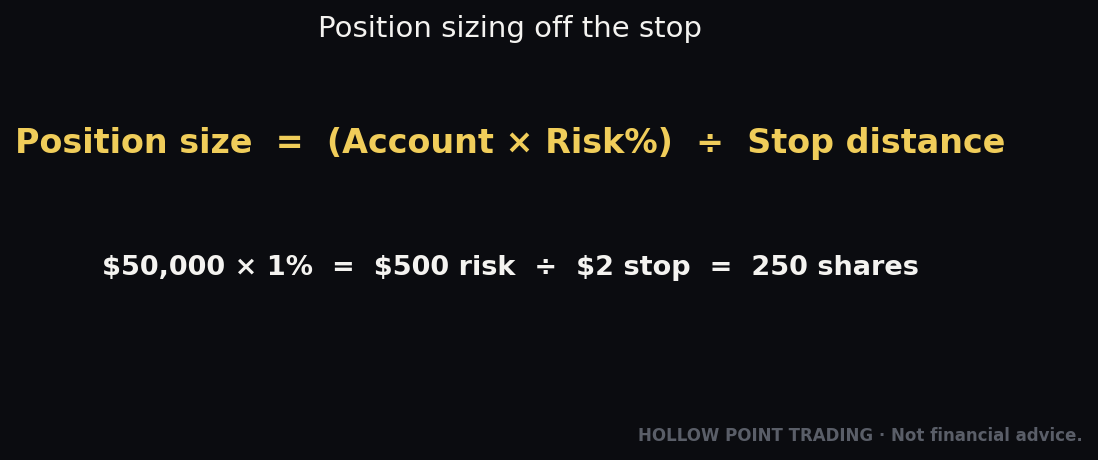
This does two genuinely useful things. First, it makes position-sizing precise. If your plan says put exactly $1,000 of risk-adjusted capital into a stock trading at $912, you can do exactly that instead of choosing between one share ($912) and two ($1,824). For disciplined position-sizing, dollar-based orders are a real edge. Second, it makes dollar-cost-averaging into expensive names trivial — you can put $100 into a four-figure stock every payday and accumulate a real position over time without ever being priced out.
Two caveats to verify on the ticket: fractional-share orders have handling nuances — they frequently execute as market orders and do not support every advanced order type — so for a fractional entry where price precision matters, understand you may not get a limit. Verify the current constraints before you rely on them.
Cash Sweep & Interest — The Underrated Edge
This is one of Fidelity's most underrated advantages and one almost every beginner ignores. Your uninvested cash goes into a core position you choose:
- SPAXX (Fidelity Government Money Market Fund) — a money market fund paying a yield that tracks short-term interest rates. It is not FDIC-insured (it is a fund, covered instead by SIPC up to limits), but historically it pays a meaningfully higher yield than a bank sweep, and government money-market funds are among the most stable instruments in existence.
- FDIC-Insured Deposit Sweep — your cash swept into partner banks, FDIC-insured up to limits, but typically paying a lower yield than SPAXX.
Here is why this matters so much. At many brokers, idle cash earns essentially nothing unless you manually buy a money fund and manually sell it before you trade — friction that most people never bother with, leaving thousands of dollars earning zero. At Fidelity, choosing SPAXX as your core means every dollar sitting between trades is automatically earning a competitive yield, and it remains instantly available to trade with — you do not have to sell anything first; buying a stock just draws down the core. For an active trader who naturally holds cash between setups (which, if you are disciplined, is most of the time), that is yield you would otherwise leave lying on the table for no reason.
Worked example: an active trader keeps an average $40,000 in cash between setups over a year. At a SPAXX yield of, say, 4%, that idle cash earns roughly $1,600 over the year — automatically, on money that was doing nothing but waiting. In an FDIC sweep at 2%, the same cash earns half that. That gap is a real, risk-free difference produced by a single setting most people never look at. Understand the FDIC-vs-fund distinction, choose deliberately, and for most traders prioritizing yield on trading cash, the money-market core is the common pick. Verify current core-position options and yields — both change with rates.
How the Pros Use Fidelity Differently From Beginners
The same platform, in two different pairs of hands, produces two completely different experiences. The gap is almost never about knowing a secret feature — it is about habits of use.
Beginners route market orders; pros route limits and read the fill. A beginner types the ticker, hits Buy, hits market, and clicks through. A professional sets a limit at a level that came from an actual read, previews the order, places it, and then checks the fill price against the limit to confirm the price-improvement edge actually showed up. The pro treats every fill as data.
Beginners place entries; pros place brackets. The beginner buys and then thinks about a stop, usually after the position is already moving against them and their judgment is compromised. The professional builds the entire trade as an OTOCO — entry, target, stop — in one ticket, at the moment of decision, when their judgment is clean. The stop exists before the emotion does.
Beginners ignore the core position; pros optimize it. The beginner has no idea whether their cash is in SPAXX or an FDIC sweep and leaves real yield uncollected for years. The professional checks it on day one, chooses deliberately, and treats between-trade cash as a working asset rather than dead money.
Beginners over-apply for options levels; pros match the level to the strategy. The beginner reaches for Level 4 because "more access is better," then finds themselves holding an undefined-risk position they do not understand. The professional applies for exactly the level their actual strategies require — usually Level 2 — and grows the approval only when a real, understood strategy demands it.
Beginners fight the platform's identity; pros exploit it. The beginner is frustrated that Fidelity's options tools are not thinkorswim and that there are no futures, and wastes energy resenting it. The professional knows exactly what Fidelity is elite at — equity execution, cash, cost of ownership, one-roof convenience — routes those trades here, and cheerfully keeps a second broker for the futures and a second tool for the options analytics. The pro does not demand one platform be everything.
Beginners react to rules; pros plan around them. The beginner discovers the PDT rule by getting flagged. The professional knows before opening the account whether they will run cash or margin, sizes the account with the $25k threshold in mind, and plans their trade cadence around settlement. Rules are inputs to the plan, not surprises.
Common Beginner Mistakes on Fidelity
1. Trading in the wrong account. Multiple accounts — taxable, Roth, Traditional — all appear under one login, and the ticket does not care which one you meant. A trade you intended for the taxable account executed in the Roth, or vice versa, can carry tax consequences you cannot undo. Confirm the account field on every ticket before anything else.
2. Using market orders by default. Fidelity's price improvement is excellent, but on a thin or fast-moving name a market order still costs you real money by filling away from where you saw the quote. Default to limit orders and reserve market orders for genuine emergencies on liquid names.
3. Ignoring the core position. Leaving cash in a low-yield FDIC sweep when SPAXX would pay more — or, more commonly, having no idea which one you are even in. This is free money left uncollected. Check it and choose deliberately.
4. Applying for too high an options level. Overstating your experience to reach Level 3 or 4 hands you access to strategies with undefined or unlimited risk that you do not yet understand. Match your approval to the strategies you can actually explain and manage. The application is not a videogame difficulty setting to max out.
5. Not using OTOCO / bracket orders. Placing an entry with no attached stop and no attached target means you manage every exit manually, in real time, with your emotions fully engaged and your P&L flashing. Bracket the trade at entry and let the plan run itself.
6. Good-faith violations in a cash account. Buying with unsettled proceeds and then selling before the original sale settles gets you flagged, and three flags in a year restricts the account. Know whether you are in a cash or margin account, and know what is actually settled before you redeploy proceeds.
7. Assuming the PDT rules have not changed. With the 2026 intraday-margin rule transition underway, the day-trading treatment of your account is genuinely in flux. Do not rely on either the old $25k assumption or a new framework you have not confirmed — verify the current, actual rule on your specific account.
8. Expecting thinkorswim-grade options tools. They are not here, and no amount of digging will find them. Do your options analysis knowing Fidelity gives you accurate data, not deep modeling — and bring a second tool if you need the modeling.
9. Misreading a stop as a price guarantee. A stop-loss converts to a market order when triggered; in a fast drop it can fill well below your stop price. Beginners set a stop, feel protected at that exact price, and are shocked by the fill. Understand the stop-versus-stop-limit tradeoff before you rely on either.
10. Chasing illiquid options. Buying a contract with a wide bid/ask spread and low open interest means you lose value the instant you enter, and you may struggle to exit at all. Beginners look only at the option's price; professionals look at the spread and open interest first. Prioritize liquid contracts.
11. Treating margin's leverage and its settlement convenience as the same thing. Beginners either avoid margin entirely and suffer settlement friction, or embrace leverage without understanding margin calls. The two halves are separable — use the convenience, respect the leverage.
12. Neglecting the preview screen. The Preview Order screen is your last checkpoint, and clicking through it reflexively is how fat-finger errors — wrong quantity, wrong side, wrong symbol — become real losses. Read the preview, every single time. It exists precisely to save you.
Frequently Asked Questions
Is Fidelity really free? Where's the catch? Stock and ETF trades are genuinely $0 commission with no account fees, and there is no hidden PFOF catch on equities — Fidelity does not sell your stock flow. The real costs, where they exist, are the $0.65-per-contract options fee, margin interest if you borrow, transaction fees on some non-Fidelity mutual funds, and small regulatory fees. For a cash equities trader, it is about as close to free as brokerage gets.
Can I trade futures on Fidelity? No. Fidelity offers no futures or futures options at all. For NQ, ES, or any futures you need a separate, dedicated futures broker. This is a hard architectural limit, not a settings issue.
What options level should I apply for? For most retail traders, Level 2 is the target — it unlocks buying calls and puts and writing cash-secured puts, which covers the vast majority of directional retail options trading. Apply higher only when a specific, understood strategy (spreads, etc.) genuinely requires it.
SPAXX or the FDIC sweep for my core position? For most traders prioritizing yield on cash that is still instantly available to trade, SPAXX (the money-market fund) is the common choice — higher historical yield, SIPC-covered, very stable. Choose the FDIC sweep if FDIC insurance specifically matters more to you than the yield difference. Verify current yields, which move with rates.
Do I need Active Trader Pro, or is the website enough? If you place considered, planned trades and manage a long-term portfolio, the website is genuinely enough. Download ATP when you want streaming real-time data, Level II depth, faster conditional-order entry, hotkeys, and a customizable multi-window layout — i.e., when you are actively trading rather than investing.
How do I avoid the Pattern Day Trader rule with a small account? Trade in a cash account rather than a margin account — the PDT rule does not apply to cash accounts. The tradeoff is settlement: you can only trade with settled funds under T+1, which limits how fast you recycle the same capital. Note the PDT framework itself is changing in 2026; verify current rules.
Will price improvement actually make a difference for me? On any single small trade, it is a few dollars — negligible. Across a full trading career of thousands of trades, the compounding effect of consistently better fills is real and meaningful, and it costs you nothing to capture. It is a quiet structural edge, not a per-trade windfall.
Can I run options strategies inside my IRA? Yes, within the more conservative IRA approval tiers (up to defined-risk spreads and iron condors at Level 3) and with no naked/undefined-risk writing allowed. Add limited margin (requires $25k) to trade nimbly with unsettled proceeds without borrowing.
Does Fidelity charge to move my account in from another broker? No — and Fidelity frequently reimburses the transfer-out fee your old broker charges (often around $75) if you ask. Incoming ACATS transfers take roughly a week and move your positions in-kind so you do not trigger taxes by selling.
Quick-Start Cheat-Sheet
Open & fund: Pick the account type (taxable brokerage / Roth IRA / Traditional IRA) → apply → answer suitability questions honestly (they set your options level) → link bank via ACH → deposit → choose SPAXX or the FDIC sweep as your core position so idle cash earns yield.
First trade: Trade → confirm the account → enter symbol → Buy → quantity (or switch to dollars for fractional) → Limit order (your default discipline) → set price → Day or GTC → Preview (read it) → Place → verify the fill price in Positions.
Order types at a glance: Market (now, any price) · Limit (your price or better — default) · Stop (trigger → market) · Stop-limit (trigger → limit, may not fill on a gap) · Trailing stop (follows price, locks gains). Conditional: Contingent · OTO · OCO · OTOCO — use OTOCO to place entry + target + stop as one bracketed ticket.
Options: Apply for approval → Level 2 unlocks buying calls/puts for most retail → find the Option Chain → pick expiration → read bid/ask spread, open interest, IV, and the Greeks (delta, gamma, theta, vega) → prioritize liquid contracts (tight spreads, high open interest) → mind IV before events.
Fees: $0 stocks/ETFs · $0 + $0.65/contract options (buy-to-close ≤ $0.65 waives the fee) · no PFOF on equities (price improvement across ~50 market centers instead) · SPAXX core earns yield on idle cash · zero-expense-ratio Fidelity index funds.
Rules to respect: PDT = $25k equity in a margin account for 4+ day trades in 5 business days (framework modernizing in 2026 — verify current) · a cash account avoids PDT but is capped by T+1 settlement · margin amplifies losses and can trigger forced-liquidation calls · good-faith violations bite in cash accounts.
Regime notes: Calm trend → lean on brackets, fractional DCA, SPAXX yield. Chop → let OCO brackets pick your exits, do not chase. High-vol → price-improvement matters most, stops fill worse than expected, keep leverage off.
Platform: Web for research + considered trades · Active Trader Pro for active trading, streaming, Level II, and conditional orders · mobile for managing on the road. Pair with TradingView for charts and a futures broker for NQ/ES.
The HPT read on Fidelity: it is the broker that fights for your fill and pays you to hold cash, wrapped in tooling that respects a long-term investor more than an options gunslinger, and offers a futures trader nothing at all. Build your core here — retirement, index funds, dividend compounders — and let the zero-expense funds and clean execution do their quiet work. Trade equities and ETFs here with the confidence that your fills are genuinely elite and that you are not the product on your stock orders. Grow into options here knowing, honestly, that you will outgrow the analytics before you outgrow the platform, and that pairing it with a real options-analysis tool is the professional move, not an admission of defeat. And if your active edge is futures, keep a dedicated futures broker for that and let Fidelity do the several things it does better than almost anyone. Route smart, bracket every trade at entry, optimize the core position on day one, and let the price improvement compound quietly in the background of a trading career.
Menus, tiers, rates, and rules described here change — Fidelity ships updates constantly and 2026 brings live regulatory rule transitions in the day-trading framework. Verify the current screen and the current rule before you act on any specific path or number in this guide.
Bound by rules, feared by trade.