
You bought an option. You were right about the direction. The stock moved your way. And somehow… you still lost money.
If that has ever happened to you — or if you're smart enough to want to avoid it before it happens — then you've just met the reason we're here today. That invisible force that reached into your trade and drained value even though you called the move correctly has a name. It's called Vega, and it might be the most misunderstood idea in all of beginner options trading.
Here's the good news: Vega is not complicated once someone explains it in plain English instead of Greek letters and textbook formulas. By the time you finish this guide, you'll understand exactly what Vega is, why fear literally makes options more expensive, and how to spot the trap that catches almost every new trader at least once. You'll be able to use this on Monday.
Let's build it from the ground up.
First, What Even Is an Option? (The 60-Second Version)
Before we talk about Vega, we need to make sure we're standing on solid ground. If you already know what an option is, skim this — but don't skip it, because the whole point of this guide is that nobody gets left behind.
An option is a contract. It gives you the right, but not the obligation, to buy or sell a stock at a specific price, before a specific date.
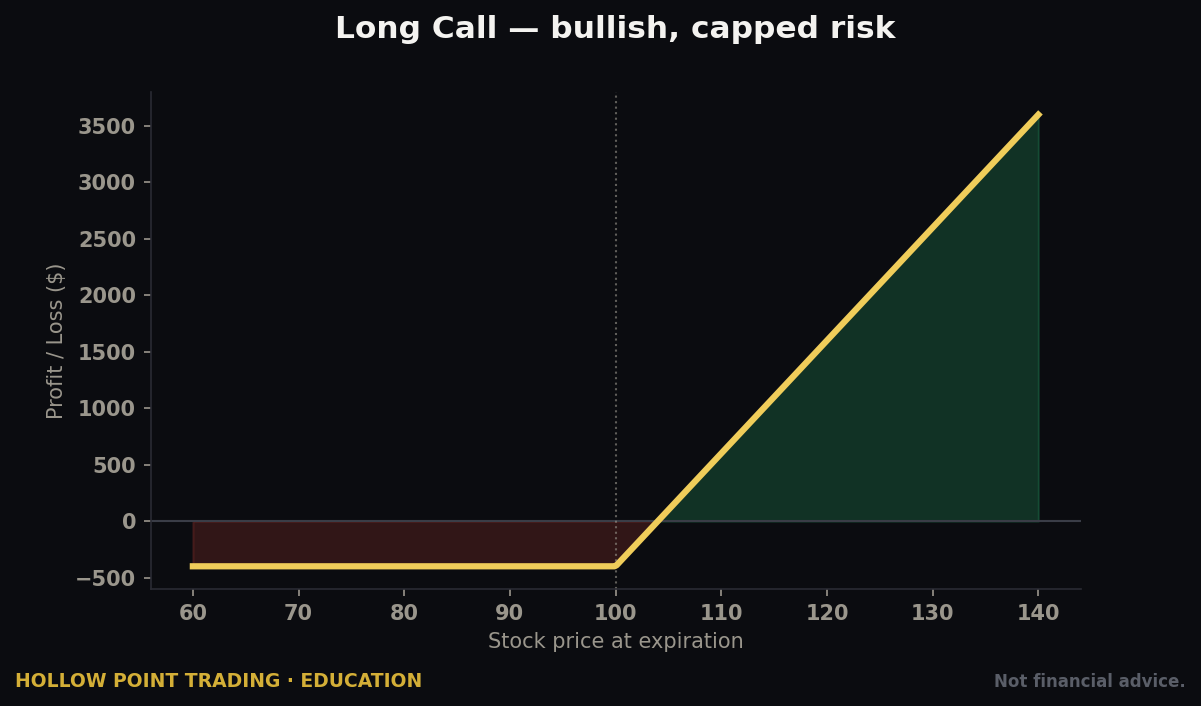
- A call option is the right to buy a stock at a set price. You buy calls when you think the price is going up.
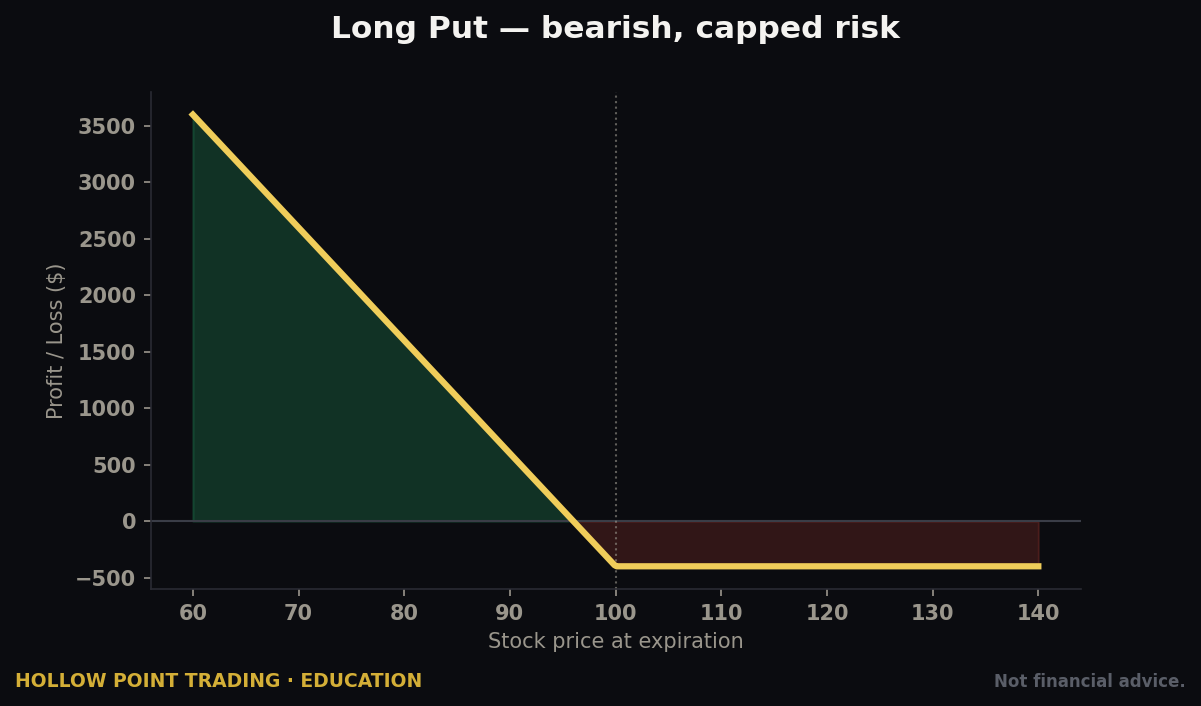
- A put option is the right to sell a stock at a set price. You buy puts when you think the price is going down.
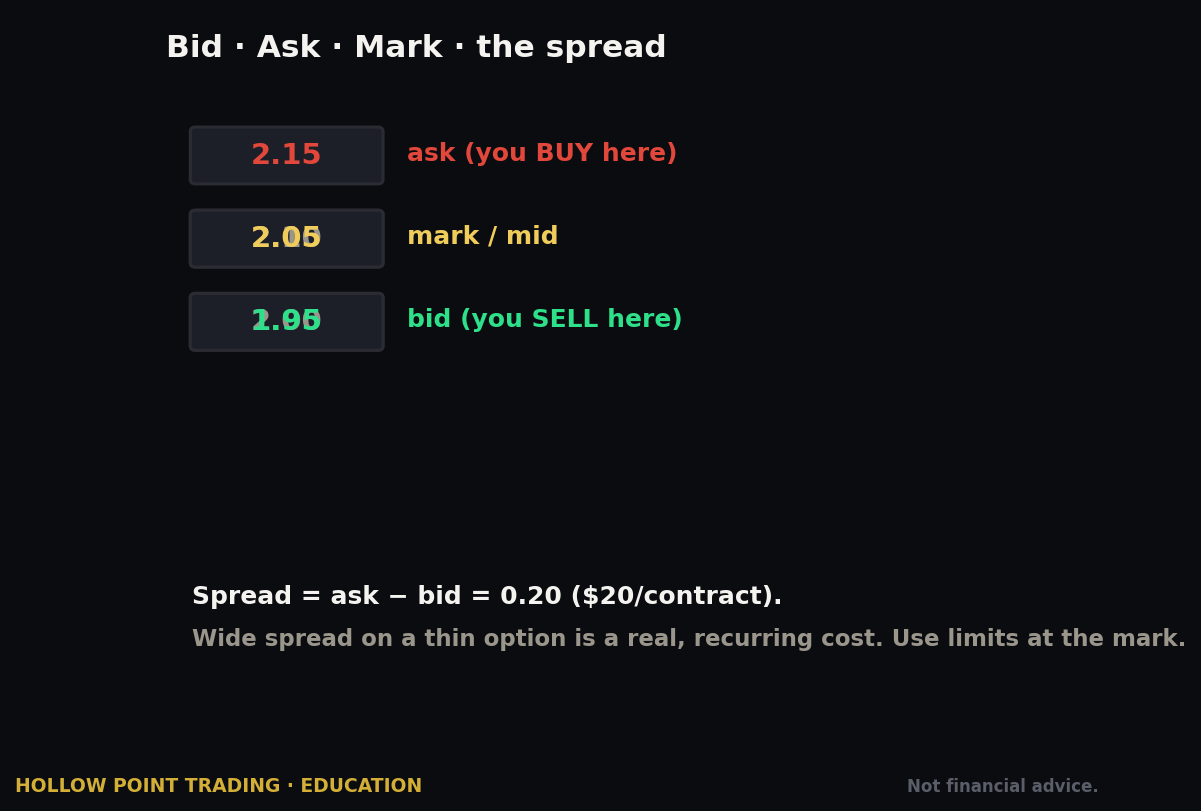
The set price is called the strike price. The deadline is called the expiration date. And the money you pay to own the option is called the premium — that's just the price of the option itself.
Think of an option like a coupon. Imagine a coupon that lets you buy a $50 video game for $40, and the coupon is good for one month. That coupon has value, right? You'd pay something for it. Maybe you'd pay $5 for it. That $5 is the premium. The $40 price is the strike. The one-month deadline is expiration.
Now here's the key idea that unlocks everything: the price of that coupon can change even if the video game's price never moves. That's weird, isn't it? How can the coupon's value change if the thing it's attached to stays still?
That question is the doorway to Vega. Walk through it with me.
The Greeks: Meet the Family That Moves Your Option's Price
Options don't just have one price that sits still. The price is constantly being pushed and pulled by several different forces at the same time. Traders gave these forces nicknames borrowed from the Greek alphabet, so we call them the Greeks.
You don't need all of them today. But you should meet the family so you know where Vega fits in:
- Delta — how much the option price moves when the stock moves. (Direction.)
- Gamma — how fast Delta itself changes. (Acceleration.)
- Theta — how much value the option loses every single day just from time passing. (The ticking clock.)
- Vega — how much the option price moves when fear and uncertainty change. (The mood of the market.)
- Rho — how much interest rates affect the price. (Rarely matters for beginners.)
Notice something. Delta is about direction. Theta is about time. But Vega is about something totally different — it's about how nervous the market is. It doesn't care which way the stock moves. It cares about how much the stock might move, and how scared everyone is about it.
That's the piece beginners almost always miss. Let's zoom all the way in on it.
What Vega Actually Is, In Plain English
Here is the cleanest definition you'll ever read:
Vega measures how much an option's price will change when expected volatility goes up or down by one percentage point.
Let's unpack that, one word at a time, because two of those words are doing all the heavy lifting: expected volatility.
Volatility is just a fancy word for how much a stock bounces around. A calm, boring stock that drifts a few cents a day has low volatility. A wild stock that swings 5% up and 5% down in an afternoon has high volatility. That's it. Volatility = movement, jumpiness, drama.
But notice I said expected volatility. This is the magic word. Options aren't priced on how much a stock bounced around in the past. They're priced on how much the market expects it to bounce around in the future. This forward-looking, expectation-based number has its own name: implied volatility, or IV for short.
Say that word out loud, because you'll hear it constantly: implied volatility, IV. It's the market's collective guess about how bumpy the ride is going to be from here until the option expires.
So now we can restate our clean definition even more simply:
Vega tells you how much your option's price changes when the market's fear-and-uncertainty level (IV) goes up or down.
When IV rises, options get more expensive. When IV falls, options get cheaper. Vega is the number that tells you exactly how much more or less expensive, for every 1-point change in IV.
Why Does Fear Make Options Cost More? (The Insurance Analogy)
This is the single most important idea in the whole guide, so let's take our time.
An option is a form of insurance. That's not a metaphor — it's literally how the market treats it. When you buy a put option, you're buying insurance against a stock falling. When someone sells you that option, they're the insurance company taking on your risk.
Now ask yourself: when does insurance get expensive?
Home insurance in a quiet, safe neighborhood is cheap. Home insurance right before a hurricane is coming? The price rockets. Same house, same coverage — but the uncertainty and danger have spiked, so the insurance costs more.
Options work exactly the same way. When the market is calm and everyone's relaxed, options are cheap. When fear spikes — a scary headline, an earnings announcement, a Fed meeting, a market crash — everyone suddenly wants protection at once, uncertainty explodes, and the "insurance" (options) gets more expensive. Even if the stock hasn't actually moved a single penny yet.
That rising fear shows up as rising IV. And rising IV, through Vega, pushes up the price of your option.
Here's the beautiful part: this cuts both ways. When the scary event passes and everyone calms down, fear drains out of the market. IV collapses. And through Vega, that falling IV pushes your option's price down — sometimes brutally, even if you were right about the direction.
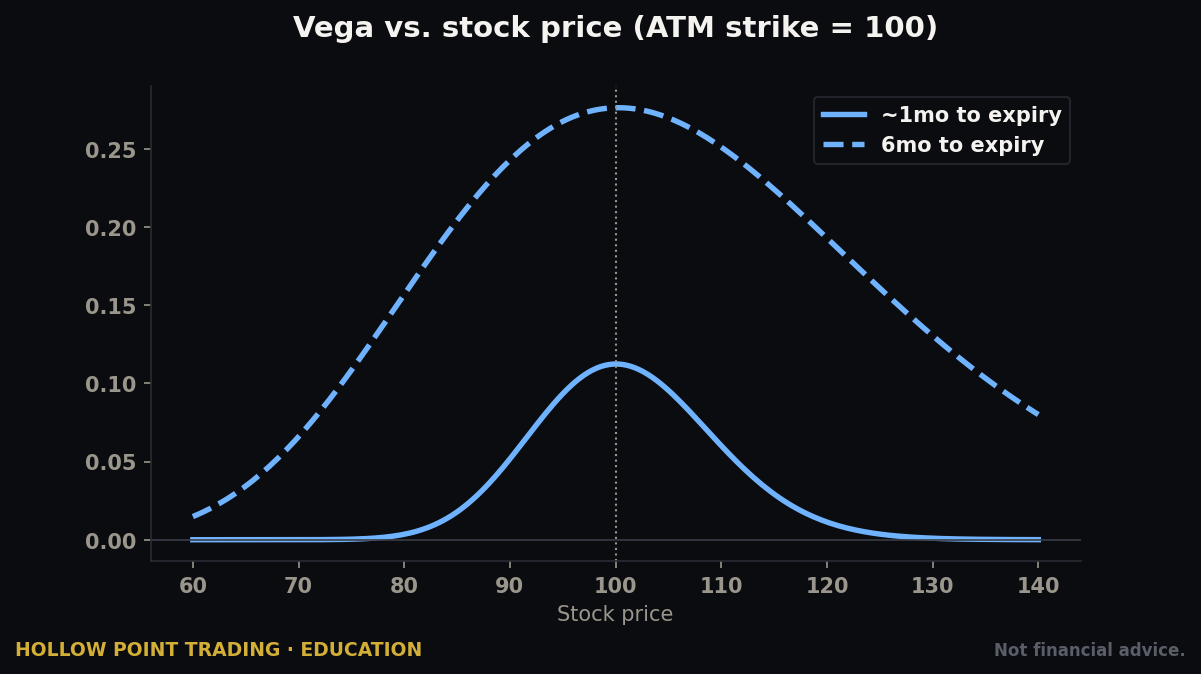
There's even a "fear gauge" that measures this for the whole market. It's called the VIX (the Volatility Index), and traders literally call it "the fear index." When the VIX is high, the market is scared and options everywhere are expensive. When it's low, the market is calm and options are cheap. IV is like the VIX, but for one individual stock.
Burn this into your memory:
High fear = high IV = expensive options. Calm markets = low IV = cheap options.
How Vega Works, Step by Step
Now let's get practical. How do you actually use Vega? It's simpler than you'd think.
Step 1: Every option comes with a Vega number. Your broker shows it to you. It might say Vega = 0.10, or 0.05, or 0.25. This number is measured per contract, per 1-point move in IV.
Step 2: That number tells you the dollar impact. A Vega of 0.10 means: if IV rises by 1 percentage point, this option gains $0.10 in value. If IV falls by 1 point, it loses $0.10.
Step 3: Remember the ×100 multiplier. One option contract controls 100 shares. So option prices are always quoted per share, but you pay 100× that. A Vega of 0.10 means $0.10 per share × 100 shares = $10 of real money per 1-point IV move, per contract.
Let me show you the math slowly:
- Your option's Vega = 0.10
- IV rises by 3 points (say from 20% to 23%)
- Price change per share = 0.10 × 3 = $0.30
- Real dollars per contract = $0.30 × 100 = +$30
And if IV had fallen 3 points instead? You'd lose $30 per contract. Same option. The stock didn't have to move at all.
Step 4: Know which way you're exposed.
- When you buy an option (a call or a put), you are long Vega. You want IV to rise. Rising fear helps you.
- When you sell an option, you are short Vega. You want IV to fall. Falling fear helps you.
That's the whole mechanism. Vega isn't hard math — it's a single multiplication and knowing which side of the fear trade you're on.
Two More Rules That Make Vega Click
Before the big worked example, two quick patterns that will save you real money. These aren't optional trivia — they explain why Vega surprises beginners.
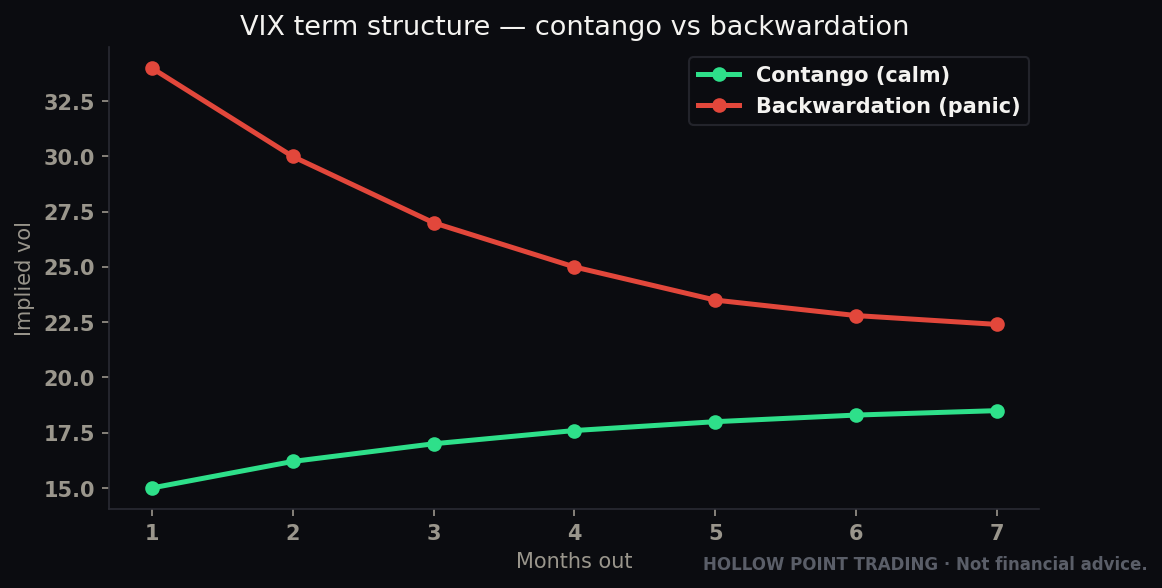
Rule 1: Longer-dated options have MORE Vega. An option that expires in six months has a lot of Vega because there's a ton of time for volatility to matter. An option that expires tomorrow has almost no Vega — there's no time left for volatility swings to change much. So the further out your expiration, the more a fear spike (or fear collapse) moves your option.
Think of it like a long ocean voyage versus a short ferry ride. On a six-month voyage, a change in the weather forecast matters enormously. On a five-minute ferry ride, who cares — you'll be there before the weather turns.
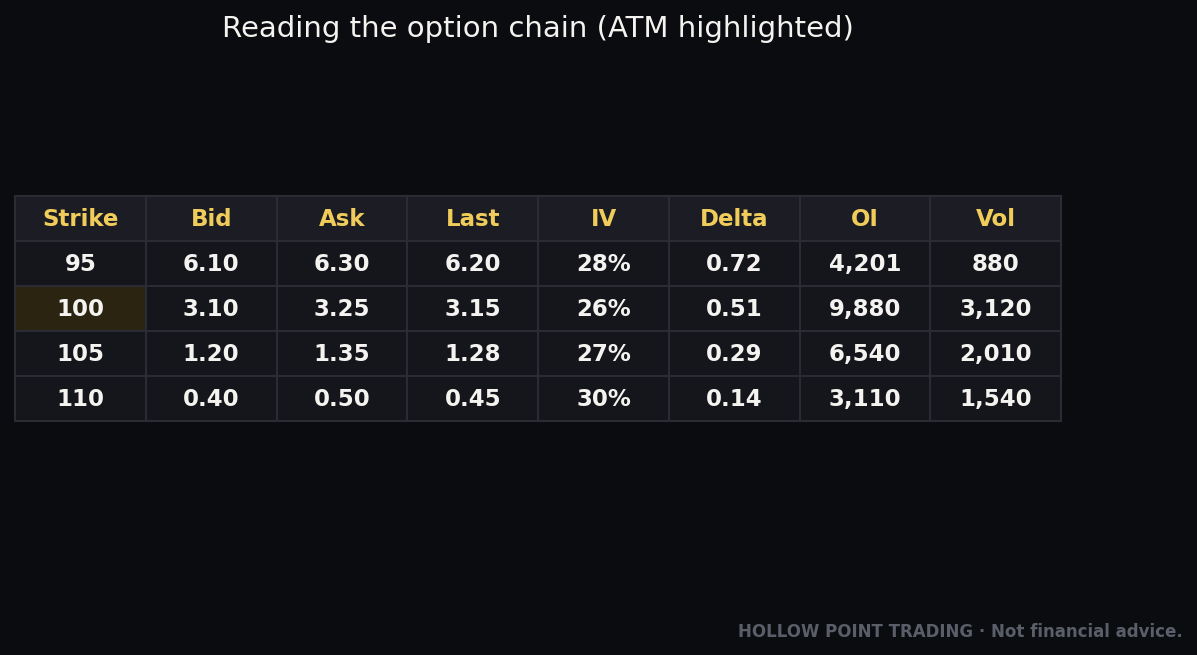
Rule 2: At-the-money options have the MOST Vega. An option whose strike price is right around the current stock price (we call that at-the-money) is the most sensitive to volatility. Options far away from the current price (deep in-the-money or far out-of-the-money) have less Vega. So the "coin-flip" options sitting right at the current price feel volatility changes the hardest.
Keep these two in your back pocket. Now let's run a full example.
A Fully Worked Beginner Example: The Earnings Trap
This is the classic story, and it happens to thousands of beginners every single earnings season. Let's walk through it so it never happens to you.
Meet our trader. We'll call her Sam. Sam has never traded options before, but she's been watching a company we'll call BrightCo, currently trading at $100 per share.
BrightCo reports earnings in three days. Sam is convinced the earnings will be great and the stock will pop. So she decides to buy a call option to profit from the jump.
Here's what Sam sees at her broker:
- BrightCo stock: $100
- She buys the $100 strike call (at-the-money), expiring in two weeks
- The option premium (price): $4.00 per share → $4.00 × 100 = $400 total
- The option's Vega: 0.15
- Current IV: 80% ← notice how high this is
That 80% IV is enormous. Why is it so high? Because earnings are coming. The whole market expects a big move, nobody knows which direction, and everyone's buying options to bet or protect. Fear and uncertainty are maxed out. High uncertainty = high IV = expensive options. Sam is paying a fear premium baked right into that $400 price. She just doesn't know it yet.
Earnings come out. Sam was right — BrightCo beats expectations! The stock jumps from $100 to $104. A 4% pop. Sam is thrilled and opens her account expecting a fat profit.
Instead, her $400 option is now worth… $300. She lost $100. She was right about the direction and she still lost money. How?
Let's do the autopsy, because two forces fought over her option:
Force 1 — Delta (the good news). The stock rose $4. Her call had a Delta around 0.50, meaning it gained roughly $0.50 per $1 of stock move. So: $4 × 0.50 = +$2.00 per share = +$200. Direction helped her. Good.
Force 2 — Vega (the ambush). The moment earnings were announced, the uncertainty vanished. There's no more mystery — the news is out. So IV collapsed from 80% all the way down to 30%. That's a 50-point drop in IV. Her Vega was 0.15, so:
- IV change: −50 points
- Vega impact per share: 0.15 × 50 = −$7.50 per share
That's a devastating drop. In reality the Vega impact tapers as IV falls, but the direction is unmistakable: Vega hammered her. This IV collapse after a scheduled event even has a nickname traders use constantly: IV crush.
The Delta gain (+$200 worth of direction) simply couldn't outrun the Vega loss (the IV crush). The fear premium she paid at purchase evaporated the instant the uncertainty resolved. Net result: right on direction, still down money. That is the earnings trap, and Vega is the villain.
Now flip the whole story. Imagine Sam had been on the other side — imagine she'd sold that option to someone else before earnings. She would have collected that inflated $400 fear premium, and when IV crushed, the option's value would have collapsed in her favor. Sellers of options love IV crush. That's why experienced traders often sell premium into high-fear events rather than buy it. (Selling options carries its own serious risks — a topic for another day — but the Vega logic is worth seeing now.)
The lesson isn't "never trade earnings." The lesson is: when IV is high, you're paying a fear tax, and that tax gets refunded to the seller — not you — the moment the fear disappears.
The Beginner Mistakes to Avoid
Let's turn that story into a set of guardrails. These are the specific, concrete ways Vega bites new traders. Read them twice.
Mistake 1: Buying options right before earnings. This is the big one. IV is at its highest right before a scheduled announcement. You're buying insurance the day before the hurricane, at hurricane prices, and the storm is guaranteed to pass. Unless you understand you're fighting an IV crush, don't buy premium into earnings.
Mistake 2: Ignoring IV entirely and only thinking about direction. New traders obsess over "will it go up or down?" and completely ignore "how expensive is this option right now?" Direction is only half the battle. You can be right on direction and lose on volatility. Always check IV before you buy.
Mistake 3: Not knowing if IV is high or low for that stock. An IV of 40% might be cheap for a wild tech stock and insanely expensive for a sleepy utility. Context matters. Many brokers show IV Rank or IV Percentile — a 0-to-100 score of whether current IV is high or low compared to that stock's own history. An IV Rank near 100 means fear is unusually high (bad time to buy, good time to sell). Near 0 means it's unusually calm (options are relatively cheap).
Mistake 4: Buying long-dated options without respecting their Vega. Remember, longer expirations have more Vega. That six-month option feels every twitch in market fear. If overall market volatility drops after you buy, your long-dated option can bleed value from Vega alone.
Mistake 5: Forgetting Vega and Theta gang up on you. When you buy an option, Theta (time decay) chips away at it every day, and if IV falls, Vega drains it too. Two forces, both pulling your premium down, while you wait for direction to save you. Buyers are swimming against two currents. Respect that.
Mistake 6: Selling options and forgetting IV can spike further. If you sell an option because IV looks high, understand IV can go even higher first — a full-blown market panic can send it soaring, and short-Vega positions lose fast when that happens. High doesn't mean it can't go higher.
Your Simple Vega Cheat-Sheet
Tape this to your monitor. Everything you need, in one glance:
What Vega measures:
- How much your option's price moves per 1-point change in IV (implied volatility = the market's expected movement / fear level).
The core rule:
- Fear UP → IV UP → options get more EXPENSIVE
- Fear DOWN → IV DOWN → options get CHEAPER
Which side are you on:
- Buy a call or put → you're long Vega → you want fear to rise
- Sell a call or put → you're short Vega → you want fear to fall
The math:
- Dollar impact = Vega × (points IV moved) × 100
- Example: Vega 0.12 × 5-point IV rise × 100 = +$60 per contract
Where Vega is biggest:
- Longer expiration = MORE Vega
- At-the-money strike = MOST Vega
The single biggest trap:
- Buying options right before earnings = paying peak fear prices → IV crush after the announcement can wipe out your gains even when you're right on direction.
Before every option purchase, ask:
- Is IV high or low right now (check IV Rank)?
- Is there a scheduled event (earnings, Fed) about to crush IV?
- Am I okay if the stock is right but Vega hurts me?
How Vega Fits the Bigger Hollow Point Picture
Here's where we zoom out, because Vega isn't just a Greek letter — it's a discipline lesson wearing a costume.
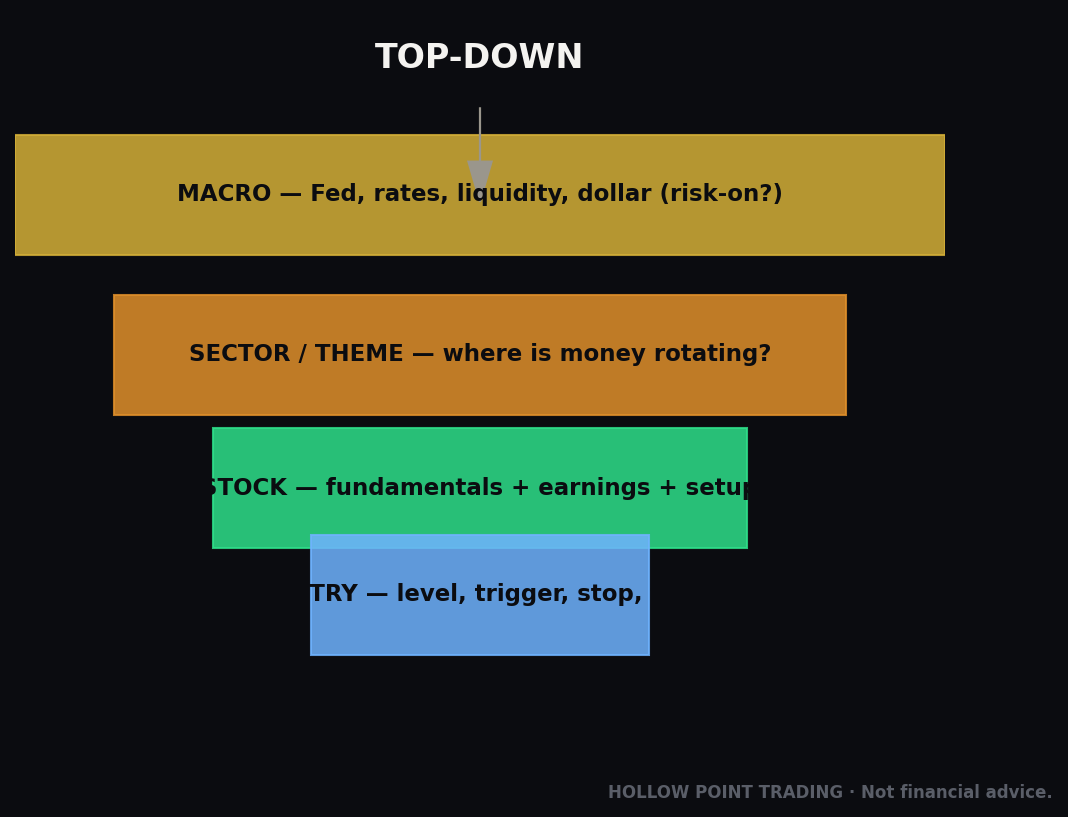
At Hollow Point, we teach a top-down way of seeing the market: macro → sector → stock. Start with the big weather system (the overall market's fear level — that's the VIX, that's broad IV), then the neighborhood (the sector), then the individual house (the stock). Vega lives at every layer of that stack. When the whole market gets scared, IV rises across everything, and every option everywhere reprices. You can't understand your one little option without understanding the fear temperature of the whole room. Vega is the thread that ties the macro mood to your specific trade.
Second, our core belief: discipline over prediction. The earnings trap is the perfect illustration. Sam predicted correctly and still lost, because she didn't respect the mechanics. A disciplined trader doesn't just ask "which way will it go?" — she asks "what am I paying, what forces are working against me, and is this even a fair price?" Understanding Vega turns you from a gambler hoping for direction into a trader who knows the true cost of the ticket.
Third, protect capital first. Vega awareness is capital protection. Every dollar of fear premium you don't overpay is a dollar still in your account. Every IV crush you sidestep is a loss you never took. Knowing Vega isn't about finding a magic winning trade — it's about not walking into the obvious losing ones.
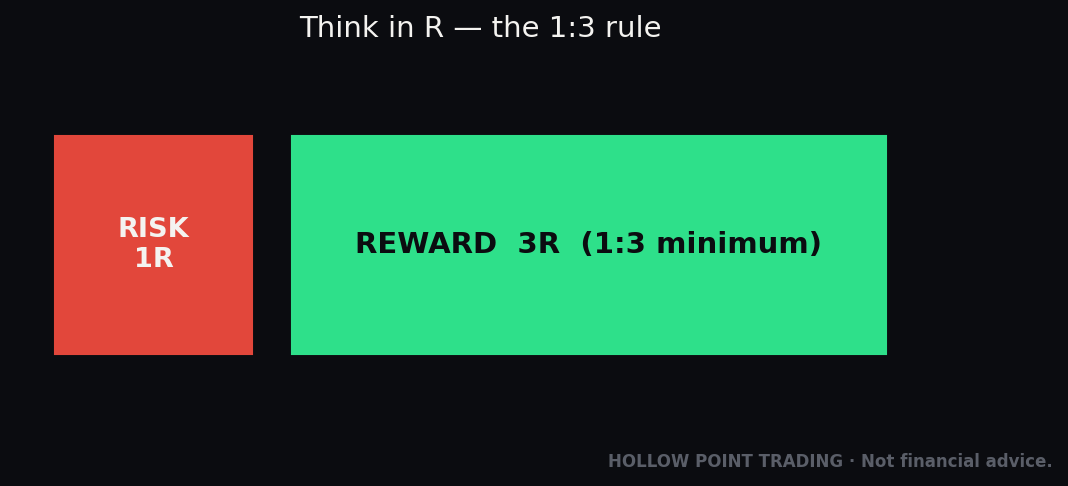
And finally, our bread and butter: 1:3 reward-to-risk. We only take trades where we can make at least three dollars for every one dollar we risk. Vega feeds directly into that math. If you overpay for an option because IV is sky-high, your break-even moves further away and your reward-to-risk quietly gets worse — even before the stock moves. Buying options when IV is low (cheap insurance) and being cautious when IV is high (expensive insurance) is how you keep the reward-to-risk math honest. Vega is not a side character in the 1:3 story. It's part of the "risk" side of the ratio.
So the next time you look at an option, don't just see a bet on direction. See the fear baked into the price. See which way the volatility wind is blowing. Ask whether you're buying cheap insurance or overpaying at the peak of a panic. That single shift — from predicting direction to understanding what you're truly paying for — is the difference between the trader who gets crushed by earnings and the one who saw it coming.
Vega isn't scary once you can see it. It's just the market's mood, wearing a Greek letter. And now you can read it.
Master this one idea, and you're already ahead of most people who've been trading options for years.
Bound by rules, feared by trade.