
Imagine you buy a ticket to an outdoor concert three weeks from now. You paid $100 for it. Nothing about the band changes, the weather forecast stays the same, the venue is the same — but every single day that passes, that ticket is worth a little less to someone who might buy it from you, because there's less anticipation left, less "anything could happen" between now and showtime. On the morning of the concert, the ticket is worth exactly what the concert is worth and not a penny more. All the "maybe" has drained out of it.
That slow leak of value as time runs out is the single most important idea a brand-new options trader has to understand. In options, it has a name: theta. And if you don't respect it, it will quietly bleed your account dry while you're staring at the chart wondering why you were "right" about the direction and still lost money.
This guide assumes you have never traded anything in your life. We're going to build theta from the ground up, in plain English, with lots of small examples and real-ish numbers. By the end, you'll understand what theta is, why it exists, why it gets faster and more dangerous right before an option expires, and — most importantly — how to stop being its victim and start putting it to work for you.
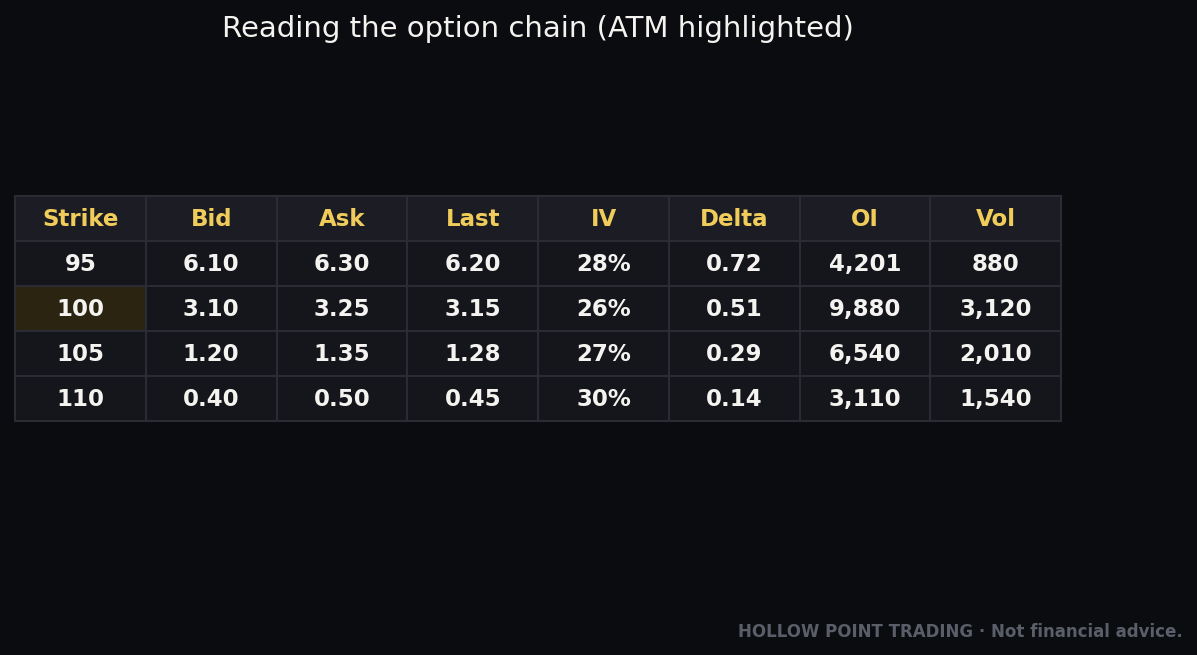
First, What Even Is an Option? (Start Here — No Shame)
Before we can talk about theta, we need to make sure we're standing on the same ground. Skip this section only if you already know what a call and a put are.
An option is a contract that gives you the right, but not the obligation, to buy or sell a stock at a fixed price before a certain date. You pay money up front for that right. Two flavors:
- A call option gives you the right to buy a stock at a fixed price. You buy calls when you think the stock is going up.
- A put option gives you the right to sell a stock at a fixed price. You buy puts when you think the stock is going down.
A few pieces of vocabulary you'll need, defined once and used forever:
- Strike price — the fixed price written into the contract. If you own a call with a $100 strike, you can buy the stock at $100 no matter how high it climbs.
- Expiration date (or just "expiration," or "expiry") — the deadline. After this date, the contract is done, gone, worthless-or-cashed-out. This is the "showtime" in our concert analogy.
- Premium — the price you pay to own the option. If an option costs $2.50, that's the premium. (Small but important detail: one option contract usually controls 100 shares of stock, so a "$2.50" option actually costs you $250. We'll keep the math simple, but remember that multiplier — it matters when real dollars are on the line.)
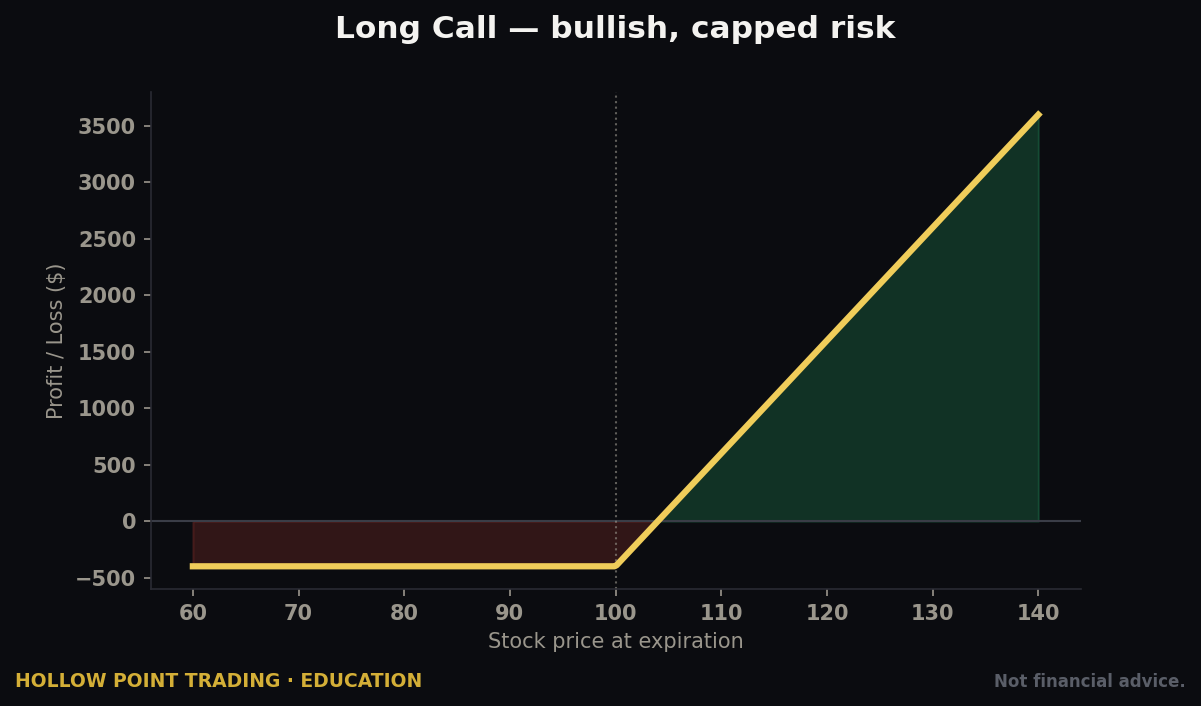
So an option's premium is what you pay for a possibility. And that possibility has an expiration date stapled to it. Hold that thought — it's the whole reason theta exists.
What Theta Actually Is, in Plain English
Theta is the amount of money an option loses every day, purely because one more day has passed. Nothing else has to happen. The stock can sit perfectly still. The news can be quiet. And your option still gets a little cheaper overnight, every night, like clockwork.
That's why theta has a nickname: time decay. The option is decaying — losing value — as time drains away.
Theta is written as a negative number when you own an option, because it's working against you. If an option has a theta of –0.05, that means the option is expected to lose 5 cents of value per day from time decay alone. Remember the 100-share multiplier — 5 cents of premium is $5 of real money per contract, per day, evaporating while you sleep.
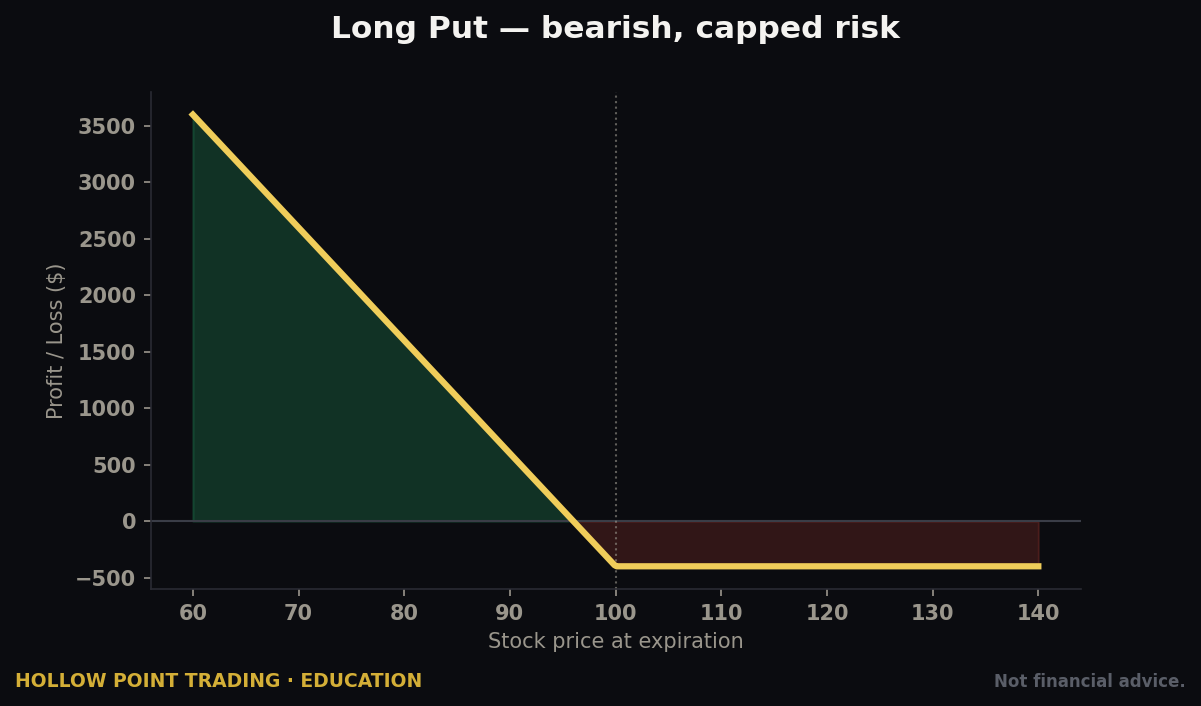
Here's the mental model that will serve you for your entire trading life: when you buy an option, you are renting time. You don't own the stock. You own a temporary bet with a countdown timer. And just like renting an apartment, every day you hold it, you owe rent. Theta is the rent. The landlord always gets paid. The only question is whether the stock moves in your favor fast enough and far enough to cover the rent and then some.
Why Options Lose Value Every Single Day
To really get theta — not just memorize it — you need to understand what you're actually paying for when you buy an option. An option's premium is made of two parts:
1. Intrinsic value — the "real, right now" value. If a stock is trading at $105 and you own a call with a $100 strike, that call is worth at least $5, because you could exercise it, buy at $100, and immediately be up $5. That $5 is intrinsic value. It's solid. It's earned. Time decay does not touch intrinsic value.
2. Extrinsic value (also called time value) — this is the "maybe" money. It's the extra you pay on top of intrinsic value for the chance that the stock moves even more in your favor before expiration. This is the anticipation, the "anything could happen," the concert-three-weeks-away premium.
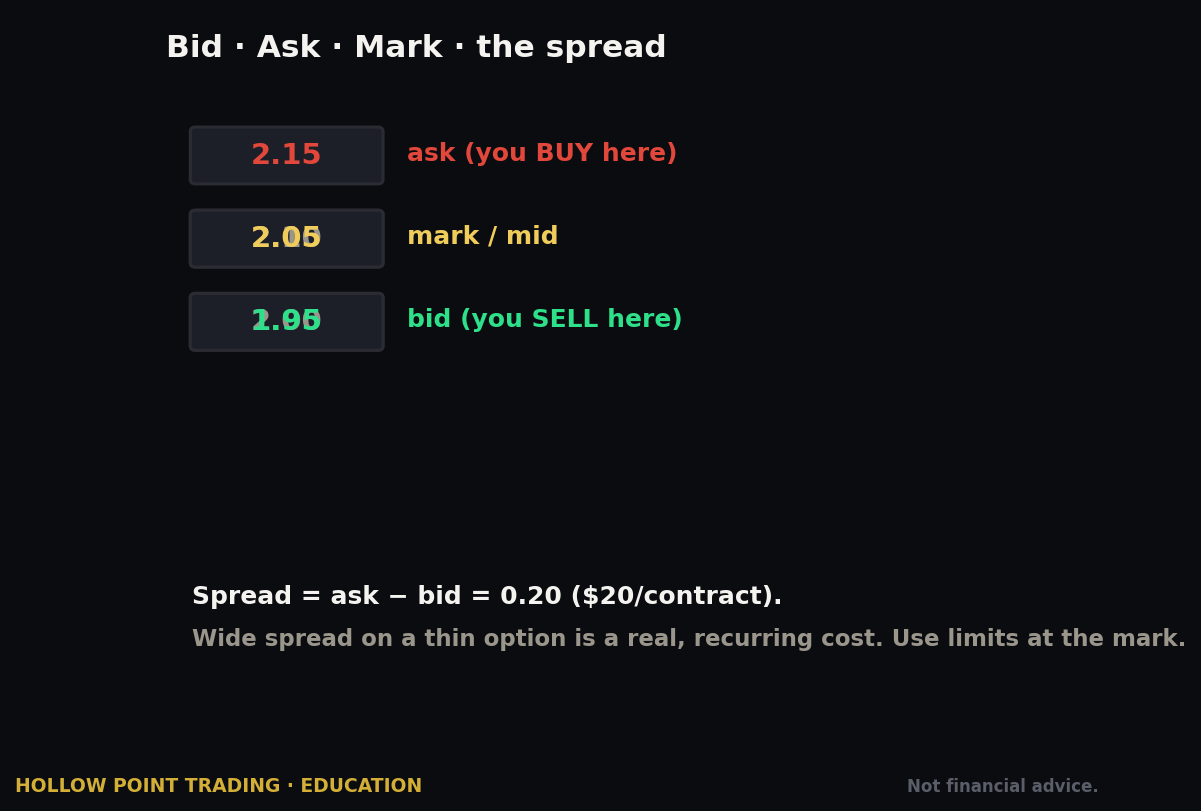
Theta only eats the extrinsic value — the "maybe" money.
And this is the key insight most beginners miss: the "maybe" is only valuable because there's time left for the maybe to come true. Three weeks of "anything can happen" is worth more than three days of "anything can happen," which is worth more than three hours. As the clock runs down, there's less and less runway for a big favorable move, so the "maybe" money is worth less and less. On expiration day, there's no time left for anything to happen, so the extrinsic value is zero. All that's left is the cold, hard intrinsic value — and if there isn't any, the option expires worthless.
So options lose value every day because every day that passes is one less day of "maybe." The chance-of-a-big-move is literally shrinking, and you're holding the thing whose price is built on that chance.
Why Theta Speeds Up Near Expiration (The Part That Surprises People)
Here's where beginners get ambushed. You might assume time decay is steady — that an option loses the same little sliver of value every day from the moment you buy it to the day it expires. It doesn't. Time decay accelerates. It's slow and gentle when expiration is far away, and it becomes a screaming, brutal collapse in the final week or two.
If you graph an option's time value against the days remaining, you don't get a straight line sloping down. You get a curve that's nearly flat at first and then drops off a cliff at the end. Many people describe it as looking like a playground slide: a gentle ramp that suddenly plunges.
Why does this happen? Go back to the "maybe" money. Think about the percentage of remaining time you lose each day.
- When you have 90 days left and one day passes, you've lost 1 out of 90 days — about 1.1% of your remaining time. Barely a scratch.
- When you have 30 days left and one day passes, you've lost 1 out of 30 — about 3.3% of your remaining time. Noticeable.
- When you have 10 days left and one day passes, you've lost 1 out of 10 — a full 10% of your remaining time. Ouch.
- When you have 2 days left and one day passes, you've lost half your remaining time in a single day.
Each passing day removes a bigger and bigger fraction of the anticipation that's still left. The "maybe" money doesn't drain at a constant dollar amount — it drains faster and faster because there's proportionally less and less runway to lose. Mathematicians will tell you time value decays roughly in proportion to the square root of time remaining, but you don't need the formula. You need the picture: the last two weeks are where options go to die.
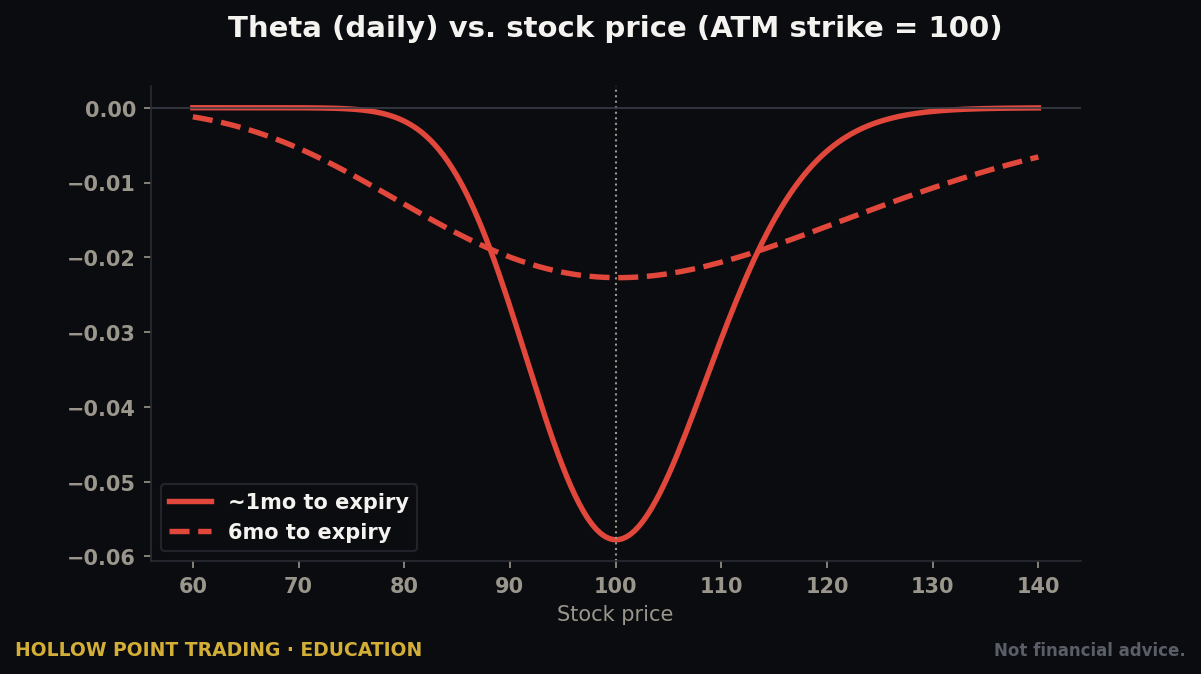
There's one more wrinkle that makes it even more dramatic. This acceleration is fiercest for at-the-money options — options whose strike price is right at the current stock price, where the "maybe" is at its absolute maximum because the stock could tip either way. Those options are almost entirely "maybe" money, so they have the most to lose and they lose it fastest near the end. Options that are deeply in-the-money (stuffed with intrinsic value) or far out-of-the-money (basically no realistic chance) have less extrinsic value to bleed, so their theta behaves differently. We'll keep our examples at-the-money because that's where most beginners get burned.
A Fully Worked Beginner Example — Watch the Money Melt
Let's make this concrete with a story you can follow step by step. We'll use round, realistic-feeling numbers.
Meet a stock we'll call Acme Corp, trading at exactly $100 per share.
You're feeling bullish — you think Acme is going up. So you buy a call option with a $100 strike that expires in 30 days. Because the strike equals the current price, this is an at-the-money option — pure "maybe" money, no intrinsic value yet.
The premium is $3.00 per share. Remember the 100-share multiplier, so you actually pay $300 for one contract. That $3.00 is entirely extrinsic value — every penny of it is anticipation, because the stock isn't above your strike yet.
The option's theta right now is about –0.05. That's your daily rent: roughly 5 cents per share, or $5 per contract, per day.
Now let's let time pass, and — here's the important part — let's assume the stock does absolutely nothing. Acme sits at $100 the whole time. No good news, no bad news. Just days ticking by. Watch what happens to your $300 option:
- Day 0: Stock $100. Option worth $3.00. You paid $300.
- After 10 days: Stock still $100. Option now worth about $2.45. You've lost roughly $55 — and you were right, the stock didn't drop! It just sat there. Theta took it anyway.
- After 20 days: Stock still $100. Option now worth about $1.70. You're down about $130.
- After 25 days (5 days left): Stock still $100. Option worth about $1.10. Down about $190. Notice the losses are getting bigger per day now, even though nothing changed. The decay is accelerating.
- After 29 days (1 day left): Stock still $100. Option worth maybe $0.40. You've lost $260 of your $300.
- Expiration day: Stock still exactly $100. Your $100-strike call is worth… nothing. The stock never got above your strike, there's no time left for it to, and all the "maybe" money is gone. Your $300 is gone with it.
Let that sink in. You were not wrong about direction. The stock didn't fall a single penny. And you still lost 100% of your money. That is theta. That is the lesson that costs most beginners their first account, and now you've learned it for free.
Now here's the flip side — the reason people buy options anyway. Suppose that instead of sitting still, Acme had jumped to $106 by day 10. Your $100 call would now have $6 of intrinsic value ($106 minus your $100 strike) plus some leftover "maybe" money — the option might be worth around $7.00. You'd have turned $300 into roughly $700. The move outran the rent. That's the whole game: when you buy options, the stock has to move enough, and fast enough, to beat the clock. Being right slowly is the same as being wrong.
The Other Side of the Trade — Theta Can Work For You
Everything above describes what happens when you buy an option. But remember: for every option contract, there's someone on the other side who sold it to you. That person is called the option seller or option writer.
Here's the beautiful, symmetrical truth: if theta works against the buyer, it works in favor of the seller.
When you sell an option, you collect the premium up front — that $300 in our example goes into your pocket. And then, every day that passes, the option you sold gets cheaper. If it eventually expires worthless, you keep the entire $300 and never have to do anything. The seller is the landlord collecting the rent. The seller wants time to pass. The seller wants the stock to sit still.
This is why you'll hear more experienced traders talk about "being on the right side of theta" or "collecting premium." They've realized that instead of fighting the clock, they can be the clock.
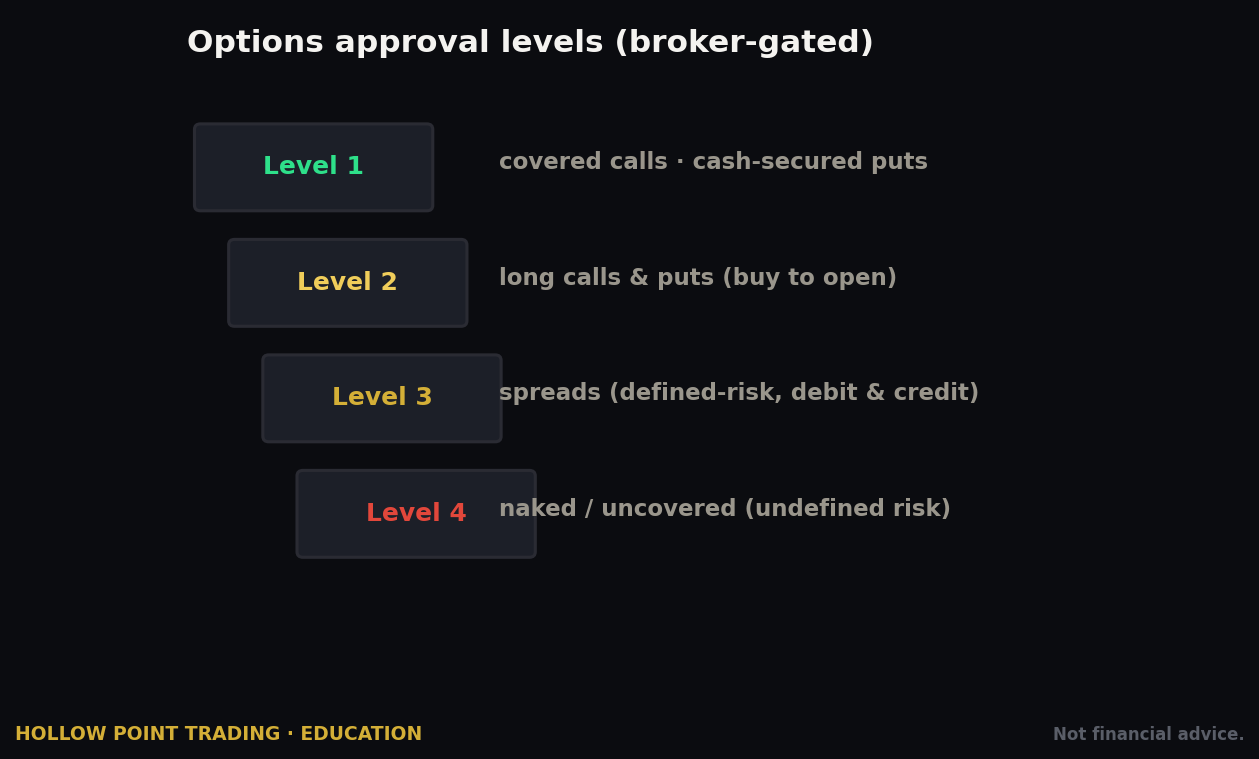
Now — a giant, flashing warning for beginners: selling options is not free money, and some ways of selling options carry very large, sometimes unlimited, risk. Selling a "naked" call (one where you don't own the underlying stock) can theoretically lose you an unlimited amount if the stock rockets up. That is absolutely not a beginner move. There are defined-risk ways to be a seller (spreads, covered calls) where your maximum loss is known and capped, and those are where a careful beginner would eventually learn this craft — slowly, in tiny size, long after mastering the basics. For today, just plant this seed in your mind: theta is a two-sided coin. You can be the one it robs, or the one it pays.
The Beginner Mistakes That Theta Punishes
Let's turn all this understanding into a survival guide. These are the specific, repeatable ways beginners hand their money to time decay. Read them twice.
Mistake 1: Buying options that expire too soon. New traders are drawn to cheap, short-dated options — the ones expiring this Friday — because they cost only a few dollars and can "double overnight." What they don't see is that these options are sitting at the bottom of the decay cliff, losing value violently every hour. You're renting time at the most expensive possible rate. Being even slightly early or slightly wrong wipes you out.
Mistake 2: Buying at-the-money or out-of-the-money options and "hoping." These options are mostly or entirely "maybe" money — the exact part theta devours. If your whole thesis is "I hope it goes up soon," the clock is a co-signer on your loss.
Mistake 3: Being right about direction but too slow. As our Acme example showed, a correct-but-lazy trade still loses. Beginners repeatedly say "but I was right!" Theta doesn't care if you were right eventually. It cares whether you were right before the rent ate the trade.
Mistake 4: Holding losers over the weekend and holidays. Time decay doesn't take days off. A Thursday-to-Monday hold is three days of theta (Friday, Saturday, Sunday) even though the market was only open one of them. Many pricing models bleed some of that weekend theta out on Friday, so options often sag into the weekend. Beginners holding "just to see what Monday brings" are paying rent on a closed store.
Mistake 5: Not knowing what an option is made of. If you never checked whether your option's price was intrinsic (solid) or extrinsic (meltable), you never knew how much of your money was exposed to theta in the first place. Always know: how much of this premium is "real" versus "maybe"?
Mistake 6: Averaging down on a decaying option. When a bought option drops, the instinct is to buy more to lower your average cost. But you're not buying a discounted stock that can wait forever — you're pouring more money into a melting ice cube with a fixed expiration. You're increasing your rent bill on a countdown clock.
Mistake 7: Ignoring theta entirely because you were focused on direction. Most beginners obsess over "will it go up or down?" and never look at the little Greek letters (theta and its cousins) that tell you how the option's price actually behaves. Direction is only half the trade. Time is the other half.
A Simple Theta Cheat-Sheet You Can Use Monday
Print this. Tape it to your monitor. Read it before every options trade until it's automatic.
Before you buy any option, ask:
- How much of this premium is "maybe" money? Subtract intrinsic value (stock price minus strike, for a call) from the premium. Whatever's left is extrinsic — that's what theta will eat. If it's all extrinsic, respect that it can all disappear.
- How many days until expiration? Fewer than ~14 days = you're on the steep part of the decay cliff. Beginners are usually safer with 30–60+ days so the daily rent is gentler and you have room to be a little early.
- What's the theta? Look it up on your broker's option screen. If theta is –0.10, you're paying $10 per contract, per day, just to hold. Ask: can the move I expect realistically beat that?
- What's my move-and-timing thesis? Not just "up" — but "up how much, and by when?" If you can't answer both, you can't beat the clock.
- Am I renting or collecting? Buyers pay theta; sellers collect it. Know which side you're on and whether that matches what you want time to do.
Quick rules of thumb:
- Time value decays slowly far from expiration, violently near it. The last two weeks are a minefield for buyers.
- Theta is worst (fastest) for at-the-money options. It's smaller for deep in-the-money options (which are mostly solid intrinsic value).
- Theta never sleeps — weekends and holidays decay too.
- If you're a buyer, buy yourself time. If you're wrong about timing, extra weeks are cheap insurance.
- The stock sitting still is a loss for a buyer and a win for a seller. Neutral is not neutral once time is involved.
How Theta Fits the Bigger Hollow Point Picture
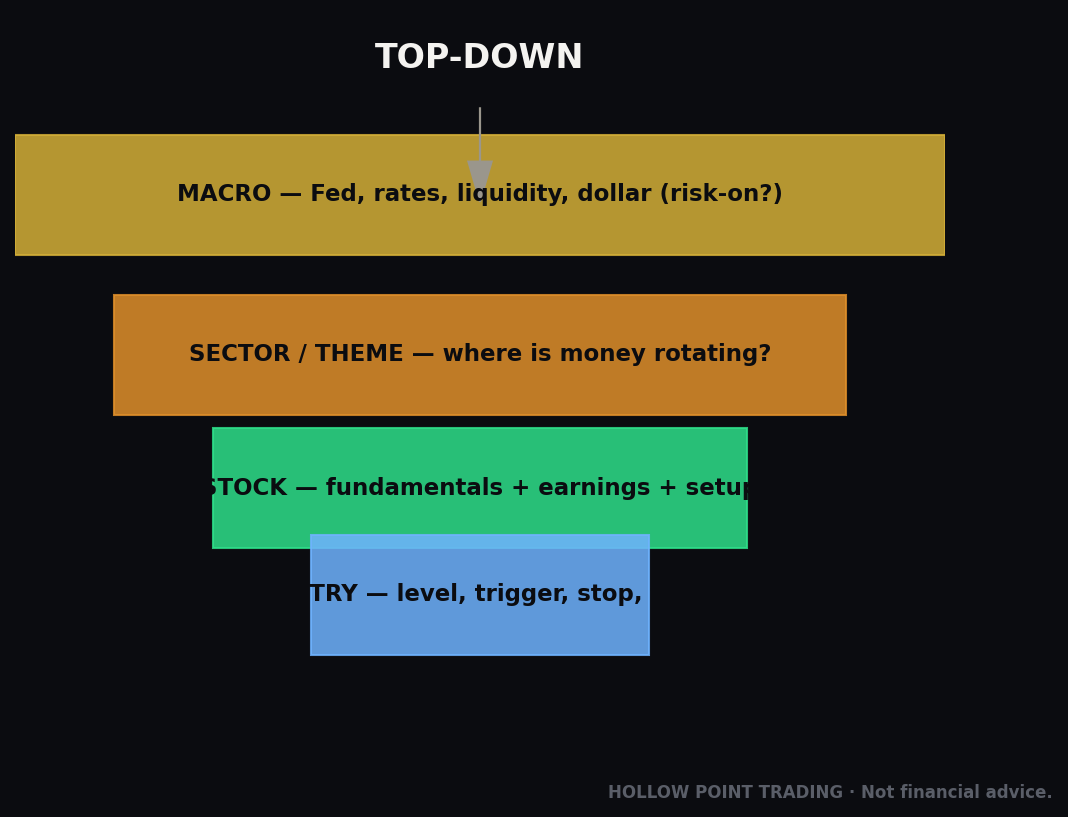
At Hollow Point Trading, we teach a specific order of operations: macro → sector → stock. Understand the big-picture environment first (is money flowing into risk or out of it?), then find the strong or weak sector, then pick the individual stock that expresses it. Only then do you think about how to trade it — and if that "how" involves options, theta walks into the room as a full member of the decision.
Here's how theta connects to everything we stand for.
Discipline over prediction. We don't worship being "right about direction." Markets humble prediction every single day. Theta is the purest possible lesson in this: you can predict direction perfectly and still lose because you disrespected time. A disciplined trader doesn't just ask "which way?" — they ask "which way, how far, by when, and what is time costing me while I wait?" Theta forces you to trade with a plan instead of a hope.
Protect capital first. Everything we do starts with defense. Theta is one of the most reliable ways beginners quietly lose capital — not in one dramatic blowup, but in a slow leak they never diagnosed. Understanding time decay is capital protection. Choosing longer-dated options, avoiding the expiration-week cliff, and knowing exactly how much "maybe" money you have at risk are all defensive moves. You can't protect capital from an enemy you can't see, and now you can see theta.
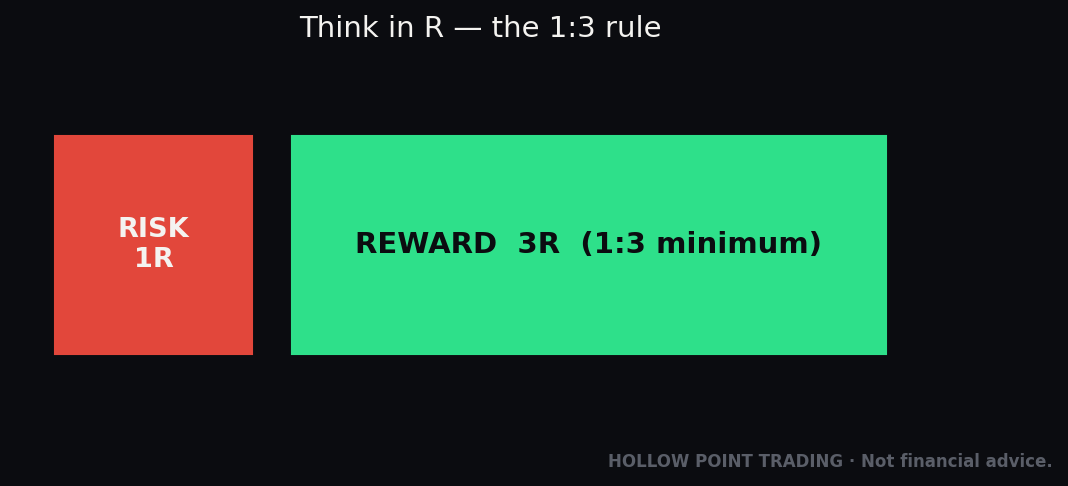
1:3 reward-to-risk. This is a core Hollow Point rule: we want to risk one dollar to make three. Theta is a tax on that math. Every day of rent raises the bar the trade has to clear to hit your 1:3 target. When you factor theta into your planning, you naturally gravitate toward trades where the expected move is big enough and soon enough to clear the rent and deliver 3-to-1. Trades that can't clear that bar reveal themselves as bad trades before you take them. Theta, understood, is a filter that kills weak setups early.
The read adapts; the rules don't. We're analysts, not fortune-tellers. The market moves hundreds of times a day and the read changes with it — but the rules that protect you don't move. "Respect time decay" is one of those permanent rules. A weak setup gets called weak. A trade that only works if the stock cooperates immediately gets called what it is: a bet against the clock, and the clock usually wins.
So when you sit down to trade an option, run the Hollow Point stack — macro, sector, stock — and then run the theta cheat-sheet. Direction gets you into the conversation. Time decides whether you get paid.
Putting It All Together
Let's zoom all the way back out and make sure the big ideas are locked in.
An option is a rented bet with a countdown timer. The premium you pay is part "real" money (intrinsic value, which time can't touch) and part "maybe" money (extrinsic value, which is pure anticipation). Theta is the daily leak of that "maybe" money — the rent you pay for holding a possibility. It's negative for buyers because it works against you, and positive for sellers because it works for them.
Theta is gentle when expiration is far away and brutal when it's near, because each passing day removes a bigger and bigger fraction of the time — and therefore the anticipation — that's left. The final two weeks are a decay cliff, and at-the-money options fall off it fastest.
The beginner who loses to theta is usually the one who bought a cheap, soon-to-expire, all-"maybe" option and hoped. The beginner who beats theta is the one who buys enough time, knows exactly how much of their premium is meltable, demands that the expected move be big and soon enough to clear the rent, and — eventually, carefully, in tiny size — learns to sit on the seller's side of the coin where time pays them.
You now understand something that a shocking number of people who trade options don't: that in this game, being right about direction is only half the job. Time is the silent, relentless other half. Respect it, plan around it, and it stops being the thing that quietly kills your account and starts being just another factor you've already accounted for before you ever click the button.
That's the whole point of this education series. We don't want you to gamble. We want you to know. Come back for the next pieces, where we'll meet theta's cousins — delta, gamma, and vega — the other forces that decide how your option's price really moves. Understand all four, and you'll trade like someone who reads the machine instead of praying to it.
Bound by rules, feared by trade.