
If you have ever bought an option and watched the stock jump a whole dollar while your option barely twitched, you have already met Delta. You just did not know its name yet.
Delta is the single most useful number for a brand-new options trader to understand. Not because it is fancy, but because it quietly answers three of the biggest questions you will have on day one: How much will my option move when the stock moves? How likely is this trade to actually work out? And how much "stock-like" risk am I really carrying?
This guide assumes you have never traded a single option in your life. We will define every term the first time it shows up, walk slowly through simple examples with real-ish numbers, and by the end you will be able to look at any option and read its Delta like a speedometer. Let's go.
First, A Two-Minute Refresher On What An Option Even Is
Before we can talk about Delta, we need to be crystal clear on the thing Delta describes. If you already know this cold, skim it. If you don't, read every word.
An option is a contract. It gives you the right, but not the obligation, to buy or sell a stock at a specific price, before a specific date.
There are two flavors:
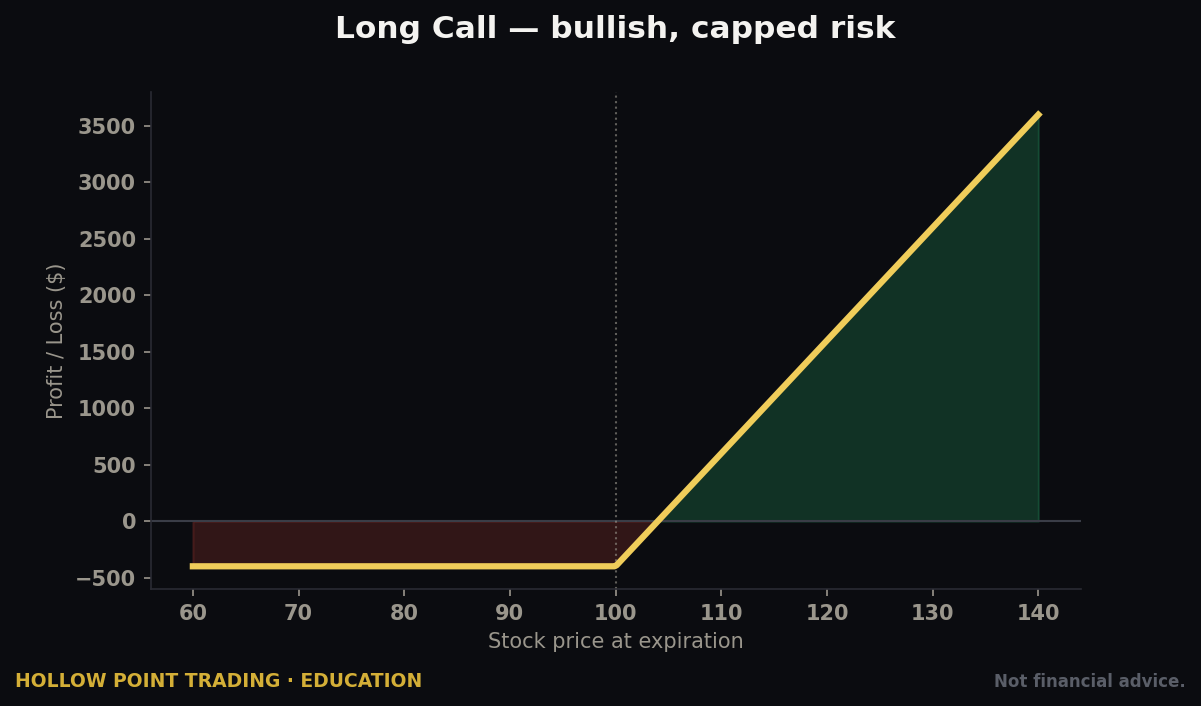
- A call option gives you the right to buy a stock at a set price. You buy calls when you think the stock is going up.
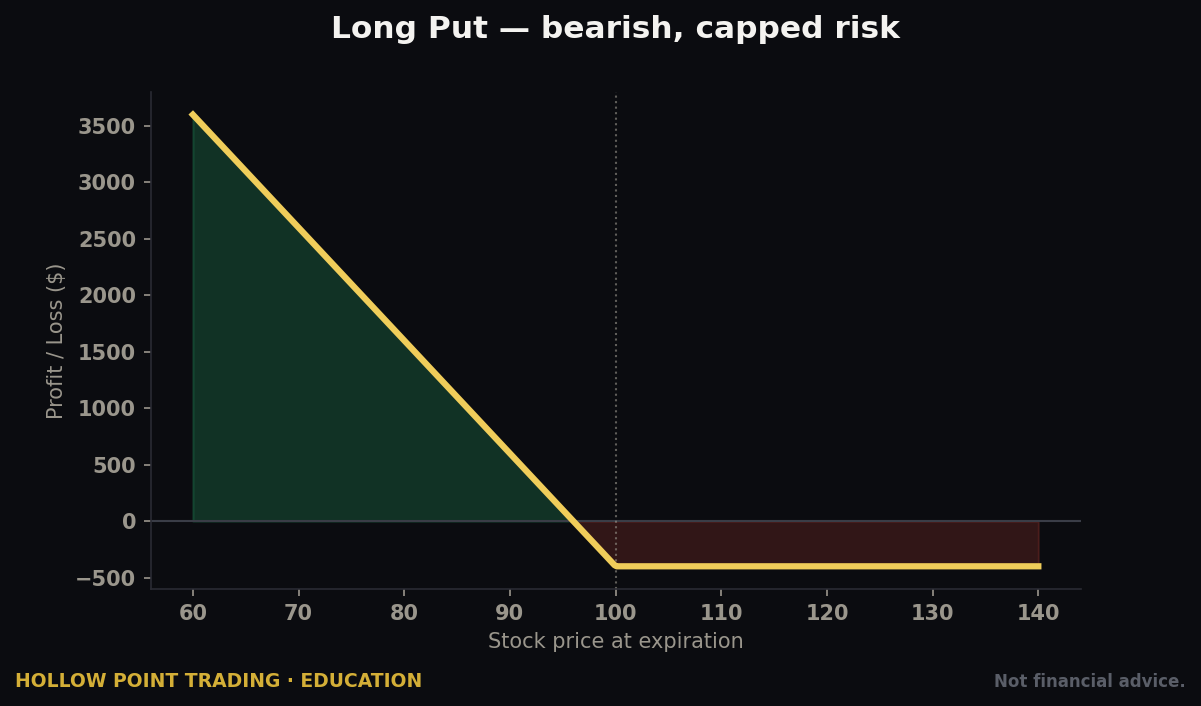
- A put option gives you the right to sell a stock at a set price. You buy puts when you think the stock is going down.
That "set price" is called the strike price — the price at which your contract lets you buy or sell. The "specific date" is the expiration date — the day the contract dies and is worth nothing if it is not useful.
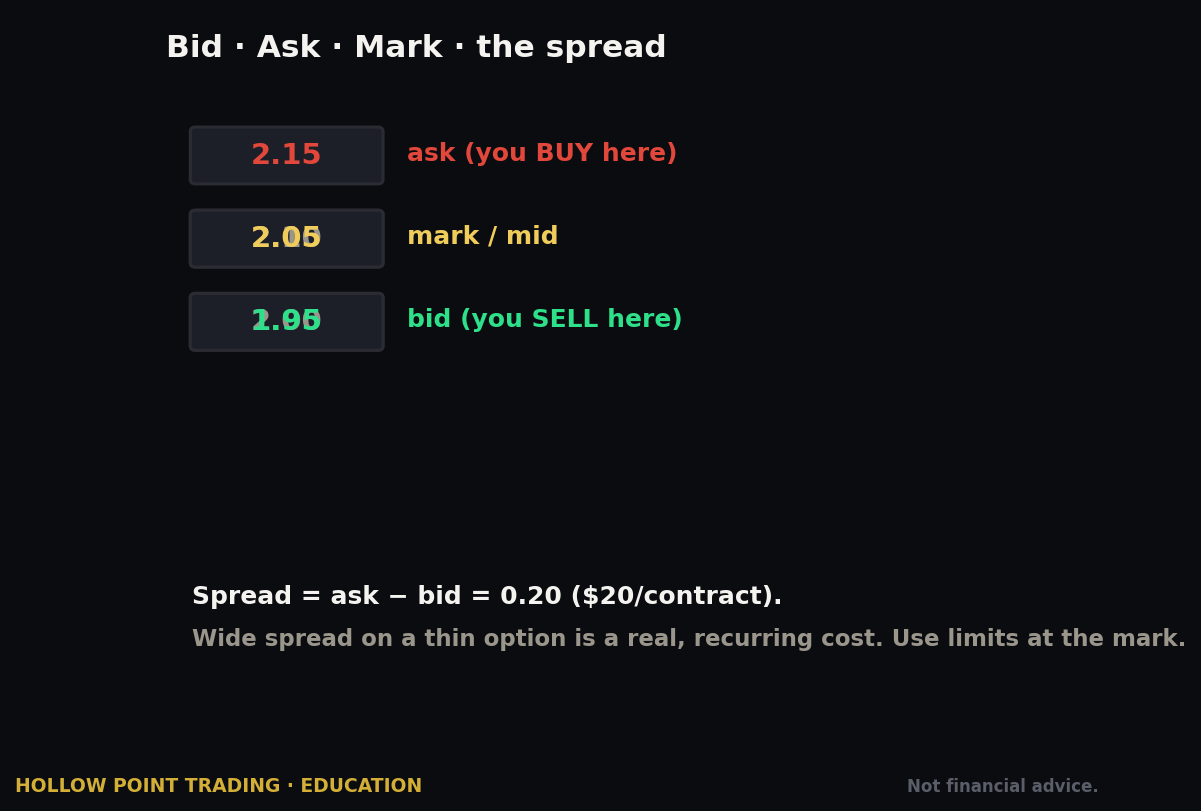
The price you pay for the option itself is called the premium. That is the cost of the ticket. If the option is worth $2.50, and one contract controls 100 shares of stock, you pay $2.50 × 100 = $250 to own it.
That last detail matters a lot: one option contract controls 100 shares. Remember that number. It comes back later and trips up nearly every beginner at least once.
Okay. Now we have a stock, and we have an option on that stock. Delta is the number that connects the two.
What Delta Is, In Plain English
Here is the whole idea in one sentence:
Delta tells you how much the price of your option is expected to move when the stock moves by $1.
That's it. That's the core.
Think of Delta as a translation rate between the stock's world and your option's world. The stock speaks in dollars-per-share. Your option speaks in premium. Delta is the exchange rate between the two languages.
Delta is written as a decimal number:
- Call options have a Delta between 0 and 1.00. (Sometimes written as 0 to 100.)
- Put options have a Delta between 0 and –1.00. The minus sign just means the put moves in the opposite direction of the stock, which makes sense — puts go up when the stock goes down.
Let me make that concrete right away.
Say you own a call option with a Delta of 0.50. The stock goes up $1. Your option's premium is expected to increase by about $0.50 per share. Because one contract is 100 shares, that is 0.50 × 100 = $50 of actual money in your account.
Same option, stock drops $1 instead. Your option is expected to lose about $0.50 per share, or $50.
That is Delta doing its one job: turning a $1 move in the stock into an expected dollar change in your option.
A quick analogy. Imagine you and a friend are walking dogs on leashes of different lengths. The stock is you, walking a straight line. Your option is the dog. A Delta of 1.00 is a dog glued to your leg — every step you take, it takes the exact same step. A Delta of 0.50 is a dog on a loose, stretchy leash — when you move a foot, it only gets pulled about half a foot. A Delta of 0.10 is a dog way out at the end of a long, floppy leash, barely feeling your movement at all. Delta measures how tightly your option is leashed to the stock.
Why A Beginner Should Care About Delta More Than Almost Anything Else
You might be thinking, "There are a hundred things to learn in options. Why start here?" Fair question. Three reasons.
Reason one: Delta sets your expectations so you don't panic. The number one emotional mistake new traders make is watching the stock rip higher while their option "does nothing," then selling in frustration right before it finally moves. Nine times out of ten, that option simply had a low Delta, and it was behaving exactly as it should. Knowing Delta means you know in advance how responsive your option will be. No surprise, no panic, no dumb exit.
Reason two: Delta is a rough probability gauge. We will dig into this in a moment, but Delta doubles as a quick, back-of-the-napkin estimate of how likely your option is to finish "in the money" (profitable at expiration). A 0.30-Delta option is roughly a 30% shot. A 0.70-Delta option is roughly a 70% shot. For a beginner, having any honest read on your odds is enormously valuable.
Reason three: Delta tells you how much stock risk you actually have. An option with a Delta of 0.80 behaves almost like owning 80 shares of the stock. An option with a Delta of 0.15 behaves like owning just 15 shares. If you don't know your Delta, you genuinely don't know how much market exposure you're carrying — and at Hollow Point Trading, protecting capital comes first, which means you never carry risk you can't measure.
How Delta Actually Works, Step By Step
Let's build up your understanding one layer at a time. We'll start with vocabulary you need, then the mechanics.
Step 1: Learn the three "moneyness" positions
"Moneyness" is just a fancy word for where the stock price sits relative to your strike price. There are three positions, and Delta behaves very differently in each.
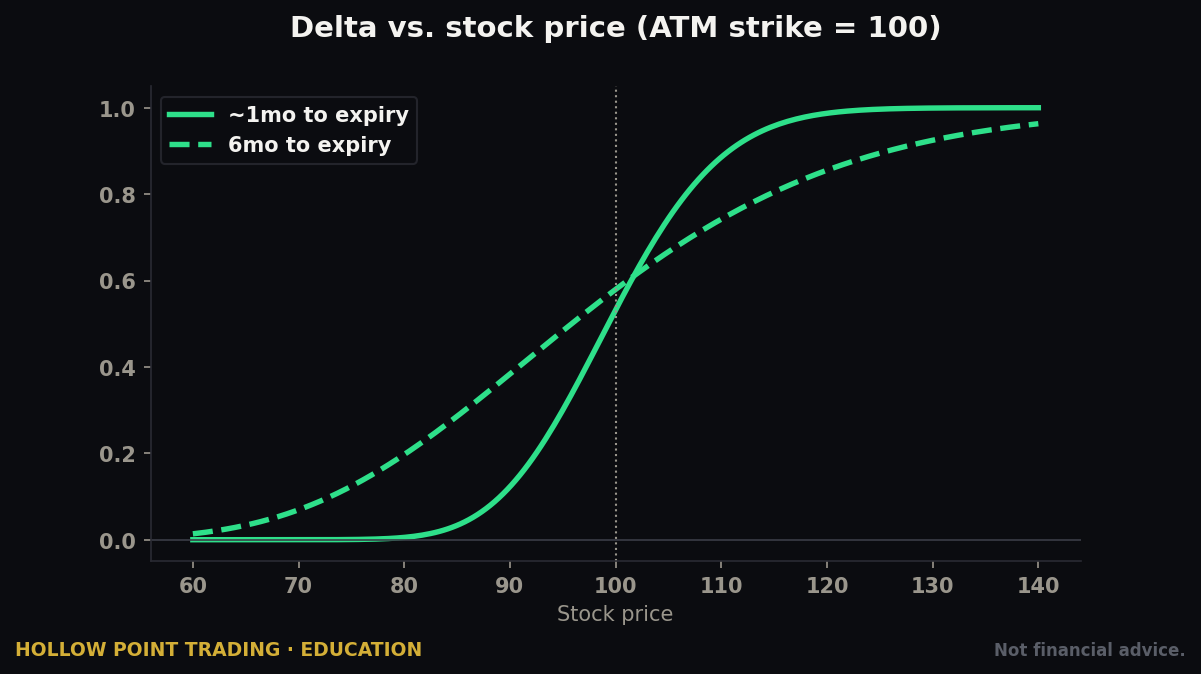
In the money (ITM). For a call, this means the stock price is above your strike. Your right to buy cheap already has real value. ITM calls have a high Delta — think 0.60 to 1.00. They move a lot when the stock moves.
At the money (ATM). The stock price is right around your strike, give or take. ATM options have a Delta right around 0.50. This is the balance point — a coin flip.
Out of the money (OTM). For a call, the stock price is below your strike. Your right to buy is not useful yet; you're betting it becomes useful later. OTM calls have a low Delta — think 0.05 to 0.40. They barely move when the stock nudges, but they're cheap.
Here's the pattern to burn into your memory:
- Deep in the money → high Delta → moves almost like the stock.
- At the money → Delta near 0.50 → moves about half as much.
- Far out of the money → low Delta → barely moves at all.
Step 2: Understand why the numbers are what they are
Why does a deep-in-the-money call have a Delta near 1.00? Because it is already acting like the stock. If you own a call to buy a $200 stock at a $150 strike, and the stock climbs from $200 to $201, your right to buy at $150 gets almost exactly $1 more valuable. There's essentially no doubt it will finish profitable, so it tracks the stock nearly dollar-for-dollar. Delta ≈ 1.00.
Why does a far-out-of-the-money call have a Delta near 0.05? Because a $1 move in the stock barely changes the odds that a long-shot bet pays off. If the stock is $200 and your call's strike is $260, the stock ticking to $201 barely moves the needle on whether it'll ever reach $260. So the option barely responds. Delta ≈ 0.05.
And the at-the-money option sits at 0.50 because it's a genuine coin flip — the stock is right at the strike, and it's equally likely to go up or down from here.
Step 3: Convert Delta into real dollars
This is the step beginners fumble, so let's be painfully explicit. To find the dollar impact of a stock move on your option, you multiply three things:
Stock move (in $) × Delta × 100 shares per contract = expected dollar change in one contract.
Let's run it. You own one call, Delta 0.40. The stock rises $3.
- $3 × 0.40 = $1.20 per share of premium gained.
- $1.20 × 100 shares = $120 gained on that one contract.
If you owned five contracts, multiply by five: $600. Simple, but you must remember the ×100, or your math will be off by two decimal places every single time.
A Fully Worked Beginner Example, Start To Finish
Let's do a complete, realistic trade so you can see Delta breathing in the wild. We'll invent a company — call it Northgate Robotics, ticker NGR — trading at $100.00 per share. All numbers here are illustrative, chosen to be clean and teachable, not a real quote.
You're mildly bullish. You think NGR drifts higher over the next month. You look at the options chain (the menu of all available strikes and expirations) and you see a call option:
- Strike price: $102 (so it's out of the money — stock is at $100, below the strike)
- Expiration: 30 days away
- Premium: $2.00 per share, so $200 to buy one contract
- Delta: 0.40
Scenario A — the stock goes your way. The next day, NGR jumps from $100 to $103. Nice, a $3 move up.
Using our formula: $3 × 0.40 × 100 = $120 gain. Your option that cost $200 is now worth roughly $320. But wait — there's a subtlety we'll cover next. Because as the stock rose, your Delta changed. Hold that thought.
Scenario B — the stock goes against you. Instead, NGR slips from $100 to $98, a $2 drop.
$2 × 0.40 × 100 = $80 loss. Your $200 option is now worth roughly $120. Notice you did not lose $200 — you lost $80, because the option only moved 40 cents on the dollar. That muted response is Delta protecting you on the downside (though of course, options have other risks like time decay that we're setting aside for this lesson).
Scenario C — the stock does nothing. NGR closes at exactly $100.00, unchanged.
Delta predicted zero movement from price, so from the stock's angle, nothing happened. (In reality your option would still lose a little value to time passing — but that's a different Greek called Theta, a story for another day. Delta only speaks about price movement.)
This is the whole beginner value of Delta: before you place the trade, you can say, "If NGR moves $3 in my favor, I expect to make roughly $120. If it moves $2 against me, I expect to lose roughly $80." You've turned a mystery into a measurable bet.
Delta Doesn't Sit Still — Meet Its Sidekick, Gamma
Here's the plot twist that separates people who sort of get Delta from people who really get it: Delta is not a fixed number. It changes as the stock moves.
Go back to Northgate. When NGR was at $100, your $102 call had a Delta of 0.40. But as NGR climbs toward $102 and beyond, the option moves from out-of-the-money toward in-the-money — and as it does, its Delta rises. By the time NGR hits $103, that same option might have a Delta of 0.55 or 0.60. It has become more responsive.
The reverse is also true. If NGR falls, the option gets more out-of-the-money, and its Delta shrinks toward zero, becoming less and less responsive.
This "Delta of the Delta" — the rate at which Delta itself changes — has its own name: Gamma. You don't need to master Gamma today. You just need one beginner-level takeaway:
Winning options speed up, losing options slow down.
As your call goes right, its Delta grows, so each additional dollar of stock movement earns you more than the last. As your call goes wrong, its Delta shrinks, so each additional dollar of loss costs you less than the last. This is a genuinely beautiful feature of long options: your gains can accelerate while your losses decelerate. Delta and Gamma working together are why people buy options in the first place.
But — and this is important — that acceleration is also why beginners misjudge trades. Because Delta shifts mid-move, the simple "$3 × 0.40 × 100 = $120" calculation is an approximation that's most accurate for small moves. For a big move, the real gain is usually a bit higher than the simple math predicts (for a winner), because your Delta grew along the way. Treat the formula as a solid estimate, not a guarantee to the penny.
Delta As A Rough Probability — The Beginner's Crystal Ball
Now for the second superpower. Beyond measuring movement, Delta gives you a quick, honest estimate of your odds.
Here's the rule of thumb, and it's genuinely one of the most useful shortcuts in all of options trading:
An option's Delta is roughly the probability that it finishes in the money at expiration.
- A call with Delta 0.30 has roughly a 30% chance of finishing profitable-at-expiration.
- A call with Delta 0.50 — the at-the-money coin flip — has roughly a 50% chance.
- A call with Delta 0.80 has roughly an 80% chance.
Let that sink in, because it reframes everything. When you buy that cheap, exciting, far-out-of-the-money call with a Delta of 0.10, the market is quietly telling you: this has about a 1-in-10 chance of working out. That doesn't mean don't buy it — long shots sometimes pay huge. But it means you should know it's a long shot and size it accordingly. Beginners who buy 0.05-Delta lottery tickets thinking they're "due" are the ones who blow up accounts.
A few honest caveats so you don't over-trust this tool:
- It's an approximation, not a precise statistic. Delta is a decent proxy for probability, not the exact figure a mathematician would calculate. Treat it as "roughly," always.
- It's the probability of finishing in the money by even a penny, which is not the same as the probability of the trade being profitable. Remember you paid a premium. An option can finish slightly in the money and still be a net loss after what you paid. So "70% chance ITM" is not "70% chance I make money" — your break-even is a bit further out.
- Put Deltas work the same way using their absolute value. A put with Delta –0.35 has roughly a 35% chance of finishing in the money.
Even with those caveats, this is gold for a beginner. It gives you a reality check on every trade. High-Delta options are safer, slower, and more expensive — you're buying probability. Low-Delta options are riskier, faster in percentage terms, and cheaper — you're buying a lottery ticket. Neither is "right." But knowing which one you're holding is everything.
Delta As "How Many Shares Do I Really Own?"
The third and final superpower. This one clicks a lot of lightbulbs.
Delta tells you how many shares of stock your option behaves like. This is called your share-equivalent or "Delta-adjusted" exposure, and the math is dead simple:
Delta × 100 = number of shares your one contract acts like.
- One call, Delta 0.40 → behaves like owning 40 shares.
- One call, Delta 0.75 → behaves like owning 75 shares.
- One deep-ITM call, Delta 0.95 → behaves like owning 95 shares — almost the full 100.
Why does this matter to a beginner? Because it's your true risk gauge. If you own three calls at 0.60 Delta each, you're carrying 3 × 0.60 × 100 = 180 shares of exposure — whether you realized it or not. That's a meaningful position. If NGR gaps down $5 overnight, you feel it like a 180-share holder would: roughly 180 × $5 = $900 of pain (adjusting as Delta shifts).
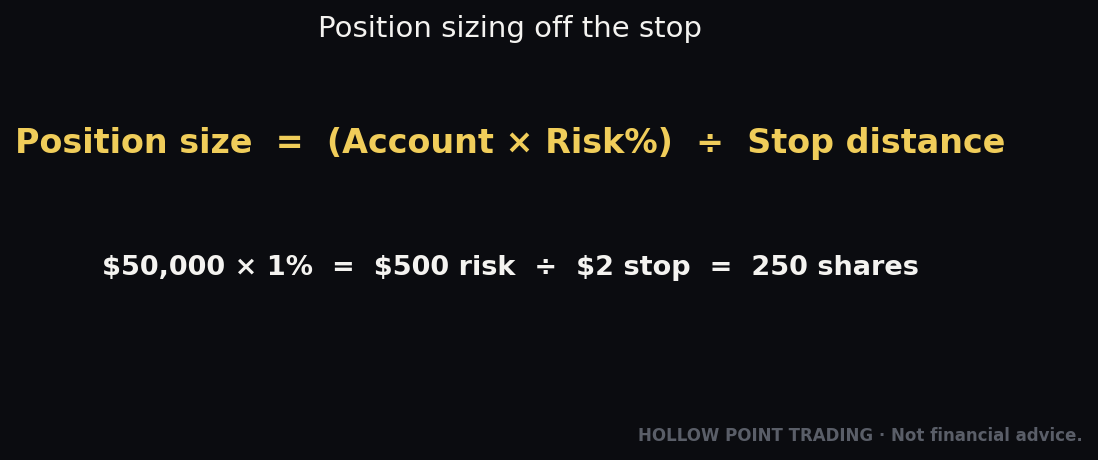
At Hollow Point Trading, this is exactly how we think about position sizing. You never size a trade by "how many contracts feels fun." You size it by how much real market exposure those contracts represent — and Delta is the number that reveals it. Protect capital first. You cannot protect what you refuse to measure.
The Beginner Mistakes To Avoid
You will make some mistakes. Everyone does. But these specific Delta mistakes are so common and so avoidable that we're going to inoculate you right now.
Mistake 1: Forgetting the ×100. You calculate "$3 move × 0.40 Delta = $1.20" and think you made a dollar-something. No — one contract is 100 shares. You made about $120. Or on the flip side, you assume a "cheap" $1.50 option only risks a buck fifty, forgetting it actually costs $150. The ×100 is everywhere. Never drop it.
Mistake 2: Treating Delta as fixed. As we learned, Delta shifts as the stock moves (that's Gamma). Beginners plug the starting Delta into a big-move calculation and then get confused when the real number differs. Use Delta for estimates on small-to-moderate moves, and expect winners to slightly outrun the simple math.
Mistake 3: Buying ultra-low-Delta lottery tickets and expecting them to behave. A 0.05-Delta option is cheap and thrilling, but it barely moves and it's telling you it has about a 5% chance. New traders load up on these, watch the stock rise nicely, and rage that their option "isn't moving." It's moving exactly as a 0.05 Delta should — which is to say, barely. Know what you bought.
Mistake 4: Confusing "chance of finishing in the money" with "chance of making money." You paid a premium. Your true break-even is past the strike. A 0.55-Delta option is not a 55% chance of profit — it's a rough 55% chance of finishing in the money by a penny, which is a lower chance of actually beating what you paid. Be honest with yourself about the difference.
Mistake 5: Ignoring the minus sign on puts. Put Deltas are negative because puts rise when the stock falls. A put with Delta –0.40 gains about $40 per contract when the stock drops $1. The negative isn't scary — it just encodes direction. Don't let it confuse you.
Mistake 6: Forgetting Delta says nothing about time or volatility. Delta only answers "what happens when the price moves." It's silent on time decay (Theta) and volatility swings (Vega). Your option can have a perfect Delta read and still lose money because time passed or volatility fell. Delta is one gauge on the dashboard, not the whole dashboard.
Your Delta Cheat-Sheet
Tape this to your monitor. Everything you need in one glance.
The core definition
- Delta = how much your option moves when the stock moves $1.
- Calls: Delta 0 to +1.00. Puts: Delta 0 to –1.00.
The moneyness map
- Deep in the money → Delta near 1.00 → moves like the stock.
- At the money → Delta near 0.50 → moves about half.
- Far out of the money → Delta near 0.05–0.20 → barely moves.
The dollar formula
- Expected $ change = Stock move × Delta × 100 × number of contracts.
The probability shortcut
- Delta ≈ rough chance of finishing in the money.
- 0.30 ≈ 30%. 0.50 ≈ coin flip. 0.80 ≈ 80%.
- Remember: chance-ITM is not chance-of-profit (you paid premium).
The exposure shortcut
- Delta × 100 = shares your contract behaves like.
- Add them up across all contracts to see your true market exposure.
The three things Delta will NOT tell you
- It won't tell you about time decay (that's Theta).
- It won't tell you about volatility (that's Vega).
- It won't stay put — it changes as the stock moves (that's Gamma).
A Simple Monday-Morning Routine
Here's how to actually use this the next time you look at an option, in five honest steps:
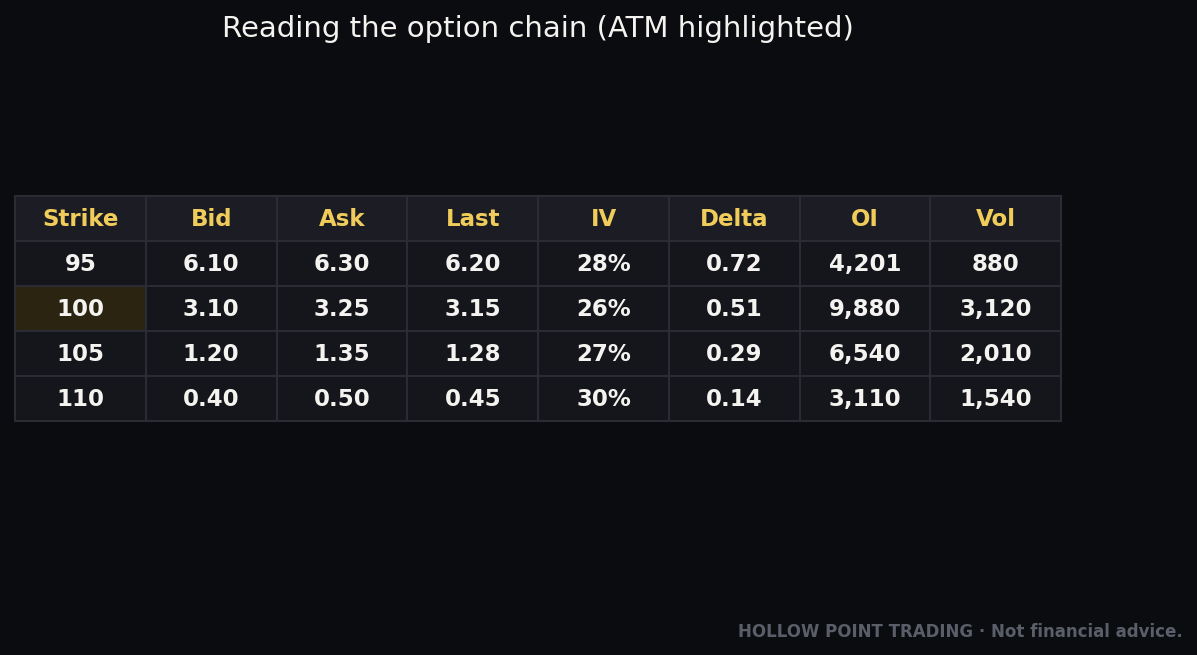
- Find the Delta. It's right there in your broker's options chain, usually a column labeled "Delta." If it's shown as a whole number like 40, that's 0.40.
- Read your odds. Multiply mentally: 0.40 means roughly a 40% chance of finishing in the money. Ask yourself, "Am I comfortable being on the long-shot side or the favored side of this?"
- Estimate your movement. Decide how far you think the stock could move, then run Stock move × Delta × 100. That's your rough dollar swing per contract.
- Check your true exposure. Delta × 100 × contracts = your share-equivalent. Is that a size you can stomach if the stock gaps against you overnight?
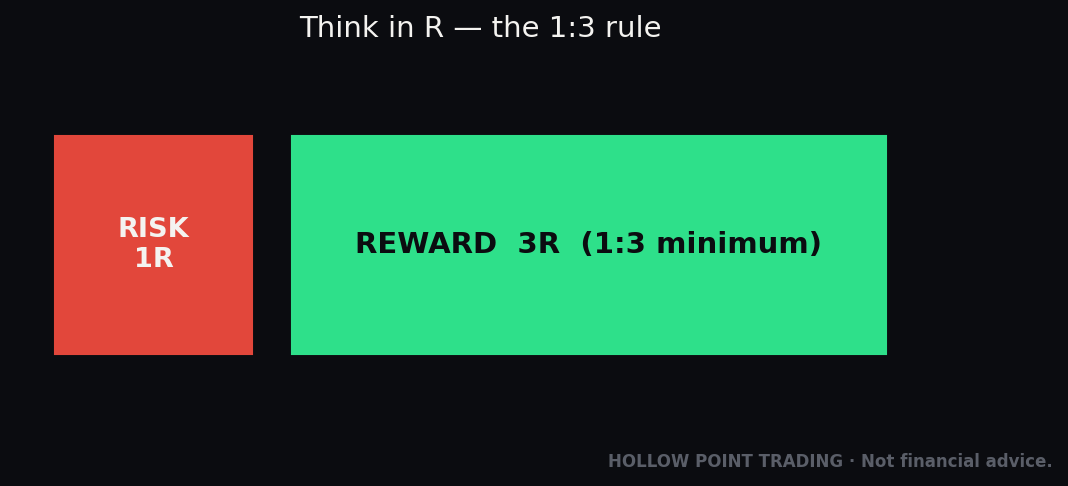
- Confirm it fits your plan. Does the potential reward justify the risk at roughly 1:3 reward-to-risk? If a trade risks $100 to make $300 and the Delta odds are sane, it earns a look. If not, pass. There's always another trade.
That routine takes about thirty seconds once it's habit, and it will keep you out of more bad trades than any indicator ever will.
How Delta Fits The Bigger Hollow Point Picture
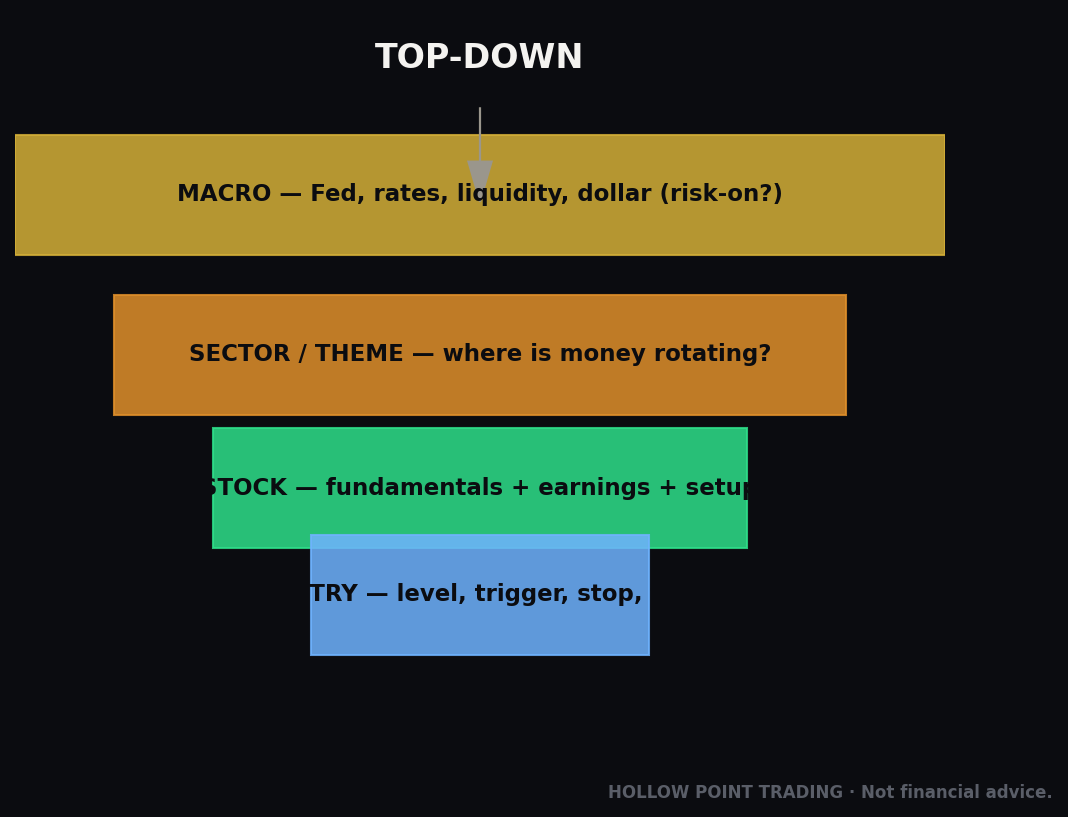
At Hollow Point Trading, we don't trade on hunches, and we don't worship predictions. We build a case from the top down: macro → sector → stock. First, what's the broad market environment doing? Then, is the sector in favor? Only then do we zoom into the individual stock and the setup. Delta doesn't replace that work — it lives inside the final step, after you've already decided the direction and the setup make sense.
Once you've done the top-down homework and you have a real reason to be bullish or bearish, Delta becomes the tool that translates your conviction into a measured, disciplined position. It tells you your odds, so you're never fooling yourself. It tells you your movement, so you're never surprised. It tells you your true exposure, so you can size the trade to survive being wrong — because the first job, always, is to protect the capital that lets you play again tomorrow.
This is the heart of our whole approach: discipline over prediction. Anyone can guess a direction. The trader who lasts is the one who knows their odds, measures their risk, sizes for survival, and only takes trades where the math — roughly 1:3 reward for every unit of risk — is on their side. Delta is one of the humble, unglamorous numbers that makes that discipline possible. It won't make you feel like a genius. It'll do something better: it'll keep you in the game long enough to become one.
Master this one number first. Get comfortable reading it, converting it to dollars, and using it as your probability and exposure gauge. Then, when you're ready, we'll add its sidekicks — Gamma, Theta, and Vega — one patient step at a time. But Delta is the foundation. Build here first, and build it solid.
Bound by rules, feared by trade.