
You bought your first option. You were right about the direction. The stock went up like you thought it would... and somehow your option lost money.
Welcome to the moment every new options trader hits. It feels like the market cheated you. It didn't. You just met the Greeks — and you hadn't been introduced yet.
The Option Greeks are four simple measurements that explain why an option's price moves the way it does. They are the difference between guessing and understanding. And here is the good news: you do not need to be a mathematician to use them. You need to understand what each one measures, in plain English, and how it can quietly help you or hurt you. That is exactly what this guide gives you — enough to actually use on Monday.
Let's start from zero.
First, What Even Is an Option?
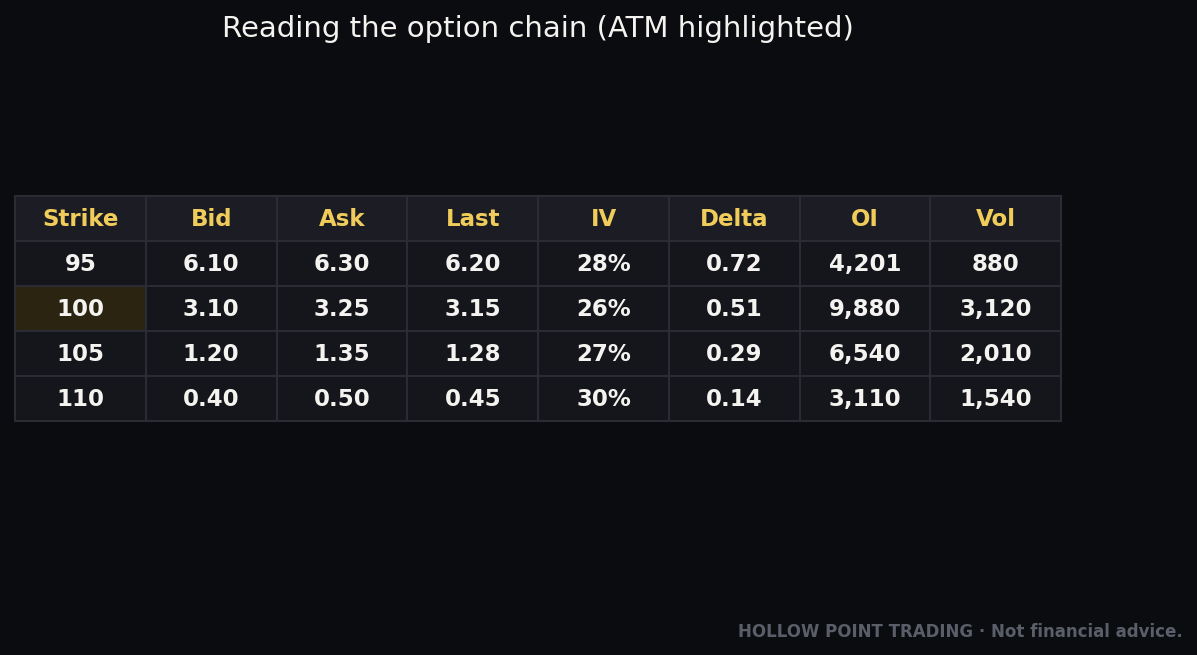
Before we can talk about the Greeks, we need one shared starting point. If you already know this cold, skim it. If you don't, read slowly — nothing later works without it.
An option is a contract that gives you the right, but not the obligation, to buy or sell a stock at a set price before a set date.
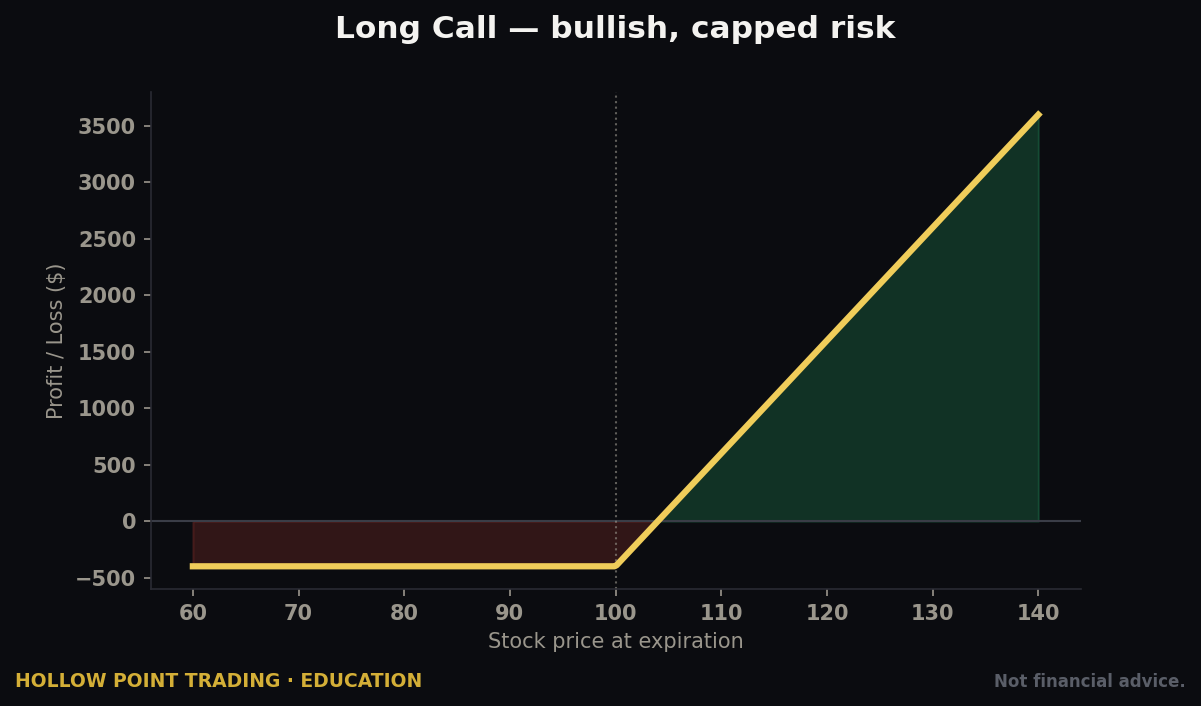
- A call option is a bet that a stock will go up. It gives you the right to buy the stock at a fixed price.
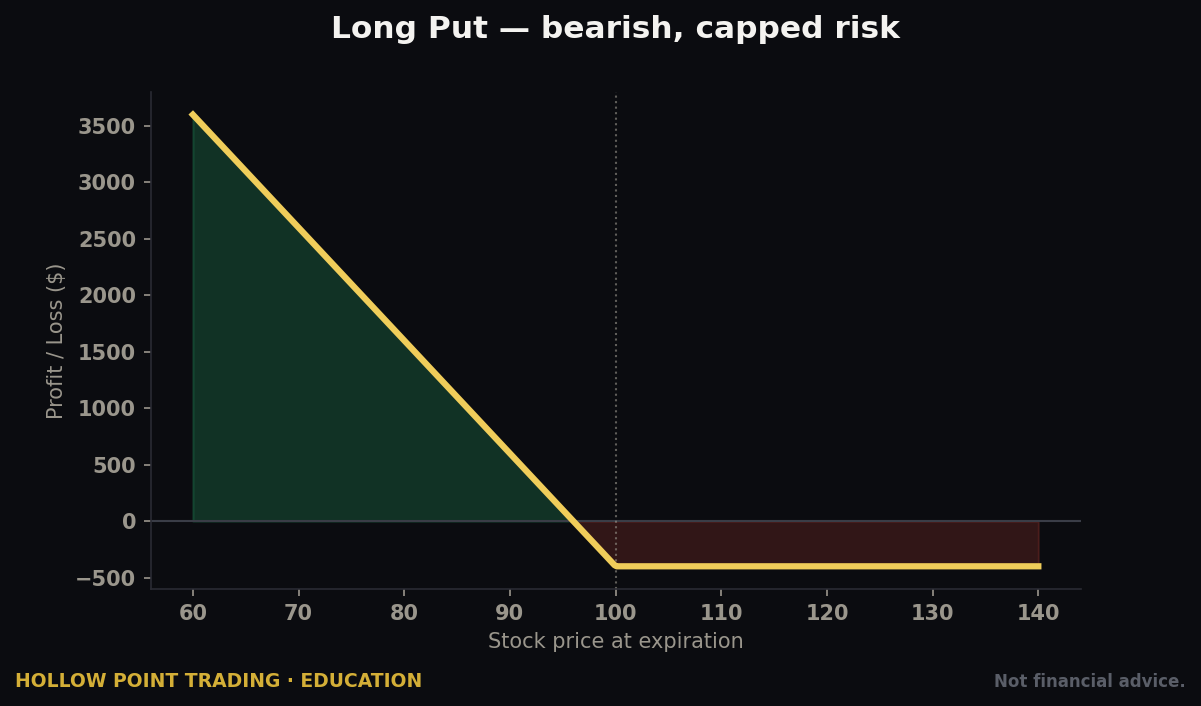
- A put option is a bet that a stock will go down. It gives you the right to sell the stock at a fixed price.
Two more words you'll see constantly:
- Strike price — the fixed price written into the contract. If you own a call with a $100 strike, you have the right to buy the stock at $100, no matter how high it climbs.
- Expiration — the deadline. After this date, the contract is done. This is the single biggest difference between options and stocks: options have a clock, and the clock never stops ticking.
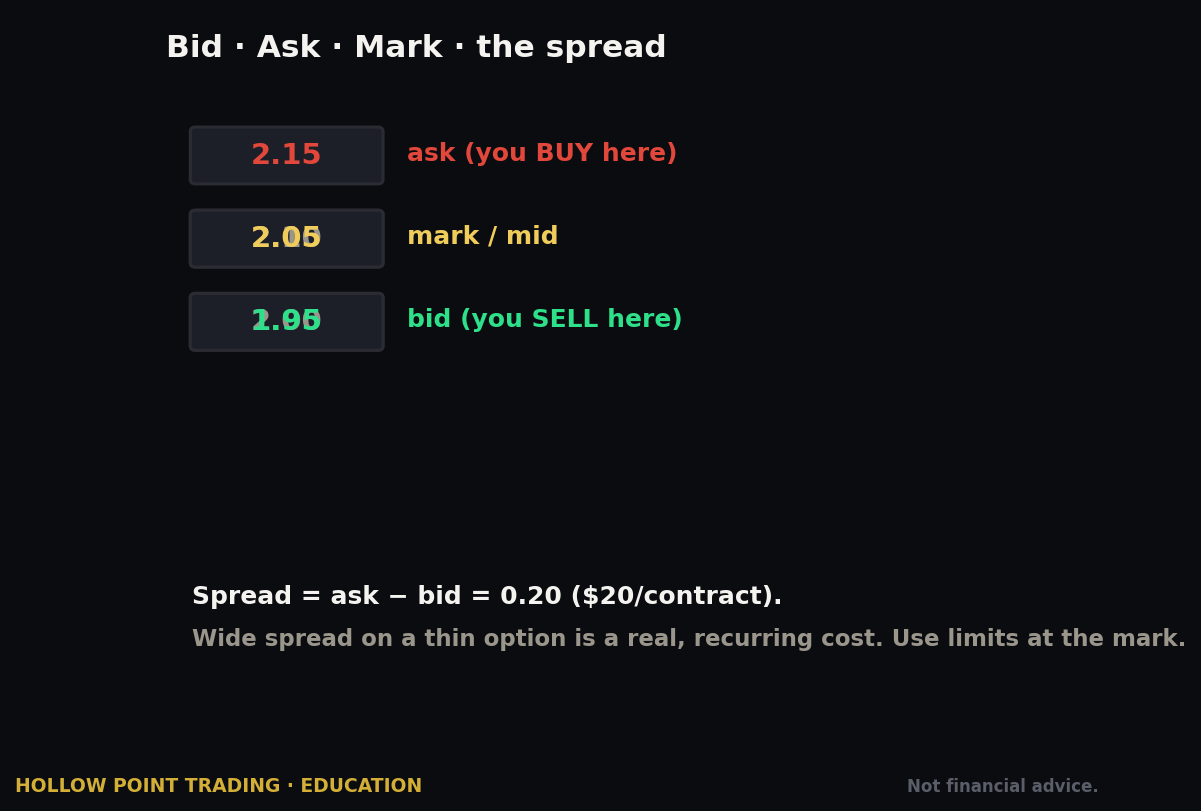
One option contract normally controls 100 shares of stock. So if an option is priced at $2.00, you actually pay $200 to own one contract ($2.00 × 100). Keep that ×100 in your head — it makes every example below real money.
The price you pay for the option is called the premium. And the entire job of the Greeks is to explain what makes that premium go up and down.
So What Are "The Greeks"?
The Greeks are a set of numbers — each named after a Greek letter — that measure how sensitive an option's price is to different forces in the market.
Think of an option's premium as being pushed and pulled by four different forces at the same time:
- The stock moving up or down — measured by Delta
- How fast that first force is changing — measured by Gamma
- Time passing — measured by Theta
- Fear and calm in the market — measured by Vega
Every option you look at has all four of these numbers attached to it, right there in your broker's platform. Most beginners never look. Then they wonder why the trade "made no sense." The Greeks are the sense.
Here's the mindset to carry through this whole guide: the Greeks don't predict the future. They tell you how your option will react if something happens. They're a reaction chart, not a crystal ball. That distinction is the beginning of trading like a professional instead of a gambler.
Let's take them one at a time.
Delta — "How Much Will My Option Move?"
What it is, in plain English
Delta measures how much your option's price changes when the stock moves $1.
That's it. If a stock goes up by one dollar, Delta tells you roughly how many dollars (or cents) your option should gain or lose.
Delta is shown as a number between 0 and 1 for calls, and 0 and -1 for puts. (You'll sometimes see it written as 0 to 100 instead — same thing, just multiplied.)
- A call with a Delta of 0.50 gains about $0.50 for every $1 the stock rises.
- A put with a Delta of -0.50 gains about $0.50 for every $1 the stock falls (the minus sign just means puts move opposite to the stock).
Why a beginner should care
Delta is the first thing you should look at because it answers the question every new trader actually has: "If I'm right about direction, how much do I actually make?"
A low-Delta option (say 0.15) barely reacts when the stock moves. You can be right and still make almost nothing. A high-Delta option (say 0.80) moves almost dollar-for-dollar with the stock. Understanding this stops the heartbreak we opened with — being right and losing anyway.
How Delta works, step by step
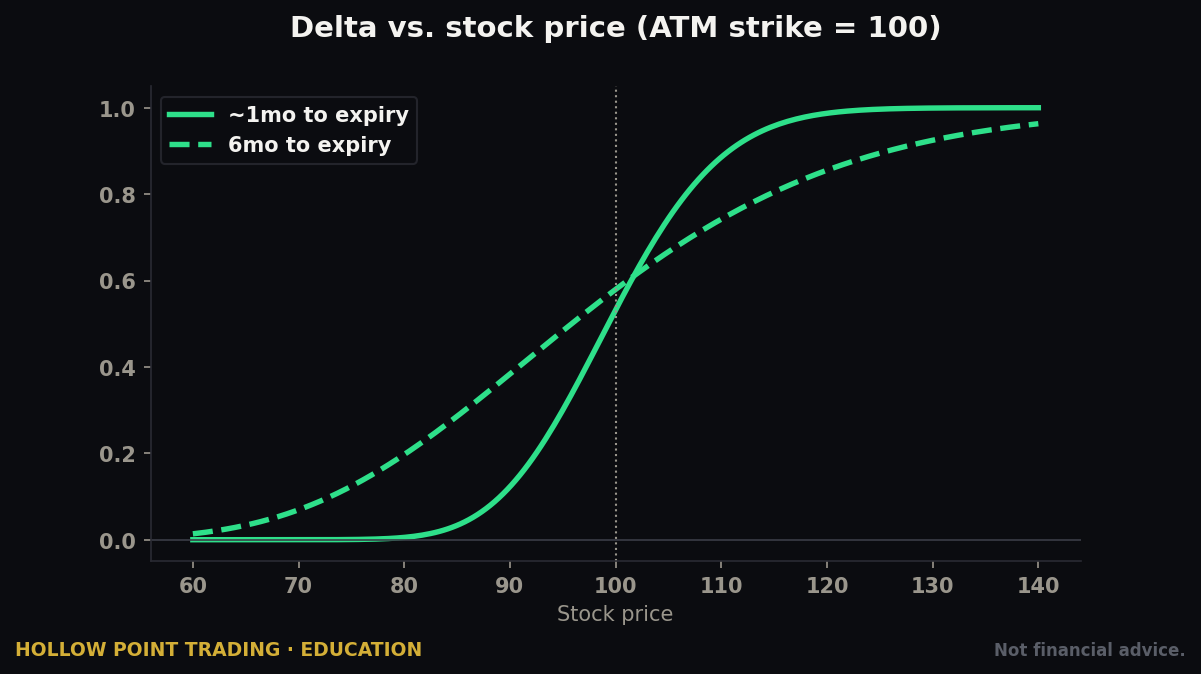
Delta isn't a fixed number. It changes depending on where the stock price sits relative to your strike. There are three neighborhoods:
- In the money (ITM) — the option already has real value. A call is ITM when the stock is above the strike. These have high Delta (0.60 to 1.00). They move a lot like the stock.
- At the money (ATM) — the stock is sitting right around the strike. Delta is about 0.50. It's a coin flip.
- Out of the money (OTM) — the option has no real value yet, only potential. A call is OTM when the stock is below the strike. These have low Delta (0.01 to 0.40). They barely react until the stock gets closer.
There's a bonus meaning traders love. Delta also roughly equals the probability that your option finishes in the money. A 0.30 Delta call has about a 30% chance of expiring with real value. This isn't perfectly exact, but it's close enough to be genuinely useful — and it quietly tells you the odds you're actually taking.
A fully worked beginner example
You buy one call option on a stock trading at $100. You choose the $100 strike (at the money). Delta is 0.50. The premium is $3.00, so you pay $300 (remember, ×100).
The next day the stock rises to $102 — up $2.
- Delta of 0.50 means the option gains about $0.50 per $1, and the stock moved $2.
- 0.50 × $2 = $1.00 gain in the option's price.
- Your premium goes from $3.00 to about $4.00.
- In dollars: $4.00 × 100 = $400. You're up $100 on a $300 trade.
Now compare that to a beginner who bought a far-out-of-the-money call with a 0.10 Delta. Same $2 stock move: 0.10 × $2 = $0.20. Their option barely budged. Same correct call on direction, a fraction of the reward. That's Delta teaching you a lesson before the market has to.
Gamma — "How Fast Is My Delta Changing?"
What it is, in plain English
If Delta is your option's speed, Gamma is its acceleration.
Gamma measures how much your Delta changes when the stock moves $1. It's the Greek that tells you how quickly the other Greek is shifting under your feet.
Why a beginner should care
Beginners ignore Gamma because it feels like a "math on top of math" number. Here's why you shouldn't: Gamma is what makes options feel explosive — both up and down. High Gamma means your Delta (and therefore your gains and losses) can change dramatically and fast. It's the reason an option can go from boring to life-changing to worthless in a single afternoon, especially near expiration.
You don't trade Gamma directly. You respect it. It's the thing that turns a calm position into a wild one.
How Gamma works, step by step
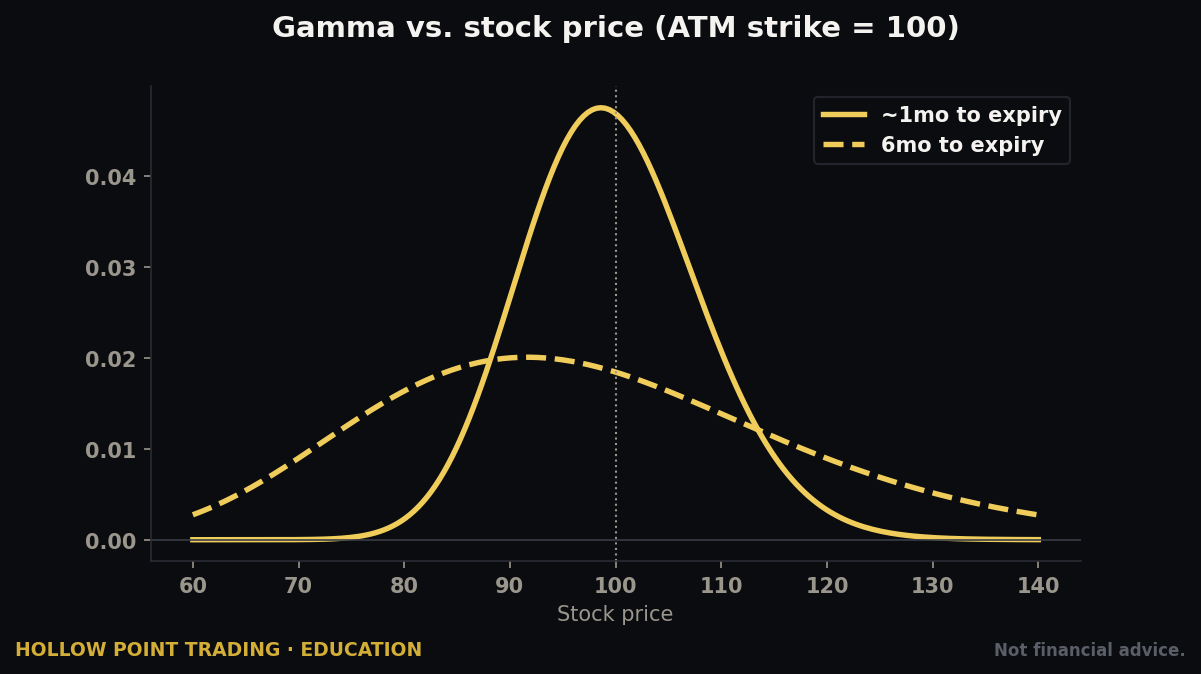
- Gamma is highest for at-the-money options — the coin-flip strikes react most violently to movement.
- Gamma is lowest for deep in- or out-of-the-money options — they're already "decided," so their Delta barely changes.
- Gamma grows as expiration approaches. A near-the-money option on expiration day has enormous Gamma — tiny stock moves flip it from worthless to valuable and back. This is the famous danger of trading options that expire the same day (often called "0DTE," zero days to expiration). It's a Gamma firestorm, and it eats beginners alive.
A fully worked beginner example
You own that same $100 call, Delta 0.50, and its Gamma is 0.05.
The stock rises $1, to $101.
- Gamma of 0.05 means your Delta increases by 0.05.
- New Delta = 0.50 + 0.05 = 0.55.
So the next dollar the stock moves, your option now gains $0.55 instead of $0.50. If the stock keeps climbing, each dollar of movement makes your option gain even faster — Delta ratchets up toward 1.00. That's the acceleration. It cuts the other way too: if the stock falls, your Delta shrinks and your option loses steam. Gamma is the engine behind both.
Theta — "How Much Am I Losing to Time?"
What it is, in plain English
Theta measures how much value your option loses every single day, just from time passing.
This is the Greek that surprises beginners the most, because it works against you the entire time you own an option. Even if the stock does absolutely nothing — sits perfectly still — your option gets a little cheaper every day. That silent leak is Theta, often called time decay.
Theta is shown as a negative number for buyers, because it's money bleeding out. A Theta of -0.05 means your option loses about $0.05 per day (that's $5 in real money on one contract).
Why a beginner should care
This is the concept that explains our opening mystery — "I was right and still lost money." You were right, but slowly. The stock drifted your way, but time decay ate your gains faster than the move fed them. Theta is why you cannot buy an option and "wait and see" the way you can with a stock. Options are perishable. They rot on a schedule.
Understand Theta and you'll stop buying options with months of hope and no plan. You'll start respecting the clock.
How Theta works, step by step
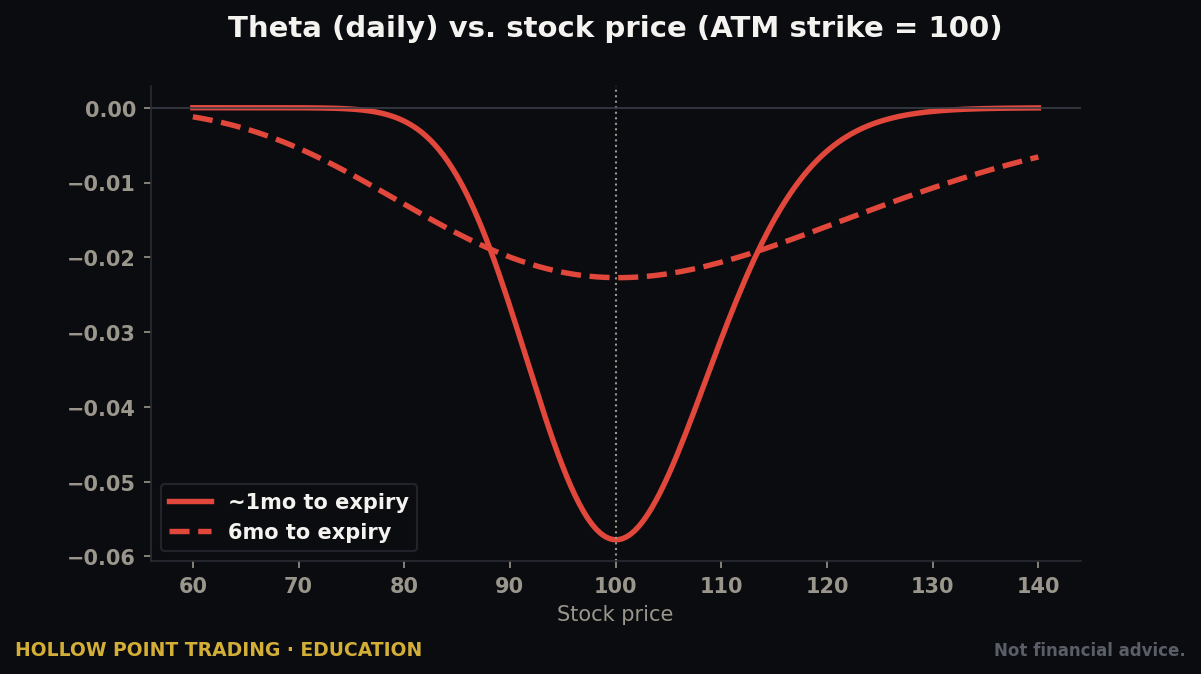
- Theta speeds up as expiration gets closer. An option with 90 days left decays slowly. The same option with 5 days left decays fast. The last week or two is a cliff, not a slope.
- Theta hits at-the-money options hardest, because they have the most "time value" to lose.
- Theta is the mirror image of the option seller's advantage. When you buy an option, Theta is your enemy. When someone sells an option, Theta pays them every day. (You'll meet selling strategies later — for now, just know time is picking a side.)
A fully worked beginner example
You buy a call for $3.00 ($300) with 30 days until expiration. Its Theta is -0.05.
The stock doesn't move at all for 10 days. Nothing happens. The news is quiet.
- Theta of -0.05 per day × 10 days = -$0.50 of value lost.
- Your option is now worth about $2.50 — down $50 — and the stock never moved.
Now imagine you'd held it into the final week, where Theta might accelerate to -0.12 per day. Five more still days would cost another $60. You can see how a "patient" beginner gets slowly bled out. The stock owed you nothing, and time took its cut anyway.
Vega — "How Much Does Fear Move My Option?"
What it is, in plain English
Vega measures how much your option's price changes when the market's expected volatility changes.
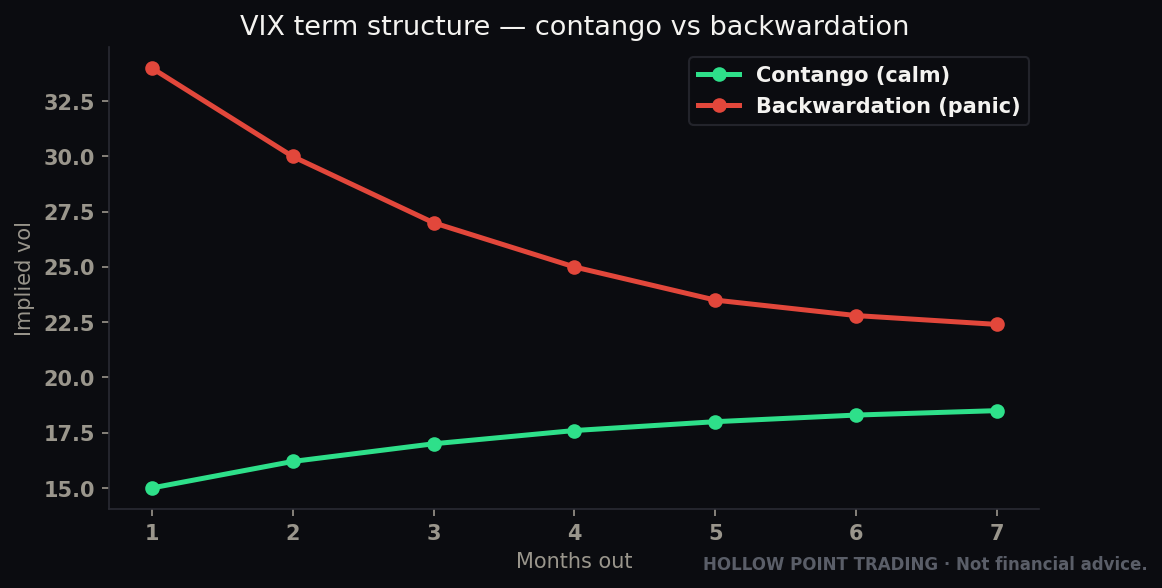
"Volatility" just means how much the market expects a stock to swing around. When traders get scared or excited — before earnings, during a crisis, ahead of big news — they expect bigger swings, and that expectation is called implied volatility (IV). When things are calm, IV is low. When things are wild, IV is high.
Vega tells you how sensitive your option is to those shifts in expectation. A Vega of 0.10 means your option gains or loses about $0.10 for every 1-point change in implied volatility.
(Quick note: "Vega" isn't actually a Greek letter — it's the odd one out — but it's used everywhere, so we use it too.)
Why a beginner should care
Vega is the invisible trap. Here's the classic beginner disaster: you buy a call right before a company's earnings announcement because you're sure the stock will pop. Everyone else expects a big move too, so implied volatility is sky-high — and the option is expensive because of it. The stock does pop. You were right! But the moment earnings pass, the uncertainty vanishes, IV collapses, and Vega drags your option's price down — sometimes more than the stock's move lifted it. You lose money on a correct call. This is so common it has a nickname: IV crush.
If you don't understand Vega, you will eventually get crushed by it. If you do, you'll know to be suspicious of any option that suddenly looks expensive.
How Vega works, step by step
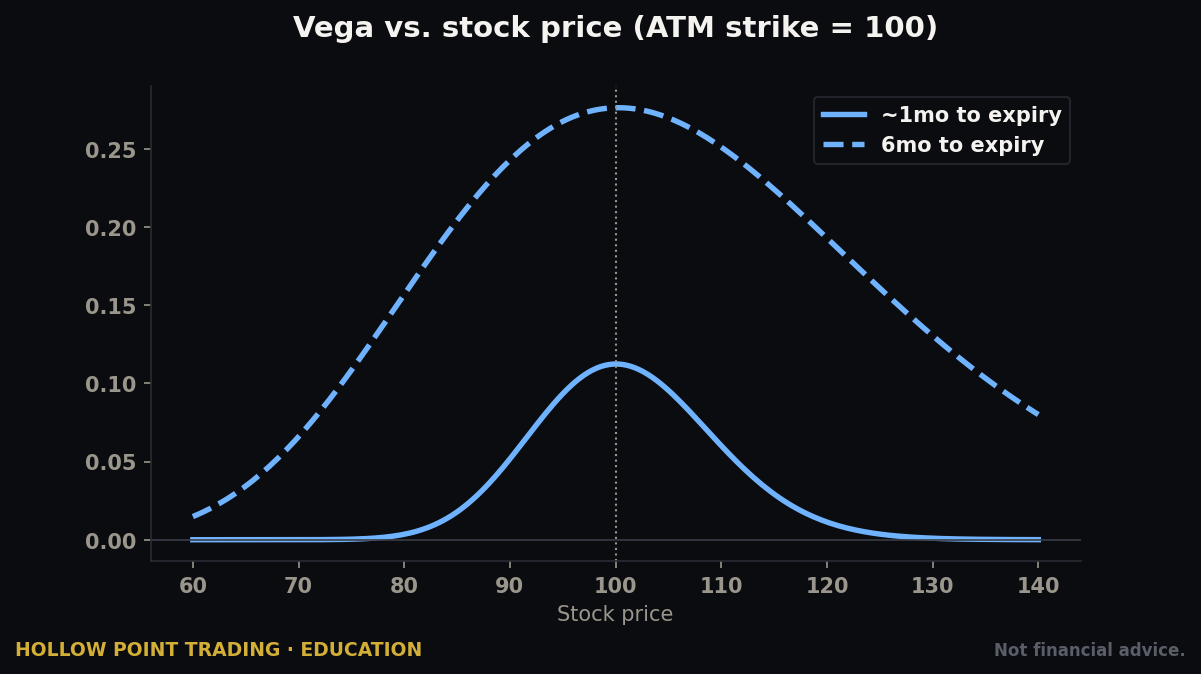
- Vega is highest for options with lots of time left — more time means more room for volatility to matter.
- Vega is highest at the money, like Gamma and Theta.
- Implied volatility tends to rise before big events (earnings, Fed announcements, product launches) and collapse right after, once the uncertainty is resolved.
A fully worked beginner example
You buy a call for $4.00 ($400) the day before earnings. Implied volatility is a hot 60. Your Vega is 0.15.
Earnings come out. The stock jumps a nice $3 — you called it right. But now the news is known, so implied volatility crashes from 60 down to 40 — a drop of 20 points.
- Vega hit: 0.15 × 20 points = -$3.00 lost to volatility collapse.
- Delta gain from the $3 stock move (say Delta was 0.50): 0.50 × $3 = +$1.50.
- Net: +$1.50 from being right, -$3.00 from IV crush = -$1.50.
- Your option is now worth about $2.50. You were right about the stock and still down $150.
That is Vega. That is why "the stock went up but my option went down" is one of the most common sentences in a beginner's vocabulary — and one you'll never have to say once you respect it.
Putting All Four Together
Here's the truth that ties it up: all four Greeks are acting on your option at the same time, every second.
Buy a call and the moment you own it:
- Delta is working for you if the stock rises.
- Gamma is making that Delta stronger or weaker as the stock moves.
- Theta is bleeding value out of you every single day.
- Vega is swinging your value around based on the market's mood.
A great trade is one where the forces you want outweigh the forces working against you. When you buy an option, you're usually hoping Delta and Gamma (movement) beat Theta and Vega (time and volatility). If the stock doesn't move enough, fast enough, time and volatility win. That's the whole game in one sentence.
The Beginner Mistakes to Avoid
Every one of these comes straight from the Greeks. Now you'll see them coming.
1. Buying cheap, far-out-of-the-money options because they "could 10x." These have tiny Delta and get destroyed by Theta. They're lottery tickets. The stock has to move huge, fast, just to break even. Most expire worthless.
2. Holding through earnings without understanding IV crush. You already know this one now. High IV before the event means you're overpaying, and Vega punishes you the second the news drops. Being right isn't enough when you bought at the top of the fear.
3. Ignoring the clock. Buying options with a week left and treating them like stock you can "hold." Theta accelerates into expiration. Short-dated options are a sprint, not a stroll.
4. Trading same-day expiration ("0DTE") as a beginner. This is maximum Gamma and maximum Theta at once — the most violent, fastest-moving corner of the entire options market. It looks like easy money. It is not. Learn to walk first.
5. Never actually looking at the Greeks. They're in your platform, for free, on every option. Not looking is like driving with your eyes closed and blaming the road.
Your Simple Greeks Cheat-Sheet
Tape this to your monitor.
| Greek | Measures | Beginner takeaway |
|---|---|---|
| Delta | Price change per $1 stock move | How much you make if you're right on direction. Higher = moves more like the stock. Also ≈ your odds of finishing in the money. |
| Gamma | How fast Delta changes | Acceleration. Highest at-the-money and near expiration. Makes options explosive — respect it. |
| Theta | Value lost per day | Time decay. Your enemy as a buyer. Speeds up near expiration. Options rot. |
| Vega | Price change per volatility shift | Fear factor. High before earnings, crushes after (IV crush). The invisible trap. |
The four questions to ask before every options trade:
- Delta — If I'm right, will this option actually move enough to pay me?
- Gamma — How fast could this get wild? (Higher near expiration and at-the-money.)
- Theta — How much am I bleeding per day, and can my move outrun it?
- Vega — Is volatility high right now? Am I about to get IV-crushed?
If you can answer those four, out loud, you are already ahead of most people clicking "buy."
How This Fits the Hollow Point Picture
At Hollow Point Trading, we don't believe in predicting the market. We believe in reading it and then managing risk with discipline. The Greeks are that philosophy in miniature.
Think about how they map to the way we teach the whole game — macro to sector to stock. The big-picture mood of the market (macro fear and calm) shows up in Vega and implied volatility. The strength or weakness flowing into your specific stock shows up in Delta — whether your directional read is even worth taking. And the discipline to not overstay, to respect the clock and take your risk off the table, lives in Theta. Time is not your friend when you're a buyer, and pretending otherwise is how accounts die slowly.
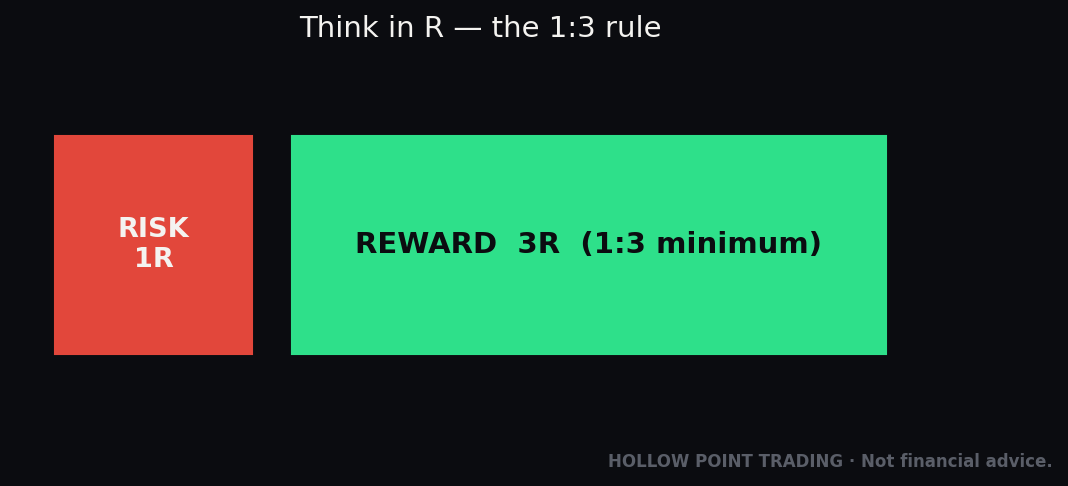
This is also where our bones-deep rule on reward-to-risk meets the Greeks. We look for setups offering at least 1:3 — risking one dollar to make three. The Greeks tell you whether a trade can actually deliver that. A low-Delta, high-Theta lottery ticket almost never will; you'll be right on direction and still lose to decay. A thoughtfully chosen option — enough Delta to pay you, enough time that Theta isn't a cliff, bought when volatility is reasonable rather than panic-priced — gives that 1:3 a fighting chance.
And above everything: protect capital first. The Greeks are, at their heart, a risk-measurement tool. They exist to tell you how you can get hurt before you get hurt. A beginner who checks Delta, Gamma, Theta, and Vega before every trade isn't being fancy. They're being a professional. They're refusing to be surprised. That's the entire ethos — you don't have to predict the future if you understand exactly what you're exposed to and you refuse to over-risk on any single bet.
Your First Week With the Greeks
You don't need to master these overnight. Here's a calm, beginner path:
- This week: Open your broker's option chain on any stock you follow. Just look at the Delta, Gamma, Theta, and Vega columns. Don't trade. Watch how Delta is near 0.50 at the money, how Theta grows as you look at closer expirations, how Vega swells with more time. Make it familiar.
- Next: Pick one stock and "paper trade" (fake money) a single option. Write down its four Greeks. Check it daily. Watch Theta quietly do its work. See Delta pay you when the stock moves. Feel the forces instead of reading about them.
- Then: Only once the four questions on your cheat-sheet come automatically — only then do you risk real money, small, with a plan for your exit written before you enter.
The Greeks turn options from a slot machine into a measured decision. That's the whole point. You came here confused about why being right could lose money. Now you know: because Delta, Gamma, Theta, and Vega were all in the room, and you hadn't met them.
Now you have. Trade like it.
Bound by rules, feared by trade.