
Most people who lose money in the markets don't lose it because they picked the wrong stock. They lose it because they traded when there was nothing to trade. They pushed buttons out of boredom, out of anger, out of the fear of missing out — and the market handed them the bill.
This guide is about the single most underrated skill in all of trading: knowing when not to trade. Not as a punishment. Not as sitting in the corner. As a genuine, learnable, edge-protecting skill — the same way a good poker player folds most of their hands, or a sniper waits hours for one clean shot instead of spraying bullets at everything that moves.
By the end of this, you'll understand what "dead tape," "no edge," "revenge trading," and "FOMO" actually mean in plain English, why each of them quietly destroys beginner accounts, and exactly how to protect yourself with a simple rule set you can use on Monday morning. Let's build it from zero.
First, Some Plain-English Words You'll Need
Before we go anywhere, let's define the handful of terms this guide uses. If you already know them, skim. If you don't, read carefully — every one of these gets used again.
A trade is when you buy something (a stock, a futures contract, whatever) hoping to sell it later for more, or sell it first hoping to buy it back cheaper. Either way, you're putting real money at risk to try to make more money.
The tape is old slang for the live stream of prices and trades happening right now. A hundred years ago, prices came out of a machine that printed them on a paper ribbon — "the ticker tape." Today it's on a screen, but traders still say "reading the tape" to mean "watching what price is actually doing this moment."
An edge is any repeatable reason you have to believe a trade is more likely to win than lose. A casino has an edge on every spin of the roulette wheel — not because it wins every time, but because the math is tilted in its favor over thousands of spins. A trader's edge is the same idea: a specific situation where, if you took the same setup a hundred times, you'd come out ahead.
A setup is the specific pattern or situation you're waiting for — your personal signal that says "this is the spot." No setup, no edge.
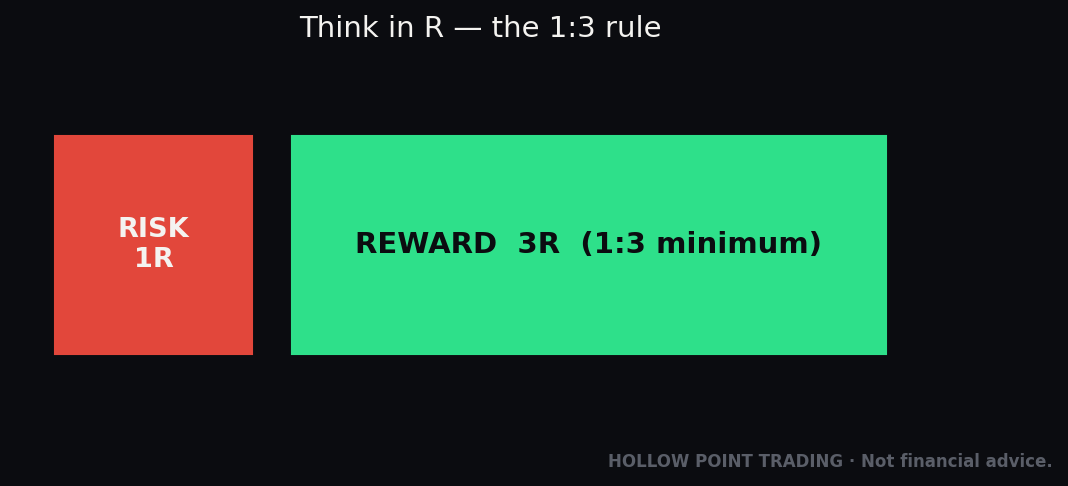
Risk/reward (written "1:3") is how much you're risking versus how much you're trying to make. 1:3 means you risk 1 dollar to try to make 3. We'll come back to this — it's central to how Hollow Point Trading (HPT) thinks.
Capital is your money — the actual cash in your trading account. "Protecting capital" means keeping that money alive so you can trade again tomorrow.
Got those? Good. Now let's talk about why doing nothing is so hard — and so valuable.
Why Doing Nothing Feels Impossible (and Why That's the Whole Problem)
Here's an uncomfortable truth: the market is open for hours every day, and your brain assumes that if you're sitting there watching it, you should be doing something. That instinct is completely natural and completely wrong.
Think about a lifeguard. A good lifeguard spends 99% of their shift doing nothing but watching. They don't jump in the water to look busy. They don't "practice rescues" on swimmers who are fine. They wait, scanning, until there's a real emergency — and then they move. If a lifeguard jumped in every ten minutes to justify their chair, they'd be exhausted, in the way, and useless when it actually mattered.
Trading is the same. Your job is not to be busy. Your job is to be ready — and to only act when a real opportunity shows up. The hours of watching aren't wasted time; they're the setup for the one good moment.
Beginners get this backwards. They feel that every day they don't trade is a day "wasted," every hour of watching without clicking is a failure. So they invent reasons to trade. And inventing reasons to trade is exactly how you lose money.
Why should a beginner care about this more than anyone? Because you have the least room for error. A professional with a large account and years of experience can absorb some sloppy trades. You cannot. Every bad trade you take when there was no reason to trade is money leaving your account for nothing — money you needed to survive long enough to actually get good. Protecting your capital is the beginner's whole game. You don't win by making money fast. You win by not going broke while you learn.
Now let's walk through the four big situations where the right move is to sit still.
No-Trade Situation #1: Dead Tape
What it is, in plain English: "Dead tape" means the market is barely moving. Price is drifting sideways in a narrow little range, volume is thin, and nothing is really happening. The tape is "dead" — flat, quiet, going nowhere.
Volume, by the way, is simply how many shares or contracts are being traded. High volume means lots of people are active and money is moving. Low volume means hardly anyone's trading — the market is half-asleep.
Why a beginner should care: Dead tape is a trap because it looks safe. Price isn't crashing, nothing scary is happening, so it feels like a fine time to poke around. But here's the problem — you make money when price moves. If price is stuck in a tiny range going nowhere, there's no move to catch. You'll buy near the top of the little range, price will drift back down, you'll get scared out, and you'll have paid fees and lost a bit for absolutely nothing. Do that ten times in a dead session and you've bled your account with a thousand paper cuts.
There's also a hidden cost. Every time you trade, you usually pay a small fee (a commission) and you lose a tiny bit to the spread — the gap between the price to buy and the price to sell. In a dead market, those costs eat you alive because you're not making enough on the move to cover them.
How to spot dead tape, step by step:
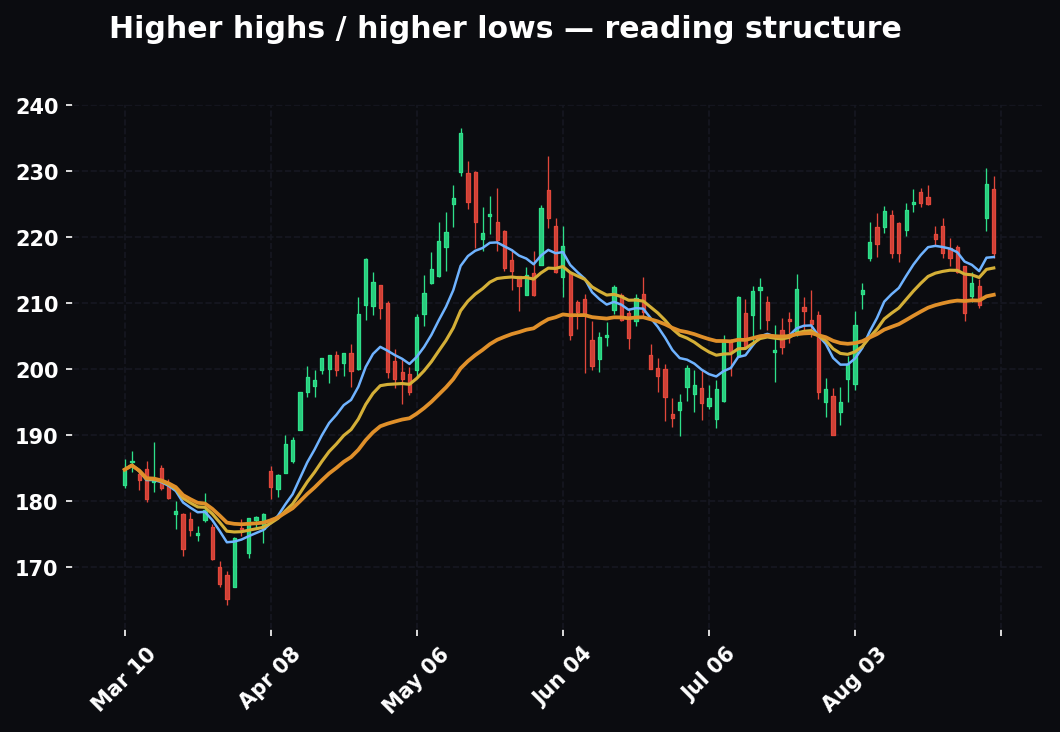
- Look at the price over the last hour or two. Is it making higher highs and higher lows (an uptrend), or lower highs and lower lows (a downtrend)? Or is it just chopping sideways in a flat band? Sideways and flat is your first clue.
- Look at the size of the recent price bars (candles). Are they tiny compared to earlier in the day? Small bars = small moves = dead.
- Look at volume. Is it drying up — the bars getting shorter and shorter? Fading volume confirms it.
- Check the clock. Certain times are famously dead: the middle of the lunch hour, the hours right before a big scheduled news release when everyone's waiting, and the last sleepy stretch of a summer Friday.
If most of those say "quiet," the tape is dead. Close the laptop. Go for a walk.
A fully worked beginner example: It's 12:15 in the afternoon. You've been watching a stock we'll call XYZ. All morning it swung in a healthy range — from about 100 to 103, big clean candles, lots of volume. Real movement. But since noon, it's been pinned between 101.40 and 101.70. That's a 30-cent range. The candles are tiny. Volume has fallen off a cliff.
A beginner thinks: "It's been at 101.40 twice, I'll buy there and sell at 101.70, easy 30 cents." They buy at 101.45. Price drifts to 101.55… then back to 101.42… then 101.48. Nothing happens for forty minutes. Bored and annoyed, they sell at 101.44, losing a penny plus fees. They "traded" and got nothing but stress. The tape was dead, and the dead tape won.
The disciplined move: recognize the range is tiny and volume is gone, write in your notes "12:15 — dead tape, standing aside," and do literally nothing until the market wakes back up (often in the last hour or two of the day, when volume returns).
No-Trade Situation #2: No Edge
What it is, in plain English: "No edge" means you don't actually have a real, specific reason to be in this trade. You don't have a setup you recognize. You're not seeing the pattern you wait for. You just… feel like it might go up. That feeling is not an edge. That's a guess.
Remember, an edge is a repeatable situation where the odds tilt your way. If you can't say out loud, in one clear sentence, why this trade should work — "I'm buying because price pulled back to a level it bounced off three times and buyers are stepping in again" — then you don't have an edge. You have a coin flip, and you're paying fees to flip it.
Why a beginner should care: This is maybe the most important idea in this entire guide. Trading without an edge is guaranteed to lose over time, because the small costs of trading (fees, spread) slowly grind you down even on a 50/50 bet. You're not just flipping a fair coin — you're flipping a coin that costs you a nickel every flip. Do it long enough and you go broke by pure math, even if you're "right" half the time.
Beginners massively underestimate how often the correct answer is "there's no setup here." Professionals will tell you they're truly in a trade only a small fraction of the time they're at the screen. The rest is waiting, watching, and passing on things that aren't quite right.
How to check for an edge, step by step:
- Name the setup. Say it out loud: "This is a pullback-to-support bounce," or "This is a breakout of the morning range." If you can't name it, stop.
- State the reason in one sentence. "I'm buying because ___." If the blank is "it feels like it'll go up" or "it's been going up so it'll keep going," that's not a reason. That's hope.
- Find your invalidation. Where, exactly, would price prove you wrong? If you can't point to a specific price that says "I was wrong, get out," you don't understand the trade well enough to be in it.
- Check the reward. Is there room for price to run at least three times as far as your risk (that 1:3 again)? If the nearest logical target is barely past your entry, there's no meat on the bone. Pass.
If any of those four fail, you have no edge. Stand aside.
A fully worked beginner example: You're watching stock ABC at 50.00. It's been climbing all morning. You think, "It's strong, it'll keep going, I'll buy." Let's run the four checks.
- Name the setup? You… can't. "It's going up" isn't a setup.
- Reason in one sentence? "Because it's been going up." That's just describing the past, not a reason for the future.
- Invalidation? You have no idea where you'd be wrong. You'd probably just hold and hope.
- Reward? No specific target, so no way to know if the reward is worth the risk.
Four for four — no edge. The disciplined trader passes. Now compare: an hour later, ABC pulls back to 49.00, a price where it clearly bounced twice earlier in the day, and you see buyers stepping in with rising volume. Now you can say: "I'm buying at 49.05 because price is holding the 49.00 support that bounced twice, my invalidation is a close below 48.80 where I'd risk about 25 cents, and my target is 49.80 for roughly three times my risk." That's an edge. Same stock, same day — the difference is entirely whether a real setup showed up.
No-Trade Situation #3: Revenge Trading
What it is, in plain English: "Revenge trading" is when you just lost money on a trade and you immediately jump into another one to "win it back." You're not trading the market anymore — you're trading your feelings. You're angry, embarrassed, and you want the market to give you back what it took. So you take a trade you'd never normally take, usually bigger than normal, to get "even" fast.
Why a beginner should care: Revenge trading is where small losses turn into account-ending disasters. Here's the ugly chain reaction: you lose $50 on a bad trade. Instead of accepting it, you get mad and take a rushed trade to win it back — but because you're rushed, it has no edge, so you lose $80. Now you're down $130 and furious, so you double your size to get it all back in one shot… and lose $200. In twenty minutes, a $50 mistake has become a $330 hole, and every trade after the first was driven by emotion, not by any setup.
The market doesn't know you lost money and doesn't care. It will not "give it back" just because you feel owed. Believing otherwise is a fantasy that has drained more beginner accounts than any bad stock pick ever will.
How revenge trading actually works in your head, step by step:
- You take a loss. Real money leaves your account.
- Your brain treats it like an insult, not a normal cost of business. Emotion spikes.
- That emotion screams "fix it NOW." Urgency replaces patience.
- You take a trade with no edge (because there wasn't a setup — you just needed a trade).
- It usually loses, because it was never a good trade. The emotion gets worse.
- You size up to win it back faster. The next loss is bigger. Repeat until the account is gutted.
The whole spiral runs on one broken belief: that you must win the money back right now, from the market that took it. You don't. You can win it back next week, next month, from a completely different, good trade.
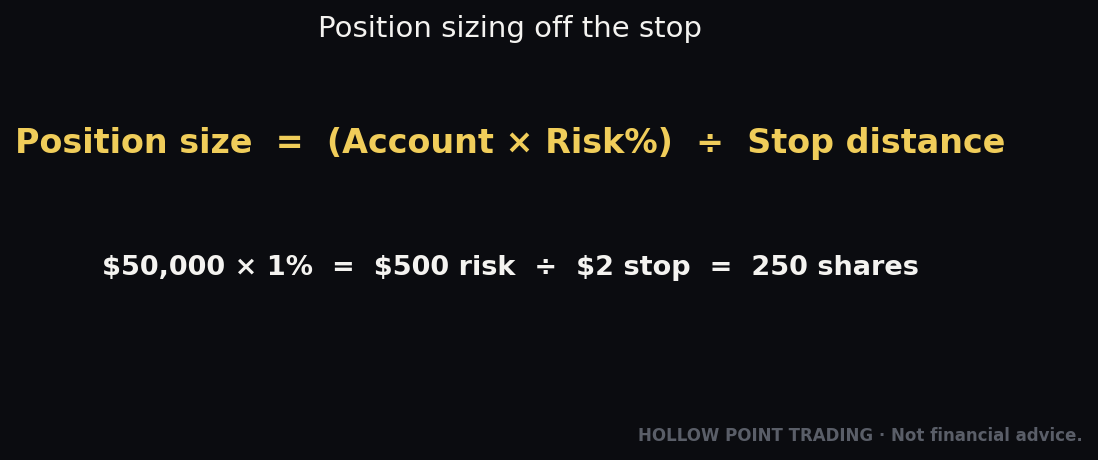
A fully worked beginner example: Sarah has a $2,000 account and a rule to risk about $40 per trade. She takes a clean setup and it doesn't work — down $40. Normal. Fine. But it stings. Instead of stepping away, she immediately sees price "looking like it'll bounce" (no real setup — sound familiar?) and jumps in risking $60 to make the $40 back plus a little. It drops. Now down $100. Heart pounding, she goes again, this time risking $120 — "one good trade fixes everything." It fails. Down $220. In half an hour, over 10% of her account is gone, all because of a single $40 loss she couldn't accept.
The disciplined version: Sarah takes the first $40 loss, notices herself getting heated, and follows her rule — one loss that makes me angry means I'm done for the session. She closes the platform, logs "stopped after emotional loss, protecting capital," and comes back tomorrow with a clear head and her $1,960 intact. That $1,960 is a live account that can still make money. The revenge-trader's $1,780-and-falling is an emotional wreck. Same starting loss. Completely different outcome, decided entirely by discipline.
No-Trade Situation #4: FOMO (Fear of Missing Out)
What it is, in plain English: FOMO stands for "Fear Of Missing Out." In trading, it's the panicky feeling you get when something is rocketing higher without you and you rush in late so you don't "miss it." You're not buying because of a setup. You're buying because everyone else seems to be making money and you can't stand watching from the sidelines.
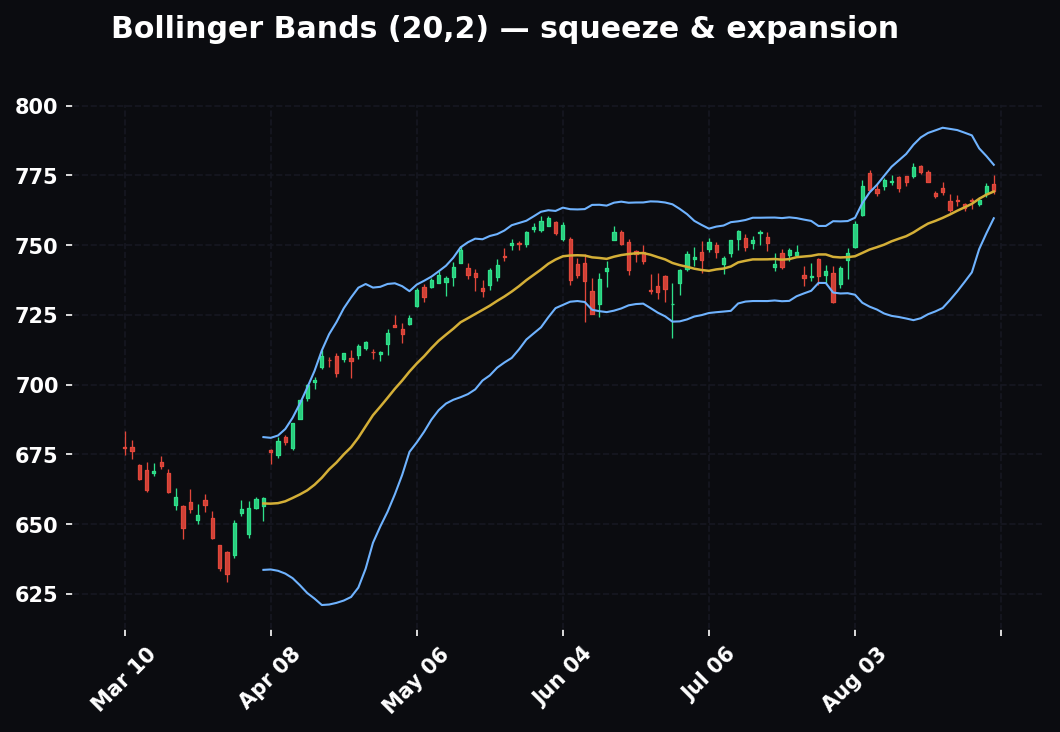
Why a beginner should care: FOMO makes you buy at the worst possible price — the top. Here's why: by the time a move is so big and so obvious that it triggers your fear of missing out, most of the move has already happened. The people who bought early (with an actual setup) are now getting ready to sell to you. You're arriving at the party right as it's ending, paying premium prices to the very people who are about to leave. Then the price drops, and you're the one holding the bag.
FOMO is especially brutal because it's fueled by other people — social media, chat rooms, a friend bragging about a win. It feels like the whole world is getting rich and you're being left behind. That feeling is a liar. You never see the losses people don't post about, and you never see the folks who bought the same hot thing an hour after you and lost even more.
How FOMO works, step by step:
- Something makes a big, fast move. Green candles everywhere.
- You didn't have a position (correctly — there was no setup when it started).
- You watch it climb and feel the money you "could have made" slipping away.
- The fear of missing out overwhelms your patience. You buy — late, high, with no plan.
- The early buyers sell into your buying. The move stalls and reverses.
- You're now underwater on a trade you never had a reason to take, with no idea where to get out because you never had a plan.
A fully worked beginner example: A stock called FAST opens at 20.00 and by mid-morning it's screaming — 20, 22, 25, 28. Your trading chat is on fire: "FAST TO THE MOON." You didn't buy at 20 because there was no clean setup then, which was correct. But now it's 28 and climbing and you can't take it anymore. You buy at 28.50 — no plan, no invalidation, no target, just "I have to be in this."
Ten minutes later, the early buyers who got in at 20 start cashing out their huge profits. All that selling stops the climb. FAST slides — 27, 26, 24. You're down over $4 a share on a trade you entered purely on emotion. You don't know whether to sell (and lock the loss) or hold (and hope), because you never had a plan. That paralysis is the signature of a FOMO trade.
The disciplined move: watch FAST run without you and feel totally fine about it. There will be another setup tomorrow, and the day after, forever. Missing one move costs you nothing. Chasing one bad move can cost you plenty. As HPT puts it — discipline over prediction. You don't need to catch every move. You need to catch your move, the one that fits your plan.
The Power of Standing Aside
Let's reframe all of this, because beginners hear "don't trade" as "do nothing, be passive, be weak." It's the opposite. Standing aside is an active, powerful, chosen decision. It's you saying: "I looked, I checked my rules, there's nothing here for me, and I'm keeping my money instead of donating it."
Here's a mindset shift that changes everything: not losing money is the same as making money. If the average distracted beginner loses money on a dead, choppy, no-setup day, then you keeping your money on that same day means you just beat the average by exactly the amount they lost. Your account is now ahead of theirs, and you didn't take a single risk to get there. Cash preserved is a position — it's the position that says "I'm ready for the next real opportunity, fully loaded."
There's also a compounding benefit. Every time you stand aside correctly, you're training the muscle. You're proving to yourself that you can wait, that the fear passes, that missing a move doesn't kill you. Over months, that muscle becomes who you are — a patient trader who only acts on real edges. That trader survives long enough to get good. The impatient one usually doesn't.
And notice how all four no-trade situations share one root: they're all about acting on emotion instead of a plan. Dead tape gets you when you're bored. No-edge gets you when you're hopeful. Revenge gets you when you're angry. FOMO gets you when you're afraid. Boredom, hope, anger, fear — four feelings, one cure: a rule that says "if it's not on my plan, I don't touch it."
The HPT No-Trade Skill: Your Green-Light Checklist
At Hollow Point Trading, the "no-trade" skill isn't a vibe — it's a checklist you run before every single trade. The idea is simple: a trade has to earn its way in. It's guilty until proven innocent. If it can't pass every item, you don't take it. No exceptions, no "just this once."
Run through these. Every "no" is a reason to stand aside.
The HPT Green-Light Checklist
- Is the tape alive? Is there real movement and real volume, or is it dead and drifting? (Dead = no trade.)
- Do I have a named setup? Can I say what pattern this is out loud? (Can't name it = no trade.)
- Can I state my reason in one sentence? "I'm buying/selling because ___." (Blank is "I feel like it" = no trade.)
- Do I know my invalidation? The exact price that proves me wrong and gets me out. (No invalidation = no trade.)
- Is the reward at least 3x my risk? Room to make 3 for every 1 I risk. (Less than 1:3 = no trade.)
- Am I calm? Not angry from a last loss, not panicked about missing out. (Emotional = no trade.)
- Does it fit the bigger picture? Is the overall market and sector pointing the same way as my trade? (Fighting the tide = think twice.)
Print it. Tape it to your monitor. Run it out loud before you click. If you get seven yeses, you have a real, HPT-approved trade. If you get even one no, the answer is to wait. That's the whole skill. It's not fancy. It's not a secret indicator. It's the discipline to run the list honestly and obey it when it says no.
How This Fits the Bigger HPT Picture
Everything in this guide serves one master idea that runs through all of Hollow Point Trading: protect capital first. You cannot make money in the markets if you don't have money in the markets. The fastest way to run out of money isn't a few losing trades — it's a flood of unnecessary trades taken out of boredom, hope, anger, and fear. The no-trade skill plugs that leak.
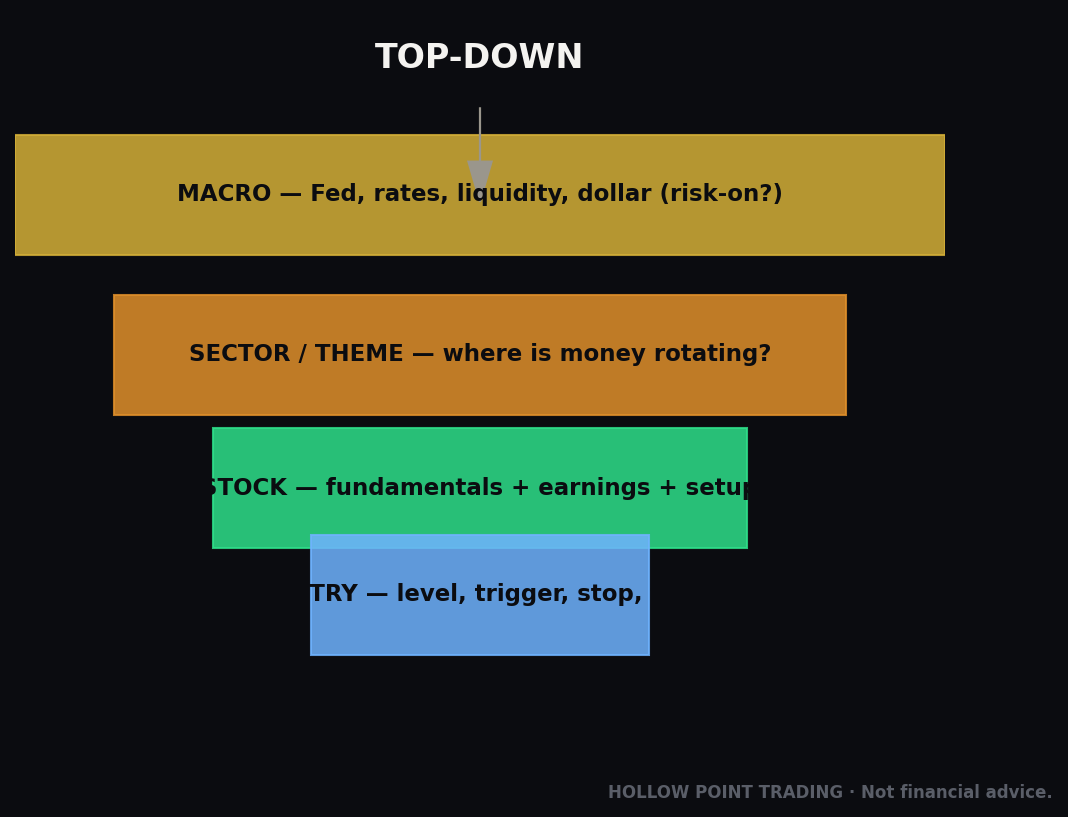
It also connects to how HPT decides what to trade in the first place, through what's called the macro → sector → stock approach. In plain English: first look at the big picture (the whole market — is it strong or weak?), then the neighborhood (the sector or group — is this type of stock in favor?), then the individual stock. When all three line up, you have the wind at your back. When they don't, you're fighting the tide — which is often another quiet signal to stand aside. Notice that this is a filter, a way of throwing out trades, not a way of finding more of them. Good trading is mostly subtraction.
And it ties directly to that 1:3 reward-to-risk rule. When you only take trades where you can make three times what you risk, you can be wrong more than half the time and still come out ahead. But that math only works if you have the discipline to skip the trades that don't offer 1:3 — the mediocre, cramped, no-room setups. In other words, the 1:3 rule and the no-trade skill are the same skill wearing two hats. Both are about waiting for the good ones and passing on the rest.
This is why HPT treats standing aside as a core competency, not a fallback. The trader who has mastered when not to trade has already solved the biggest problem in the business. Everything else — entries, targets, indicators — is refinement on top of that foundation.
Beginner Mistakes to Avoid (a Quick-Hit List)
- Confusing action with progress. Sitting still is the work sometimes. Busy hands lose money.
- Trading to "make back" a loss. The market doesn't owe you. Win it back later, from a good trade, with a clear head.
- Chasing green candles. By the time it's obvious and exciting, you're late. Let it go.
- Skipping the checklist "just this once." The "just this once" trade is almost always the one that hurts. The rule only works if it's a rule.
- Trading through news you don't understand. If a big scheduled announcement is about to drop and you don't know what it means, that's a stand-aside, not a gamble.
- Measuring yourself by number of trades. More trades is not better. Better trades is better. Some of your best days will have zero trades.
- Ignoring your own emotional state. If you're tilted, tired, or rattled, you are the risk — not the market. Step away.
Your Monday Morning Plan
Here's how to actually use this the next time you sit down to trade:
- Before the session, write your green-light checklist on a sticky note and put it on your screen.
- Watch the open. Ask: is the tape alive or dead? If dead, you already know — hands off.
- When something looks interesting, do not click. Run the seven questions out loud first.
- Any "no," and you say to yourself, "Not my trade," and you wait. Say it like it's a win, because it is.
- If you ever take a loss and feel heat rising, that's your signal: one emotional loss and you're done for the day. Close it down. Protect the capital.
- At the end of the day, count your discipline, not just your dollars. A day where you correctly stood aside all day is a successful day.
Do this for a month and something quietly powerful happens: you stop being the beginner who bleeds out on dead, choppy, no-setup days, and you become the trader who's still standing — capital intact, patience sharp, ready for the real ones when they come. The market will always be there tomorrow. Your job is to make sure you are too.
The best traders in the world aren't the ones who trade the most. They're the ones who've made peace with sitting still — who understand, deep down, that the empty screen and the folded hands are not the absence of a strategy. They are the strategy.
Bound by rules, feared by trade.