
Imagine you're offered a coin-flip game. Heads, you win $30. Tails, you lose $10. The coin is fair — it comes up heads only half the time. Would you play?
If your gut says "only if I win more than I lose," you already understand the single most important idea in trading. You just don't have the words for it yet. By the end of this guide, you will — and you'll be able to use it on Monday.
Most beginners think trading is about being right. It isn't. Being right feels good, but "feeling good" doesn't pay your bills. Trading is about making sure that when you're right, you win a lot, and when you're wrong, you lose only a little. That imbalance — big wins, small losses — is the whole game. It's what lets a trader be wrong more often than right and still walk away with more money than they started with.
That imbalance has a name: risk/reward. And Hollow Point Trading builds every single trade around one version of it — the 1:3 rule. Let's take it apart slowly, from zero.
What Risk/Reward Actually Is (In Plain English)
Let's define our terms carefully, because everything downstream depends on getting these two words exactly right.
Risk is the money you could lose on a trade if it goes against you. Not the money you put in — the money you could lose. Those are different, and confusing them is the first mistake most beginners make. If you buy something for $100 but you've decided in advance that you'll sell and walk away the moment it drops to $95, your risk isn't $100. It's $5. That's the most you're willing to lose before you admit you were wrong and get out.
Reward is the money you could make if the trade goes your way. If you buy at $100 and plan to sell at $115, your reward is $15.
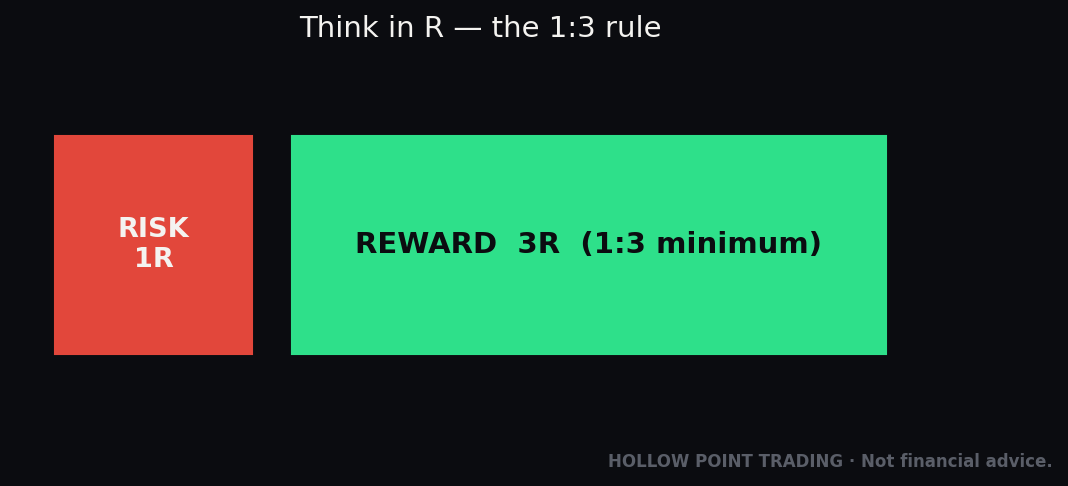
Risk/reward (traders write it as "R/R" or as a ratio like "1:3") simply compares those two numbers. You put the risk first and the reward second. So a trade where you're risking $5 to potentially make $15 is a 1:3 — you risk one unit to make three.
Here's the analogy that makes it stick. Picture a seesaw at a playground. On the left side sits your risk. On the right side sits your reward. Risk/reward is just asking: which way does this seesaw tip, and by how much? A 1:3 trade is a seesaw where the reward side is three times heavier than the risk side. A 1:1 trade is perfectly balanced. And a 3:1 trade — risking three to make one — is a seesaw tipped badly against you, even though beginners take those constantly without realizing it.
That's the whole concept. Risk is what you can lose. Reward is what you can make. Risk/reward is the shape of the bet. Everything else in this guide is just consequences of that one idea.
Why a Beginner Should Care More Than Anyone
You might be thinking: "Fine, bigger reward than risk, got it. Why is this the most important thing? Why not focus on picking winners?"
Because picking winners is the part you have the least control over, and risk/reward is the part you have the most control over.
Think about what actually happens when you place a trade. Once you're in, the market does whatever the market wants. Prices are moved by millions of people, giant institutions, news you'll never see coming, and events that haven't happened yet. You cannot control whether any single trade wins or loses. Nobody can. The best professional traders on Earth are wrong all the time.
But here's what you can control, completely, before you ever click the button:
- How much you're willing to lose (where you'll get out if you're wrong).
- How much you're aiming to make (where you'll get out if you're right).
- Whether the shape of the bet is even worth taking.
Risk/reward lives entirely inside the stuff you control. That's why HPT treats it as the foundation. You don't get to decide if you're right. You do get to decide that you'll never risk a dollar to make a dollar — that every bet you place is shaped so the good outcome dwarfs the bad one.
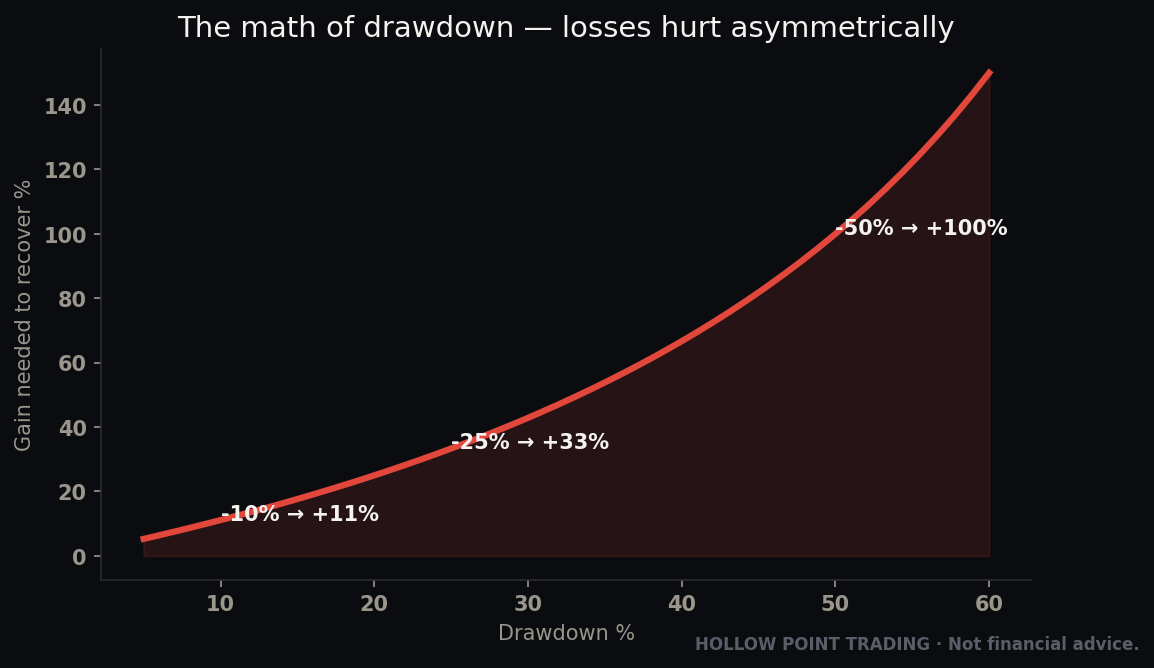
For a beginner, this changes everything about survival. New traders don't usually blow up their accounts because they picked bad stocks. They blow up because they let small losses become huge ones, and let good trades turn into small wins by grabbing profit too early. They get the shape of every bet backwards — big risk, small reward — and then wonder why being "right half the time" still left them broke. Risk/reward is the fix, and it's a fix you can apply before you know anything else about charts.
The Idea That Breaks Every Beginner's Brain: Win Rate Isn't Everything
Now we get to the part that sounds impossible the first time you hear it.
You can lose more trades than you win and still make money.
Beginners hate this sentence. It feels like a trick. Surely if you lose most of the time, you lose money? That's how everything else in life works, right?
No — and this is exactly the misunderstanding that separates people who last from people who don't. Let me prove it with the simplest possible example.
First, one term. Your win rate is just the percentage of your trades that make money. If you place 10 trades and 4 of them win, your win rate is 40%. That's it — 4 out of 10, forty percent.
Now, watch what happens when we combine a low win rate with a good risk/reward. Let's say you take 10 trades. On every one, you risk $100. And because you follow the 1:3 rule, every winner makes you $300.
You lose 6 of them. Six losses at $100 each:
6 × $100 = $600 lost
You win only 4 of them. Four wins at $300 each:
4 × $300 = $1,200 made
Add it up. You made $1,200 and lost $600. You're up $600 — even though you were wrong 60% of the time. You lost more often than you won, and you still nearly doubled your risked money over those ten trades.
Read that example again until it clicks, because it's the hinge the entire guide swings on. The losers were small and frequent. The winners were rare and large. And large-and-rare beat small-and-frequent. That's not a trick or an accident. It's arithmetic, and it works every time the numbers line up.
This is why chasing a high win rate is a beginner trap. It's completely possible to win 90% of your trades and still go broke — if your one loss is bigger than all nine of your wins combined. And it's completely possible to win 40% of your trades and get rich, if your winners are big enough. How often you're right matters far less than how much you make when you're right versus how much you lose when you're wrong.
Expectancy: The One Piece of Math That Ties It All Together
Everything above can be captured in a single simple calculation. Traders call it expectancy. Don't let the word scare you — it's just a fancy name for one honest question:
"On average, how much do I expect to make or lose every time I place a trade?"
If that number is positive, you have an edge — a system that makes money over time. If it's negative, you're slowly feeding the market, no matter how good any single trade felt. Expectancy is the scoreboard that tells you whether your approach actually works.
Here's the beginner-friendly formula. We'll build it in pieces so nothing feels like it came from nowhere.
Expectancy = (Win rate × Average win) − (Loss rate × Average loss)
Let's decode each part with plain words:
- Win rate — how often you win, as a decimal. 40% becomes 0.40.
- Average win — how much money a typical winner makes you.
- Loss rate — how often you lose, as a decimal. If you win 40% of the time, you lose 60%, which is 0.60. (Win rate and loss rate always add up to 1.)
- Average loss — how much money a typical loser costs you.
The formula takes your good outcomes, weights them by how often they happen, then subtracts your bad outcomes weighted by how often those happen. What's left is your average result per trade.
Let's plug in the exact numbers from our earlier example. Win rate 40% (0.40), average win $300, loss rate 60% (0.60), average loss $100.
Step one — the winning side:
0.40 × $300 = $120
Step two — the losing side:
0.60 × $100 = $60
Step three — subtract:
$120 − $60 = $60 per trade
Your expectancy is +$60 per trade. That means every single time you place a trade with this system — win or lose, you don't know which yet — you can expect to make about $60 on average. Take 100 trades and you'd expect around $6,000. Take 10 and you'd expect around $600 (which is exactly what we got when we counted it up the long way — the math agrees with itself).
This is the number professionals actually care about. Not "did I win today," but "is my expectancy positive, and am I following the system that keeps it positive." A positive expectancy is the mathematical definition of a real edge. Everything HPT does — the 1:3 rule, the discipline, the refusal to move stops — exists to protect that one number.
How the 1:3 Rule Works, Step by Step
So where does HPT's specific demand — 1:3, minimum — come from? Let's connect it directly to the math we just did, then walk through how you'd actually apply it.
The 1:3 rule says: you may not take a trade unless the reward is at least three times the risk. Risk $100 to make $300. Risk $50 to make $150. Risk $1 to make $3. The specific dollar amounts don't matter — the shape does. Three units of reward for every one unit of risk.
Why three specifically, and not two, or four? Because 1:3 buys you a huge margin for being wrong. Let's find the break-even win rate — the win rate where you'd exactly break even, making nothing and losing nothing.
With a 1:3 setup, a winner makes 3 and a loser costs 1. You break even when your winnings exactly cancel your losses. It turns out you only need to win 1 out of every 4 trades — a 25% win rate — just to break even. Let's verify: win 25% of the time (0.25) making $300, lose 75% of the time (0.75) losing $100.
0.25 × $300 = $75 0.75 × $100 = $75 $75 − $75 = $0
Exactly break-even at 25%. So with the 1:3 rule, anything above a 25% win rate makes money. You can be wrong three times out of four and still not lose. Win just a third of your trades and you're solidly profitable. That's the enormous cushion the 1:3 rule builds in — it lets you be a beginner, lets you be wrong constantly while you're learning, and still keeps the math on your side.
Compare that to a 1:1 trade, where reward equals risk. There you need to win more than 50% just to break even — you need to be right more than half the time, forever, which is genuinely hard. The 1:3 rule drops that bar from "more than half" all the way down to "one in four." That's why HPT demands it. It's not a preference. It's the setting that makes survival mathematically likely instead of a coin flip.
Here's how you actually apply it, in order, every time:
Step 1 — Find your exit-if-wrong first. Before anything else, decide the price where you'd admit the trade failed. This is your stop loss — a pre-set exit that caps your loss. Say you buy at $100 and the trade is clearly broken if it hits $97. Your risk is $3 per share.
Step 2 — Multiply your risk by three. $3 × 3 = $9. That's the minimum reward you need.
Step 3 — Find your target. Add that $9 to your entry: $100 + $9 = $109. That's your take-profit — the price where you'll cash out the win.
Step 4 — Ask the honest question. Is it realistic for price to reach $109 before it drops to $97? If yes, the trade qualifies. If $109 is fantasyland — there's a wall of resistance at $103 that price never gets through — then the trade does not meet 1:3, and you don't take it. You pass. You wait for a better one.
That fourth step is where the discipline lives. The rule isn't just "hope for 3x." It's "only take trades where 3x is genuinely reachable before your stop." Most setups won't qualify. That's the point. The 1:3 rule is a filter that throws away mediocre trades and keeps only the ones shaped to win big.
A Fully Worked Beginner Example, Start to Finish
Let's run one complete trade the way HPT would, with real-ish numbers, so you see every decision in sequence. We'll keep it simple and pretend you're trading a stock called "XYZ."
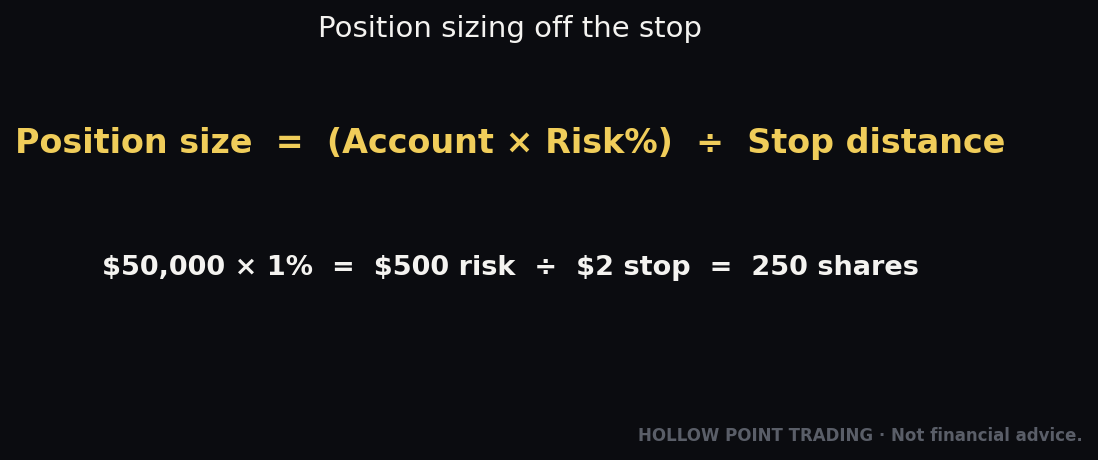
The account. You have $10,000. Rule one of protecting capital: never risk more than a small slice on one trade. HPT-style discipline says risk 1% or less per trade. 1% of $10,000 is $100. That $100 is the absolute most you'll allow yourself to lose here — no matter what.
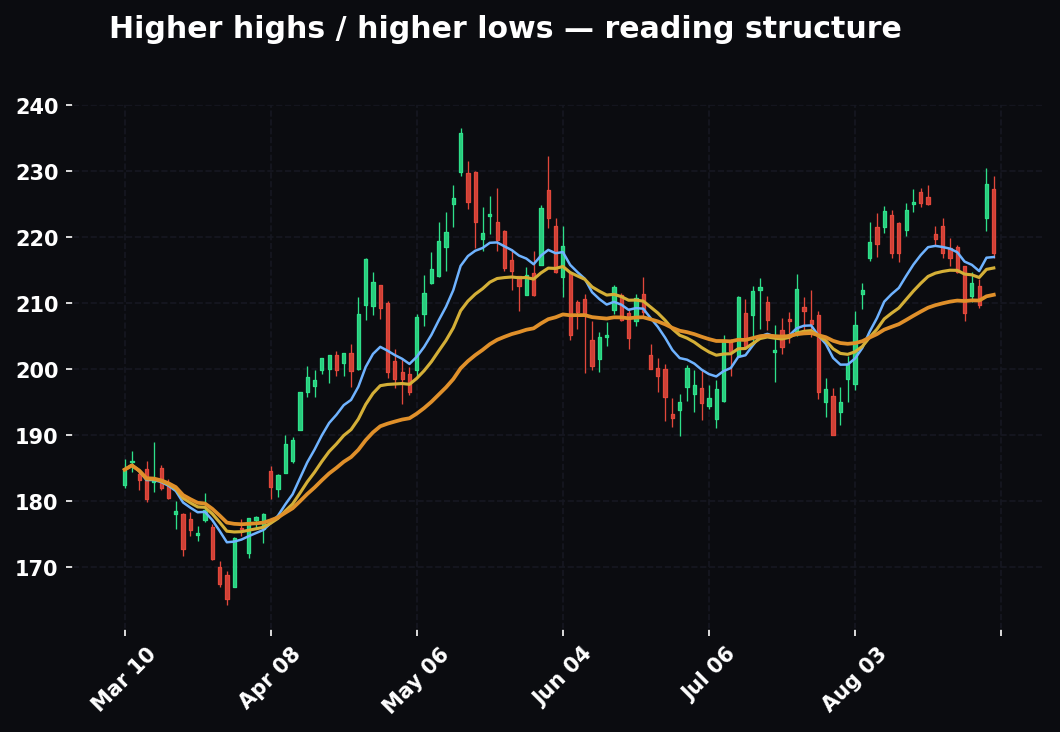
The setup. XYZ is trading at $50. You've done your homework — the broader market looks healthy, the sector is strong, and this particular stock has been holding above a price level of $48 that buyers keep defending. (That top-down check — market, then sector, then stock — is the HPT way, and we'll come back to it.) You decide $48 is your line in the sand: if XYZ falls below it, your reason for the trade is gone.
Step 1 — Risk per share. You'd buy at $50 and get out at $48. That's $2 of risk per share.
Step 2 — Position size. Here's the beautiful part. You're allowed to lose $100 total, and each share risks $2. So how many shares can you buy?
$100 ÷ $2 = 50 shares
You buy 50 shares of XYZ at $50, which costs $2,500 of your $10,000. But remember — the $2,500 is not your risk. Your risk is $100, because the moment XYZ hits $48, you're out, and 50 shares × $2 = exactly $100 lost. You engineered it that way on purpose.
Step 3 — The 1:3 target. Your risk is $2 per share. Times three is $6. Add that to your $50 entry: your target is $56. In share terms, that's 50 shares × $6 = $300 of reward.
Step 4 — The honest check. Is $56 reachable before $48? You look at the chart. There's clear room to run up to $57 before any real resistance, and the market's tailwind is behind it. Yes — $56 is realistic. The trade qualifies. You place it: buy at $50, stop at $48, target at $56.
Now only two things can happen, and you've already decided both:
- XYZ falls to $48. Your stop triggers. You lose $100. It stings for a minute, then you move on — that's 1% of your account, and you'll barely feel it next week.
- XYZ rises to $56. Your target hits. You make $300. One winner just paid for three losers.
That's the entire lifecycle. Notice what you did not do: you didn't guess, you didn't hope, you didn't decide anything in the heat of the moment. Every number was set in cold blood before you entered. The market's job is just to pick one of your two pre-planned doors. Whichever it picks, you're fine — because the math is built to win over many trades even when plenty of individual ones go wrong.
The Beginner Mistakes That Wreck the Whole System
The 1:3 math only works if you actually follow it. Here are the specific ways beginners quietly break it — usually without noticing.
Moving your stop loss down. This is the account-killer. Price drops toward your $48 stop, and instead of taking the small planned loss, you tell yourself "it'll come back" and move the stop to $46. Now your $100 risk has secretly become $200. Do this enough and one trade eats what four winners built. Your stop is a promise you made to yourself when you were calm. Keep it.
Grabbing the win too early. The flip side. XYZ climbs to $53, you're up $150, and the fear of giving it back makes you sell. Feels smart — you "locked in a profit." But you just turned your carefully planned $300 reward into $150. You cut your reward in half while keeping your full risk on every loser. Do that repeatedly and your beautiful 1:3 system quietly becomes a 1:1.5 system, and your edge evaporates. Let winners reach the target you set.
Risking too much on one trade. Betting 20% of your account on a single "sure thing" means a normal losing streak can wipe you out before your edge ever gets to play out. Even a great system loses several in a row sometimes — that's just randomness. Small risk per trade (1% or so) is what keeps a losing streak survivable. Protect capital first; profits come later.
Judging a single trade instead of the system. A beginner takes one 1:3 trade, loses it, and concludes "the rule doesn't work." But a system with a 40% win rate is supposed to lose sometimes — even several times in a row. Expectancy is an average over many trades, not a promise about any one. Quitting after a few losses is like flipping a coin three times, getting three tails, and declaring the coin broken. Judge the process over dozens of trades, not the outcome of one.
Fake targets to force a trade. The sneakiest mistake. You want to trade, but the setup only offers 1:1.5. So you invent a target far up the chart to make the ratio "look like" 1:3 on paper — ignoring the resistance wall in the way. That's lying to yourself with math. A 1:3 ratio only counts if the target is genuinely reachable before the stop. If it isn't, the trade doesn't qualify, and the right move is to pass.
Your Simple Risk/Reward Cheat-Sheet
Print this. Tape it to your monitor. Run through it before every single trade.
Before you enter — the 5 checks:
- Where's my stop? Find the price that proves me wrong. Set it first.
- What's my risk per share? Entry price minus stop price.
- What's my position size? (Account × 1%) ÷ risk per share = number of shares.
- Where's my 1:3 target? Entry + (risk per share × 3). Is it realistically reachable before the stop? If no → pass on the trade.
- Is my total risk ≤ 1% of my account? If no → shrink the position.
The numbers worth memorizing:
- 1:3 — risk one to make three. HPT's minimum shape for every trade.
- 25% — the win rate that merely breaks even at 1:3. Anything above it makes money.
- 1% — the most of your account to risk on any single trade.
- Expectancy = (Win% × Avg win) − (Loss% × Avg loss). Positive = you have an edge.
The three unbreakable habits:
- Never move a stop loss further away to avoid a loss.
- Never sell a winner before its target out of fear.
- Never judge the system on one trade — think in dozens.
If you do nothing else from this entire guide, do those five checks and hold those three habits. That alone puts you ahead of the overwhelming majority of beginners, who trade on hope and gut feeling and wonder why the account keeps shrinking.
How This Fits the Bigger Hollow Point Picture
Risk/reward isn't a standalone trick — it's the load-bearing wall of the entire HPT way of trading. Let's zoom out and see where it sits.
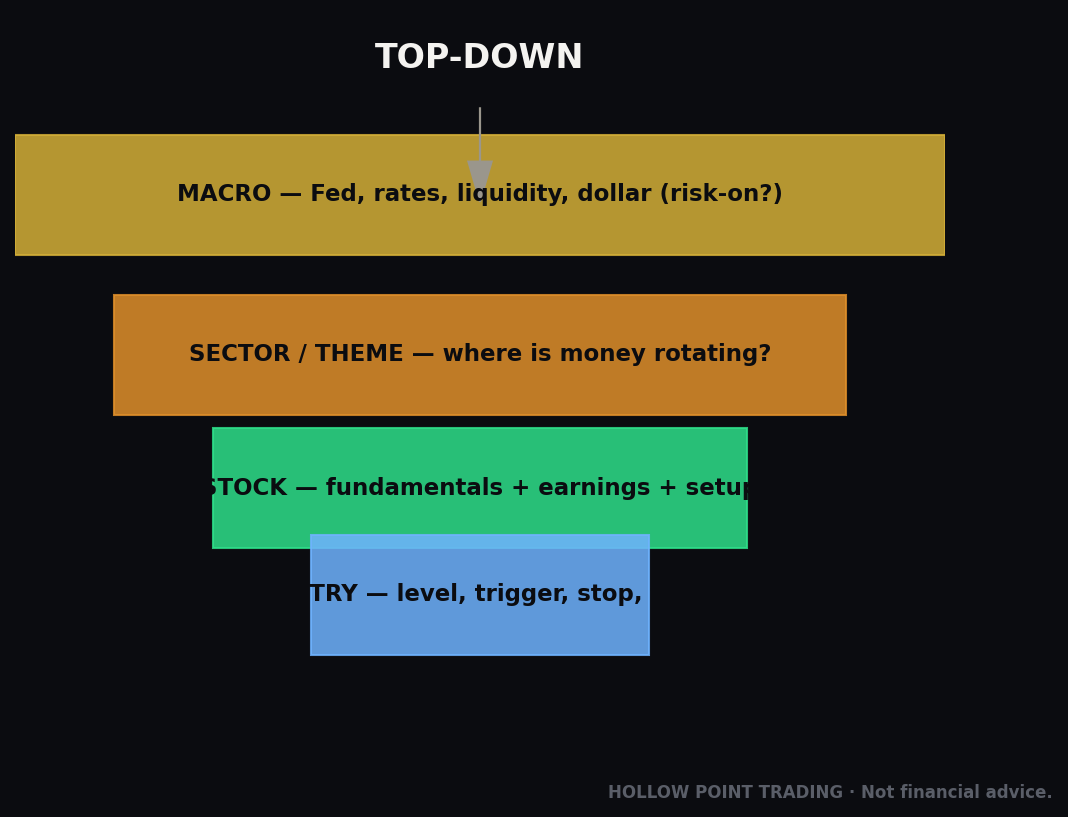
HPT thinks about markets from the top down: macro, then sector, then stock. That means you start with the big picture — is the overall market healthy or fragile (macro)? Then you narrow to which industries are leading or lagging (sector). Only then do you look at an individual stock. The idea is to trade with the big forces at your back, not against them. In our XYZ example, that top-down check was step zero — we only cared about XYZ because the market was healthy and its sector was strong. Risk/reward decides the shape of the bet; the top-down read decides which bets are even worth shaping.
Then comes the HPT ethos that risk/reward serves directly: discipline over prediction. Most beginners think trading is a prediction contest — guess the future, get rich. HPT rejects that. Nobody can predict the next tick. What you can do is follow a disciplined process where the math works out over time regardless of any single guess. The 1:3 rule is discipline made concrete. It doesn't ask you to predict — it asks you to only accept bets with a certain shape, and to hold your exits no matter what your emotions scream. The expectancy math is the proof that discipline beats prediction: a disciplined 40%-right trader crushes an undisciplined 60%-right one every time.
And underneath all of it: protect capital first. You cannot trade tomorrow if you don't survive today. The 1% risk rule, the non-negotiable stop loss, the refusal to bet the farm on one idea — all of it exists so that no losing streak, and every trader has them, can take you out of the game. Big wins are exciting, but HPT's real obsession is making sure you're still standing to catch those big wins when they come. Capital is the ammunition. Run out and the game is over, no matter how good your next idea would have been.
Put it together and here's the whole philosophy in one breath: read the market top-down to find where the wind is blowing, shape every trade at 1:3 so your winners tower over your losers, risk only a sliver of your account so no streak can kill you, and hold your rules with iron discipline instead of trying to predict the unpredictable. Risk/reward is the piece that makes all the rest mathematically work. It's why an HPT trader can lose a trade, shrug, and place the next one with total calm — because they know the scoreboard that matters isn't today's win or loss. It's the expectancy, and the expectancy is on their side.
That's the edge. Not being right. Being shaped right. Learn to lose small and win big, hold the line when it's boring or scary to do so, and let the math do what math does over time. You don't have to be a genius. You just have to be disciplined enough to let a good system be a good system.
Now go run the five checks on your next idea — and if it doesn't clear 1:3, be proud of the trade you didn't take.
Bound by rules, feared by trade.