
Most people who lose money on options do it the same way. They buy a single call or a single put, they're right about the direction, and they still lose. Then they quit and tell everyone options are a scam.
They're not a scam. That trader just used the wrong tool. This guide is about a tool built for beginners who want to bet on direction without the two things that wreck new traders: uncapped cost and the slow bleed of a ticking clock. It's called the vertical spread, and by the end of this piece you'll be able to build one on paper Monday morning and know — to the penny — the most you can lose before you risk a single dollar.
Let's start from zero. No assumed knowledge. We'll define every word.
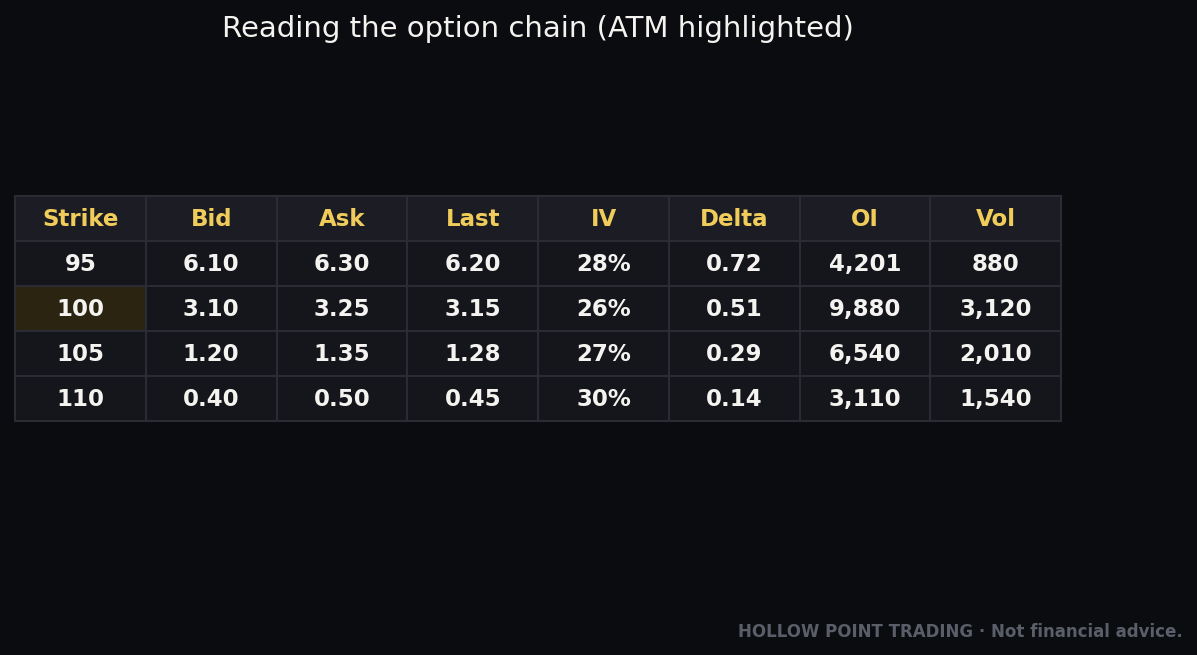
First, The Words You Need (Plain English)
Before we can build anything, we need a shared vocabulary. Read this section slowly — everything after it depends on these five ideas.
An option is a contract. It gives you the right, but not the obligation, to buy or sell a stock at a fixed price for a limited time. Think of it like a coupon. A coupon says "you may buy this TV for $500 until Sunday." You don't have to. But if the TV's price jumps to $800, that $500 coupon is suddenly worth a lot. If the TV drops to $300, your coupon is worthless — you just throw it away. You were never forced to buy.
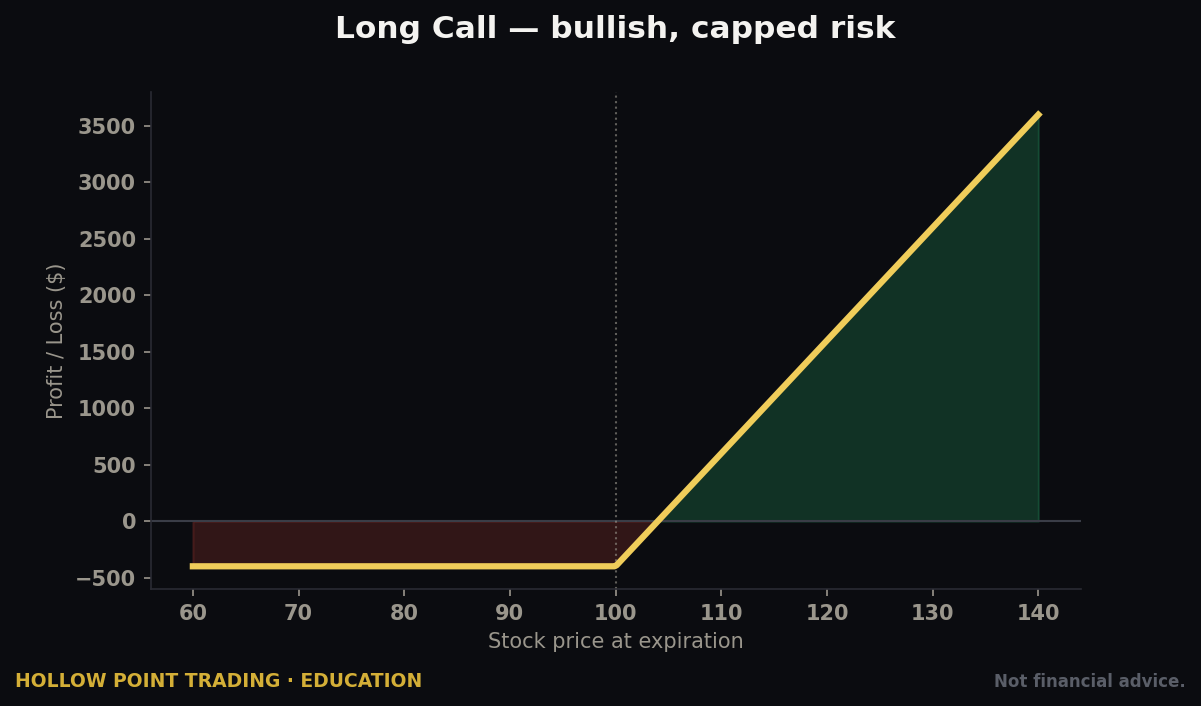
A call option is a coupon to buy a stock at a set price. You buy calls when you think the stock is going up.
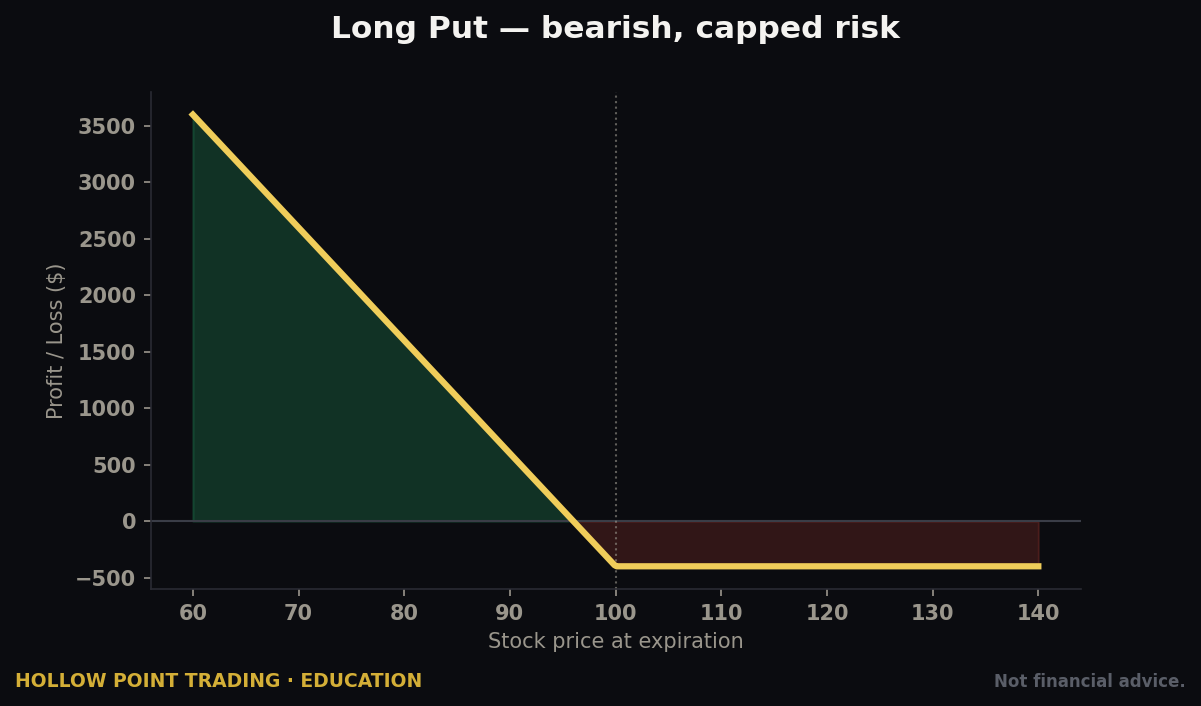
A put option is a coupon to sell a stock at a set price. You buy puts when you think the stock is going down.
The strike price is the fixed price written on the coupon — the price you're allowed to buy or sell at. If a call has a strike of $100, it lets you buy the stock at $100 no matter how high the real price climbs.
Expiration is the date the coupon expires. After that day, the option is done. This is the ticking clock, and it matters enormously — we'll come back to it.
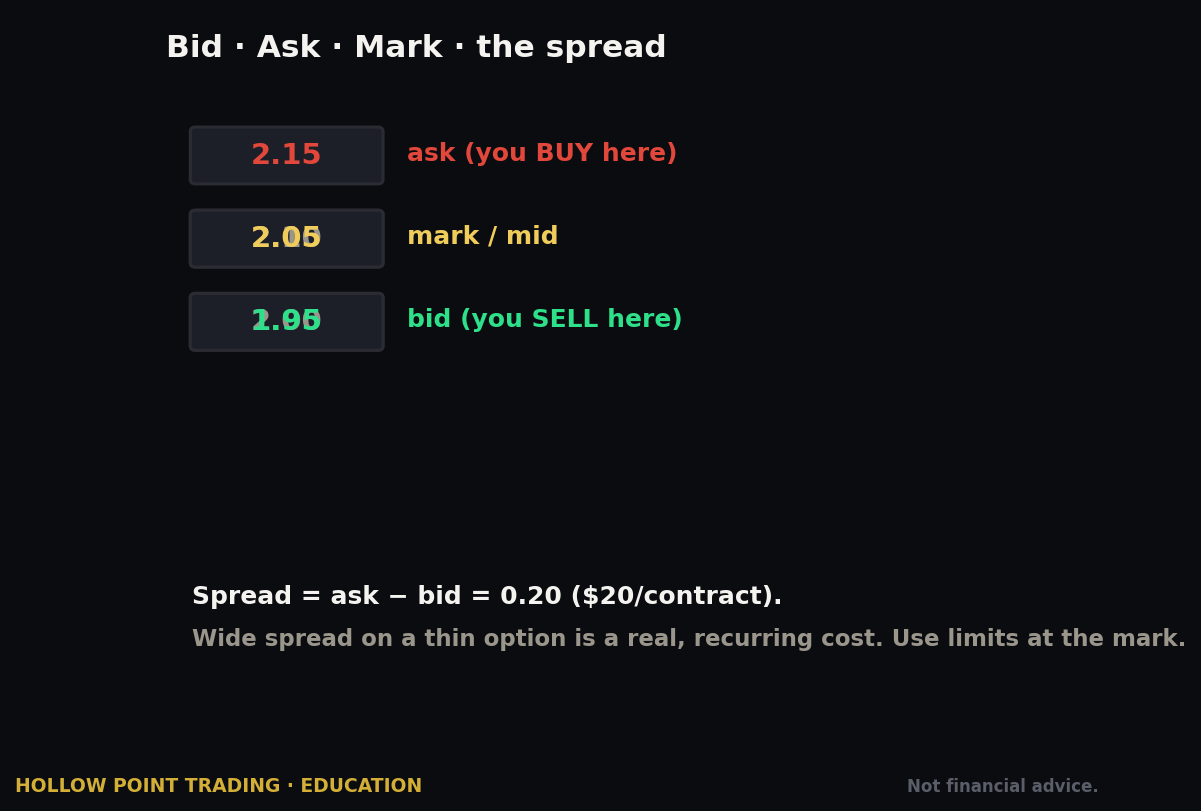
The premium is the price you pay to own the option. Here's the one piece of math that trips up every beginner: one option contract controls 100 shares of stock. So if an option is quoted at $2.00, you don't pay $2. You pay $2 × 100 = $200. Always multiply the quoted price by 100. Burn that in.
That's it. Call, put, strike, expiration, premium, times 100. With those five ideas, we can build the whole guide.
The Problem With Buying a Single Option
Let's see why the beginner's instinct — just buy one call — is a trap.
Say a stock, we'll call it XYZ, trades at $100. You think it's going to $110. So you buy one call option with a $100 strike that expires in 30 days. The premium is $3.00, so you pay $300 (remember, ×100).
For you to make money, three things have to go right at the same time:
- Direction. The stock has to go up. Fair enough — that was your bet.
- Distance. It has to go up enough to cover the $3 you paid. At expiration, XYZ has to be above $103 just for you to break even. Below $103 and you lose money even if you were right that it went up.
- Timing. It has to happen before the clock runs out. This is the killer.
That third one deserves its own explanation, because it's the silent account-killer.
Time decay (the professionals call it theta) means an option loses value every single day, just from time passing, even if the stock doesn't move. Go back to the coupon: a coupon good for 30 days is worth more than the exact same coupon good for only 3 days, because more time means more chances for the price to move your way. As expiration approaches, that "extra chance" value drains out. An option is a melting ice cube. Every morning you wake up owning a little less.
So the single-call buyer faces a brutal setup. They can be right about direction, watch the stock drift sideways for two weeks, and lose half their money to the melting clock. Then the stock finally pops — but too late, and not far enough. Right idea, dead trade.
There's also the cost problem. A single call on an expensive stock can cost $800, $1,200, even $2,000. That's a lot of money exposed to one melting ice cube.
The vertical spread fixes both of these problems at once. Here's how.
What a Vertical Spread Actually Is
A vertical spread is when you buy one option and sell another option of the same type at a different strike, with the same expiration, at the same time. Two legs, one trade.
Let's unpack the one new idea in there: selling an option.
When you buy an option, you pay a premium. When you sell an option (also called "writing" it), the reverse happens — someone pays you a premium, and in exchange you take on an obligation. In a spread, you don't need to worry about that obligation getting scary, because the option you bought protects you. The two legs cover each other. We'll see exactly how in a moment.
The word "vertical" just refers to how these look on an options screen. Strikes are listed in a vertical column, and you're picking two of them stacked on top of each other — same expiration date, different price levels. That's all "vertical" means. Don't overthink it.
Here's the core idea in one sentence: you buy an option to get your directional bet, and you sell another option to pay for part of it. The premium you collect from the sold leg reduces the cost of the leg you bought. Cheaper trade, smaller melting ice cube, and — the big one — a defined, known maximum loss.
That last phrase is why HPT teaches spreads to beginners before anything else. Defined risk means you know your worst-case loss the moment you enter, and nothing the market does can make it worse. Protecting your capital comes first, always. A vertical spread has that protection built into its very structure.
There are two you need to know. One for when you think a stock goes up, one for when you think it goes down.
The Bull Call Spread (Betting Up, Safely)
A bull call spread is your play when you think a stock will rise, but you want it cheaper and safer than a plain call. "Bull" means you're bullish — you expect the price to go up.
Here's the recipe:
- Buy a call at a lower strike (this is your directional bet).
- Sell a call at a higher strike (this collects premium and pays for part of your bet).
- Same stock, same expiration.
Because the premium you collect from the sold call offsets the premium you pay for the bought call, the whole package costs less than buying the call alone. You pay a net debit — "debit" just means money leaves your account. That net debit is the total you paid, and here's the beautiful part: it is also the absolute most you can lose. Full stop.
The trade-off? You give up unlimited upside. By selling that higher call, you've agreed to cap your winnings at the higher strike. If the stock goes to the moon, you don't catch all of it — you catch the distance between your two strikes and no more. But for a beginner, capping a fantasy-scenario profit in exchange for a much cheaper, defined-risk trade is a great deal. You're trading a lottery ticket you'll probably never cash for real, repeatable structure.
Let's make it concrete.
A Fully Worked Bull Call Spread
XYZ trades at $100. You think it climbs to $110 over the next month. Instead of buying that single $100 call for $300, you build a spread.
- Buy the $100 call for $4.00 → costs you $400
- Sell the $105 call for $2.00 → pays you $200
- Net debit: $400 − $200 = $200
Your total cost is $200. Write that number down, because it's also your maximum loss. There is no scenario — not a crash, not a bankruptcy, not a Monday gap-down — where this trade loses more than $200. That's the safety net doing its job.
Now let's walk through what happens at expiration in three scenarios.
Scenario 1: XYZ finishes at $110 (your target hit). Your $100 call gives you the right to buy at $100 while the stock is at $110 — that's worth $10 per share, or $1,000. But your $105 call, the one you sold, is now working against you: whoever bought it can exercise, costing you the $5 above $105, or $500. Net value of the spread: $1,000 − $500 = $500. You paid $200, so your profit is $300.
Here's the key: the spread's value maxes out at the distance between strikes ($105 − $100 = $5, or $500) no matter how high XYZ goes. At $110, $120, or $200, this spread is worth exactly $500 and no more. That's the cap you agreed to.
Maximum profit = (distance between strikes × 100) − net debit = $500 − $200 = $300.
Scenario 2: XYZ finishes at $103. Your $100 call is worth $3 per share ($300). Your sold $105 call is worthless — the stock never reached $105, so nobody wants the right to buy at $105 when they could buy at $103 in the open market. The spread is worth $300. You paid $200. Profit: $100. Notice you made money even though the stock only moved $3 — and your break-even was just $102 (your $100 strike plus the $2 debit).
Scenario 3: XYZ finishes at $98 (you were wrong). Both calls are worthless. Nobody wants the right to buy at $100 or $105 when the stock is at $98. The spread expires at zero. You lose your $200 — the whole net debit, and not a penny more. Compare that to buying 100 shares at $100 ($10,000 exposed) or even the naked call. Your downside was capped and known from the very first second.
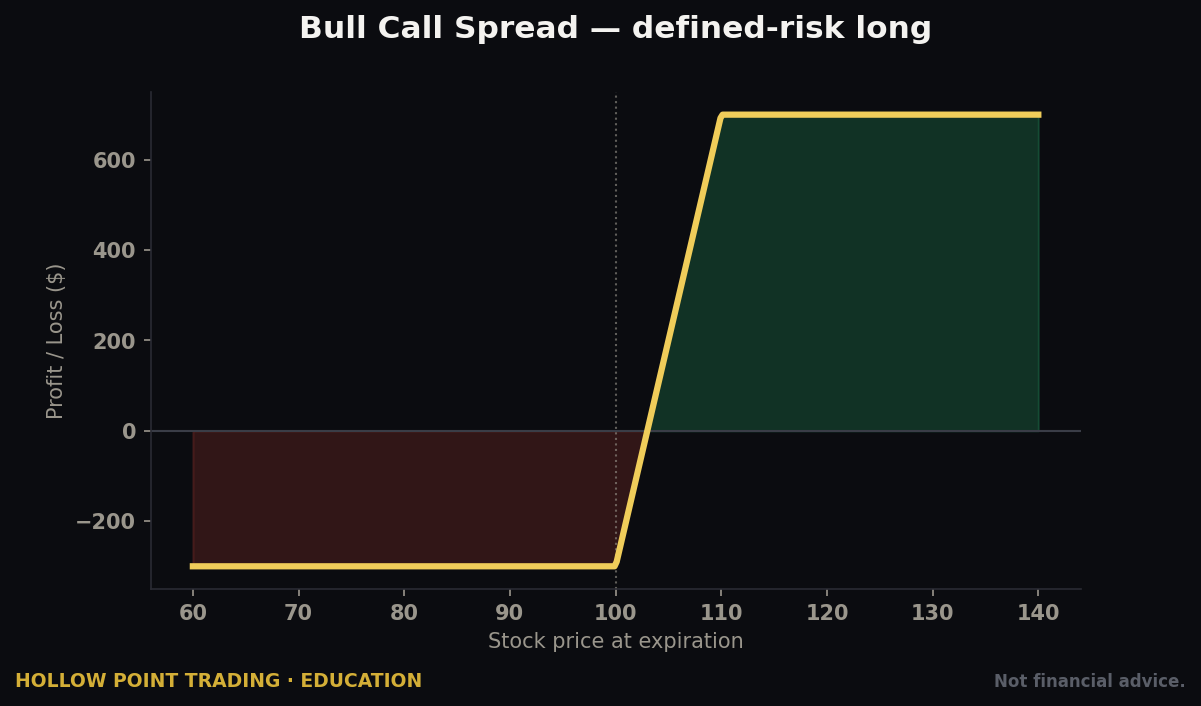
Look at the shape of this trade. Max loss: $200. Max profit: $300. That's a reward-to-risk ratio of 1.5-to-1. HPT teaches a minimum of 1-to-3 — risk one to make three — so this particular spread, honestly, is a bit skinny for our standards. To hit 1:3 you'd widen the strikes or pick a cheaper entry so the potential reward is at least three times the risk. We'll cover how to hunt for that in the checklist. The point of the example is the mechanics; the point of HPT is only taking the spreads where the math pays you enough to bother.
The Bear Put Spread (Betting Down, Safely)
Everything you just learned flips cleanly for the downside. A bear put spread is your play when you think a stock will fall. "Bear" means bearish — you expect the price to go down.
The recipe:
- Buy a put at a higher strike (your directional bet that it drops).
- Sell a put at a lower strike (collects premium, pays for part of your bet).
- Same stock, same expiration.
Same logic, same benefits: cheaper than a single put, smaller melting ice cube, and a maximum loss defined the instant you enter — your net debit.
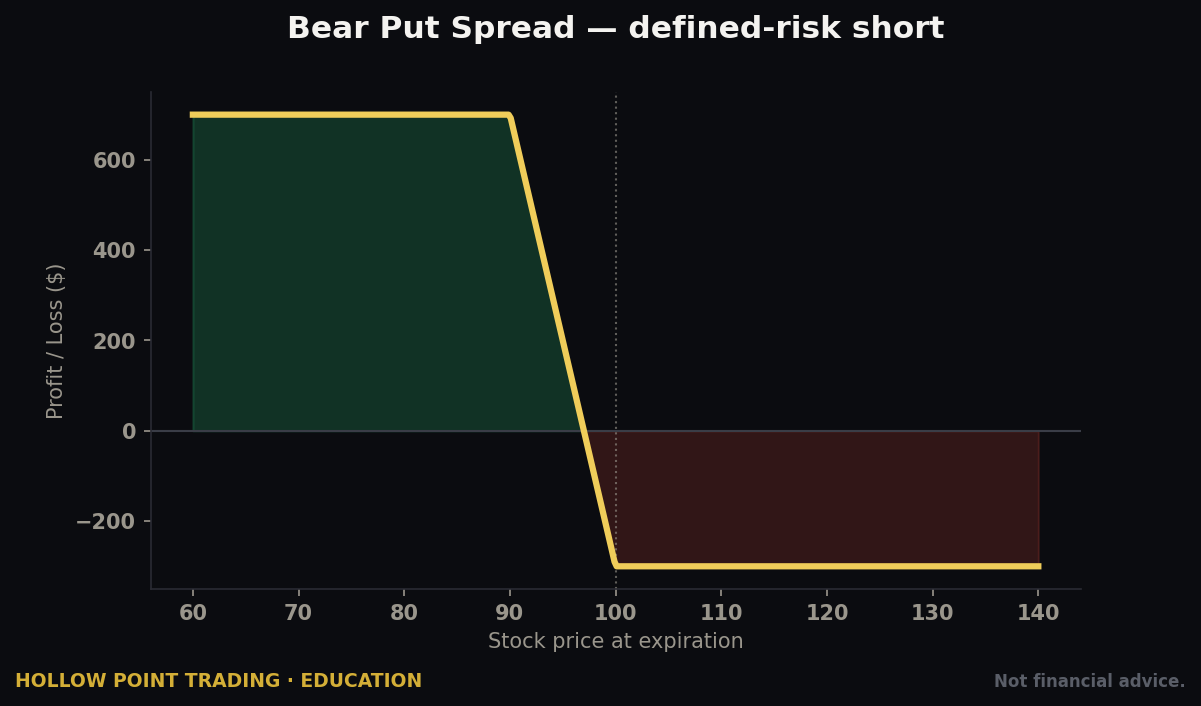
Why would a beginner ever bet a stock down? Two honest reasons. First, stocks fall faster than they rise — fear moves markets quicker than greed, so downside moves can be sharp and profitable. Second, and more importantly for HPT, a bear put spread is a defined-risk way to profit from weakness without "shorting" the stock. Shorting shares (borrowing stock to sell it) has theoretically unlimited loss — if you short at $100 and it rockets to $300, you're down $200 a share with no ceiling. A bear put spread can never do that to you. Your loss is capped at the debit. That structural safety is exactly why we reach for it.
A Fully Worked Bear Put Spread
XYZ trades at $100. You think it falls to $90 over the next month — maybe the sector's weak, maybe the chart broke a level. You build a bear put spread.
- Buy the $100 put for $4.00 → costs you $400
- Sell the $95 put for $2.00 → pays you $200
- Net debit: $200 (your maximum loss, locked in)
Scenario 1: XYZ falls to $90 (target hit). Your $100 put lets you sell at $100 while the stock is at $90 — worth $10 ($1,000). Your sold $95 put works against you below $95, costing $5 ($500). Spread value: $1,000 − $500 = $500. Profit: $500 − $200 = $300. Just like the bull spread, the value caps at the $5 strike distance no matter how far the stock crashes below $95.
Scenario 2: XYZ finishes at $102 (you were wrong, it went up). Both puts expire worthless — nobody wants the right to sell at $100 or $95 when the stock trades at $102. You lose your $200. That's it. If you'd shorted 100 shares instead and the stock kept climbing to $130, you'd be down $3,000 with no floor. The spread's floor is the whole point.
Notice the symmetry. Bull call spread: buy the lower strike, sell the higher, profit when price rises. Bear put spread: buy the higher strike, sell the lower, profit when price falls. Same skeleton, opposite direction. Learn one and you've basically learned both.
Why Spreads Are Genuinely Safer Than Naked Longs
"Naked long" is trader-speak for buying a single call or put by itself, with nothing paired against it. It's the beginner default, and it's more dangerous than it looks. Let's line up the three real advantages of a spread, plainly.
1. Your maximum loss is defined and small. With a spread, the net debit is the whole story. A $200 spread can lose $200 — never $201. You can't get a margin call, you can't get surprised over a weekend, you can't lose more than you put in. For a beginner, this is the single most important property any trade can have. Capital preservation first; everything else is second.
2. Time decay hurts you far less. Remember the melting ice cube? In a spread you own an option (which melts against you) but you also sold an option (which melts in your favor). The two ice cubes partly cancel. The sold leg's decay is money in your pocket as the clock ticks, offsetting the bought leg's decay. A naked long feels the full force of the melt; a spread feels a fraction of it. That's why spread buyers can be patient in a way naked-call buyers can't afford to be.
3. It costs less, so you risk less per idea. The premium you collect on the sold leg directly lowers your entry cost. Our example spread cost $200 instead of $400 for the naked call. Less money committed per trade means you can be wrong several times in a row and still be in the game. Surviving your losing streak is the whole job — you can't win next month if this month wipes you out.
The one honest cost: you cap your upside. If XYZ triples overnight, the naked call captures it and your spread doesn't. But betting your account on triple-overnight fantasies is how beginners go broke. HPT would rather take the defined-risk, repeatable, boring version every single time. Discipline over prediction. You are not trying to hit one home run; you are trying to be in business next year.
The Beginner Mistakes That Cost Real Money
Every one of these is common. Every one is avoidable. Read them twice.
Mistake 1: Forgetting to multiply by 100. A "$2.00" spread is $200 of risk, not $2. Beginners size positions wildly wrong because they read the quoted number as dollars. Always multiply by 100 before you decide if you can afford it.
Mistake 2: Trading with money you can't lose. Never put a spread on with rent money, and never size a single trade so large that a full loss hurts your life. A common beginner rule: risk no more than 1-2% of your account on any one trade. On a $5,000 account, that's $50-$100 of risk per spread. Small. That's the point.
Mistake 3: Picking expiration dates too close. An option expiring in 3 days is a melting ice cube in a hot car. It needs the stock to move right now or it's gone. Give your idea room to breathe — beginners generally do best with expirations 30 to 45 days out. Enough time for the thesis to play out, slow enough decay to survive a few flat days.
Mistake 4: Strikes too far out-of-the-money. "Out-of-the-money" means the strike is far from the current price — a cheap, long-shot bet that needs a huge move to pay. It's tempting because it's cheap. It's cheap because it usually loses. Beginners are better served buying a strike near the current price (at- or near-the-money) so the trade actually works when the stock makes a normal move.
Mistake 5: Holding to the last day and getting "assigned." Assignment is when the option you sold gets exercised against you and you're suddenly forced to deal in real shares. This mostly becomes a risk right at expiration when your sold strike is in-the-money. The simple fix beginners should adopt: close the whole spread before expiration week — sell it back and take your profit or loss. Don't let it go to the wire. Set a target (say, take profit at 50-70% of max) and an exit, and act on it.
Mistake 6: No plan for being wrong. You will be wrong often — good traders are wrong 40% of the time or more. The spread already caps your loss, but you should still decide in advance when you'll bail if the thesis breaks. Write the exit before you enter. The defined-risk structure is your seatbelt; a written exit is you actually choosing to brake.
Mistake 7: Chasing a stock with no reason behind the trade. A spread is a tool, not a thesis. You still need a reason the stock should move — a level on the chart, a strong sector, a catalyst. The structure protects your downside; it doesn't supply your edge. That comes next.
Where This Fits in the Bigger HPT Picture
A vertical spread is how you express a bet. It is not why you make one. This is the part beginners skip and the part that actually matters.
At Hollow Point, an idea flows in one direction: macro → sector → stock. You start with the big picture — is the overall market strong or weak, is money flowing in or running for cover? Then you narrow to the sector — is technology leading, are energy stocks strong, is the group your stock lives in actually working? Only then do you look at the individual stock and its chart. You want the market at your back, the sector at your back, and the stock setting up. When all three line up, that's confluence — multiple independent reasons agreeing. That agreement is your edge.
The spread comes after all that. Once the top-down read says "this stock should go up over the next month," you ask: what's the cleanest, safest way to bet on it? For a beginner with a directional, few-weeks view, the answer is very often a vertical spread. Bullish read → bull call spread. Bearish read → bear put spread. The structure caps your risk while your top-down homework supplies the reason.
And this is where 1-to-3 reward-to-risk becomes your filter. Before you place any spread, you measure it: if the most I can lose is $200, is the realistic reward at least $600? If the strikes and price don't give you roughly three-to-one, you pass and find a better one. Most spreads you look at won't qualify — that's correct. You're supposed to say no far more than you say yes. The trades that survive that filter are the only ones worth your capital.
Put it all together and you have the HPT beginner's operating system: read top-down for a reason, express it with a defined-risk spread, size it so a full loss is a scratch, demand 1:3 or walk away, and manage the exit before the clock forces your hand. Protect capital first, let the structure do the worrying, and let the boring math compound. That's not exciting. It's not supposed to be. Excitement is what the naked-call buyers feel right before they blow up.
Your Vertical Spread Cheat-Sheet
Tape this next to your screen. Run every prospective spread through it before you risk a dollar.
The two setups:
- Think UP → Bull Call Spread: buy the lower-strike call, sell the higher-strike call.
- Think DOWN → Bear Put Spread: buy the higher-strike put, sell the lower-strike put.
The numbers that matter (memorize these):
- Net debit = premium paid − premium collected. This is your maximum loss.
- Max profit = (distance between strikes × 100) − net debit.
- Break-even (bull call) = lower strike + net debit per share.
- Break-even (bear put) = higher strike − net debit per share.
- Every quoted price is × 100. A "$2" spread risks $200.
The pre-trade checklist — every box must be ticked:
- [ ] I have a top-down reason (macro + sector + stock agree).
- [ ] Direction is clear: up = bull call, down = bear put.
- [ ] Expiration is 30-45 days out, not this week.
- [ ] Strikes are near the current price, not long-shot far.
- [ ] I calculated the net debit and I can afford to lose all of it.
- [ ] Risk is 1-2% of my account or less.
- [ ] Reward-to-risk is at least 1:3 — if not, I pass.
- [ ] I've written my exit plan: profit target and the "I was wrong" line.
- [ ] I will close before expiration week to avoid assignment.
If any box is empty, the trade isn't ready. That's not being timid — that's being a professional. The market will hand you another setup tomorrow, and the day after, forever. Your only job is to still be here to take them.
The One-Paragraph Summary
A vertical spread is buying one option and selling another of the same type, same expiration, different strike. Bullish, you build a bull call spread (buy low strike, sell high). Bearish, you build a bear put spread (buy high strike, sell low). The premium you collect cuts your cost, softens the time-decay melt, and — most importantly — hands you a defined maximum loss equal to your net debit, locked in before you enter. You give up the fantasy of unlimited upside in exchange for cheaper, safer, repeatable trades you can actually survive. Use it to express a top-down HPT read, size it small, demand 1:3, and manage the exit. Do that a hundred times with discipline and the math works for you. That's the whole game.
Bound by rules, feared by trade.