
If you are brand new to options and you only ever remember one safety rule from Hollow Point Trading, let it be this one: never sell a naked option until you fully understand what "naked" means and have lived through the math of a bad day. Most trades you will ever make have a floor — a worst case you can see and accept before you click the button. Naked options are different. They can lose you money you never put up in the first place. They can turn a $500 idea into a $40,000 bill.
This guide assumes you have never traded anything. We are going to build the whole picture from the ground up, define every word the first time it appears, walk through real-ish numbers, and hand you a checklist you can actually use. By the end you will understand exactly what a naked option is, why it is so dangerous for a beginner, what a real blow-up looks like, and — most importantly — the "defined-risk" trades that give you almost the same idea with a seatbelt on.
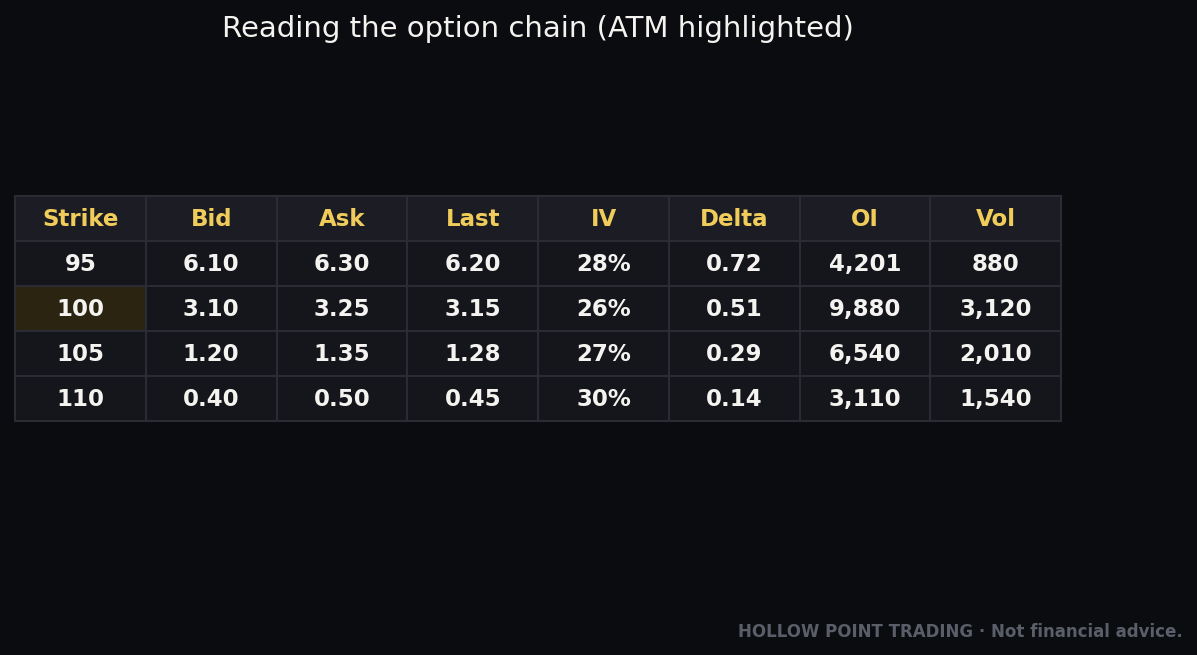
First, the vocabulary: what is an option at all?
Before we can talk about "naked," we need the basics. Skip nothing here — this is the foundation.
An option is a contract. It gives one person a right and forces the other person into an obligation. There are two flavors.
A call option gives its owner the right to buy 100 shares of a stock at a fixed price, any time before a set date. A put option gives its owner the right to sell 100 shares at a fixed price before a set date.
That fixed price is the strike price (or just "strike"). It is the agreed-upon price in the contract. The set date is the expiration date ("expiry") — the day the contract dies.
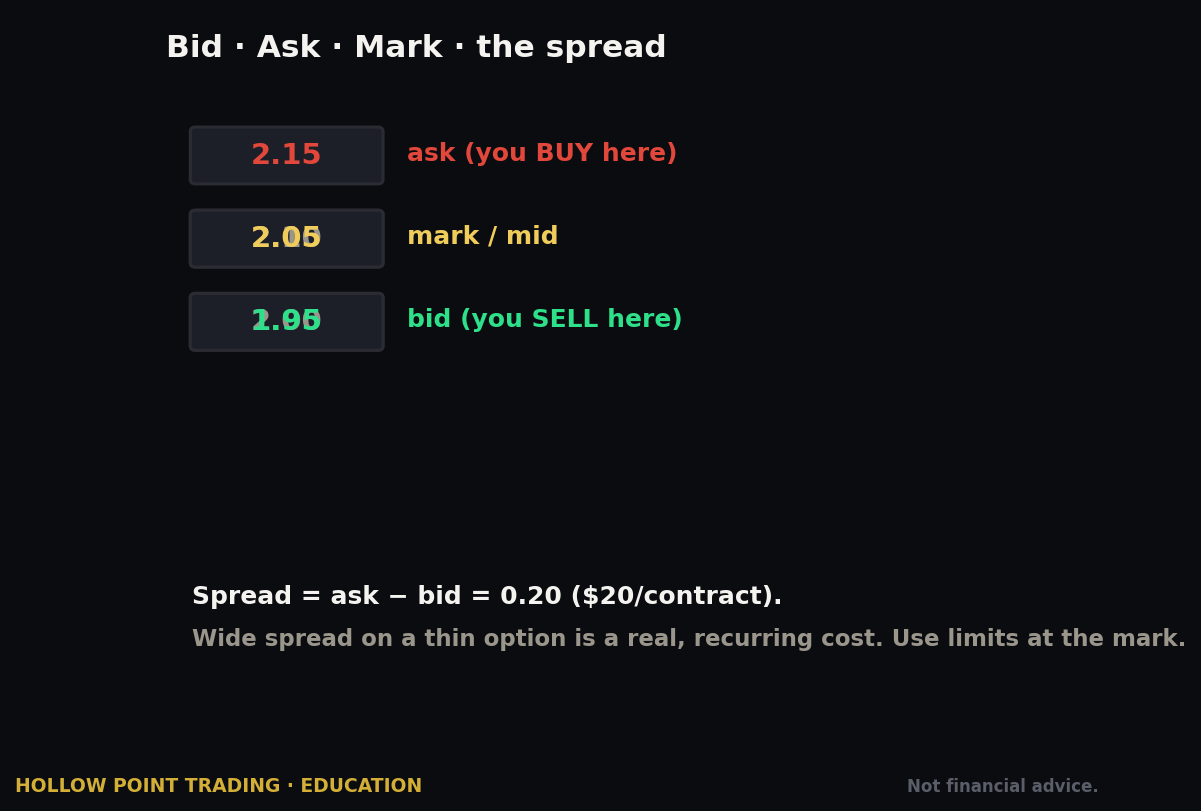
Here is the key detail beginners miss: one option contract controls 100 shares. Not one share. One hundred. So every price you see quoted gets multiplied by 100. An option priced at "2.50" actually costs $250, because 2.50 × 100 = 250. That multiplier is the whole reason options can move so violently, in both directions.
The price you pay to buy an option is called the premium. Think of premium like the price of an insurance policy. When you buy an option, you pay premium. When you sell an option, you collect premium — and in exchange, you take on an obligation.
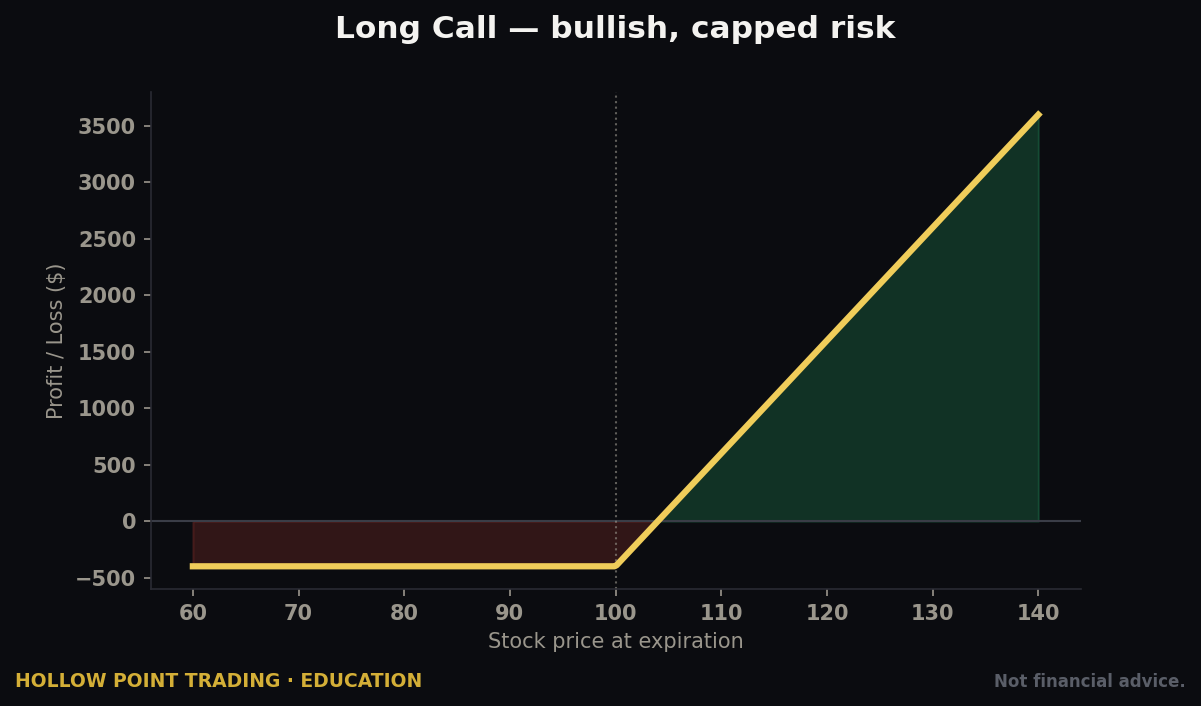
That word — sell — is where the danger lives. There are two sides to every option:
- The buyer (also called being "long" the option) pays premium and gets a right. The buyer's worst case is simple: they lose the premium they paid. That's it. A floor.
- The seller (also called being "short" the option, or the "writer") collects premium and takes on an obligation. The seller's worst case is... where this whole guide comes from.
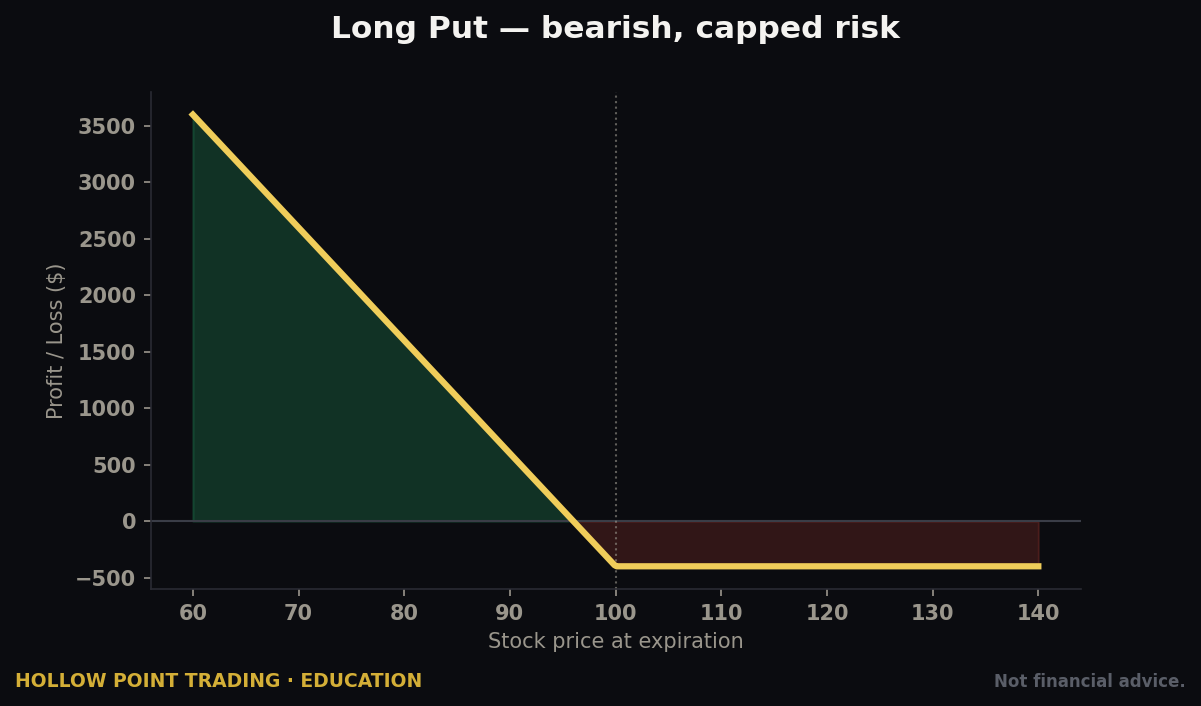
So what does "naked" actually mean?
"Naked" describes a sold option that has nothing behind it to cover the obligation. You've collected the premium, you owe someone something, and you have no protection if the trade goes against you. You are exposed — hence, naked. The opposite is a covered or defined-risk position, where you own something (or hold another option) that caps how bad it can get.
Let's make it concrete with the two most common naked trades.
A naked call is when you sell a call option without owning the 100 shares of stock underneath it. Remember, a call obligates you to sell 100 shares at the strike if the buyer wants them. If you don't own those shares, and the buyer exercises their right, you have to go into the market, buy 100 shares at whatever crazy price they're at, and hand them over at the lower strike. The difference comes out of your pocket.
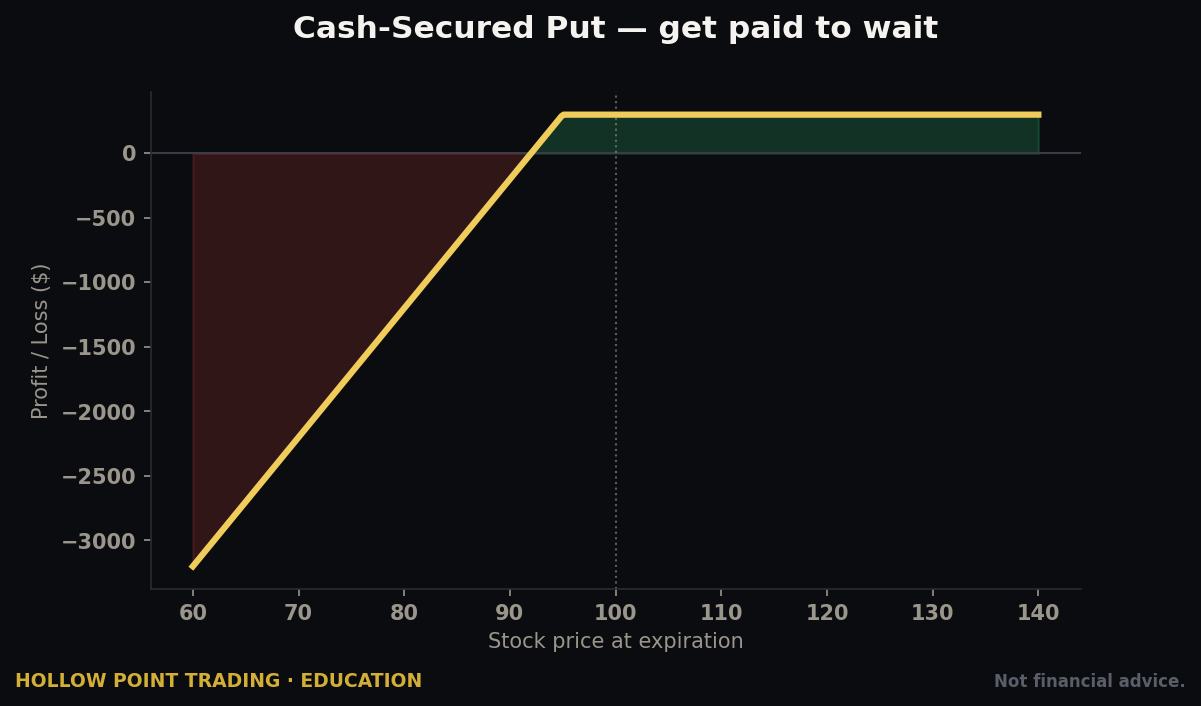
A naked put (sometimes called a "cash-secured put" when done responsibly, or a truly "naked put" when done carelessly) is when you sell a put option, obligating yourself to buy 100 shares at the strike. If the stock crashes, you're forced to buy at the strike price while the real price is far below it.
The difference between "naked" and "covered" is not a technicality. It is the entire difference between a trade with a known worst case and a trade with an unknown one. And in trading, the unknown worst case is the one that ends careers.
Why a beginner should care — the asymmetry that eats accounts
Here is the single most important concept in this entire guide. Read it twice.
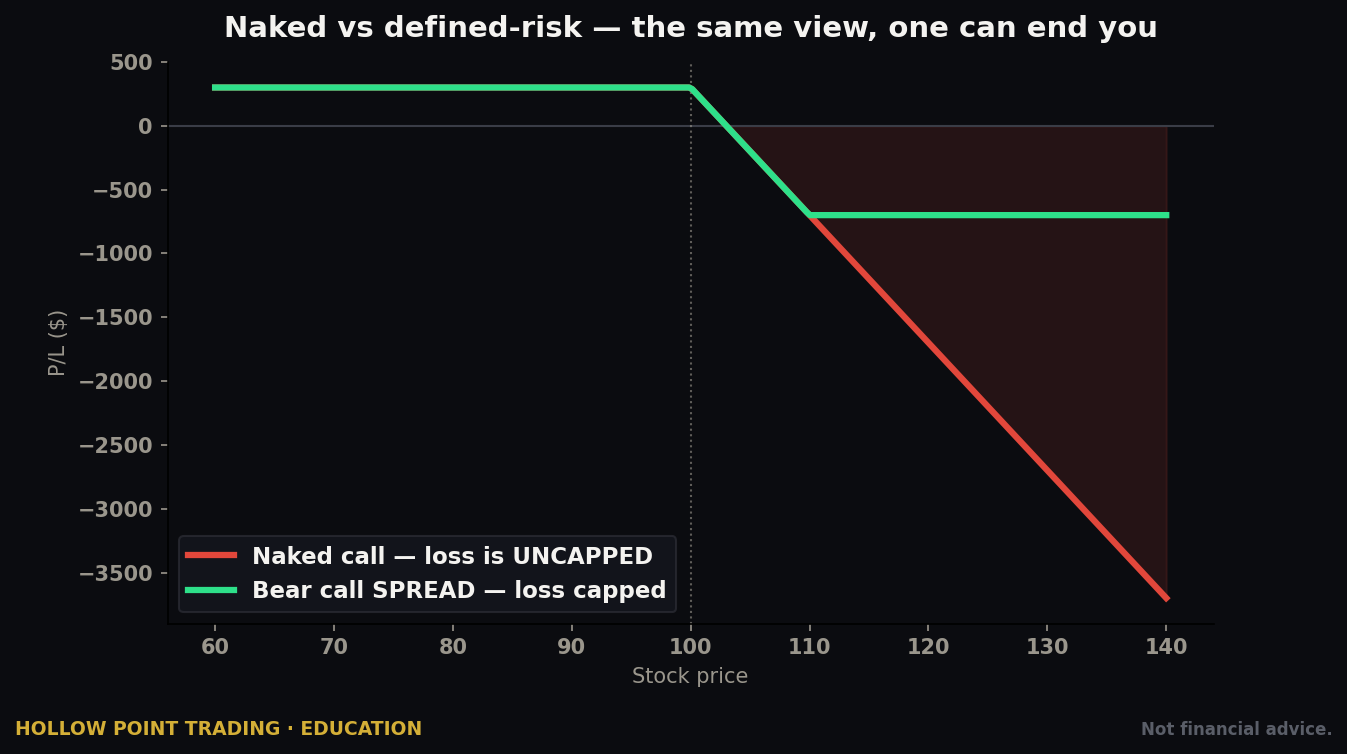
When you buy an option, your loss is capped and your gain is (theoretically) huge. When you sell a naked option, your gain is capped and your loss is (theoretically) huge. The seller has flipped the payoff upside down.
When you buy a call for $250, the worst that happens is the stock goes nowhere, the option expires worthless, and you lose your $250. Painful, but finite. You knew the number before you started.
When you sell a naked call and collect $250, that $250 is the most you can ever make. The best possible outcome is already in your hand. But the loss? A stock can double. Triple. Go up 10x on a buyout or a short squeeze. There is no ceiling on how high a stock price can go, which means there is no ceiling on how much a naked call seller can lose.
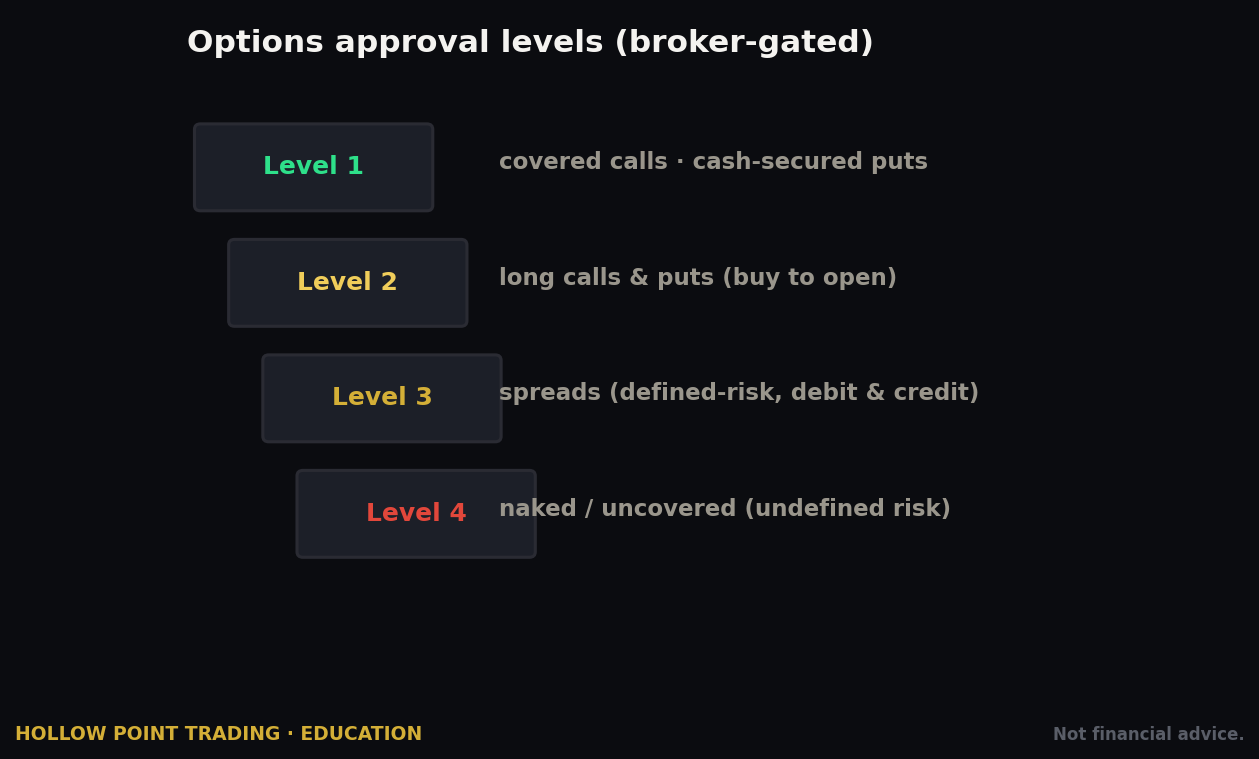
This is what traders mean by "unlimited risk." It is not marketing hype. A naked call genuinely has no mathematical maximum loss. A naked put has a very large but technically limited loss (a stock can only fall to zero), but "limited to catastrophic" is not the comfort it sounds like.
Beginners are drawn to selling options because of the win rate. Selling options feels great — you win most of the time. You collect premium, the option expires worthless, you keep the cash, and you do it again next week. You might win 9 or 19 times in a row. This builds dangerous confidence. Then the one loss arrives and it is bigger than all your wins combined, plus your account, plus money you didn't have.
That pattern — many small wins, one catastrophic loss — is the signature of naked option selling. It is sometimes called "picking up pennies in front of a steamroller." The pennies are real. So is the steamroller.
How a naked call blows up, step by step
Let's walk the whole mechanism slowly so you see exactly how the money disappears.
Step 1. Stock XYZ is trading at $100 per share. You believe it won't go up much, so you decide to sell a naked call.
Step 2. You sell one call with a $110 strike, expiring in two weeks, and collect a premium of 1.50. Because one contract is 100 shares, you actually receive 1.50 × 100 = $150 in cash, deposited into your account immediately. This feels like free money. It is not free — it is a loan against a promise.
Step 3. Your promise: if XYZ is above $110 at expiration, the buyer will "exercise" — meaning they use their right to buy 100 shares from you at $110, no matter what the real price is.
Step 4. Now the story splits.
The good ending: XYZ drifts sideways and closes at $103 on expiration day. It never crossed $110, so your call expires worthless. Nobody exercises. You keep the full $150. You feel like a genius.
The bad ending: Two days later, XYZ announces it's being bought out by a bigger company for $160 a share. The stock gaps overnight — meaning it jumps instantly, before you can react — from $103 to $158. Your $110 call is now deep "in-the-money" (the strike is far below the stock price).
Step 5. The buyer exercises. You are obligated to deliver 100 shares at $110. You don't own any shares. So you must buy 100 shares in the open market at $158 and sell them at $110.
Step 6. The math. You buy at $158, sell at $110, losing $48 per share. Times 100 shares = $4,800 lost. Subtract the $150 you originally collected, and your net loss is $4,650 — on a trade where the most you could ever make was $150.
That is a 31-to-1 loss-to-max-gain ratio, from a single ordinary-sounding trade. And $158 was a mild example. In a real short squeeze — where a stock rockets because too many people bet against it — the stock could have gone to $300, and your loss would be over $19,000. There is genuinely no upper bound.
How a naked put blows up, step by step
The put side works the same way in reverse, and it catches beginners because it feels conservative.
Step 1. Stock ABC trades at $50. You'd be "happy to own it," so you sell a naked put at the $45 strike expiring in a month, collecting 1.00 in premium = $100 cash.
Step 2. Your promise: if ABC is below $45 at expiration, you must buy 100 shares at $45 — even if the real price is far lower.
Step 3. The good ending: ABC stays above $45. Put expires worthless. You keep $100.
Step 4. The bad ending: ABC reports terrible earnings — its profit numbers disappoint badly — and the stock crashes to $28 overnight.
Step 5. You are forced to buy 100 shares at $45 while they're worth $28. That's a $17-per-share loss × 100 = $1,700, minus your $100 premium = $1,600 net loss.
A naked put's loss is technically "limited" because a stock can't go below zero. If ABC went bankrupt and hit $0, you'd be forced to buy at $45 and own worthless shares: a $4,500 loss minus $100 = $4,400 on a $100 max-gain trade. "Limited" here means limited to the entire strike value times 100. On a $200 stock, a naked put could cost you $20,000 per contract if the company failed. That is not a beginner-appropriate risk.
There is a second trap with naked selling most beginners never see coming: margin and forced liquidation.
The hidden killer: margin and the midnight margin call
When you sell a naked option, your broker doesn't just take your word that you'll cover the obligation. They freeze a chunk of your account as collateral, called margin — a security deposit that guarantees you can pay.
Here's the problem. As the trade moves against you, the broker demands more margin. If the position gets scary enough and you don't have the cash, the broker issues a margin call — a demand for more money, now — and if you can't meet it, they will liquidate your positions automatically. They sell you out at the worst possible moment, at the worst possible price, whether you like it or not. You have no say.
This means a naked seller can be destroyed even if the stock eventually recovers, because the account got force-closed at the bottom. You can be "right" in the long run and still lose everything, because you were never in control of the exit. The buyer of an option never faces this. Their money is already spent; there is nothing more to demand.
For beginners, this is the quiet reason naked selling is so brutal: the loss and the loss of control arrive together, usually overnight, usually on the one day you weren't watching.
A real, famous shape of blow-up
You don't need to name specific funds to know the pattern — it repeats every few years. A trader or fund sells options that are far "out-of-the-money" (strikes far from the current price, which feel safe and almost never get hit). They collect small, steady premium for months. The strategy is often marketed as "consistent income." Their track record looks beautiful: a smooth line going up.
Then a single violent event arrives — a natural-gas spike, a currency shock, a pandemic crash, a meme-stock squeeze — and the "impossible" strikes get blown through in hours. Because the positions were naked, the losses have no floor. One event erases years of gains and often the entire fund. In early 2018, a well-known volatility blow-up wiped out products worth billions in a single afternoon. In 2021, retail traders on the wrong side of a short squeeze on a video-game stock faced losses many multiples of their accounts.
The lesson HPT takes from every one of these stories is the same: the strategy was not consistent income. It was a hidden short position on catastrophe, and catastrophe always eventually comes. Protecting capital first is not caution for its own sake — it is what keeps you at the table long enough for your good ideas to pay off.
The defined-risk alternatives — same idea, with a seatbelt
Here is the good news, and the part every beginner should tattoo on their brain: for almost every naked trade, there is a defined-risk version that expresses the same opinion with a known, capped worst case. You give up a little of the premium, and in return you buy certainty about your maximum loss. That trade is always worth making as a beginner.
A defined-risk trade is one where you know, before you enter, the exact most you can lose. That number is small, fixed, and printed on the screen. You can size your position around it. You can sleep.
Let's cover the main ones.
Alternative 1: Just buy the option (be the buyer, not the seller)
The simplest fix of all. Instead of selling a naked call because you think a stock will rise, buy a call. Instead of selling a naked put, buy a put if you think a stock will fall. As a buyer, your maximum loss is the premium you paid — full stop. No margin calls, no overnight catastrophe, no forced liquidation.
Yes, buyers lose more often than sellers win. But when a buyer loses, they lose $250. When a naked seller loses, they lose $4,650. Beginners should learn on the side of the trade where the worst case is a number you chose.
Alternative 2: The vertical spread (the beginner's best friend)
A vertical spread is two options at once: you sell one option to collect premium, and you buy a cheaper, further-away option as insurance. That second option is your seatbelt. It caps your loss.
Let's redo our naked-call example as a spread, so you can see it side by side.
- Naked version: sell the $110 call for 1.50, collect $150, risk unlimited.
- Spread version: sell the $110 call for 1.50, and buy the $115 call for 0.50. You collect 1.50 but pay out 0.50, so your net premium is 1.00 = $100 collected.
You made a little less ($100 instead of $150). But watch what happens in the buyout disaster where XYZ rockets to $158.
Now your $115 call — the one you bought — has also gone deep in-the-money, and it pays you almost exactly the amount your $110 call costs you above $115. The two legs move together above $115. Your maximum loss is now just the distance between the strikes minus what you collected:
- Strike distance: $115 − $110 = $5, times 100 shares = $500
- Minus the $100 you collected = $400 maximum loss. Ever. No matter what.
XYZ could go to $158, $300, or $1,000. Your loss is frozen at $400. Compare that to the naked call's $4,650-and-climbing. Same basic opinion ("XYZ won't go above $110"), same premium collection, but one has a known floor and one does not. This is the trade. This is what a beginner sells instead of a naked option, every single time.
The put version works identically. Instead of a naked put, sell a put spread (also called a "bull put spread"): sell the $45 put, buy the $40 put as insurance. Your max loss is capped at the $5 strike distance minus premium, roughly $400 — instead of the naked put's potential $4,400.
Alternative 3: The cash-secured put (only if you truly want the shares)
If you sell a put but set aside the full cash to buy the shares — $4,500 sitting untouched to back a $45 put — it's called a cash-secured put. It is far safer than a naked put because you're not using borrowed margin; you can never get a margin call, since the cash is already there. Your risk is still large (the stock could fall a long way), but it's funded and known, and you only do it on a stock you genuinely want to own at that price. This is an intermediate tool, not a beginner starting point, but it's the honest version of "getting paid to buy a stock you like."
Alternative 4: The covered call (only if you already own the shares)
A covered call is selling a call when you already own the 100 shares underneath it. If the stock rockets and the shares get called away, you simply hand over stock you already owned — no scramble to buy at $158. Your "loss" is just the upside you gave up above the strike, which stings but doesn't blow up your account. The word "covered" is the whole point: the shares cover the obligation.
Notice the pattern across all four alternatives: every safe version answers the question "what covers me if I'm wrong?" before the trade is placed. The naked trade has no answer. That missing answer is the entire risk.
The beginner mistakes to avoid
These are the specific traps that catch new traders. Read them now so you recognize them later.
Mistake 1: Thinking premium is "free money." Collecting $150 feels like income. It is not income — it is payment for taking on a risk that may cost you far more than $150. The market is not handing you cash for nothing.
Mistake 2: Being seduced by the win rate. "This wins 90% of the time!" is a warning label, not a selling point. High win rate plus uncapped loss is the exact recipe for a slow climb and a sudden cliff.
Mistake 3: Selling far out-of-the-money and feeling safe. The further away the strike, the "safer" it feels and the smaller the premium. But those tiny premiums are precisely the ones that lull you to sleep before the one big move. Cheap-feeling risk is still risk.
Mistake 4: Ignoring earnings and events. Selling a naked option right before an earnings report, an FDA decision, or a Fed announcement is stacking the deck against yourself — these are exactly the moments a stock gaps violently. Always know what's on the calendar before expiration.
Mistake 5: Confusing "limited risk" with "small risk." A naked put's risk is technically limited, but "limited to $4,400 on a $100 trade" is not small. Don't let a reassuring word switch off your math.
Mistake 6: Not knowing your assignment mechanics. Assignment is when the option you sold gets exercised against you and you're forced to fulfill the obligation. It can happen early, over a weekend, on a dividend date — often when you're not watching. If you don't know how and when you can be assigned, you are not ready to sell options.
Mistake 7: Position sizing off the premium instead of the risk. Beginners size their trade by how much premium they collect ("I'll sell 10 of these for $1,500!"). You must size by the worst case. Ten naked calls in our example isn't a $1,500 opportunity — it's a $46,500 liability. Always size off the loss, never the credit.
Mistake 8: Believing you'll "just close it if it goes wrong." Overnight gaps and halted stocks don't give you a chance to close. The move happens while the market is shut and you are asleep. The plan "I'll exit if it turns" assumes a door that is often locked exactly when you need it.
The beginner cheat-sheet
Print this. Tape it to your monitor.
Before ANY option trade, ask:
- Am I the buyer or the seller? (Buyer = capped loss. Seller = read on.)
- If I'm selling — what covers me if I'm wrong? (Shares? A bought option? Nothing? If "nothing," STOP.)
- What is my exact maximum loss in dollars? (If you can't state it as a number, don't trade it.)
- Is that max loss a small, pre-planned slice of my account? (HPT rule of thumb: risk a small fixed fraction, never a life-changing sum, on one idea.)
- What's on the calendar before expiration? (Earnings, Fed, data — any gap risk?)
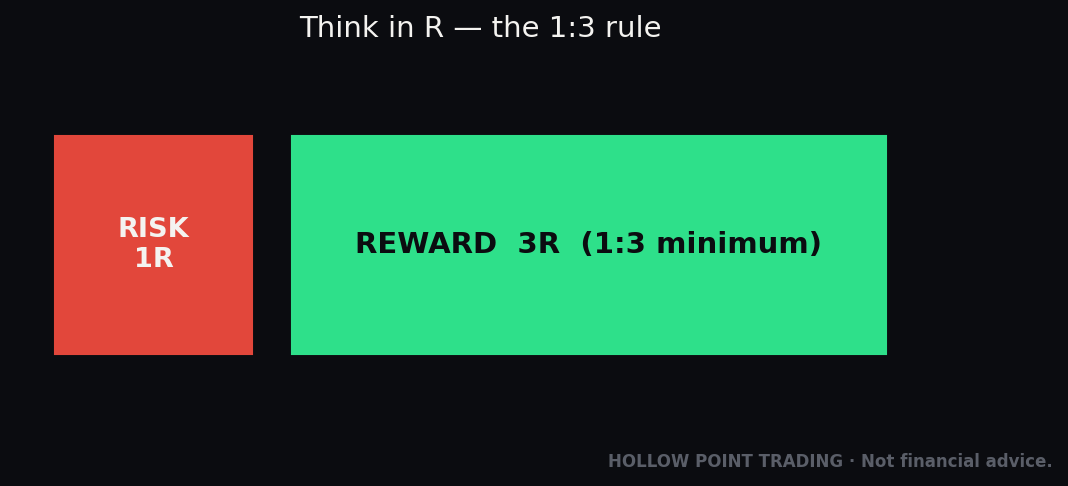
- Does the reward-to-risk make sense? (HPT targets 1:3 — risk $1 to make $3. Naked selling is often the reverse: risk $30 to make $1.)
The naked-options red-flag list — walk away if you see:
- Selling a call without owning the stock. (Naked call — unlimited risk.)
- Selling a put without the cash set aside. (Naked put — huge margin risk.)
- A pitch built on "high win rate" or "consistent income" with no mention of the worst case.
- A max loss you cannot calculate before entering.
- A position sized by premium collected, not by dollars at risk.
The beginner's safe-substitution table:
- Want to sell a naked call? → Sell a call spread instead. (Capped loss.)
- Want to sell a naked put? → Sell a put spread instead. (Capped loss.)
- Bullish and want leverage? → Buy a call. (Loss = premium only.)
- Bearish and want leverage? → Buy a put. (Loss = premium only.)
- Truly want to own a stock cheaper? → Cash-secured put on a stock you love, cash set aside.
- Own 100 shares and want extra yield? → Covered call.
How this fits the bigger Hollow Point picture
At HPT, the philosophy is always the same shape: macro → sector → stock, and discipline over prediction. We start wide — what's the overall market doing, what's the sector doing — and only then zero in on the individual name. Naked options invert that whole discipline. They force you to bet that nothing catastrophic happens at exactly the level where catastrophe originates: the macro shock, the surprise headline, the event you didn't see coming. A naked seller is, whether they admit it or not, short the very tail risk our entire process is built to respect.
The 1:3 reward-to-risk mandate — risk one dollar to make three — is impossible to honor with naked selling, where the natural math is risk many dollars to make one. That single incompatibility tells you everything. A strategy that structurally fights your risk rules is not a strategy you bend the rules for; it's a strategy you leave to people who can absorb a total loss and want to. As a beginner, that is not you, and pretending otherwise is how beginners stop being traders.
Protect capital first. This is not a slogan; it is the mathematical precondition for everything else. You cannot compound an account that is zero. Every edge you will ever build, every pattern you will ever learn, every good read you will ever make is worthless if a single naked position can erase the account before your edge has time to play out. Defined-risk trades keep you in the game. Staying in the game is the entire job.
So here is the beginner's path, in order. First, learn to buy options and feel how capped-loss trades behave. Second, graduate to spreads, where you sell premium but keep the seatbelt. Third — much later, with a funded account and scars to learn from — decide whether cash-secured puts and covered calls fit your plan. Naked selling, if it ever enters your life at all, comes last, with full understanding, and never as a beginner's "income" shortcut. Most successful traders never need it.
The trade that can take more than you put in is the one trade a beginner never has to make. There is a defined-risk version of nearly every idea. Take the seatbelt. Every time.
Bound by rules, feared by trade.