
Let's start with a promise. By the end of this guide, you will understand what a "0DTE" option is, why the internet is full of people either bragging about turning $500 into $8,000 or quietly deleting their accounts, and — most importantly — why the smartest thing a brand-new trader can do with 0DTE options is usually nothing at all.
We're going to build this from zero. If you don't know what an option is, that's fine. If you've never placed a trade in your life, that's exactly who this is for. We'll define every word the first time it shows up, use a lot of plain-English analogies, and walk through real-ish numbers so you can actually see the machine working.
Let's go.
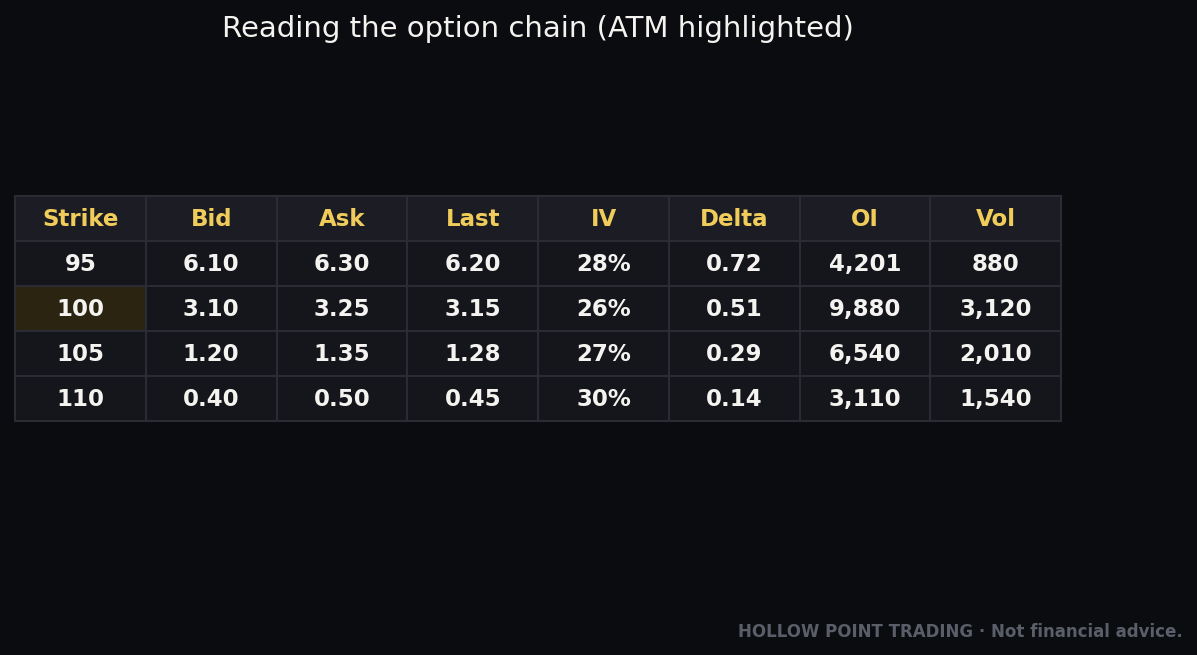
First, What Even Is an Option?
Before we can talk about 0DTE, we need the basics. An option is a contract. It gives you the right, but not the obligation, to buy or sell something at a set price before a set date.
Think of it like this. Imagine a concert ticket is going to be released next month, and you think the band is about to blow up. You pay a scalper $20 today for a coupon that lets you buy a ticket for $100 anytime in the next 30 days. If the band explodes in popularity and tickets start selling for $300, your coupon is gold — you buy at $100 and you're up big. If the band flops and nobody wants tickets, you just let the coupon expire. You lose your $20 and nothing more.
That coupon is basically an option. You paid a small amount (the premium) for the right to buy at a fixed price (the strike price) before a deadline (the expiration date).
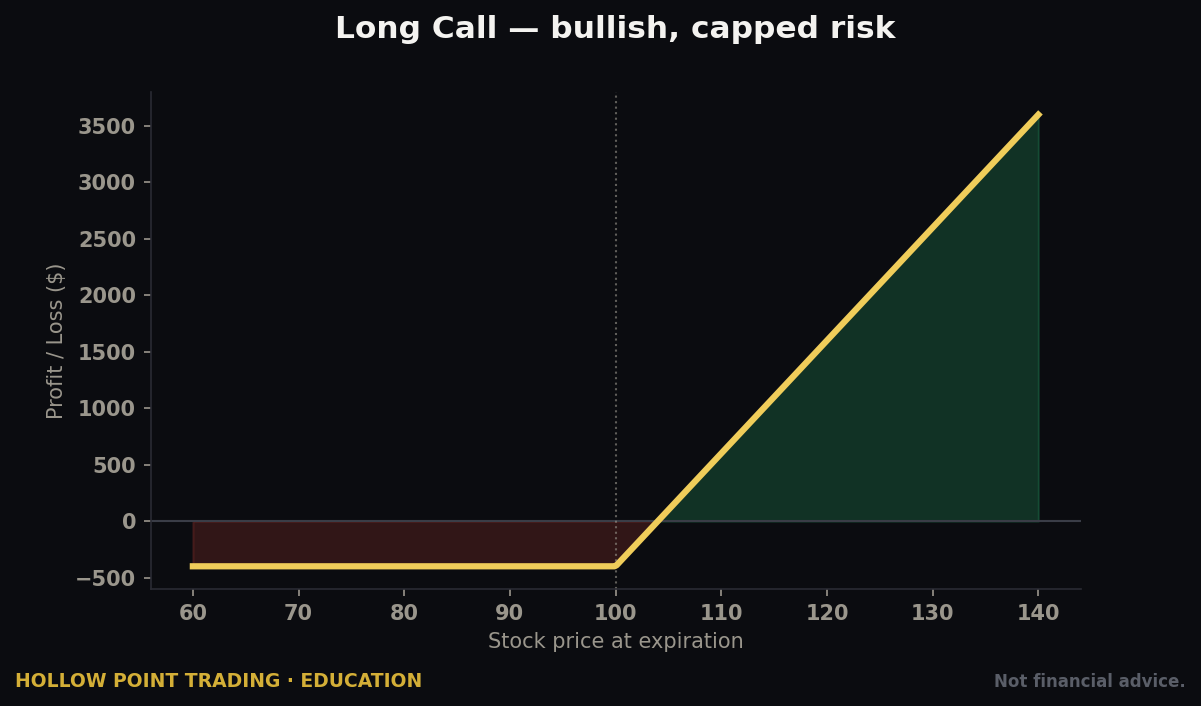
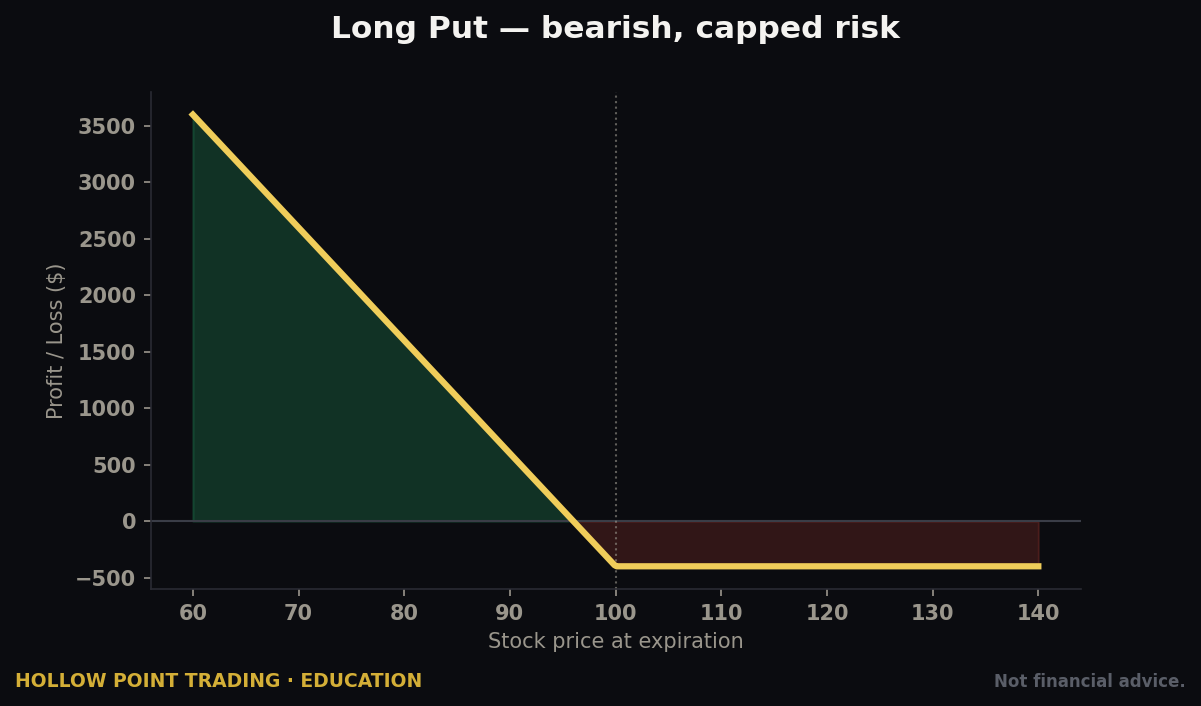
In the stock market, there are two flavors:
- A call option is a bet that a price will go up. It's the right to buy a stock at the strike price. You buy calls when you think the stock is going higher.
- A put option is a bet that a price will go down. It's the right to sell a stock at the strike price. You buy puts when you think the stock is going lower.
One more piece of vocabulary. In the U.S., one option contract usually controls 100 shares of the underlying stock. So if an option is priced at $2.00, you actually pay $2.00 × 100 = $200 to buy one contract. That number — the price you pay per share, times 100 — is your total cost, and for a beginner buying options, it's also the most you can lose. That last part matters, and we'll come back to it.
Okay — So What Does "0DTE" Mean?
DTE stands for Days To Expiration. It's just the number of days left until the option's deadline.
- A 30 DTE option expires in 30 days.
- A 7 DTE option expires in a week.
- A 0DTE option — "zero days to expiration" — expires today. By the end of the trading day, it's either worth something or it's worth absolutely nothing. There is no tomorrow for it.
That's the whole idea. A 0DTE option is a contract that lives and dies inside a single trading session. You buy it in the morning, and by 4:00 PM Eastern time when the U.S. market closes, its fate is sealed.
For years, options mostly expired only on Fridays. But the big index products — like options on the S&P 500 (the ticker symbol SPX, which tracks the 500 largest U.S. companies) and the popular exchange-traded fund SPY that follows the same index — now have options expiring every single trading day of the week. That means on any given day, there's a fresh batch of options that expire that same afternoon. Those are the 0DTEs, and they have exploded in popularity. On many days, they now make up a huge share of all the options traded on the S&P 500.
Why Should a Beginner Even Care About This?
Fair question. If they're dangerous, why not just skip the whole topic?
Three reasons.
One: you're going to hear about them constantly. Trading social media is flooded with 0DTE content — screenshots of enormous one-day gains, "$1,000 to $50,000 in a week" threads, and influencers selling courses. If you don't understand what you're looking at, you're an easy mark. Understanding the mechanics is how you protect yourself from the hype.
Two: they look irresistible to beginners for exactly the wrong reasons. They're cheap. A single 0DTE contract might cost $30, $50, $150 — pocket change compared to buying 100 actual shares of a stock. And they move fast. A 0DTE option can double in twenty minutes. To a new trader with a small account, that combination — cheap and explosive — feels like a shortcut. It is a shortcut, but usually a shortcut to a blown-up account.
Three: the danger is educational. Everything that makes 0DTE options lethal — the way their value melts by the minute, the way they whip around — is just a turbo-charged version of forces present in all options. Learn how 0DTE works and you'll understand regular options far better too.
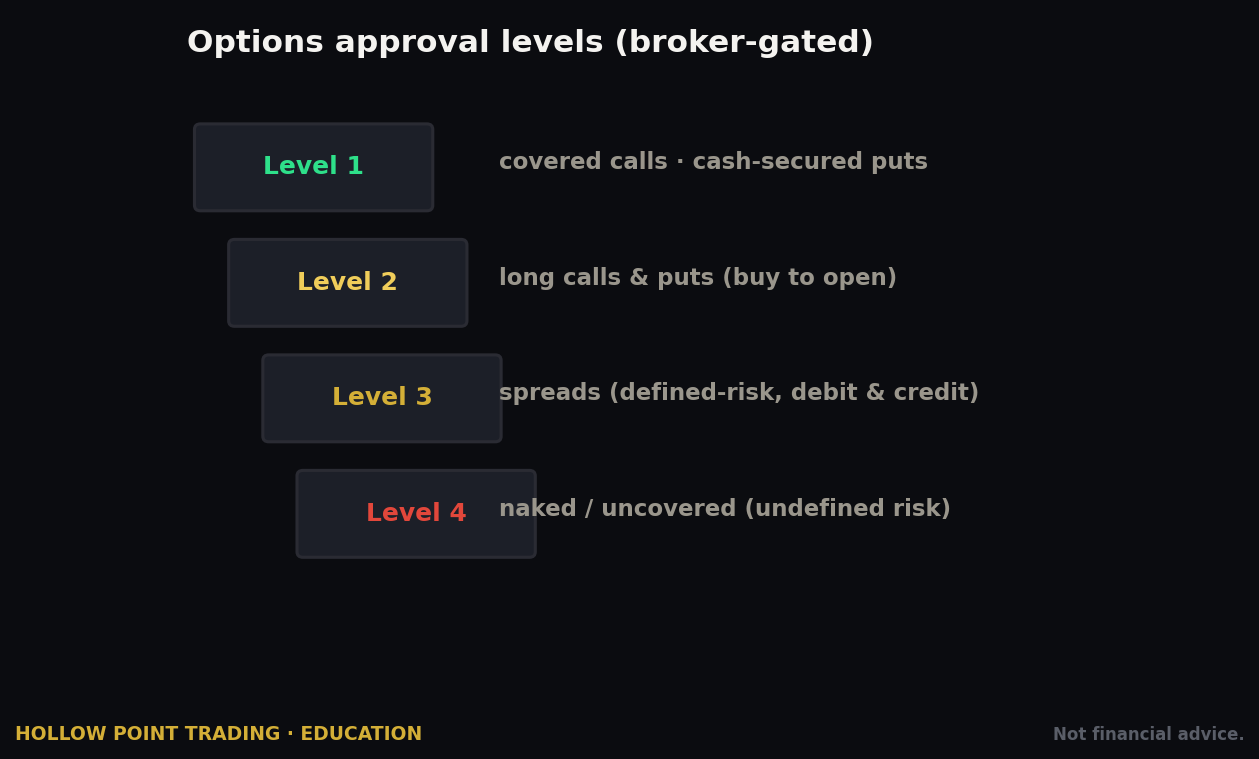
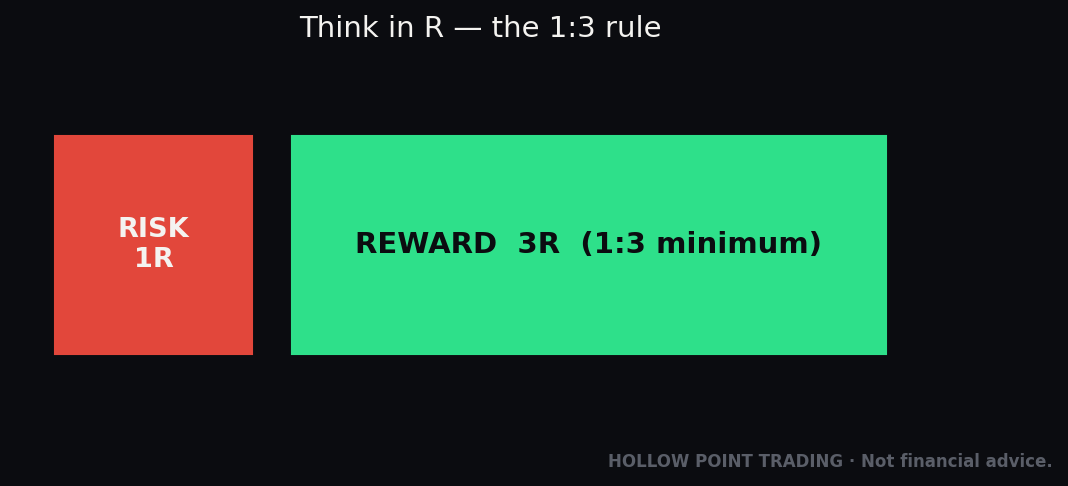
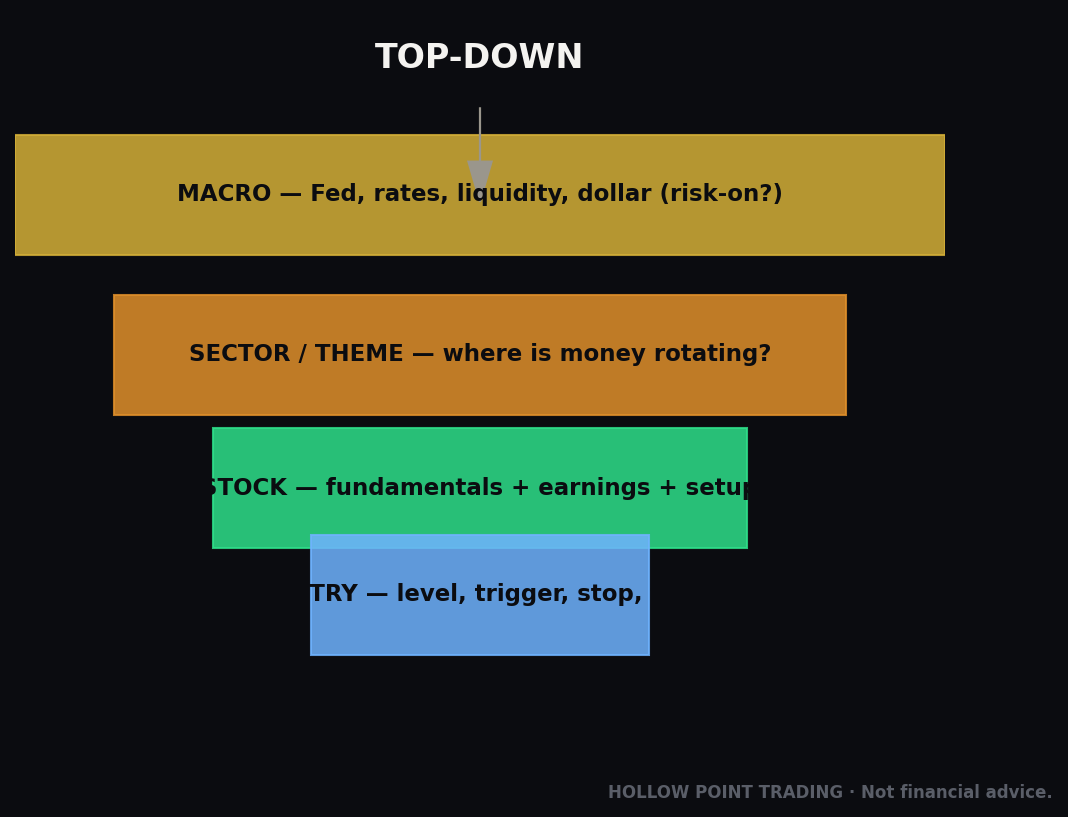
At Hollow Point Trading, the ethos is simple: protect capital first, chase profit second. We think in a specific order — the big economic picture (macro) first, then which sectors are strong, then individual stocks. We want trades where the potential reward is at least three times the risk (we'll explain that "1:3" idea near the end). 0DTE options are the opposite of that philosophy in almost every way, which is exactly why a beginner needs to understand them — so you can recognize the trap by name.
The Two Forces That Rule Every Option: Theta and Gamma
Here's where 0DTE gets its personality. To understand why these things are so dangerous, you only need to really feel two concepts. Don't be scared of the Greek names — they're just labels.
Theta: The Melting Ice Cube
Theta is time decay. It's the amount of value an option loses every day just because time is passing.
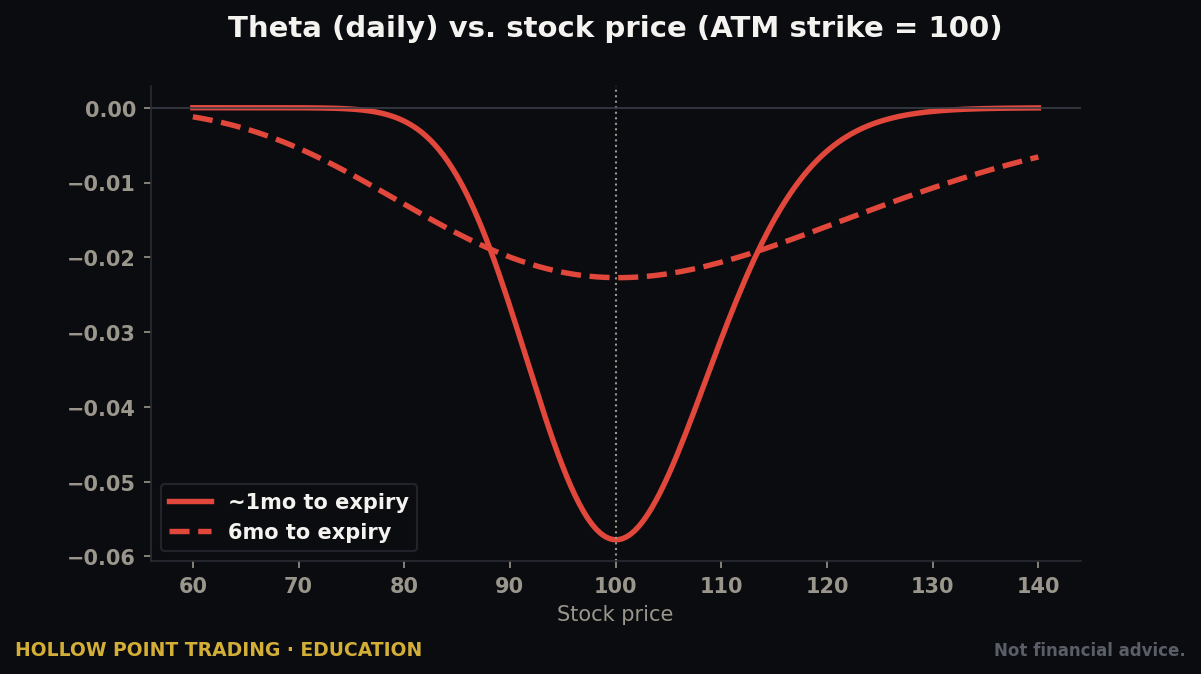
Remember the concert-ticket coupon? A coupon good for 30 days is worth more than a coupon good for 30 minutes, even if everything else is identical. More time means more chances for the price to move your way. So as the clock runs down, the coupon naturally loses value. That bleeding-away of value is theta.
Picture an option's "time value" as an ice cube sitting on a counter. A 30-day option is a big ice cube melting slowly — you barely notice it shrink hour to hour. But a 0DTE option is a tiny ice cube on a hot stove. It's melting so fast you can watch it disappear. Every hour that passes, sometimes every minute, chews away at its value.
This is the single most important thing to understand about 0DTE. Time decay is brutal and it accelerates as expiration gets closer. On expiration day itself, theta is at its most vicious. If the stock just sits still and does nothing, a 0DTE option you bought will bleed to zero by the closing bell. Not down a little. To zero. You can be right about direction eventually and still lose everything because the clock ran out first.
Gamma: The Twitchy Steering Wheel
Gamma is a little harder, so let's build it in two steps.
First, a related idea called delta. Delta tells you how much an option's price moves when the underlying stock moves $1. A delta of 0.50 means the option gains about $0.50 for every $1 the stock rises. Simple enough — it's the option's sensitivity to the stock.
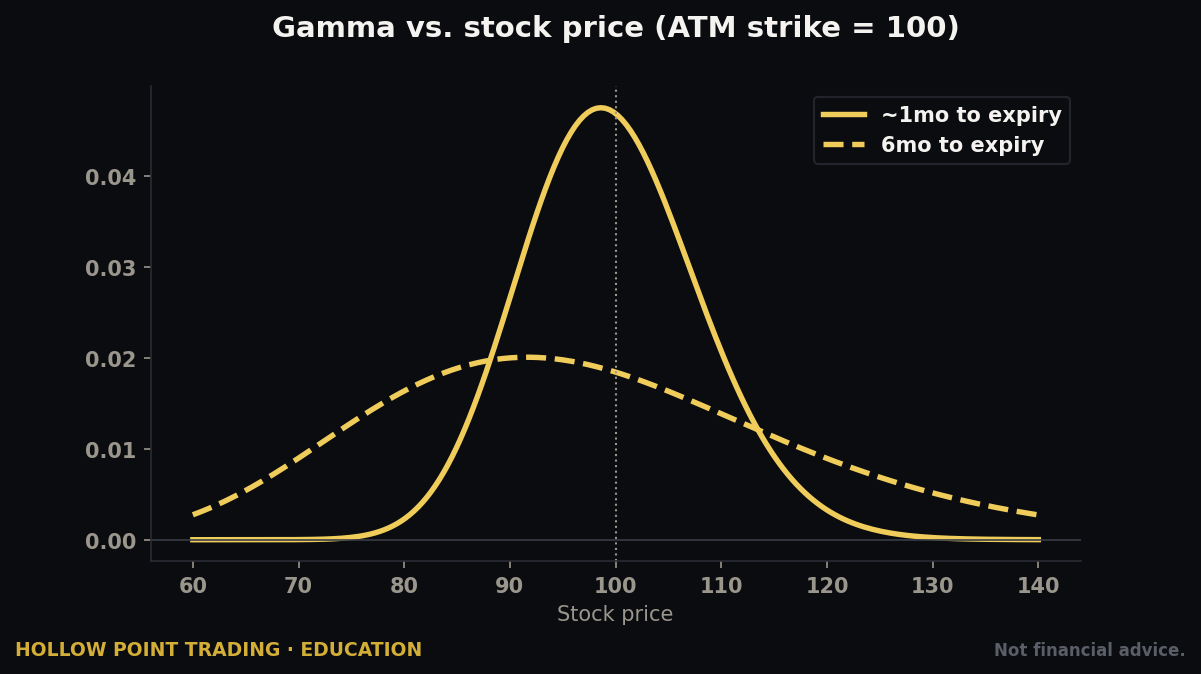
Now, gamma is how fast that sensitivity itself changes. It's the twitchiness of the steering wheel. Low gamma is like steering a big boat — you turn the wheel and the boat slowly responds. High gamma is like a race car with a hair-trigger wheel — the tiniest nudge and you're across three lanes.
0DTE options have enormous gamma. As expiration approaches, an option's delta can swing violently. A 0DTE option can flip from "barely responding to the stock" to "moving almost dollar-for-dollar with the stock" in the space of a small price move. This is why they explode in value so quickly — and why they collapse just as fast. That race-car steering wheel cuts both ways.
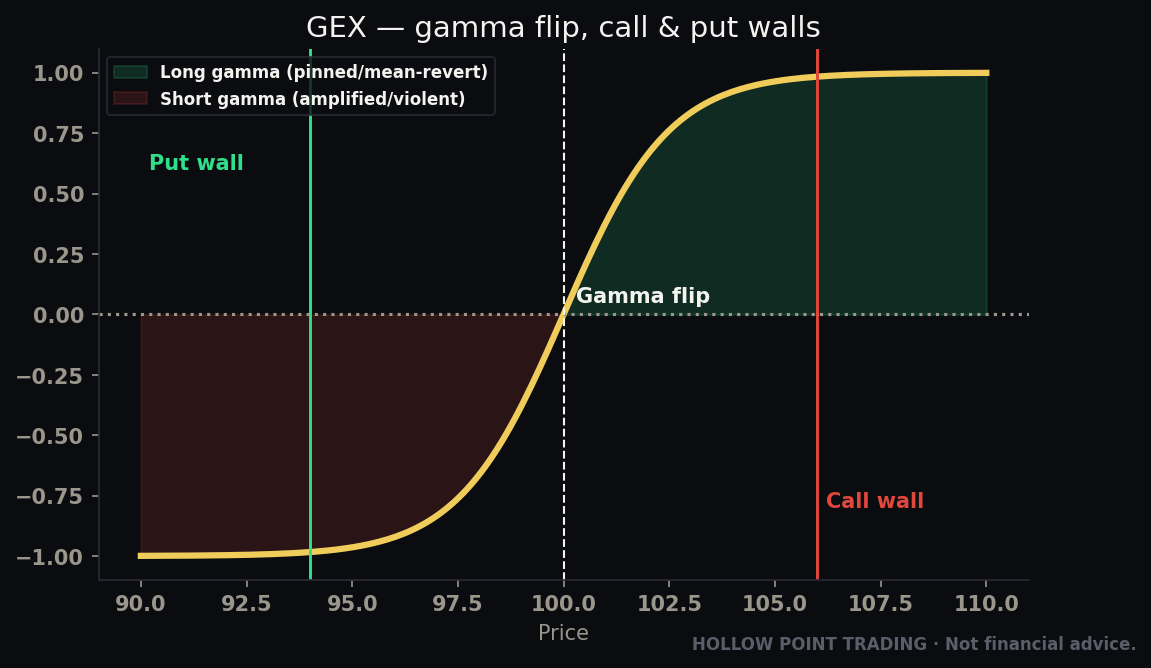
Put theta and gamma together and you have the personality of a 0DTE option: a tiny ice cube melting on a hot stove, strapped to a race-car steering wheel. It's decaying by the minute and whipping around wildly. That's not an investment. That's a coin flip where the coin is also on fire.
How a 0DTE Trade Actually Works, Step by Step
Let's slow all the way down and walk through the mechanics as if you were placing one. We'll use SPY, the fund that tracks the S&P 500, because its options are the most popular 0DTEs on earth.
Step 1 — Pick a direction. You decide the market is going up today. That means you want a call (the "up" bet).
Step 2 — Pick a strike price. Say SPY is currently trading at $500 per share. You look at the options that expire today. You could buy a call with a strike of $500 (right at the current price — this is called at-the-money), or a cheaper one with a strike of $502 (above the current price — out-of-the-money, meaning the stock isn't there yet). Beginners love out-of-the-money 0DTEs because they're the cheapest and move the most. This is a trap, and we'll see why in a moment.
Step 3 — See the price. The $502 call might be priced at $0.40. Remember, you multiply by 100. So one contract costs $0.40 × 100 = $40. Cheap! You buy one. Your total risk is $40 — that's the most you can lose.
Step 4 — Watch it move. Now the clock is running and two forces are fighting over your $40.
- If SPY rallies toward $502, gamma kicks in hard. Your $40 call could jump to $80, $120, even more — a double or triple in minutes. This is the dream everyone posts about.
- If SPY just sits at $500 and drifts, theta eats you alive. That $40 quietly bleeds to $30, $20, $10 as the hours pass, purely because time is running out. Do nothing wrong, guess no direction incorrectly, and still watch your money evaporate.
- If SPY drops, you get hit by both — wrong direction and time decay. The $40 can go to $5 fast.
Step 5 — The deadline. At 4:00 PM, it's over. If SPY closed at $503, your $502 call finished "in-the-money" (the stock is past your strike) and it's worth real money. If SPY closed at or below $502, your call expires worthless. The $40 is gone. Completely. There's no partial credit, no "wait for it to recover next week." There is no next week. It's zero.
That all-or-nothing cliff at the end of the day is the defining feature of 0DTE. Regular stock investors never face anything like it.
A Fully Worked Beginner Example: Meet "Impatient Ian"
Let's follow a made-up new trader through a real-feeling 0DTE day so you can watch the psychology and the math at the same time.
Ian has a $2,000 account. He's seen the screenshots. He decides today is the day. SPY is at $500 and the market feels "bullish" (people expect it to go up) because there's an economic report coming out at 10:00 AM that Ian read will "probably be good."
9:35 AM. Ian buys ten 0DTE call contracts at the $502 strike for $0.40 each. Ten contracts × $40 = $400 spent. That's 20% of his whole account in one click. He tells himself he's "only risking $400."
9:50 AM. SPY ticks up to $500.80. His calls rise to $0.55. On paper he's up $150 (from $400 to $550). Ian feels like a genius. He does not sell. He's thinking about the guy who turned $400 into $6,000.
10:00 AM. The economic report comes out. It's mixed. SPY dips to $499.50, then chops sideways. Ian's calls sag to $0.35. He's now down $50 from where he started. "It'll come back," he says. This is the first mistake — no plan for when he's wrong.
11:30 AM. SPY has done almost nothing — it's at $500.10. But two hours of theta have passed on a contract that expires today. His calls are now worth $0.18. His $400 is now $180. He's down 55% and the stock is basically where he bought it. He was right that it wouldn't crash, and he's still losing. That's theta doing its job.
1:00 PM. Ian, frustrated, does the classic move: he "doubles down to lower his average." He buys ten more contracts, now priced at $0.12, for another $120. He's now spent $520 total — more than a quarter of his account — on options that expire in three hours.
2:30 PM. SPY finally moves — but down, to $498.50. His $502 calls are now so far out-of-the-money and so close to expiration that they're worth $0.03. His entire position is worth about $60. He's down roughly $460.
4:00 PM. SPY closes at $499. His calls expire worthless. All $520 is gone. Twenty-six percent of his account, erased in one day, on a trade where he was never even that wrong about the market.
The market ended the day almost exactly where it started. A person who bought actual SPY shares that morning finished the day roughly flat — no harm done. Ian lost a quarter of everything. That gap — flat for the share buyer, catastrophe for the 0DTE buyer — is the entire lesson.
Why Beginners Lose at 0DTE (The Real Reasons)
Ian's story wasn't bad luck. It was the default outcome. Here's why the deck is stacked against a new trader specifically.
Theta never sleeps. Every day you buy a 0DTE, time decay is a headwind blowing directly in your face from the opening bell. You don't just have to be right about direction — you have to be right fast enough to outrun the melting ice cube. Beginners consistently underestimate how quickly value bleeds.
Gamma cuts both ways, and beginners only remember the good half. The same violent moves that create the viral 10x screenshots create silent 100%-losses far more often. For every posted winner, there are many unposted zeros. Social media is a highlight reel, not a scoreboard.
The all-or-nothing ending removes your escape hatch. With a normal stock, a bad day is a paper loss you can wait out. A 0DTE that expires worthless is a permanent, realized loss by 4:00 PM. There is no "hold and recover." This breaks the one instinct beginners lean on — patience — because patience just guarantees the ice cube fully melts.
They over-size. Because each contract is cheap, beginners buy a pile of them and end up risking a huge slice of the account, exactly like Ian's 20%-then-26%. Cheap-per-unit tricks your brain into thinking the total risk is small.
They average down. Adding to a losing 0DTE position is throwing good money into a fire that's minutes from going out. On a normal stock, "buying the dip" can work over weeks. On a 0DTE, there are no weeks. There are hours.
They confuse being right with getting paid. Ian was basically right — the market didn't crash. He lost anyway. In 0DTE, correct direction plus bad timing still equals zero. That disconnect breaks a beginner's ability to even learn from the trade.
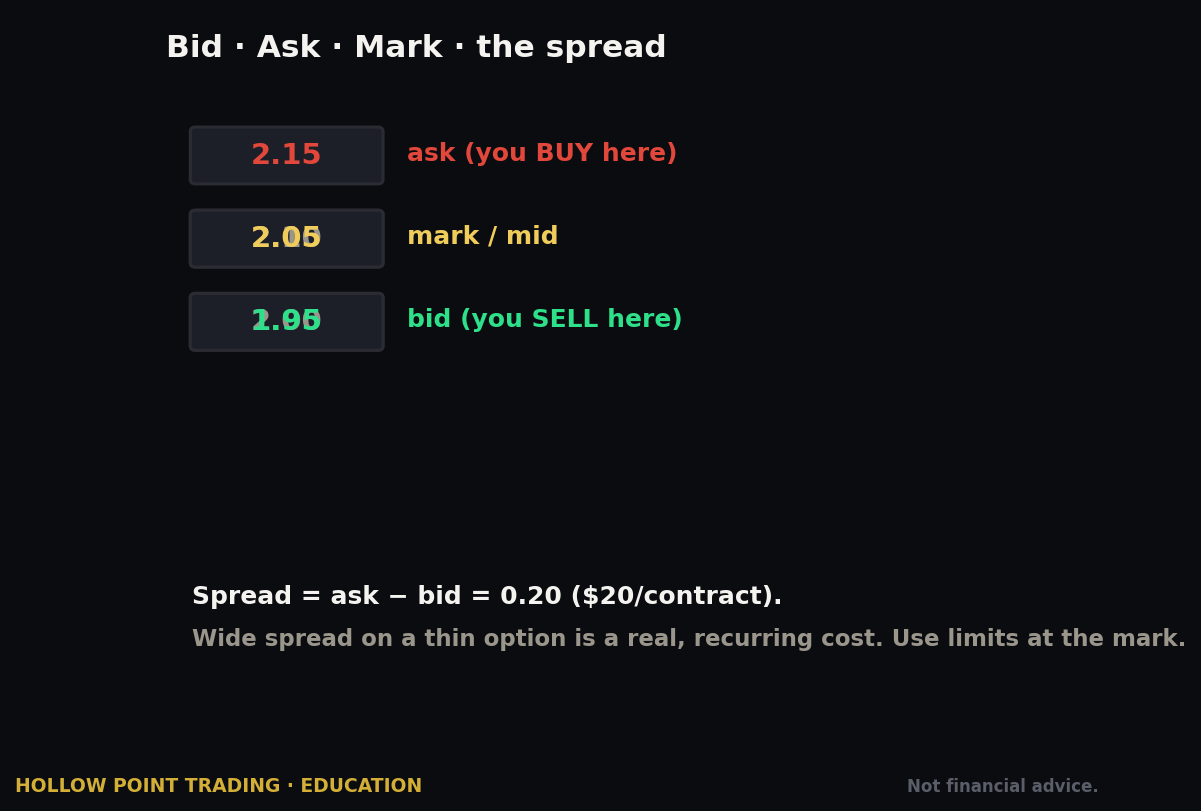
The house edge (spreads and fees) grinds them. Every option has a bid-ask spread — a small gap between the price to buy and the price to sell. Trade in and out of cheap 0DTEs all day and those little gaps, plus commissions, quietly eat your account even before you're wrong about anything.
The Beginner Mistakes to Avoid — A Blunt List
If you remember nothing else, remember these.
- Don't treat 0DTE as your "starter" trade. It is the deep end of the pool. Learn to swim in calmer water — paper trading, then small stock positions — first.
- Don't size big because it's "cheap." Cheap-per-contract is a psychological trick. Measure risk in total dollars vs. your account, never in per-contract price.
- Don't buy without a pre-written exit. Know your sell price if you're right and your sell price if you're wrong, before you click buy. No exceptions.
- Don't average down. Ever. On a 0DTE, adding to a loser is lighting more money on fire.
- Don't hold hoping it "comes back." Theta guarantees it usually won't. Time is not on your side; it is actively against you.
- Don't confuse a screenshot with a strategy. The winners get posted. The zeros don't.
- Don't trade the open on adrenaline. The first minutes are the wildest. Beginners get hurt most there.
- Don't touch this with money you need. Rent, groceries, savings — off-limits. Full stop.
If You Ever Touch Them: The Ironclad Discipline
Let's be honest and grown-up about this. We can tell you 0DTE is dangerous, and it is. But some people will try them anyway. So rather than pretend otherwise, here is the only framework we'd consider responsible — and notice how restrictive it is. That restriction is the point.
Rule 1 — Learn everything else first. You should be comfortable with stocks, then regular longer-dated options, long before you ever touch something that expires today. If you can't yet explain theta and gamma to a friend, you're not ready.
Rule 2 — Use only true "play money." Money you have 100% emotionally and financially written off. If losing it changes your week, it's too much. A tiny, fixed dollar amount — think a small fraction of 1% of your account per trade, an amount you'd shrug at losing entirely, because you frequently will.
Rule 3 — Pre-define your exit before you enter. Write it down. "I sell if it hits +X. I sell if it hits −Y. I sell no matter what by [time]." Then obey it like a robot. The plan is made when you're calm, not when you're panicking.
Rule 4 — Never average down. The position you have is the position you have. Adding to a loser is forbidden.
Rule 5 — Get out before the last hour. The final stretch into the close is where gamma and theta are at their most insane. Most disciplined traders who touch 0DTE are done well before then. Don't ride it into the closing bell hoping for a miracle.
Rule 6 — One and done. Set a daily loss limit and a "one bad trade and I'm finished for the day" rule. The revenge-trade — trying to win it back — is what turns a $100 loss into a $1,000 loss.
Rule 7 — Log every trade. Win or lose, write down what you did and why. This is how a gamble slowly becomes a skill, and how you'll notice (honestly) whether you're actually making money or just remembering your winners.
Your 0DTE Cheat-Sheet
Tape this to your wall. If a real 0DTE situation ever comes up, run down this list first.
Before you even consider it:
- Can I explain theta and gamma out loud? (No → not ready.)
- Am I comfortable with stocks and regular options already? (No → not ready.)
- Is this money I've 100% written off? (No → stop.)
If you proceed anyway:
- ✅ Tiny fixed dollar risk — an amount I'd shrug off losing entirely.
- ✅ Direction, strike, and both exit prices written down before entry.
- ✅ A hard time-stop (I'm out before the final hour).
- ✅ A daily loss limit and a "one and done" rule.
- ❌ No averaging down. No revenge trades. No "it'll come back."
- ❌ No rent money, no savings, no borrowed money.
The gut check: Am I trading, or am I gambling because it's exciting? If you can't answer honestly, you already know.
How 0DTE Fits the Bigger Hollow Point Picture
Zoom out. At Hollow Point Trading, everything starts from a top-down view: macro → sector → stock. We look at the whole economy first, then find the strong sectors, then the specific names within them. We want to hold quality ideas with a clear reason and a clear risk. We size positions so no single trade can seriously hurt us. And we insist on a reward-to-risk ratio of at least 1:3 — meaning we only take trades where, if we're right, we make at least three dollars for every one dollar we'd lose if we're wrong. Risk $100 to make $300. That math is what lets you be wrong more than half the time and still come out ahead.
Now hold a 0DTE up against that framework and watch it fail every test:
- Macro-to-stock discipline? 0DTE is usually a reaction to a single intraday wiggle — the opposite of a patient top-down thesis.
- Protect capital first? 0DTE routinely takes positions to zero in hours. It's built for maximum destruction of capital.
- 1:3 reward-to-risk? Time decay is a constant headwind, so your real odds are worse than they look, and the "risk" side is frequently a total loss.
- Discipline over prediction? 0DTE is prediction in its purest, most frantic form — guess the next few hours correctly or lose everything.
So where does 0DTE actually fit for a beginner? It doesn't — not yet. And that's the honest, valuable answer. The reason we taught you the whole machine — theta, gamma, the all-or-nothing close — isn't to hand you a new toy. It's to inoculate you. Now when an influencer flashes a $30,000 screenshot, you'll see the melting ice cube and the twitchy wheel behind it. You'll know that for every one of those posts, a dozen Ians got quietly wiped out. You'll recognize the trap by name.
Real trading is boring on purpose. It's a patient thesis, a defined risk, a good reward-to-risk ratio, and the discipline to do the same unglamorous thing over and over until it compounds. The traders who last aren't the ones chasing the fastest possible dollar. They're the ones who protect their capital so ferociously that they're still standing years later, when the gamblers are long gone.
The single most powerful move a beginner can make with 0DTE options is to understand them completely — and then walk away, at least until you've earned the experience to know exactly what you're doing. That's not weakness. That's the discipline that keeps you in the game.
Master the boring stuff first. The market will still be here. Ian's account won't be.
Bound by rules, feared by trade.