
If you have never traded an option in your life, this guide is written for you. By the time you finish, you will understand one of the oldest, calmest, most beginner-friendly income strategies in the entire market — the covered call — well enough to actually use it. Not "understand it in theory." Use it. Monday.
We are going to move slowly. Every term gets defined the first time it shows up. We will walk through the same simple example three or four different ways until it clicks. And we will be honest about the one real trade-off, because a strategy that only tells you the good part is a sales pitch, not an education.
Let's build this from the ground up.
First, What Is an Option? (Plain English, No Jargon)
Before we can talk about covered calls, you need to know what an "option" is. Don't worry — this takes about two minutes.
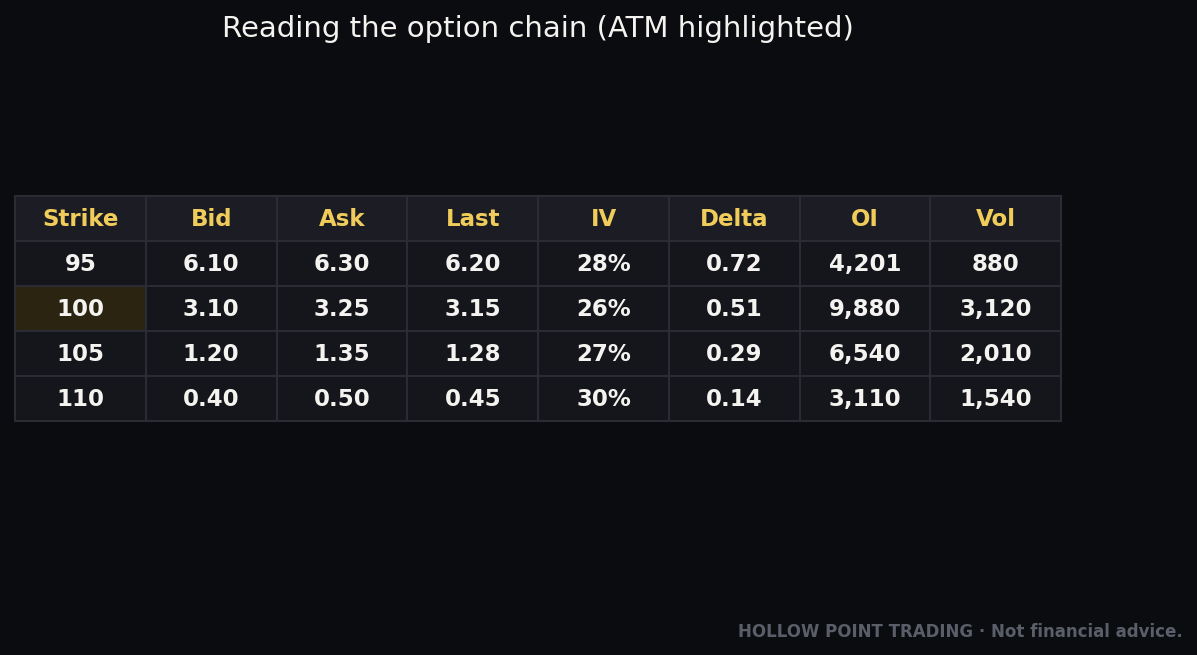
An option is a contract. It's an agreement between two people about a stock. Specifically, a call option is a contract that gives the buyer the right to buy 100 shares of a stock at a fixed price, before a certain date. The person who sells that contract has the obligation to deliver those shares if the buyer wants them.
That's it. A call option is basically a coupon. Imagine a coupon that says: "This coupon lets the holder buy 100 shares of Apple at $200 each, any time before December 19th." Someone might pay you for that coupon today, because it might be valuable to them later.
Two words you'll see constantly:
- Strike price — the fixed price written on the coupon. In our example, $200 is the strike.
- Expiration — the date the coupon stops working. December 19th, in our example. After that, the coupon is worthless.
And the most important word of all:
- Premium — the money the buyer pays the seller for the option. This is the cash. This is the whole point for us. When you sell a call option, someone hands you the premium, and it's yours to keep no matter what happens next.
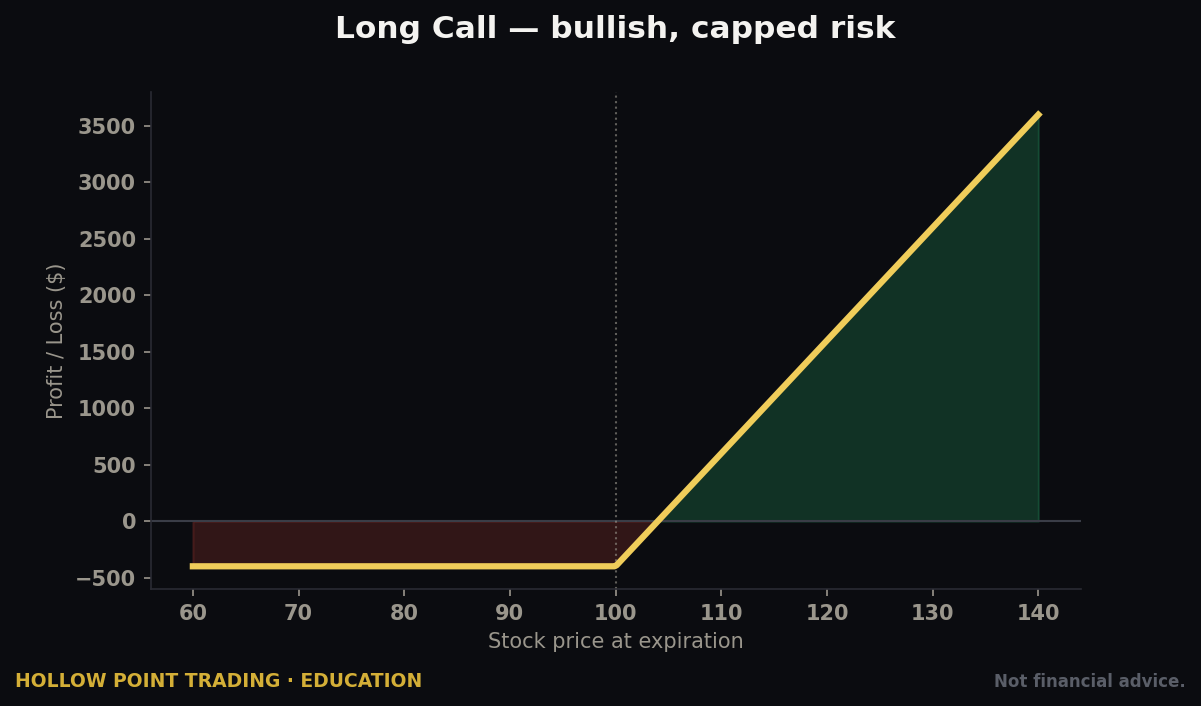
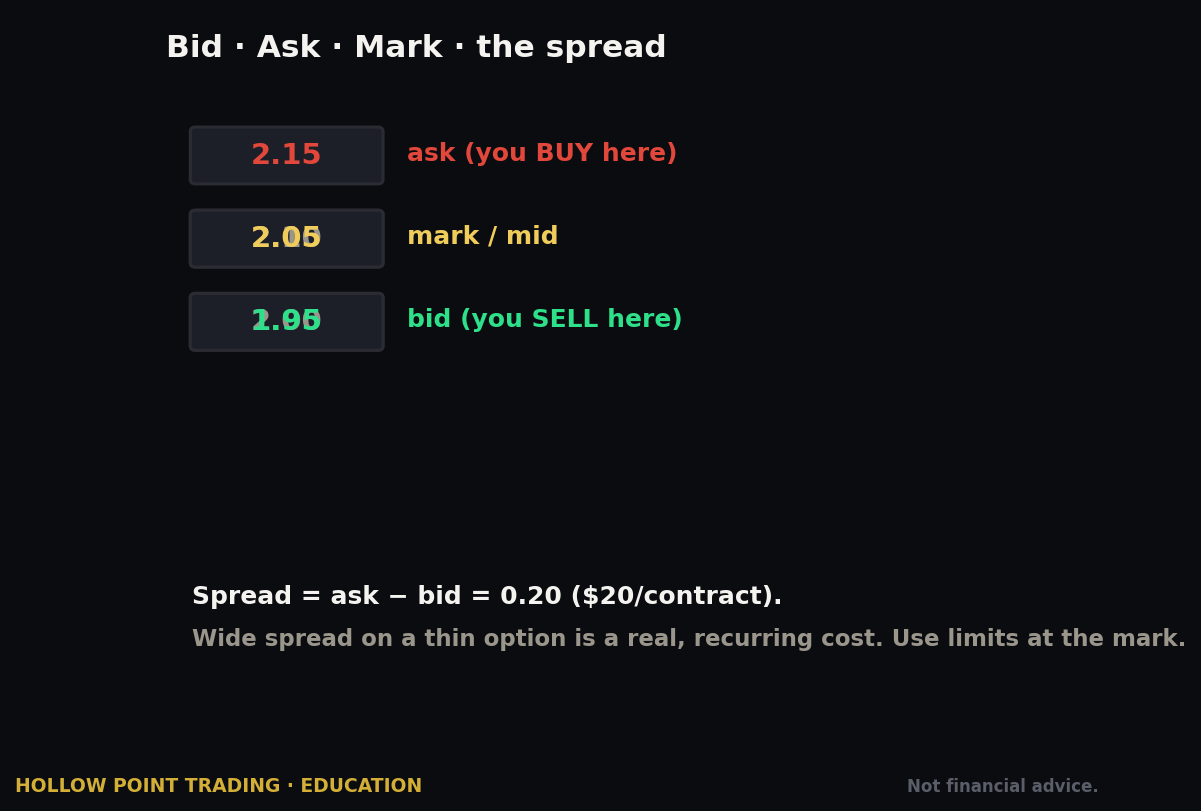
One more critical detail: one option contract almost always controls 100 shares. This is a rule that trips up every beginner. When you see an option priced at "$2.00," that's $2.00 per share, and because the contract covers 100 shares, you actually receive $200 in cash ($2.00 × 100). Burn that into your memory now. Options are quoted per-share but sold per-hundred.
So What Is a Covered Call?
Here is the whole strategy in one sentence:
A covered call is when you own 100 shares of a stock, and you sell one call option against those shares to collect cash today.
That's the entire thing. You already own the stock. You sell someone the right to buy your stock at a higher price. They pay you cash — the premium — for that right. You keep the cash, guaranteed.
The word "covered" is the key. It means you actually own the shares that you might have to deliver. If someone shows up wanting to buy your 100 shares at the strike price, you just... hand over the shares you already have sitting in your account. You're "covered." You're not exposed to some scary unlimited risk, because you're not promising to deliver shares you don't own. You have them. Right there.
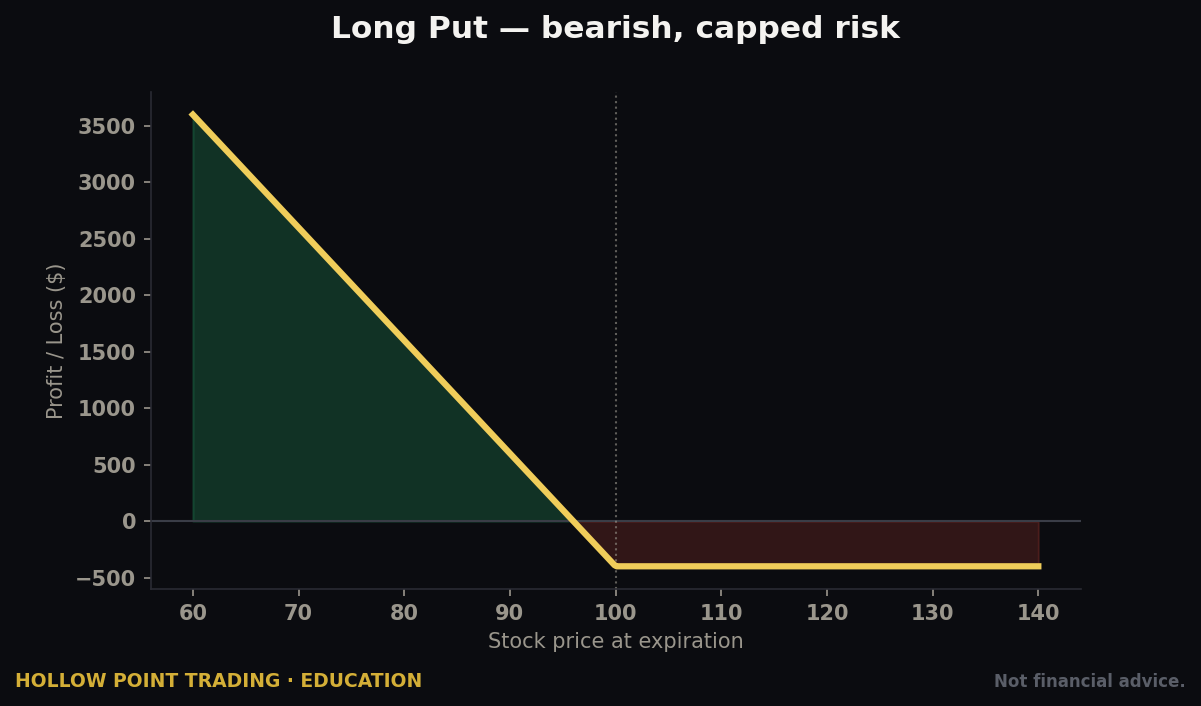
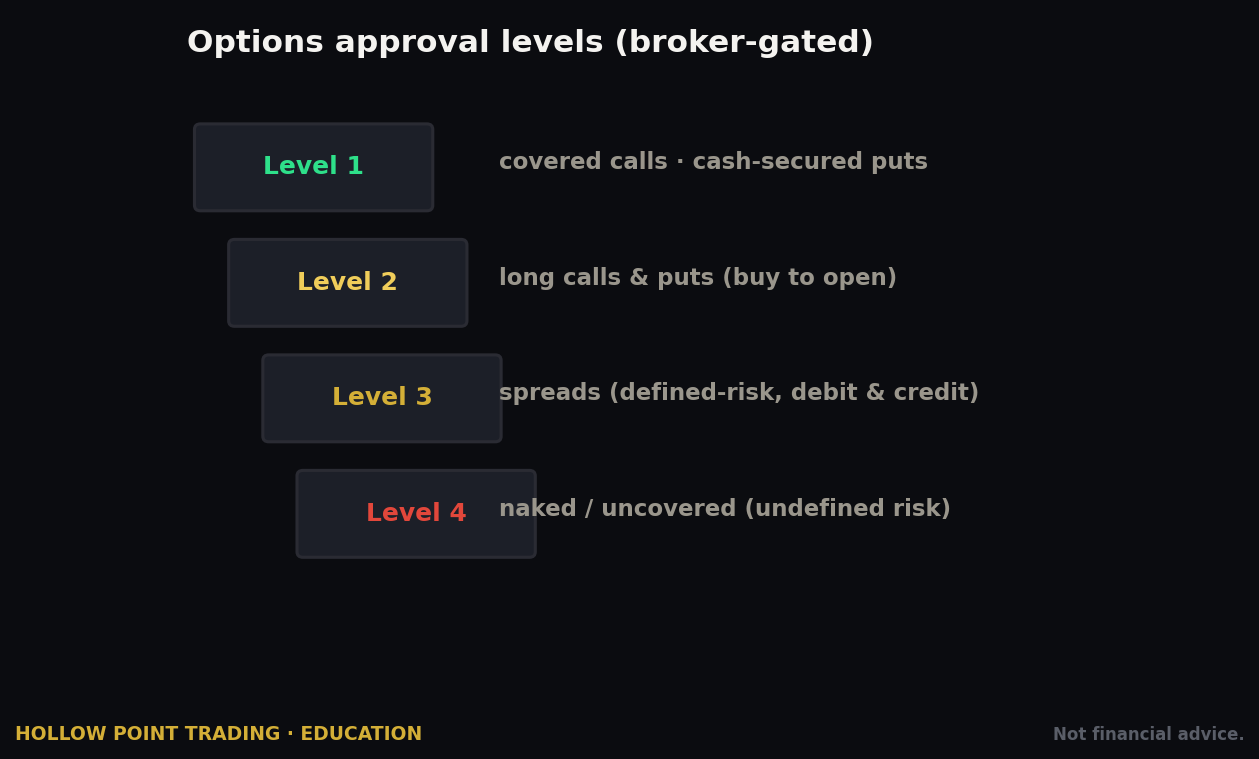
Compare that to selling a call without owning the shares — that's called a "naked call," and it's genuinely dangerous, because if the stock rockets up you'd have to buy shares at any crazy price to deliver them. Beginners should never, ever sell naked calls. The covered call is the safe, sane, grown-up version. You own the stock; you rent it out for income.
That's the best mental model for the whole strategy: you're a landlord. You own an asset (the shares). You collect rent (the premium) from a tenant (the option buyer). The rent is yours to keep. The only catch — and we'll get deep into this — is that if the property value spikes, your tenant has the right to buy the property from you at the agreed price.
Why Should a Complete Beginner Even Care?
Fair question. Here's why the covered call is often the first options strategy anyone should learn:
1. It generates income from stock you already own. If you're holding shares of a solid company and they're just sitting there, a covered call turns that dead-weight position into a cash-producing machine. You can do this over and over — sell a call this month, collect premium; sell another next month, collect again. Landlords collect rent every month. Same idea.
2. It actually lowers your risk. This surprises beginners. Selling a covered call makes your position safer, not riskier. The premium you collect is a cushion. If the stock drops a little, that cash you pocketed softens the blow. You're better off than someone who just holds the stock naked with no premium.
3. You can't blow up your account with it. Unlike almost every other options strategy, a covered call has a defined, understandable outcome. Nothing catastrophic can happen from the option itself. The worst case is a "good problem" — we'll get to it.
4. It teaches you how options actually behave. Once you've sold a few covered calls and watched premium decay in your favor, options stop being scary and start making sense. It's the training-wheels strategy — in the best possible way.
At Hollow Point, we care about one thing above all else: protecting capital first. The covered call fits that philosophy like a glove. It's not a lottery ticket. It's a slow, repeatable, rules-based way to squeeze extra return out of shares you were going to hold anyway. That's a beginner's kind of edge.
How It Works, Step by Step
Let's walk through the entire lifecycle of a covered call, slowly, one step at a time. We'll use round numbers so the math never gets in the way.
Step 1 — You own 100 shares. This is the requirement. You must own at least 100 shares of a stock. Not 50. Not 99. One hundred, because one contract covers 100 shares. If you own 200 shares, you could sell two covered calls. If you own 500, you could sell five. But let's keep it simple: you own exactly 100 shares.
Step 2 — You pick a strike price above where the stock is now. You choose a strike price higher than the current stock price. This is your "I'd be happy to sell here" price. If the stock is at $50, maybe you pick a $55 strike. You're essentially saying, "I'm willing to sell my shares at $55. If it gets there, great, I'll take the profit."
Step 3 — You pick an expiration date. How long is this contract good for? Beginners usually pick something 30 to 45 days out. Shorter than that and the premium is tiny; much longer and you're locked up for a long time. Roughly a month is the sweet spot for learning.
Step 4 — You sell the call and collect the premium instantly. You place an order to "sell to open" one call at your chosen strike and expiration. The moment it fills, cash appears in your account. That premium is yours immediately. It doesn't matter what happens next — that money is booked.
Step 5 — You wait. Now you just hold. One of a few things will happen by expiration, and here's the beautiful part: all of the outcomes are acceptable. Let's map them.
The Three Things That Can Happen
By the time your option expires, the stock is either below your strike, right around it, or above it. Let's take each.
Outcome A — The stock stays below your strike price. This is the most common outcome and the one you're quietly rooting for. Say you sold a $55 strike and the stock is sitting at $52 at expiration. Nobody wants to buy your shares at $55 when they could buy them cheaper on the open market at $52. So the option expires worthless. The buyer's coupon is trash. You keep your 100 shares and you keep the premium. Next month, you do it all again. This is the "collect rent, keep the house" outcome. It's the dream. You just want to rinse and repeat.
Outcome B — The stock finishes right around your strike. Say it's hovering at $54.90 versus your $55 strike. Basically the same as Outcome A — the option likely expires worthless or nearly so, you keep the shares and the premium. Nothing dramatic.
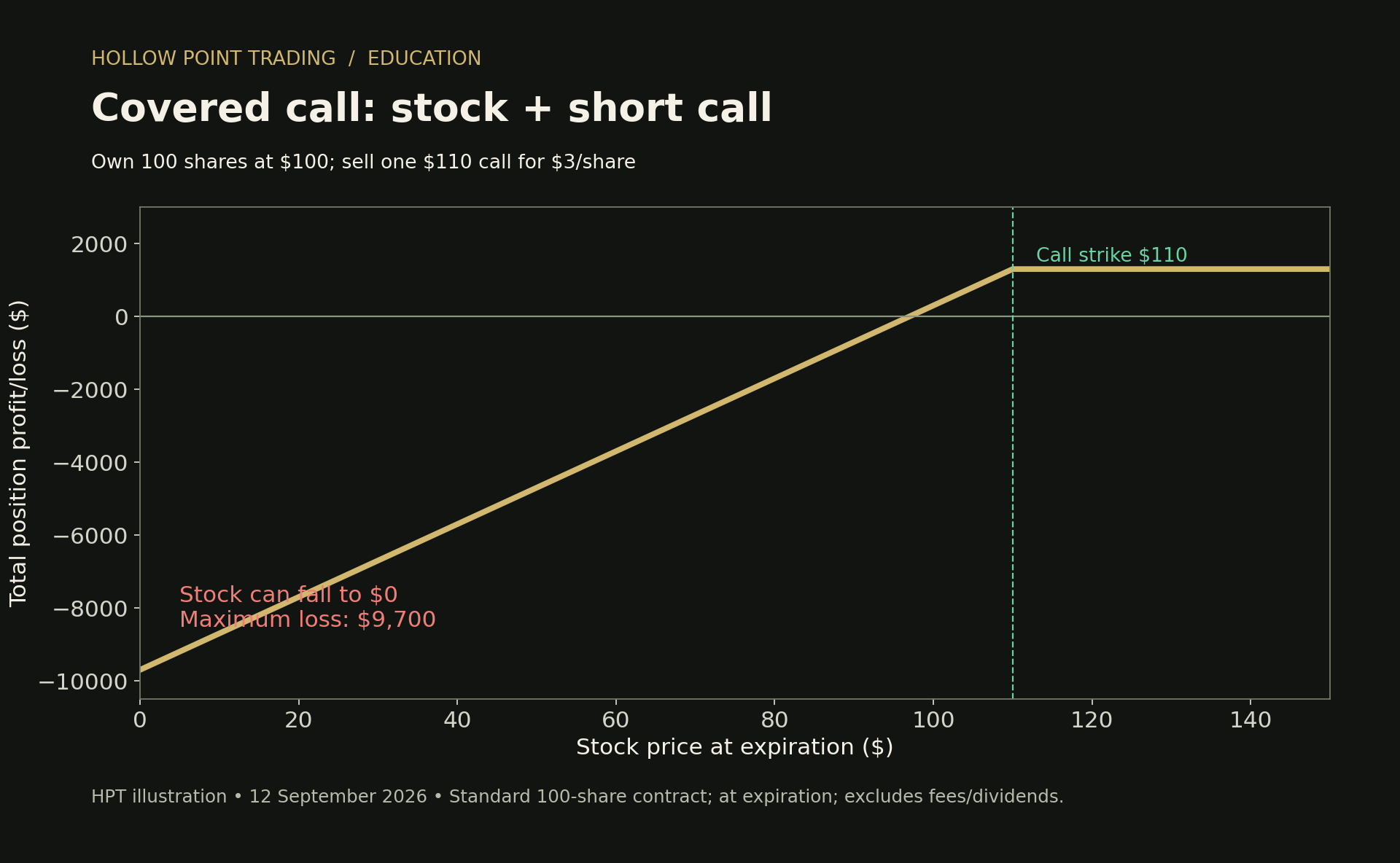
Outcome C — The stock rises above your strike price. Say the stock jumps to $60 and your strike was $55. Now the buyer definitely wants your shares — they can buy them from you at $55 and immediately sell at $60. This is called being "assigned" or "called away." Your 100 shares get sold at $55, automatically. You still keep the premium. You still made money — you sold your stock for a profit at exactly the price you said you'd be happy to sell at. But — and this is the whole trade-off — you don't get to enjoy the run to $60. Your gains were capped at $55.
Read Outcome C carefully, because it is the entire catch, and we're going to spend real time on it. Notice, though: even in the "bad" case, you made money. You sold your stock at a profit and kept a premium on top. That's why traders call it a "good problem." You didn't lose. You just didn't win as much as a pure buy-and-hold would have if the stock ran.
The One Real Trade-Off: Capped Upside
Let's be completely honest, because Hollow Point doesn't do sales pitches.
When you sell a covered call, you are trading away your unlimited upside in exchange for guaranteed cash today. That's the deal. The premium is certain; the giant moonshot rally is what you're giving up.
Think about it like being a landlord again. You rent out a house for steady monthly income. But suppose the neighborhood suddenly booms and the house doubles in value overnight. You still only collected your agreed rent — you didn't capture that explosive appreciation, because you'd committed the property to your tenant's terms. The steady income has a cost: you gave up the home-run.
Here's the crucial beginner insight: the covered call is a bet on boring. It performs best when the stock goes sideways or drifts up slowly. It performs worst — in a relative sense — when the stock explodes upward and you get capped out. It offers only limited help when the stock crashes (the premium is a small cushion, not a parachute).
So the strategy has a natural home: stocks you think are going to be calm, or drift gently higher, or ones you honestly wouldn't mind selling at a higher price anyway. If you have a stock you believe is about to triple, do not sell covered calls on it. You'd cap yourself out of the exact move you're trying to catch. Match the tool to the situation.
There's one more small cost to name honestly: while you have a covered call open, your shares are "committed." You generally shouldn't sell the underlying shares out from under the option, because then your call would no longer be covered. So there's a mild loss of flexibility for the life of the contract. For a beginner holding a stock for the long haul anyway, that's usually a non-issue.
A Fully Worked Beginner Example
Let's do this all the way through with real-ish numbers so it's concrete. Meet our beginner, Sam.
Sam owns 100 shares of a company we'll call "Steady Co." Sam bought them a while back at $48 each. Today, Steady Co. trades at $50 per share. Sam likes the company long-term, doesn't expect fireworks in the next month, and would honestly be delighted to sell at $55 if it got there. Perfect candidate for a covered call.
Sam's setup:
- Owns 100 shares at a current price of $50 (total position value: $5,000).
- Decides to sell one call with a $55 strike, expiring in 35 days.
- The market is paying a premium of $1.50 for that call.
The instant cash: Sam sells the call and immediately receives $1.50 × 100 shares = $150 in cash. That $150 is Sam's, booked, done, regardless of what happens next. On a $5,000 position, that's a 3% return collected in about a month, just for agreeing to sell at a higher price. That's the "rent."
Now let's fast-forward 35 days and play out each scenario.
Scenario 1 — Steady Co. is at $50 at expiration (went nowhere). Nobody wants to buy Sam's shares at $55 when they trade at $50. The call expires worthless. Sam keeps all 100 shares (still worth $5,000) and keeps the $150 premium. Sam's stock did nothing, but Sam earned $150 anyway. Sam can now sell another call for the next month and collect again. This is the compounding-rent dream.
Scenario 2 — Steady Co. drops to $47 at expiration. The stock fell. Sam's shares are now worth $4,700 — a $300 paper loss versus the $5,000 he started the month with. But Sam collected $150 in premium, so the net pain is only $150, not $300. The premium cushioned half the drop. Compare Sam to his neighbor who owned the same stock with no covered call: the neighbor is down the full $300; Sam is only effectively down $150. The covered call made the down-month less bad. That's the risk-reducing property in action.
Scenario 3 — Steady Co. rises to $60 at expiration (the run). Now the option buyer exercises. Sam's shares get called away at $55. Let's total Sam's result:
- Sam sold 100 shares at $55 = $5,500 (he bought at $48, so that's a $700 capital gain).
- Plus the $150 premium.
- Total profit: $850.
Sam made $850 on a stock that started the month at $50. That's fantastic! But here's the honest part: if Sam had not sold the call, he'd own 100 shares now worth $6,000 — a $1,200 gain from his $48 cost. So Sam "left $350 on the table" compared to just holding through the rally ($1,200 vs. $850). The covered call capped him at $55.
Now — is Sam upset? He shouldn't be. He set a price he was happy to sell at, the stock hit it, he sold at a profit and pocketed rent on top. He followed his plan and made $850. A profit that follows your plan is never a loss. The trader who agonizes over "missed" gains is the trader who eventually blows up chasing them. Discipline over prediction, always.
That's the full covered call, start to finish. Notice how every scenario leaves Sam having made money or having lost less than he otherwise would. That's why it's the beginner's strategy.
Choosing Your Strike: The One Real Decision
The single biggest choice you make is which strike price to sell. It's a slider between two goals — more income vs. more room for the stock to run — and understanding it is most of the skill. Options traders talk about strikes in three buckets relative to the current stock price.
At-the-money (ATM) — a strike right around the current price. Pays the most premium (most rent), but caps you almost immediately, so you're very likely to get called away. Choose this when you mostly want income and don't care much about further upside.
Out-of-the-money (OTM) — a strike above the current price (like Sam's $55 vs. $50). Pays less premium, but gives the stock room to rise before you're capped, and you get to keep any gains up to the strike. This is the beginner default — a comfortable middle ground of decent rent plus some room to grow.
In-the-money (ITM) — a strike below the current price. Pays the most total cash but you're almost certainly getting called away, and it's really a downside-protection play. Beginners can skip this one for now.
The simple beginner rule of thumb: sell a strike slightly out-of-the-money — a price you'd genuinely be happy to sell at. That way, if you keep the shares, you collected rent; and if you get called away, you sold at a price you already liked. Both outcomes are ones you signed up for. There is no bad ending when you only pick strikes you'd be happy to be assigned at.
A quick note on how far out to sell in time: a strike ~30–45 days out is the beginner standard because that's where the "time decay" — the rate at which an option loses value as expiration approaches — works most efficiently in the seller's favor. As the seller, time passing is your friend. Every day that ticks by, the option you sold is worth a little less, which is good for you. That daily melt is nicknamed "theta," and as a covered-call seller, theta is on your side. You don't need to master the Greek letters today — just know that time decay pays the patient landlord.
The Beginner Mistakes to Avoid
Every new covered-call seller makes some of these. Learn them here instead of the hard way.
Mistake 1 — Selling calls on a stock you're not willing to sell. If you'd be heartbroken to lose the shares, don't sell a call against them. Only write covered calls on stock you'd genuinely be okay parting with at the strike. Otherwise the "good problem" of assignment feels like a disaster and you'll do something dumb to avoid it.
Mistake 2 — Reaching for a strike too close to the price just for fat premium. Yes, a near-the-money strike pays more. It also caps you almost instantly and gets you called away constantly. Chasing the biggest premium is how beginners repeatedly sell their winners too early. Leave some room.
Mistake 3 — Forgetting the contract is 100 shares. Selling "one" call obligates 100 shares. If you only own 100 shares, you can only safely sell one call. Sell two and one of them is naked — dangerous. Always match: shares owned ÷ 100 = maximum contracts you can safely sell.
Mistake 4 — Selling covered calls right before earnings without knowing it. Earnings announcements can make a stock jump violently. Premiums are fat before earnings because the risk is real. A beginner can get surprised and called away on a post-earnings pop. Know your stock's earnings date. If you don't want the earnings gamble, sell calls that expire before the report, or skip that month.
Mistake 5 — Panicking and "rolling" in a loss out of ego. "Rolling" means buying back your call and selling a new one further out — a legitimate advanced move, but beginners often do it frantically just to avoid being called away, and end up paying to escape a winning trade. If the stock ran past your strike, congratulations, you won. Let the shares go. Don't pay money to un-win.
Mistake 6 — Selling calls on a stock you think is about to explode. We said it before; it's worth repeating. The covered call caps upside. Never cap a stock you believe is a rocket. Match the tool to the view.
Mistake 7 — Ignoring the downside. The covered call cushions a small drop; it does not protect you from a big crash. If Steady Co. falls to $30, that $150 premium barely matters. The covered call is an income strategy, not a hedge. You still need to actually believe in the stock you own.
Your Covered Call Cheat-Sheet
Tape this next to your screen. This is the whole strategy in checklist form.
Before you sell a covered call, confirm all of these:
- ☐ I own at least 100 shares of the stock (100 shares = 1 contract).
- ☐ I actually like this stock and am fine holding it long-term.
- ☐ I would be genuinely happy to sell at the strike I'm choosing.
- ☐ My strike is out-of-the-money (above the current price) — leaving some room.
- ☐ My expiration is roughly 30–45 days out.
- ☐ I've checked the earnings date — no surprise report inside my contract (unless I want it).
- ☐ The premium is worth it to me for the upside I'm capping.
- ☐ I don't think this specific stock is about to explode upward this month.
The mantra: Own the shares. Sell a strike you'd be happy to hit. Collect the rent. Repeat.
The three outcomes, memorized:
- Stock below strike → keep shares + keep premium → sell again.
- Stock drops → premium cushions the loss → sell again next month.
- Stock above strike → shares called away at a profit + keep premium → good problem, redeploy the cash.
Every ending is one you chose in advance. That's the whole psychological gift of this strategy.
How the Covered Call Fits the Bigger Hollow Point Picture
Here's where we zoom out, because a strategy is only as good as the framework it lives inside.
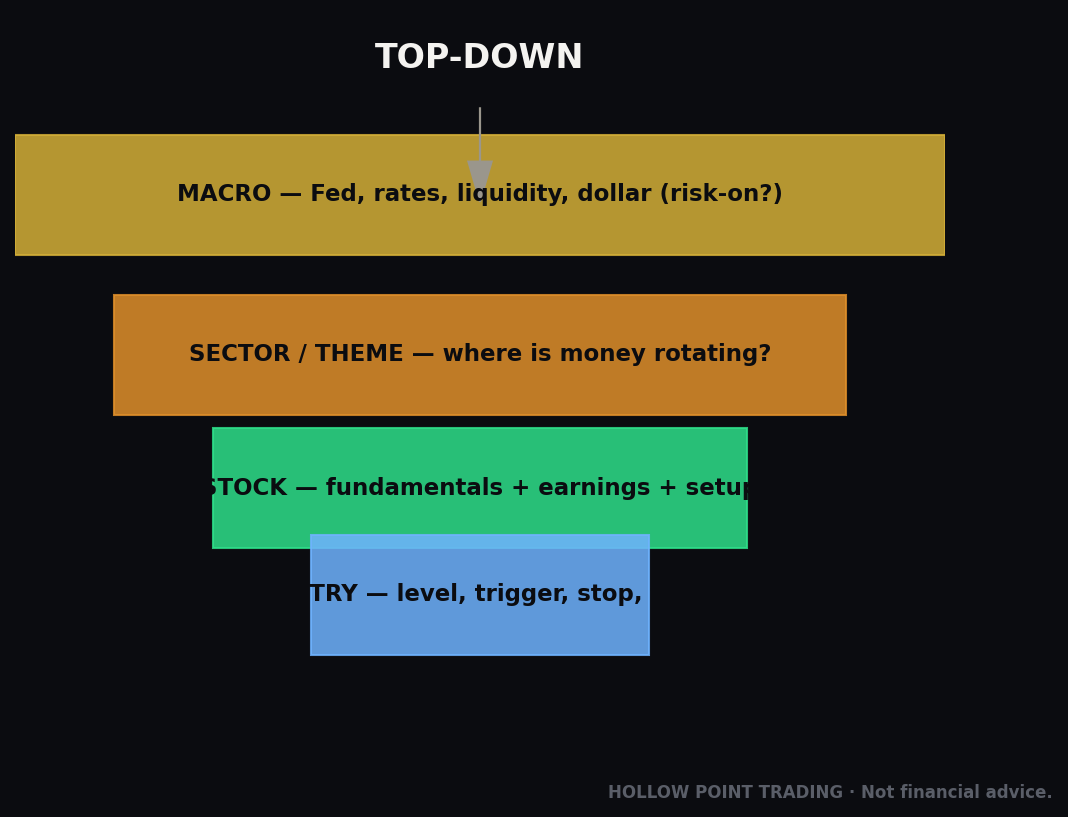
At Hollow Point, we think top-down: macro, then sector, then the individual stock. The covered call is a stock-level tool — it's the last step, not the first. Before you ever write a call, you should already have a view: Is the broad market calm or violent right now? Is this stock's sector in favor or out? Is this specific company something you want to own? The covered call doesn't replace that homework — it monetizes a position you've already decided to hold for good reasons.
The covered call is also the purest expression of our core belief: protect capital first, and let discipline beat prediction. Notice that the entire strategy is built around pre-deciding your outcomes. You choose the price you'd sell at before emotion enters. You collect certain cash instead of gambling on a maybe. You accept a capped, planned, known profit rather than chasing an unknown moonshot. That is the exact temperament that survives in markets. The covered call trains the discipline that everything else at Hollow Point depends on.
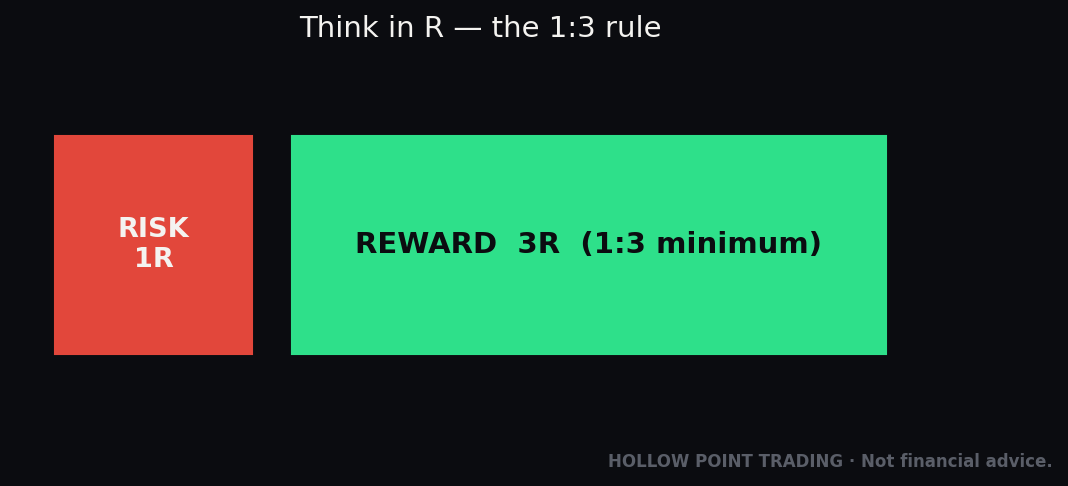
It also pairs naturally with our reward-to-risk mindset. Where our directional trades hunt for asymmetric setups — small defined risk chasing a much larger reward — the covered call plays the other side of the temperament: taking the small, certain reward when the setup is boring and there's nothing directional to chase. A complete trader needs both gears. You attack with disciplined risk when there's a real edge; you collect quiet rent when there isn't. Knowing which mode the moment calls for is the mark of a trader who lasts.
And finally, it's repeatable. Hollow Point is a rules-based house — we prize processes you can run again and again without heroics. The covered call is exactly that: a monthly, checklist-driven, low-drama routine you can execute the same way every single time. Own the shares. Check the boxes. Sell a strike you'd be happy with. Collect the premium. Let the outcome be one you already blessed. Then do it again next month. No prediction required. No hero trades. Just the patient, unglamorous accumulation of rent — which, compounded over years, is how quiet money gets built.
Start small. Sell one covered call, on 100 shares of a stock you already own and like, at a strike you'd be thrilled to sell at, about a month out. Watch all three outcomes become real and notice that you were fine in every one of them. That single experience will teach you more than a hundred more articles. Then repeat, size up slowly, and let the rent roll in.
You now know how to be a landlord in the stock market. Go collect.
Bound by rules, feared by trade.