
You have the read. You can see the wall, the flip, the level that breaks it. What you don't have is the account size to make that read pay a bill. That gap — between skill and capital — is the entire reason funded options trading exists.
A funded options account lets you trade a firm's money instead of your own. You prove you can trade inside a set of rules, the firm backs you with buying power you'd never front yourself, and you split the profits. Done right, it's leverage on your skill without leverage on your net worth. Done wrong, it's a subscription you pay monthly to fail an evaluation over and over.
This is the definitive reference. We'll build it the way HPT reads a chart — top down, macro to mechanism to the exact number that invalidates the trade. Every program prices its rules differently, so we'll frame everything generically: learn the structure, and you can drop any specific firm's numbers into the slots and know instantly whether the deal is good.
Part 1 — What a Funded Options Account Actually Is
The core deal in one sentence
A proprietary trading firm ("prop firm") gives you access to a trading account funded with its capital — or a simulated mirror of it — and in exchange for passing an evaluation and following its risk rules, you keep the majority of the profits you generate.
You are not borrowing money. You are not opening a margin loan. You never deposit trading capital and you can never lose more than the fees you paid to enter. The firm carries the downside; you carry the discipline. That asymmetry — capped personal loss, uncapped personal upside — is the whole product.
In options specifically, the firm is handing you buying power to trade contracts: calls, puts, spreads, and combinations on stocks, ETFs, indexes, or options on futures. Whether those are real live positions in a market or simulated fills against live data depends on the firm's model — and that distinction matters enormously, which we'll get to.
Why a firm would ever do this
Two reasons, and understanding both tells you how to survive.
First, evaluation fees are a business. Most retail-facing prop firms charge a monthly or one-time fee to attempt the evaluation. A large share of applicants fail — industry pass rates on the first attempt are widely reported in the single digits to low teens depending on the challenge. Those fees fund the operation. Be clear-eyed: for many firms, the eval fee funnel is a meaningful part of the revenue, and the rules are calibrated to be passable but not easy.
Second, skilled traders are genuinely valuable. A firm that finds a trader who compounds a $100k account at a steady clip and only asks for 20% of the profits has found a machine that prints money at scale. Firms want you to pass and stay funded — a funded trader who keeps producing is worth vastly more than one eval fee. The good firms mean it. The predatory ones treat funding as a lottery they never intend to pay.
Your job is to tell the two apart before you swipe a card.
The two capital models — read this before you pay anyone
Every funded-options offer sits on a spectrum between two poles.
The evaluation/simulated model. You trade a demo account fed by live market data. Your fills, your P&L, your drawdown are all simulated but tied to real prices. Pass, and you get a "funded" account — which is often also simulated, with the firm hedging or copying selected trades into the real market behind the scenes and paying you from a payout pool. This is the dominant retail model. It's cheap to enter, scales to thousands of traders, and your losses genuinely cost you nothing beyond the fee.
The real-capital/desk model. You trade actual live options in the market on the firm's account. This is closer to a traditional trading desk. It usually demands more — an interview, a track record, sometimes a licensing requirement or a refundable capital contribution/bond, and a real risk manager watching your book. The upside is real fills, real depth, and often better economics for a proven trader.
Most people reading this will start in the evaluation model. Neither is "fake" — but you must know which one you're in, because it changes what the rules mean. In a simulated funded account, "the firm's capital" is a promise to pay against a pool, not a brokerage statement with your name on it. That's fine if the firm pays reliably. Verifying payouts is the single most important piece of due diligence you'll do.
Part 2 — Funded Options vs Your Own Personal Account
Before the rules, understand what's structurally different from trading your own brokerage account, because the differences drive every decision that follows.
Capital and buying power
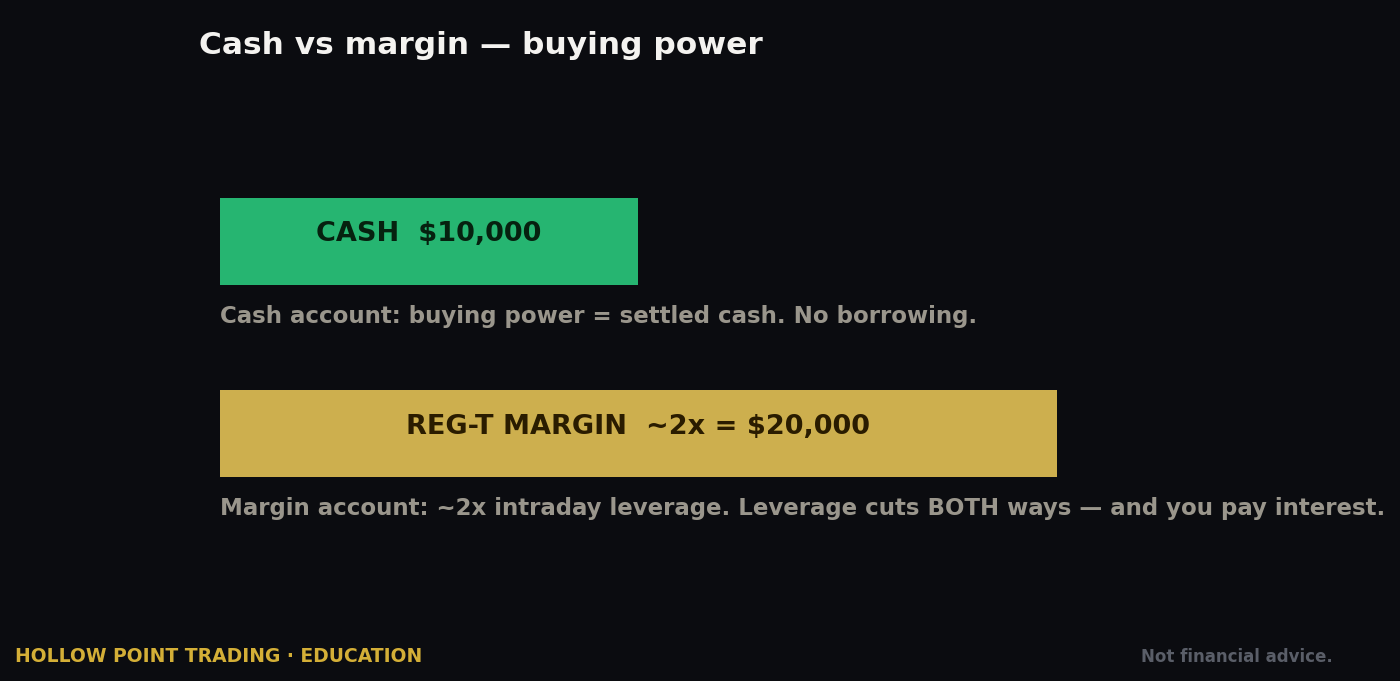
In a personal account you trade what you deposited (plus retail margin). A funded account hands you a size you likely couldn't or wouldn't stake yourself — commonly $25k, $50k, $100k, $150k, up to $500k+ on scaling plans. For options, firms often express this as buying power that can exceed the nominal account number, because defined-risk positions tie up less capital. A $100k account might carry effective buying power equivalent to several hundred thousand in retail margin on defined-risk structures.
Risk of ruin
This is the real gift. In your own account, a blowup is a blowup — your money is gone. In a funded account, the maximum you can lose is the fees you paid. The firm eats the trading loss. That cap changes the psychology completely: you can take a clean, well-sized setup knowing the worst personal outcome is "buy another evaluation," not "explain to your family where the savings went."
The trap is that this same safety can make traders reckless — treating the account as house money and oversizing. The firms know this. The rules exist precisely to weed out the ones who do.
Rules and freedom
Your own account has one rule: don't go to zero. A funded account has a rulebook — profit targets, drawdown floors, daily loss caps, consistency requirements, banned strategies, event restrictions. You trade a firm's account inside a cage. For a disciplined trader the cage is a feature, not a bug — it enforces the exact behavior that makes traders profitable. For an undisciplined one, the cage is where they die.
Structure, taxes, and ownership
You don't own the account. You can't withdraw the "capital," only your share of the profits. Payouts typically arrive as independent-contractor income (in the US, often a 1099), not capital gains — which can matter for your tax treatment versus trading a personal account. You also can't do whatever you want: many firms restrict copy-trading across multiple funded accounts, news-only trading, or automated strategies. Read those terms; violating them can void a payout you already earned.
Part 3 — The Evaluation: How You Actually Get Funded
The evaluation ("challenge") is a filter. It's a set of conditions you must satisfy over a period of trading to convert a paid attempt into a funded account. Here is every component, one mini-section each.
3.1 — The profit target
The headline number: reach a defined profit before you break a rule. Targets are usually expressed as a percentage of account size — commonly in the range of 6–10% for a one-step evaluation, sometimes split into two smaller stages for a two-step. On a $100k account an 8% target is $8,000.
Targets scale with account size. A representative ladder: ~$3,000 target on a $50k account, ~$9,000 on a $150k account. Bigger account, bigger target, bigger drawdown room — the ratios stay roughly constant.
The target is the easy part. Almost nobody fails an evaluation because they couldn't make money. They fail because of how they made it, or what they gave back doing it.
3.2 — The drawdown: the thing that actually fails you
Drawdown is the floor your account balance cannot fall below. Touch it and the evaluation (or the funded account) is over. This is the most important rule in the entire product, and it comes in flavors that behave completely differently. Know exactly which one you're under before you place a single trade.
End-of-day (EOD) drawdown
The floor is measured only at the market close each day. Intraday, you can dip below it and recover — what counts is where you end the session. EOD drawdown is far more forgiving for options traders, because option positions swing hard intraday on gamma and vega. A credit spread can look ugly at 11am and be fine by the bell. EOD rules let the position breathe.
Trailing / intraday drawdown
The floor follows your highest equity point, tick by tick, in real time. Reach a new equity high and the floor ratchets up with it, locking in a portion of your gains — but it never moves back down. Example: start at $100k with a $6k trailing drawdown, so the floor is $94k. Push equity to $108k and the floor trails to $102k. Now a drop back to $101k — still up $1k on the day — fails you, because you violated the trailing floor.
Trailing drawdown is the single most misunderstood, most lethal rule in the business. It rewards booking gains and punishes giving them back, but for options — where unrealized P&L gyrates violently intraday — it can end you on a position that was never actually losing money on a closing basis. If your firm uses a trailing intraday drawdown, you must trade as if the highest tick of your open P&L is a line you can't cross.
Static drawdown
The floor is fixed at a set dollar amount below your starting balance and never moves — not up with profits, not on the close. Start at $100k with a $4k static drawdown and the floor is $96k, permanently, until you scale the account. Static is the most predictable and, for many disciplined traders, the most comfortable. You always know exactly where the wall is.
The takeaway: the type of drawdown matters more than the size of it. A large trailing-intraday drawdown can be more dangerous than a small static one. Always ask, in order: Is it static, EOD, or trailing intraday? Where is the floor right now? Does it move?
3.3 — The daily loss limit (DLL)
Separate from total drawdown, a daily loss limit caps how much you can lose in a single day. Breach it and you're out even if your total drawdown is fine. It's the firm's circuit breaker against one revenge-trading session torching a good account. Some firms scale the DLL — e.g., setting it at a percentage of your largest winning day — so the harder you swing, the more rope you get, and vice versa.
Practically: the DLL should be your hard stop for the day. Lose it, you're done, log off. Traders who treat the firm's DLL as their personal limit rarely hit it, because they've already stopped themselves well above it.
3.4 — Minimum trading days
Most evaluations require a minimum number of active trading days (commonly 3–10) before you can pass or request a payout, even if you hit the target on day one. This exists to prove the result wasn't a single lucky lottery ticket. Some firms now offer 1-day-pass evaluations; treat those as a marketing feature, not a strategy — the consistency rules usually reappear on the funded side.
3.5 — The consistency rule
This is the rule that catches skilled traders off guard. A consistency rule caps how much of your total profit can come from a single day (or single trade). A common threshold: no one day may exceed 30–50% of your cumulative profit.
Worked example: your target is $8,000 and the consistency cap is 30%. That means no single day can contribute more than $2,400 (30% of the $8,000). If you make $5,000 on one monster day, you can't pass until your total profit grows enough that $5,000 is only 30% of it — you'd need roughly $16,700 total, more than double the target, before that one day is "consistent." The big day raises the bar you now have to clear.
The consistency rule forces steady, repeatable production over one hero trade. It's arguably the most important behavioral filter in the whole system, and it's exactly aligned with how a professional actually trades: many small, similar wins, not one lottery hit surrounded by chop. Some firms run no consistency rule on the evaluation, then impose one on the funded account (often in the 35–50% range) — read the funded terms, not just the eval terms.
3.6 — Time limits and activity rules
Older evaluations had a hard calendar deadline (e.g., 30 days) to hit the target. Many modern ones are unlimited time — you keep the subscription active and take as long as you need. Watch for inactivity rules, though: some firms reset or close accounts that go untraded for too long. And watch the cost structure — an unlimited eval with a monthly fee is only cheap if you pass quickly.
Part 4 — Buying Power: What You're Actually Given
The account "size" and your usable options buying power are not the same number, and conflating them gets people margin-called into a rule breach.
Notional vs cash
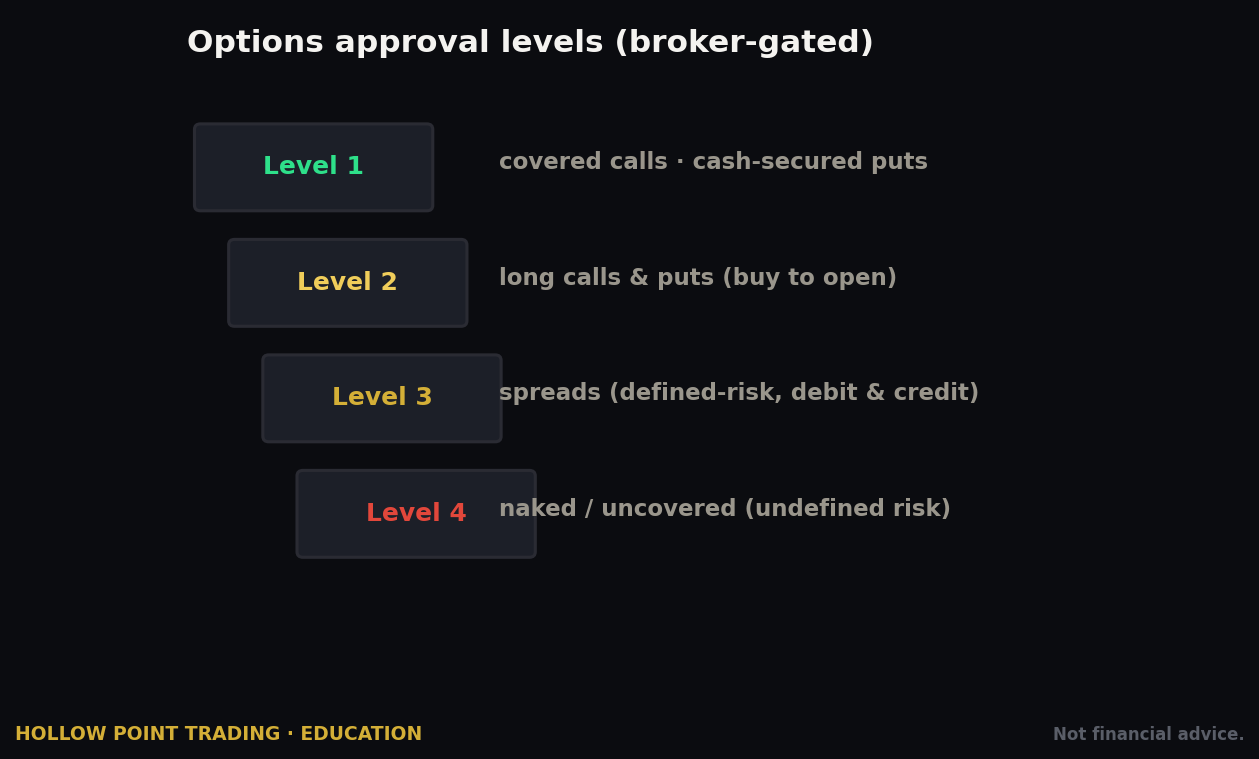
In options, buying power gets consumed differently depending on structure:
- Long options (debit) cost the premium. Buy a $3.00 call, you spend $300 per contract, full stop. Max loss is the premium.
- Defined-risk spreads (verticals, condors, flies) tie up only the width minus credit, or the debit paid. A $5-wide credit spread collected for $1.50 ties up ~$350 of buying power per contract and that's your max loss.
- Undefined-risk / naked positions consume margin that can be many multiples of the premium collected, because the theoretical loss is huge (or unlimited). This is where accounts get vaporized — and it's why most retail options prop firms restrict it.
A firm quoting "$100k buying power" is telling you how much margin you can deploy — which on defined-risk structures can control far more notional than a retail account with the same cash. That leverage is the point. It's also the rope you can hang yourself with.
Defined-risk multipliers and scaling
Because defined-risk positions cap the firm's exposure, firms often give generous size on them and tight or zero size on undefined risk. Expect explicit per-symbol and portfolio-level caps: max contracts per underlying, max premium at risk, max number of concurrent positions.
Scaling plans let your buying power grow as you prove yourself. Hit profit milestones and stay inside the rules, and the account steps up — $50k to $100k to $200k and beyond, sometimes to $500k+. The rules (targets, drawdown, DLL) scale proportionally. Scaling is where the real money is: the split matters far less on a $50k account than on the $400k one you earned by not blowing up the small ones.
Part 5 — Permitted Strategies: The Green Zone and the Red Zone
Options give you a hundred ways to express a view and a hundred ways to detonate an account. Firms permit the structures where they can bound the loss and restrict the ones where they can't. This is the section most guides skip and most traders get wrong.
The green zone — defined-risk structures
These have a mathematically capped maximum loss, so firms love them:
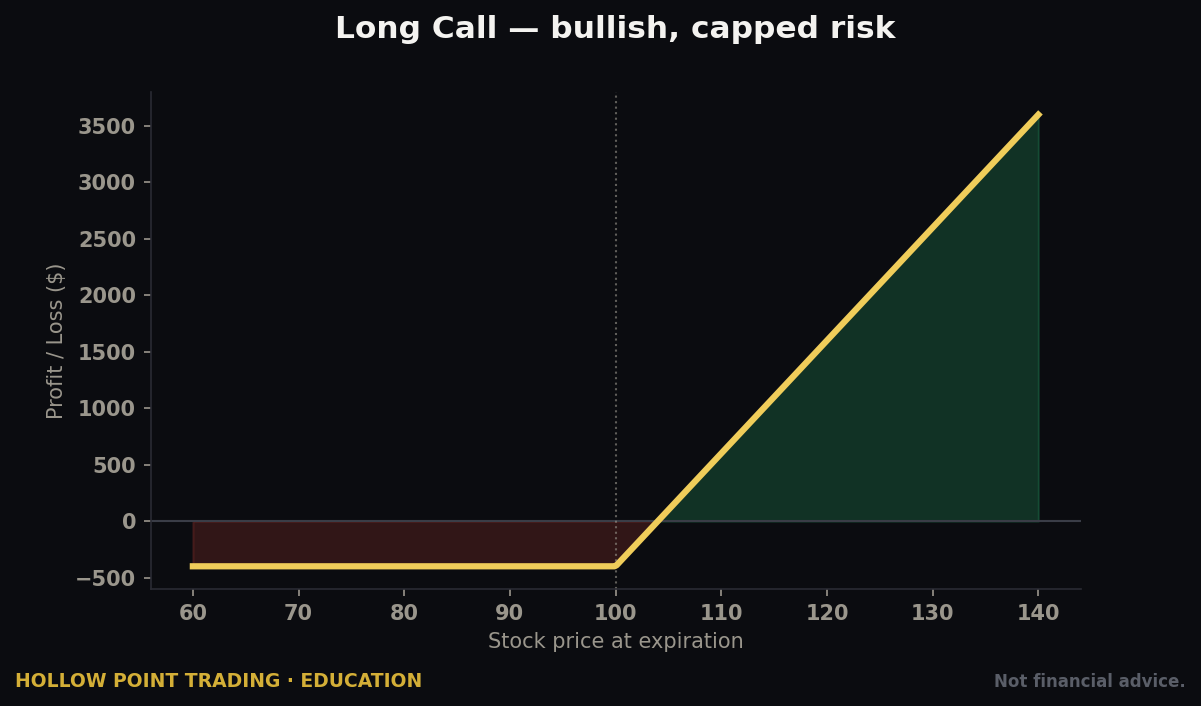
- Long calls / long puts — max loss is the premium.
- Vertical spreads (bull call, bear put, bull put, bear call) — max loss is width minus credit, or the debit.
- Iron condors and iron flies — defined on both sides; the bread and butter of premium-selling inside a cage.
- Debit and credit spreads generally — the firm knows the worst case to the penny.
- Calendars and diagonals — usually permitted, though the risk is less clean because it involves multiple expirations and vega.
If a firm has a "permitted overnight" list, it's almost always these defined-risk structures. They can hold through a gap because the gap can't exceed the defined max loss.
The red zone — undefined / naked risk
These carry large or theoretically unlimited loss and are the most restricted category across the industry:
- Naked short calls — unlimited upside risk. Very commonly banned outright, or allowed only intraday and only when hedged.
- Naked short puts — large downside risk (down to the strike). Often restricted, size-capped, or barred overnight.
- Short straddles/strangles (undefined) — short gamma bombs; frequently prohibited or heavily size-limited.
Many firms allow defined-risk short premium (condors, credit spreads) but restrict naked short gamma. A typical policy: defined-risk short premium is fine; naked short calls in single names are barred unless hedged intraday; size tightens hard around earnings. Assume undefined risk is off the table unless the rulebook explicitly permits it, and even then, treat it as the fastest way to fail.
Earnings and event rules
Holding a short-premium position through an earnings report is exactly the overnight gap risk a firm won't absorb for you. Expect one or more of: reduced size into earnings, a ban on holding undefined risk through the print, or a ban on opening new positions in a name within X days of its report. Index products (SPX, NDX) don't have single-name earnings risk, which is one reason index options are popular on funded accounts. Also watch macro events — FOMC, CPI, NFP — where some firms restrict new positions or size around the release.
Greeks limits and premium-at-risk caps
Real risk management shows up as portfolio- and symbol-level Greek limits: caps on net delta (directional exposure), vega (volatility exposure), and gamma (how fast your delta moves). You'll also see net premium-at-risk caps — the total dollars you can have exposed across the book at once. On a simple retail-style eval these may be implicit inside the buying-power number; on a real-capital desk they'll be explicit and monitored live. Either way, size so that a single adverse gap can't breach your daily loss limit.
Overnight, assignment, and expiration rules
- Overnight holds — permitted for defined risk at most firms, restricted for undefined risk. Some simulated firms bar all overnight holds and force flat by the close.
- Assignment / exercise — short options can be assigned, especially near expiration and around dividends (early assignment on short calls). Firms often require you to close short in-the-money options before expiration to avoid assignment mechanics they don't want to process.
- 0DTE and expiration-day risk — some firms embrace same-day-expiry index options; others restrict them because the gamma near expiry makes intraday drawdown wild. Check before you build a 0DTE strategy around a program that bans it.
Part 6 — The Payout: Profit Split and What You Actually Keep
You passed. You're producing. Now, what lands in your bank account?
The split
The headline number: your share of the profits. Common splits run 70/30 to 90/10 in the trader's favor, with some firms advertising 80/20 as standard, escalating to 90/10 or even 100% for top performers or after a scaling milestone. On an 80/20 split, $2,000 of monthly profit pays you $1,600.
Here's the uncomfortable truth the good analysts say out loud: the split is the least important payout number. A 90/10 split you can't actually access beats nothing, and an 80/20 split with fast, reliable, low-friction payouts beats a 95/5 split that never pays. Look past the headline.
Payout frequency and minimums
- How often can you withdraw? Weekly, bi-weekly, monthly, or on-demand after a waiting period. Faster is better — it de-risks the firm for you (you're pulling money out rather than leaving it in a pool).
- Minimum withdrawal. Some firms require a floor (e.g., you must have made at least $X before you can request). A high minimum on a small account can trap your money.
- First-payout waiting period. Many firms make you wait a set number of days or trading days after funding before the first withdrawal.
Buffers and thresholds
Some accounts include a profit buffer — you must build the account a certain amount above the starting balance before any profit is withdrawable (it acts as a cushion against your own future drawdown). Others pay from dollar one. A firm advertising "no buffer" is offering better economics if the other rules are fair.
The fine print that quietly eats your money
This is where reads get won or lost. Before you value any offer, price in:
- Activation/reset fees — some funded accounts charge a one-time activation fee after you pass.
- Rail/withdrawal fees — the payment processor's cut on each withdrawal.
- Consistency-on-payout rules — some firms apply the consistency cap to withdrawals, not just the eval, limiting how much you can pull at once.
- Minimum trading days before payout — the funded-side version of the eval rule.
- Drawdown reset on payout — on some models, withdrawing profit lowers your trailing drawdown floor proportionally, tightening your risk window. Know this before you pull money.
The net of split, frequency, minimum, buffer, and fees — not the headline percentage — is what you actually keep. Model it out before you commit.
Part 7 — How to Actually Pass: The Playbook
Everything above is the terrain. Here's how you cross it. This is where HPT lives: discipline over prediction, confluence over hope, the number that breaks the read defined before the trade.
7.1 — The single most important number: target ÷ drawdown
Before anything else, compute the ratio of your profit target to your total drawdown. If the target is $8,000 and the drawdown is $6,000, you have to make eight while never losing six — you have less room to be wrong than to be right. This ratio tells you how tight the rope is. A generous eval has drawdown comfortably larger than the target; a punishing one inverts it. Know your ratio before you place trade one.
7.2 — Size like the account is real, because your habits are
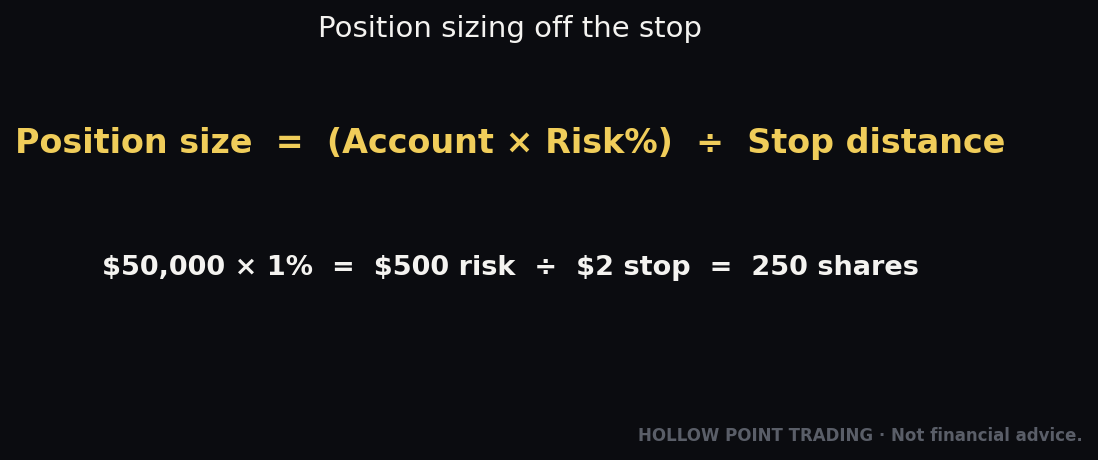
The cardinal rule: risk a small, fixed fraction per trade. The data across evaluations is blunt about this — traders who risk roughly 0.5% to 1% of the account per position post the highest pass rates. On a $100k account that's $500–$1,000 of defined risk per trade.
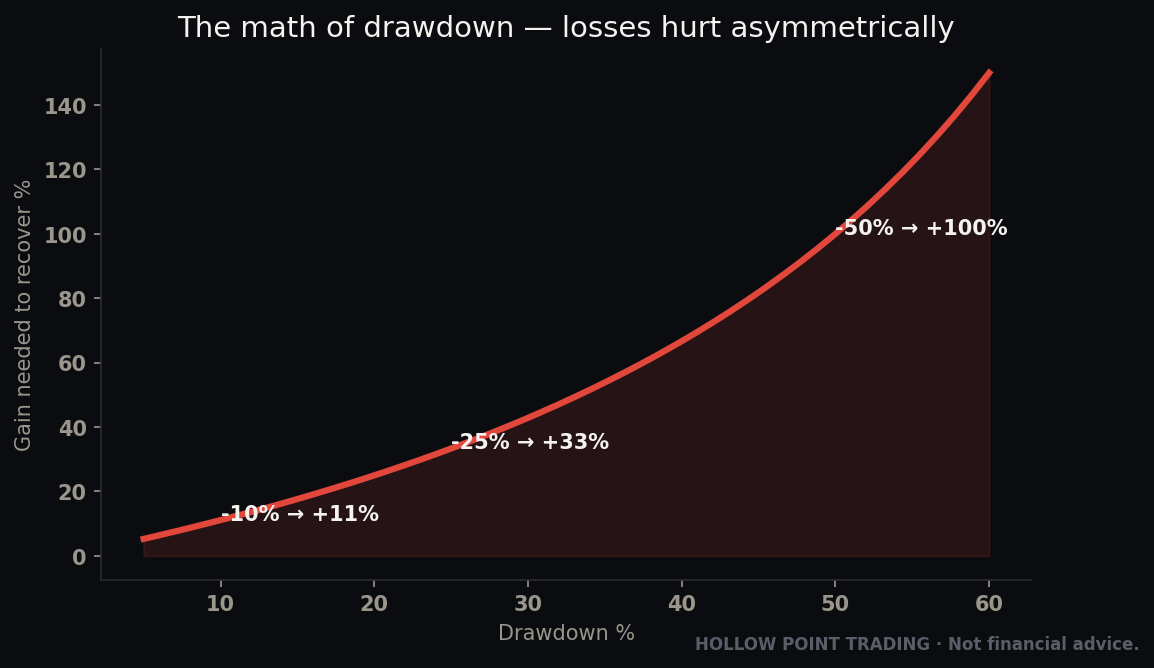
Do the arithmetic that follows from that. With a $6,000 drawdown and $600 of risk per trade, you can be wrong ten times in a row before you're out. Ten. That's a losing streak long enough that variance basically can't end you — only tilt can. Now compare the trader risking $2,000 per trade: three losers and they're done. Same skill, opposite outcome, decided entirely by sizing.
7.3 — Worked example: passing a $100k evaluation
Say the rules are: $8,000 target (8%), $6,000 trailing-EOD drawdown, $3,000 daily loss limit, 30% consistency cap, 5 minimum days, defined-risk only.
- Per-trade risk: $600 (0.6%). Max loss defined on every position — no naked anything.
- Consistency ceiling per day: to keep any single day under 30% of an $8k target, cap daily profit around $2,400. So you're not trying to hit a home run; you're trying to bank $800–$1,500 on a good day and go home.
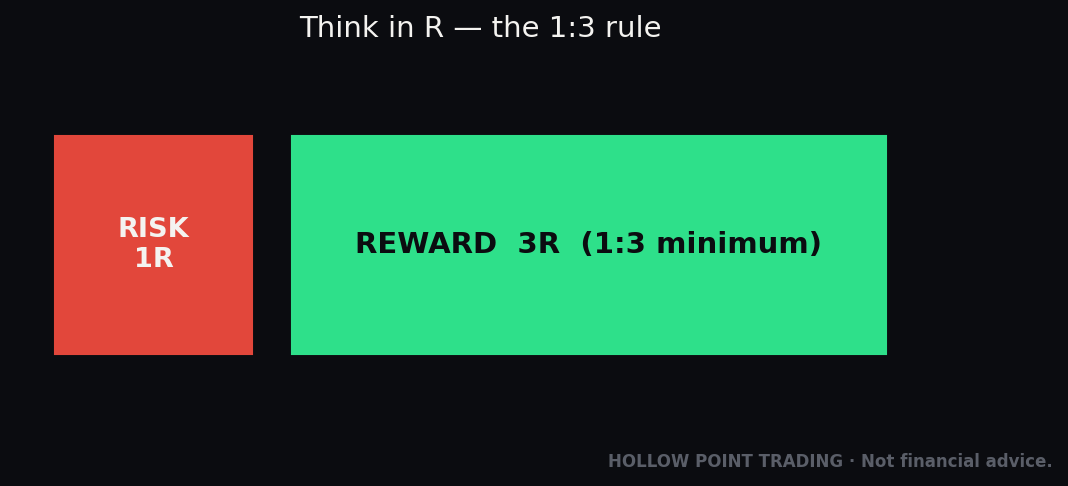
- The path: roughly 6–10 clean trading days, a handful of $600-risk trades a day at 1:3 R/R. Win rate of ~45% at 1:3 is comfortably profitable. A single 1:3 winner ($1,800) more than pays for two full losers ($1,200).
- The daily stop: two losers in a day ($1,200) and you're done — well inside the $3,000 DLL. You never let the firm's circuit breaker fire; yours fires first.
- Result: ~10–14 winning-net days, no single day over the consistency cap, drawdown never seriously threatened. Passed on production, not heroics.
That's the whole game. It is boring, and boring is the point. The evaluation is not a test of how much you can make — it's a test of whether you can be trusted with size. Prove trustworthy.
7.4 — Defined risk, always. No naked blowups.
The overwhelming majority of funded-account deaths are one oversized undefined-risk position gapping against the trader overnight or on an event. You eliminate that entire failure mode by trading defined-risk structures exclusively during the evaluation. Long options, verticals, condors — every one of them has a max loss you knew before you clicked. There is no version of "I didn't realize it could lose that much" in a defined-risk book. Adopt it as a hard rule and you've already beaten most of the field.
7.5 — Confluence as a filter, not a decoration
The HPT frame applies cleanly to options selection. You're choosing which setups to size into; make them the ones where multiple independent factors point the same way:
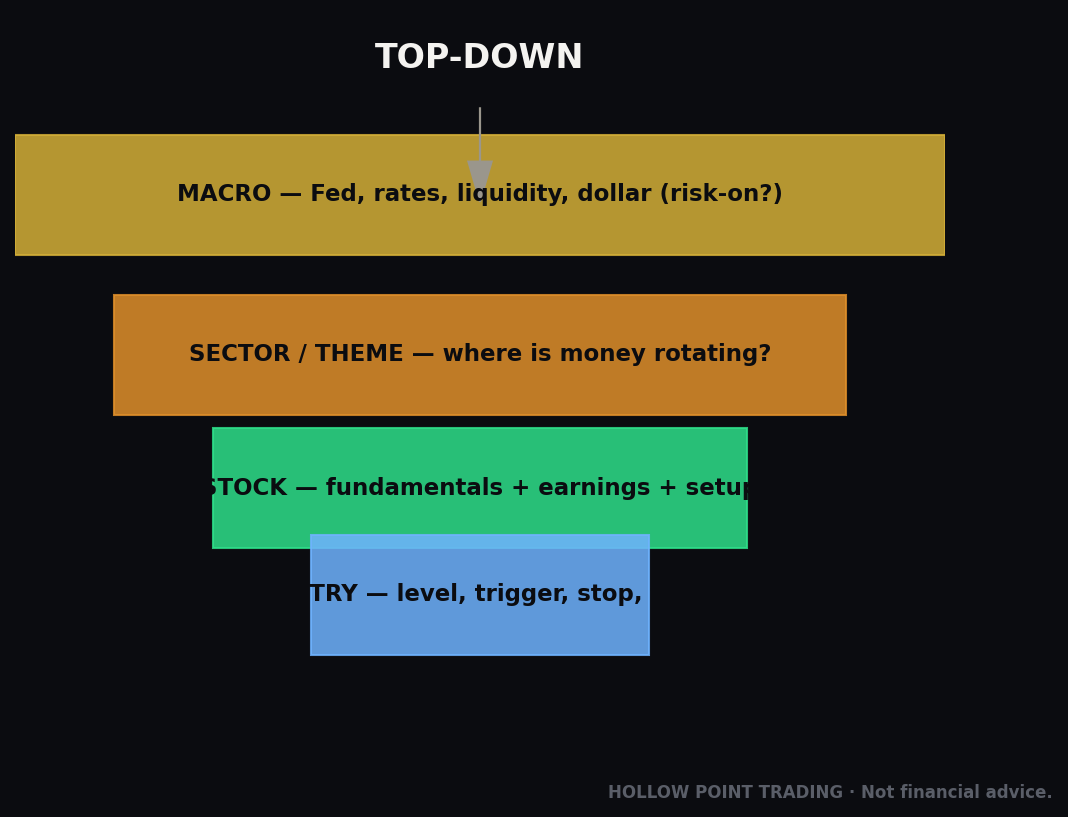
- Macro → sector → underlying. Is the broad tape (ES/SPX) with you? Is the sector leading or lagging its index? Is the specific name strong or weak relative to its sector? Trade the name that's confirmed at all three levels, not the isolated chart.
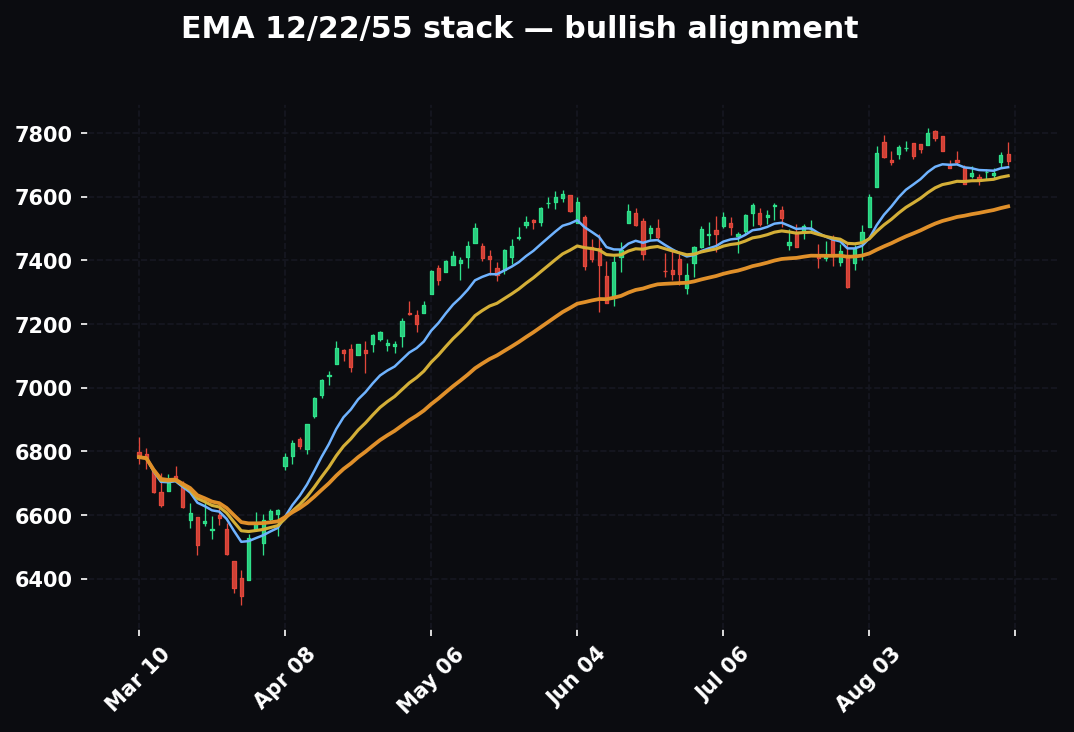
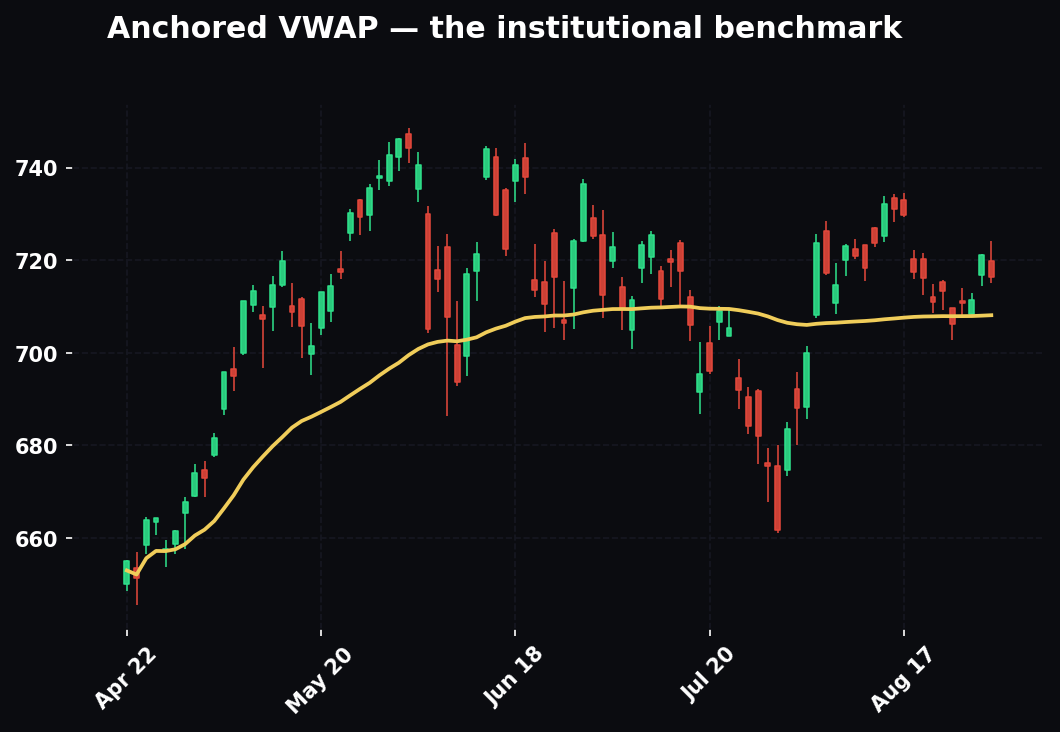
- EMA 12/22/55 structure. Use the HPT trend frame on the underlying: price stacked above a rising 12/22/55 is a long-side environment; the 55 is your bias tell. Buy calls / sell put spreads with the stack, not against it. A "505 rejection" — price rejecting the 55 EMA — is a countertrend caution flag, not an entry.
- Options positioning. Where are the call and put walls (high open-interest strikes)? Where's the gamma flip? Price tends to pin toward large gamma strikes into expiration and gets magnetized toward walls. Don't buy premium into a wall that's pinning; don't fade a level the dealers are defending. When GEX/positioning data is available, it's confluence; when it isn't, say so and lean on structure.
- Volatility regime. Is implied volatility rich or cheap versus realized? Rich IV favors defined-risk selling (spreads, condors); cheap IV favors buying (long options, debit spreads). Fighting the vol regime is how good directional reads still lose money on options.
When macro, sector, structure, positioning, and vol all agree — that's your size-up trade. When they conflict, that's a pass or a starter. Confluence isn't about being right more often; it's about only risking real size when the odds are actually stacked.
7.6 — Manage the trade like the drawdown is watching (because it is)
- Define the exit before entry — the price/level that invalidates the read is your stop, set before you're in.
- 1:3 R/R minimum. Structure positions so the target is at least three times the defined risk. At 1:3 you can be wrong more than half the time and still grind the account up. This is the math that makes a modest win rate pass an evaluation.
- Respect intraday drawdown if it's trailing. If your firm marks drawdown on the tick, your unrealized peak is a real line. Bank partials, don't let a winner round-trip into a rule breach.
- Stop when you've hit the day's number. Made your $1,000–$1,500 and stayed under the consistency cap? Log off. The best thing a funded trader does most days is nothing after the first good trade.
Part 8 — The Rules That Fail Most People
Ranked by how many accounts they quietly kill. Read this section twice.
- Trailing intraday drawdown, misunderstood. Traders anchor to their starting balance and forget the floor has ratcheted up under them. They're up on the day and still fail because equity rounded-tripped below the trailing high. Fix: always know where the floor is right now, and treat your peak unrealized P&L as a real line on trailing accounts.
- Oversizing. One position too big, one gap, one event — gone. The fix is the boring 0.5–1% rule. Almost every blowup traces back to size, not to being wrong.
- The consistency rule. A monster day that raises the bar you now can't clear, or a payout blocked because one day was too large a share of profit. Fix: cap your daily profit target so no day dominates.
- Naked / undefined risk through an event. A short call or short put held through earnings or a macro print, gapping past the strike. Fix: defined risk only; flatten undefined risk before events; know the event calendar.
- The daily loss limit + revenge trading. One bad trade becomes five as the trader tries to "get it back," and the DLL fires. Fix: your personal stop sits above the firm's DLL, and you honor it.
- Trading right up against the drawdown floor. Taking a full-size trade with only a few hundred dollars of room left. Fix: when you're near the floor, size down or stop — never take a normal-size trade with abnormal-small room.
- Banned-strategy / rule violations that void payouts. Copy-trading across accounts, prohibited instruments, holding through a barred event, hedging across accounts — technically-earned profit voided on a terms breach. Fix: read the entire rulebook, once, carefully, before you trade.
- Ignoring the funded-side rules. Passing the eval under lenient rules, then breaching a stricter funded-account rule (a consistency rule that only appears post-funding, a tighter drawdown). Fix: read the funded terms before you pay for the eval.
- Fee bleed. Failing and re-buying evaluations repeatedly, paying more in fees than you'd ever make. Fix: if you can't pass on a demo with defined risk and small size, more attempts won't fix a process problem — the process will.
Part 9 — Pros and Cons vs Trading Your Own Capital
Straight, both barrels.
The case for funded
- Capped personal downside. Worst case is the fee. Your net worth is never on the line for a trade.
- Size you couldn't self-fund. Six-figure buying power on a modest fee. Skill leverage without balance-sheet leverage.
- Enforced discipline. The rules are a professional risk framework. For many traders the cage makes them better.
- Scaling. Prove yourself and the size grows, compounding your edge on someone else's balance sheet.
- A ceiling on tilt. The DLL and drawdown physically stop a bad day from becoming a catastrophic one.
The case against / the honest costs
- You don't keep it all. The split takes 10–30% of your production, forever.
- You don't own the account. No capital to withdraw, only profit share. The relationship can end at the firm's discretion per the terms.
- Recurring fees until you pass — and if your process isn't ready, that's a real, repeated cost.
- The rule cage cuts both ways. Strategies that work in your own account (naked premium, big swing sizing, holding through events) may be banned. You trade their way.
- Counterparty risk. In the simulated model you depend on the firm actually paying. A firm that changes rules, delays payouts, or folds can cost you earned money. Your own brokerage account can't refuse to pay you your own money.
- It doesn't fix a bad trader. Funding amplifies whatever you already are. No edge, no funding will save you — it just fails you faster and cheaper.
The synthesis: funded trading is a capital and discipline solution for a trader who already has an edge but not the size. It is not a skill solution. If you're profitable small with defined risk, funding is leverage on that skill. If you're not, funding is a more expensive way to learn the same lesson.
Part 10 — Funded Options vs Futures Prop Firms
Most of the retail prop world was built for futures traders. Options funding borrows that structure but differs in ways that matter. If you're choosing a lane, read this.
Where they're the same
Evaluation with a profit target, drawdown floors, daily loss limits, consistency rules, profit splits, scaling plans, simulated-then-live models. The skeleton is identical. Everything you learned above about drawdown types and consistency applies to both.
Where options funding differs
- Buying power is expressed in margin/notional, not contracts. Futures firms give you a max-contract count on a linear instrument. Options firms give you buying power that behaves differently across strategies — defined-risk ties up little, undefined risk ties up a lot — so your "size" isn't one number, it's per-structure.
- Greeks and premium-at-risk replace tick-based risk. Futures risk is linear and easy to bound: one tick is one fixed dollar amount. Options risk is non-linear — delta, gamma, vega, theta, and IV all move your P&L. Options firms manage that with Greek limits and premium caps rather than simple stop distances. Your risk math is harder and more important.
- Strategy restrictions are heavier and more nuanced. Futures firms mostly worry about size and overnight/news holds. Options firms additionally police structure (defined vs naked), earnings/event exposure, assignment, and expiration mechanics. There's simply more that can go wrong, so there are more rules.
- Access can be harder for real listed options. For genuinely live listed equity/index options, the serious path often runs through desk-style firms with interviews, possible licensing, or a capital bond. The most accessible on-ramp to options-style exposure is frequently options on futures through an established futures prop firm — you get the prop structure you know, on an instrument the firm already knows how to risk-manage. That's often the practical starting point.
- Overnight/gap behavior is wilder. An options position can gap far more violently than a futures position on the same news, because of leverage and IV crush/expansion. That's why event rules on options accounts are stricter.
Which should you choose?
If you think in levels, direction, and momentum and want the simplest possible risk math, futures funding is the cleaner box. If you think in probabilities, volatility, defined-risk structures, and want to express nuanced views (defined-risk premium selling, spreads, condors, directional debit spreads with capped loss), options funding fits your brain — just respect that the rulebook is denser and the risk is non-linear. Many HPT-style traders run both: futures for clean directional plays, options for defined-risk premium and event-structured trades. The discipline framework — macro→sector→structure, 1:3, small fixed risk, defined loss — is identical across both.
Part 11 — Due Diligence: Choosing a Program Without Getting Farmed
Before you pay any firm, run this checklist. This is the part that protects your money.
- Do they actually pay? Search for verified payout proof — not affiliate reviews, real trader receipts and independent forums. A firm with no credible payout history is a fee farm until proven otherwise.
- What's the drawdown type? Static / EOD / trailing intraday — and where's the floor? This one answer changes everything about how you'll trade.
- What's the target-to-drawdown ratio? Compute it. Punishing ratios (target ≥ drawdown) are far harder than they look.
- Consistency rule — eval AND funded? Know both numbers. Many firms hide a stricter funded-side rule.
- Permitted strategies for YOUR style. If you trade defined-risk spreads, confirm they're allowed overnight. If you trade 0DTE index, confirm it's permitted. If your edge is banned, the account is useless to you.
- Event policy. Earnings, FOMC, CPI — what can you hold, and when are you barred from opening?
- The full payout math. Split × frequency × minimum × buffer − fees. Model the net, ignore the headline.
- Fees and resets. Eval cost, activation fee, reset cost, withdrawal rails. Total cost of one full attempt.
- Real capital or simulated? Neither is disqualifying; you just need to know which, and (if simulated) how reliably they pay.
- Rule-change history. Firms that frequently tighten rules mid-stream on funded traders are a yellow flag. Look for stability.
If a program passes all ten, it's worth an attempt. If it fails on payouts or dodges the drawdown-type question, walk.
Part 12 — Quick-Reference Cheat Sheet
Bookmark this. Everything above, compressed.
WHAT IT IS
- Trade the firm's capital (real or simulated), pass an eval, split the profits. Max personal loss = the fee. You never own the account, only your profit share.
THE EVALUATION — the five gates
- Profit target — ~6–10% of account (e.g., $8k on $100k). The easy part.
- Drawdown — the killer. Know the type:
- Static = fixed floor, never moves. Most predictable.
- EOD = measured at close only. Forgiving for options.
- Trailing intraday = floor ratchets up with your equity high, on the tick. Lethal — treat your peak unrealized P&L as a hard line.
- Daily loss limit — single-day cap. Your personal stop sits above it.
- Consistency rule — no one day > 30–50% of total profit. A big day raises the bar. Cap your daily profit.
- Minimum trading days — usually 3–10. Proves it wasn't luck.
BUYING POWER
- Expressed as margin/notional, not cash. Defined-risk ties up little; naked ties up a lot. Scales with milestones ($50k→$100k→$200k→$500k+).
STRATEGIES
- Green (allowed): long options, verticals, iron condors/flies, debit/credit spreads, calendars — all defined-risk.
- Red (restricted/banned): naked short calls (unlimited risk), naked short puts, short straddles/strangles. Undefined risk = off the table unless explicitly permitted.
- Events: flatten undefined risk before earnings/FOMC/CPI. Index options avoid single-name earnings risk.
PAYOUT
- Split 70/30 → 90/10+ in your favor. But the split is the least important number.
- What actually matters: payout frequency, minimum withdrawal, buffer, consistency-on-payout, and fees. Model the NET.
HOW TO PASS
- Risk 0.5–1% per trade, defined loss every time.
- 1:3 R/R minimum — modest win rate still passes.
- Compute target ÷ drawdown before trading. Know your rope.
- Cap daily profit under the consistency ceiling. Bank and log off.
- Personal daily stop above the DLL. No revenge trades.
- Confluence: macro → sector → underlying, EMA 12/22/55 stack, options positioning (walls/gamma flip), vol regime (rich IV → sell defined risk; cheap IV → buy). Size up only when they agree.
TOP RULES THAT FAIL PEOPLE Trailing drawdown misread · oversizing · consistency rule · naked risk through events · DLL + revenge trading · trading against the floor · terms/strategy violations voiding payouts · funded-side rules stricter than eval · fee bleed.
OPTIONS vs FUTURES PROP
- Same skeleton (target, drawdown, DLL, split, scaling).
- Options differ: margin/notional buying power, Greek + premium limits, heavier strategy/event rules, harder access to live listed options. Most accessible options-style on-ramp = options on futures via a futures firm.
DUE DILIGENCE (do this first) Verify payouts · drawdown type & floor · target/drawdown ratio · consistency (eval + funded) · your strategy permitted? · event policy · full payout math · total fees · real vs simulated · rule-change history.
The read is the same read it always is: know exactly what breaks you before you risk a dollar, size so no single trade can break you, and let confluence — not conviction — decide when you press. A funded account doesn't change that. It just hands you a bigger lever and a stricter rulebook, and rewards the trader who was already going to follow the rules anyway. Be that trader. The capital will find you.
Bound by rules, feared by trade.
Not financial advice.