
Every trade you will ever make passes through one piece of infrastructure: your brokerage account. You can have the cleanest read on the tape, perfect confluence across the EMA 12/22/55 stack, a 1:3 setup begging to be taken — and none of it matters if your broker fills you badly, buries the order ticket, denies you the options level you need, or freezes your buying power on a settlement technicality. The broker is the plumbing. Most traders spend months studying charts and about eleven minutes choosing the account that executes them. That is backwards, and this guide fixes it.
This is the definitive reference. We go from the macro question — what actually is a broker and how does it make money off you — down to the exact taps on your first stock order and your first options order. Read it once end to end, then bookmark it and come back to the cheat sheet.
One standing caveat before we start: broker UIs change constantly. Menu names move, fee schedules get revised, approval questionnaires get reworded. Every fee and feature here was verified in August 2026, but treat specific button labels as "look for something like this," not gospel. The concepts are permanent. The pixels are not.
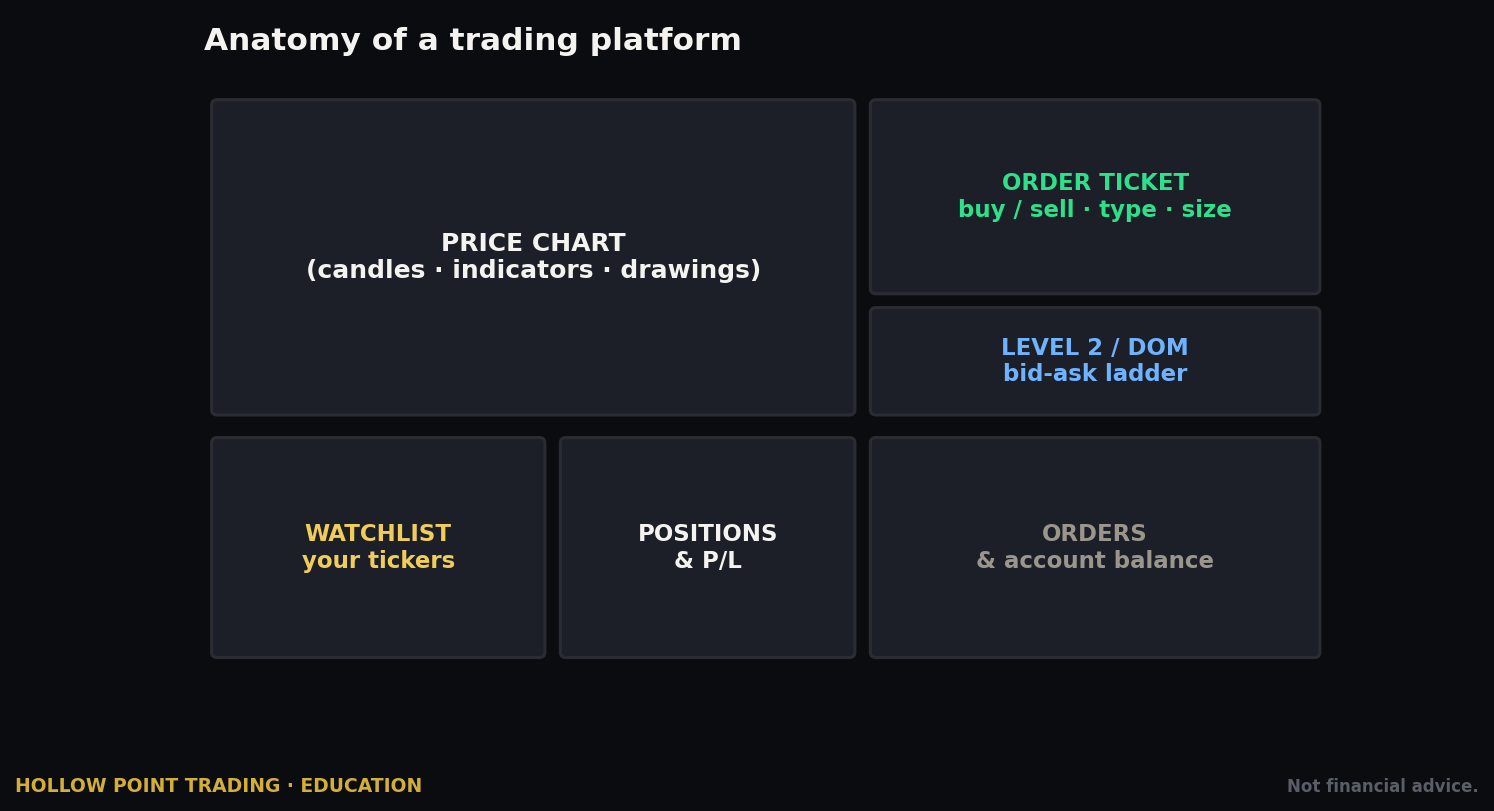
Part 1 — What a Broker Actually Is (and How It Gets Paid)
A brokerage is a licensed intermediary that holds your money and securities and routes your buy/sell instructions to a market where they get matched with a counterparty. You are not trading "on Robinhood." Robinhood is carrying your order to a venue — an exchange like Nasdaq or the NYSE, or a wholesale market maker — where the actual trade happens. Understanding how the broker gets paid for carrying that order tells you almost everything about whose interests it serves.
The four ways a "free" broker makes money
Commission-free trading is real, but the broker is not a charity. Revenue comes from somewhere, and each source has a different implication for you.
1. Payment for order flow (PFOF). When you hit buy, your broker can sell the right to fill your order to a wholesaler — Citadel Securities, Virtu, Susquehanna — who pays the broker a fraction of a penny per share, or a few cents per options contract. The wholesaler makes money on the spread and hopes to fill you slightly better than the public quote (that's "price improvement") while still netting a profit. PFOF is legal and disclosed, but it means your broker's revenue is tied to sending your order to whoever pays them the most, not necessarily whoever fills you best. For a swing trader buying 100 shares, the practical cost is pennies. For a high-frequency options scalper doing size, execution quality is real money.
2. Net interest on your cash. Your uninvested cash sits in a sweep. The broker earns interest on it and, depending on the program, passes you little or a lot. In a higher-rate environment this is enormous revenue — legacy brokers make a fortune on lazy cash.
3. Margin interest. When you borrow to trade, you pay the broker interest. Rates range from brutal (double digits at the app brokers on small balances) to institutional (low single digits at Interactive Brokers).
4. Subscriptions and premium tiers. Robinhood Gold, Webull's data packages, upgraded margin rates, Level 2 data, research. Recurring revenue the broker loves.
The takeaway: "commission-free" describes one line item. The total cost of ownership is commissions plus contract fees plus the spread you eat on bad execution plus the interest you don't earn on cash plus margin rates. HPT rule: measure the whole cost, not the headline.
PFOF vs. the alternative
Two brokers explicitly don't take PFOF on stocks: Fidelity and Interactive Brokers (on its Pro tier). Their argument is that without the incentive to sell flow, they route for best execution. Whether that's worth it depends on how you trade. If you're placing marketable orders in size, or you care about every basis point, it matters. If you're a position trader taking a handful of fills a week, the difference is noise. Know that the trade-off exists; don't be dogmatic about it either direction.
Part 2 — How to Choose a Broker: The Seven Screens
Run every candidate broker through these seven screens in order. Macro to micro, exactly like reading a market: start wide, narrow to the decision.
Screen 1 — Regulation and safety
Non-negotiable and first. The broker must be a member of FINRA and registered with the SEC, and it must carry SIPC insurance, which protects up to $500,000 in securities (including a $250,000 cash sub-limit) if the broker fails — note that's custodial protection, not protection against your trades losing money. Most large brokers carry excess-SIPC private insurance above that. Verify membership on FINRA BrokerCheck. If a platform can't show you these, close the tab.
Screen 2 — What you can actually trade
Match the instrument to your strategy. Stocks and ETFs: everyone. Options: nearly everyone, but approval and tooling differ wildly. Futures: only some (Interactive Brokers, tastytrade, Schwab/thinkorswim, E*TRADE via Morgan Stanley). Index options, futures options, crypto, bonds, international shares, fractional shares — all vary. If you trade NQ futures, half the list is dead on arrival regardless of how pretty the app is.
Screen 3 — Fees, in full
- Stock/ETF commission: $0 essentially everywhere now.
- Options per-contract fee: the number that actually matters for options traders. Ranges from $0 (Webull, Robinhood on some tiers) to $0.65 (Fidelity, Schwab, E*TRADE base) with tastytrade's capped $1-to-open/$0-to-close model as the outlier.
- Regulatory pass-throughs: tiny per-contract and per-sale fees (the Trading Activity Fee, the options regulatory fee, the SEC Section 31 fee on sales). Unavoidable, a few cents, charged by everyone.
- Margin rate: varies by an order of magnitude. Check it if you'll ever borrow.
- Everything-else fees: wire transfers, outbound account transfers (ACAT, often $75), broker-assisted trades, paper statements, and — the sneaky one — contract fees on index options, which many "free" brokers still charge ($0.50ish).
Screen 4 — Options approval ceiling
Covered in depth in Part 5. The short version: if you intend to sell cash-secured puts, run spreads, or eventually trade naked, confirm the broker will approve you for the level you need. Some are generous; some make you climb.
Screen 5 — Platform and tools
Be honest about who you are. A mobile-first scalper and a multi-monitor spread trader need opposite things. The spectrum runs from Robinhood's deliberately minimal app to thinkorswim and IBKR's Trader Workstation, which are effectively cockpits. More power means more surface area to fumble under pressure. The best platform is the one whose order ticket you can drive without thinking when price is moving against you.
Screen 6 — Execution quality
Beyond PFOF philosophy, brokers publish Rule 605/606 reports on execution quality and routing. You don't need to become a market-structure quant, but if you trade actively, price improvement statistics are a real differentiator. IBKR built its brand on it.
Screen 7 — Everything human
Customer service (phone hold times matter the day your account is frozen), funding speed, account minimums, mobile app stability, research and data, and educational content. tastytrade and thinkorswim, notably, are as much teaching platforms as brokers.
Part 3 — Account Types: Cash, Margin, and Retirement
The type of account changes what you can do more than most beginners realize. Same broker, different account, completely different rules.
Cash account
You trade only with money you actually have. No borrowing. Simple, safe, and — historically — the way sub-$25k traders sidestepped the pattern-day-trader rule. The one gotcha is settlement (Part 4): sell a stock and the cash isn't reusable until it settles, one business day later. Trade too fast in a cash account and you trigger a good-faith violation or free-riding flag for spending unsettled funds; rack those up and the broker restricts you to settled cash only for 90 days.
Margin account
The broker lends you money against your securities as collateral. Two superpowers and two dangers:
- Superpower 1 — leverage. Reg T allows up to 2:1 on most stocks (50% initial margin). $10,000 cash controls up to $20,000 of stock.
- Superpower 2 — no settlement wait. Proceeds are immediately reusable, and this is the real reason most active traders use margin even when they never borrow a dime. You can also short sell, which requires a margin account.
- Danger 1 — the margin call. If your equity drops below the maintenance requirement (typically 25%, often higher per-broker or per-stock), the broker demands more cash or liquidates your positions — sometimes without warning, sometimes at the worst possible tick.
- Danger 2 — magnified losses. Leverage cuts both ways. A 2:1 position halves the move that wipes you.
The 2026 rule change you need to know: the old pattern day trader (PDT) rule — which froze margin accounts under $25,000 to three day trades per five business days — was eliminated effective June 4, 2026. The $25k minimum and the "pattern day trader" label are gone, replaced by a modern intraday-margin framework; the floor to hold a margin account reverts to the long-standing $2,000. Traders who repeatedly run intraday deficits still face restrictions under a new 90-day freeze mechanism, so the discipline requirement didn't disappear — it just stopped being a hard $25k wall. This is a genuinely big deal for small accounts and exactly the kind of thing that will keep evolving, so verify current status with your broker.
Retirement accounts (IRA)
Tax-advantaged wrappers, not a different market.
- Traditional IRA — contributions may be pre-tax; you're taxed on withdrawal in retirement.
- Roth IRA — contributions are after-tax; qualified withdrawals are tax-free. The trader's favorite when young, because decades of gains come out untaxed.
- Rollover IRA — parking spot for an old 401(k).
- SEP / SOLO 401(k) — for the self-employed, higher contribution limits.
The catch for active traders: IRAs are cash accounts by regulation. No borrowing on margin, no naked short options, no true shorting of stock. You can get "limited margin" at some brokers (Fidelity, Schwab, IBKR) that waives the settlement wait so you can trade actively without good-faith violations — but it's not leverage. Options in an IRA typically cap at covered calls, cash-secured puts, and defined-risk spreads (level 2, sometimes 3). No naked calls, ever. Great for compounding a long-term book with income overlays; wrong tool for leveraged day trading.
Part 4 — Funding, Settlement, and Buying Power
Getting money in
- ACH transfer — link your bank, pull cash in. Free, but the first deposit often has a hold (a few days) before it's tradable, and there's a 90-day rule where recently deposited funds can't be withdrawn (anti-fraud).
- Wire transfer — same-day, but the sending bank usually charges $15–30. Use it when speed matters.
- ACAT transfer — moving an entire account in kind from another broker (positions intact). Takes about a week; the delivering broker often charges a $75 exit fee, which the receiving broker will frequently reimburse if you ask.
- Instant deposits — app brokers front you buying power immediately against a pending ACH. Convenient, and a great way to overtrade before the money is even real.
Settlement — the rule that quietly ruins new cash-account traders
When you sell, the trade doesn't finalize instantly. It settles. As of May 2024, U.S. equities settle T+1 — one business day after the trade. Options also settle T+1.
Why you care: in a cash account, proceeds from a sale aren't reusable until settlement. Sell stock Monday, the cash is genuinely available Tuesday. Spend it Monday and you've bought with unsettled funds — a good-faith violation. Three strikes in 12 months and you're locked to settled cash for 90 days. Margin accounts don't have this problem — proceeds are immediately reusable — which is the everyday reason active traders choose margin even when they never borrow.
Buying power vs. cash
Cash balance is what you have. Buying power is what you can deploy right now. In a cash account they're roughly equal (minus unsettled funds). In a margin account, buying power is typically 2x your equity for overnight stock positions and can be 4x intraday for day trades under the new intraday-margin framework. Options buying power is calculated differently again — defined by the risk/margin requirement of the specific position. Never confuse the big buying-power number for money you own. It's rope. Leverage is rope. You decide whether it's a ladder or a noose.
Part 5 — Every Order Type, Explained
The order ticket is where reads become positions. Master every type; the difference between a market and a limit order is sometimes the difference between a good trade and a disaster.
The four foundational orders
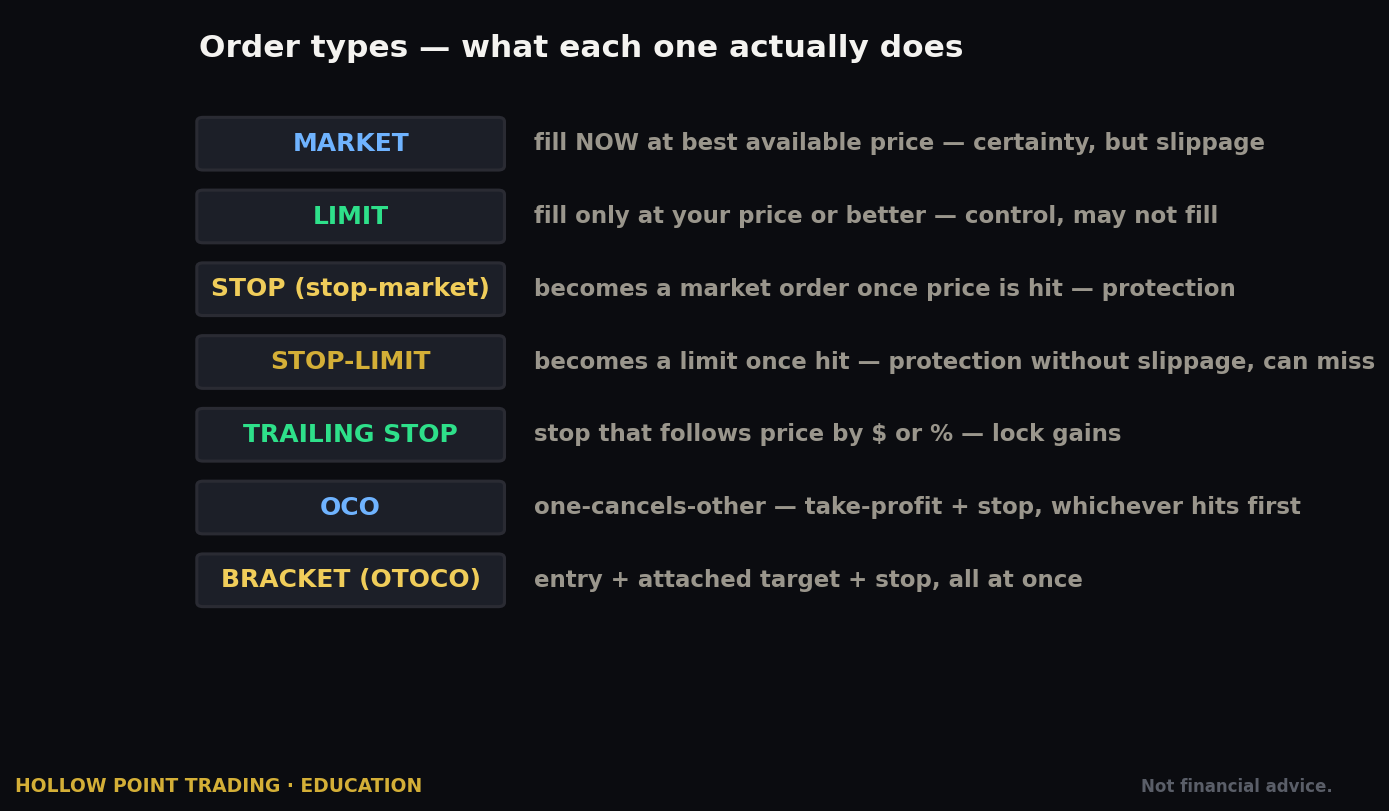
Market order. "Fill me now, at whatever the best available price is." Guarantees execution, not price. Fine for large, liquid names in regular hours. Dangerous in thin names, fast tape, or pre/post market, where the spread can be wide and you can get filled far from where you saw the quote. On options especially, a market order into a wide bid/ask is a self-inflicted wound.
Limit order. "Fill me at this price or better, never worse." Guarantees price, not execution — if the market never trades to your limit, you don't get filled. This is the default professional order. On options, always use limits; the spreads are too wide to trust a market order. Set your limit at the mid or work it toward your side.
Stop (stop-market) order. A resting instruction: "when price touches my stop level, send a market order." Used to cut losses or protect profit. The danger: it becomes a market order when triggered, so in a gap or a fast flush you can be filled well past your stop. Your stop is a trigger, not a guaranteed exit price.
Stop-limit order. "When price touches my stop, send a limit order at my specified limit." Protects against slippage — but if price blows through your limit, you don't get filled at all and you're still holding the loser. Stop-limits protect your price at the risk of protecting you right out of an exit. Choose stop vs. stop-limit deliberately: stop = "get me out no matter what," stop-limit = "get me out only if I can get a decent price."
Worked example — stop vs. stop-limit
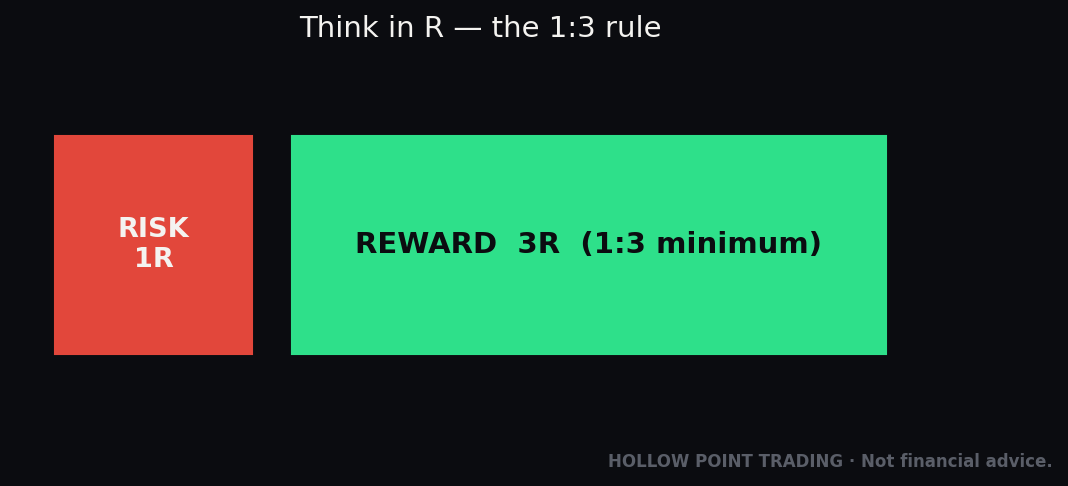
You're long a stock at $100.00, risking to $97.00, targeting $109.00 — a clean 1:3 (risk $3 to make $9).
- Stop-market at $97.00: bad earnings gap opens the stock at $94.50. Your stop triggers and fills near $94.50. You lost $5.50, not $3. Slippage hurt, but you're out.
- Stop-limit, stop $97.00 / limit $96.50: the stock gaps to $94.50 and never trades back to $96.50. Your order sits unfilled. You're still long, now down $5.50 and still exposed.
Neither is "better." The stop guarantees escape at an uncertain price; the stop-limit guarantees a price you may never get. On a hard-stop risk-management exit, most traders take the market stop and accept slippage as the cost of certainty.
Advanced and conditional orders
- Trailing stop. A stop that follows price by a set distance ($ or %) as it moves your way, locking in gains while giving room to run. Trails up on longs, never down.
- OCO (One-Cancels-Other) / bracket. Two resting orders — a profit-target limit and a stop-loss — where filling one auto-cancels the other. This is how you set your 1:3 at entry and walk away. Bracket orders (entry + target + stop as one package) are the disciplined trader's best friend: your exit rules are locked before emotion arrives.
- OTO / OTOCO (One-Triggers-Other). An entry that, once filled, triggers the bracket. Full automation of a plan.
- Trailing stop-limit. As above but with a limit — same unfilled-order risk.
- Time-in-force qualifiers — attached to every order:
- DAY — expires at the close if unfilled.
- GTC (Good-'Til-Canceled) — persists across days (brokers cap it, often 60–90 days).
- IOC (Immediate-Or-Cancel) — fill what you can instantly, cancel the rest.
- FOK (Fill-Or-Kill) — all of it instantly or none.
- GTD (Good-'Til-Date) — expires on a date you set.
- Extended-hours / pre-post — routes into pre-market or after-hours sessions (limit orders only, thinner liquidity).
Confluence: orders and the HPT framework
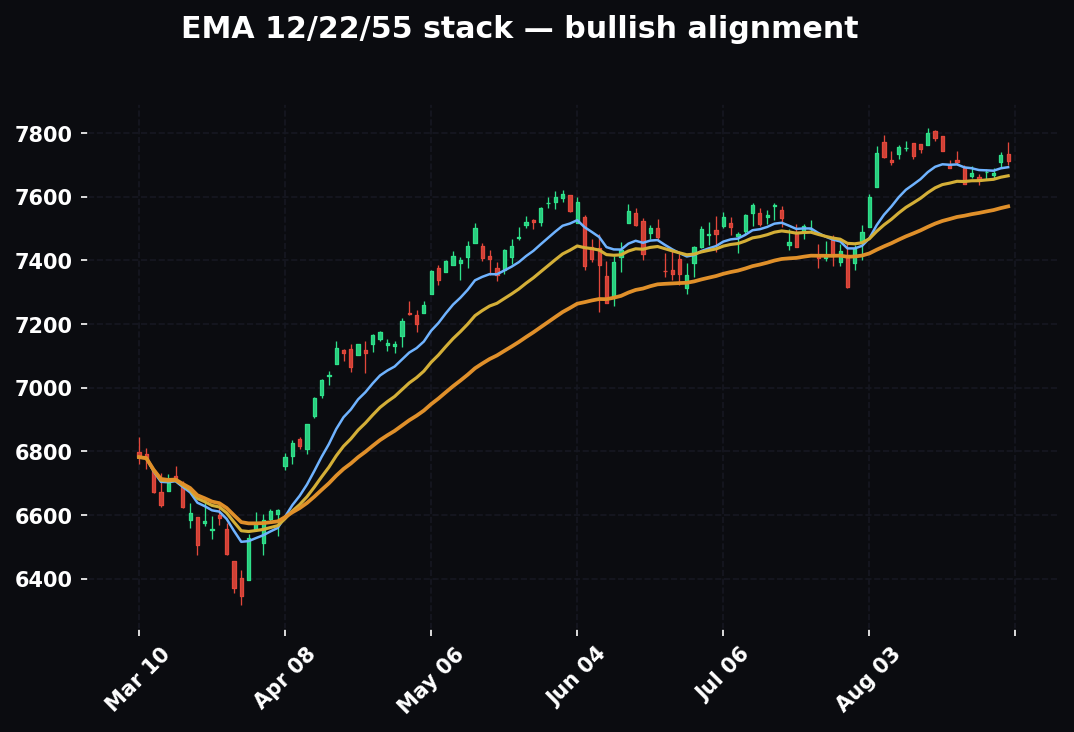
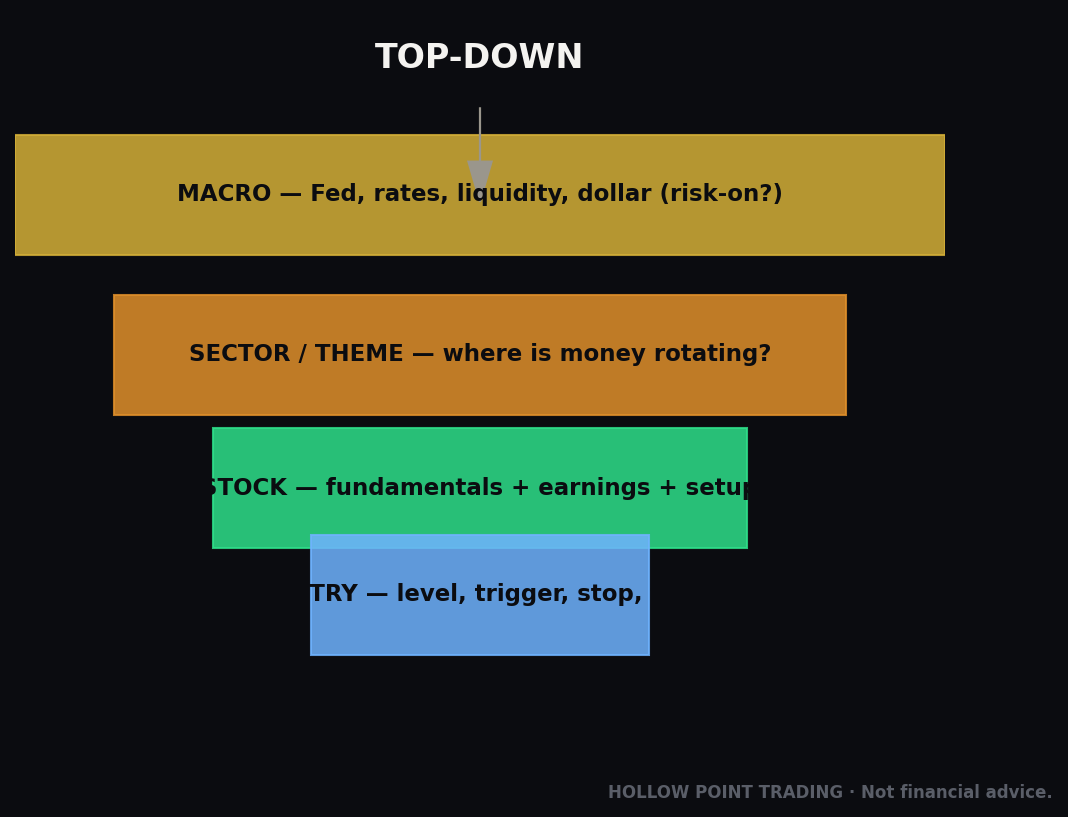
An order type isn't just mechanics — it enforces the plan. The 1:3 R/R mandate lives in the bracket order: define your invalidation (the stop) and your target before you enter, and let OCO hold you to it. The EMA 12/22/55 read tells you where the stop belongs — under the 55 on a daily-bias long, not at some random round number. Discipline over prediction means the order ticket, not your feelings, exits the trade. If you can't state your stop price out loud, you don't have a trade — you have a hope. Build the exit into the order and the market can't talk you out of it.
Part 6 — Options Approval Levels
You don't just "trade options." The broker grades you and unlocks strategies in tiers based on a questionnaire about your income, net worth, experience, and objectives. Level names vary by broker (0–3, 1–4, "tiers," "levels"), but the ladder is universal because it maps to risk. Higher level = more ways to lose money faster = more scrutiny.
The universal ladder
Level 0 / entry — long-only, fully covered. Covered calls (you own 100 shares, sell a call against them) and cash-secured puts (you set aside the cash to buy 100 shares if assigned). Defined, collateralized risk. Some brokers fold this into Level 1.
Level 1 — covered strategies. Covered calls, cash-secured puts, protective puts, collars. Risk is capped by an asset you already hold. Easy approval; a beginner with a real income answer clears it.
Level 2 — long options (the level most retail traders live at). Buying calls and puts outright, plus the covered stuff. Your max loss on a long option is the premium paid — defined risk. This is where directional trading happens: buy a call on a bullish read, a put on a bearish one. Straightforward approval for anyone with a pulse and a modest net worth.
Level 3 — spreads (defined-risk multi-leg). Vertical spreads (debit and credit), iron condors, calendars, butterflies. You're both buying and selling options, so risk is defined by the width of the spread minus credit. Level 3 almost always requires a margin account and, at many brokers, evidence you've actually traded Level 2. This is the workhorse level for serious options traders — spreads are capital-efficient and let you sell premium with a hard-capped loss.
Level 4 — naked / uncovered selling. Selling calls or puts without the underlying or the cash to cover — naked calls carry theoretically unlimited loss. Requires the largest account, the most experience, and the highest margin. Brokers gate this hard, and rightly so.
How to actually get approved (and up-leveled)
The questionnaire is a risk assessment, not a test you can fail by being honest. Answer truthfully — but understand that stated experience, income, net worth, liquid net worth, and objective ("speculation" vs. "income") all feed the decision. Selecting the most aggressive objective and understating nothing gets you further. If you're denied a level, most brokers let you re-apply after you've logged trades at the level below. tastytrade and IBKR tend to be generous up-leveling active traders; the legacy shops can be stickier.
HPT note on discipline: just because you're approved for naked selling doesn't mean you should touch it. Approval is a permission, not a strategy. Most durable options income lives at Level 3 — defined-risk spreads, sized to survive being wrong, structured to your 1:3. Level 4 is where accounts blow up in a single overnight gap. Feared by trade means respected by risk.
Part 7 — The Major Brokers, Head to Head
Fees verified August 2026. Options per-contract fee is the number that separates them; stock commissions are $0 across the board. UIs and fee schedules change — reverify before you fund.
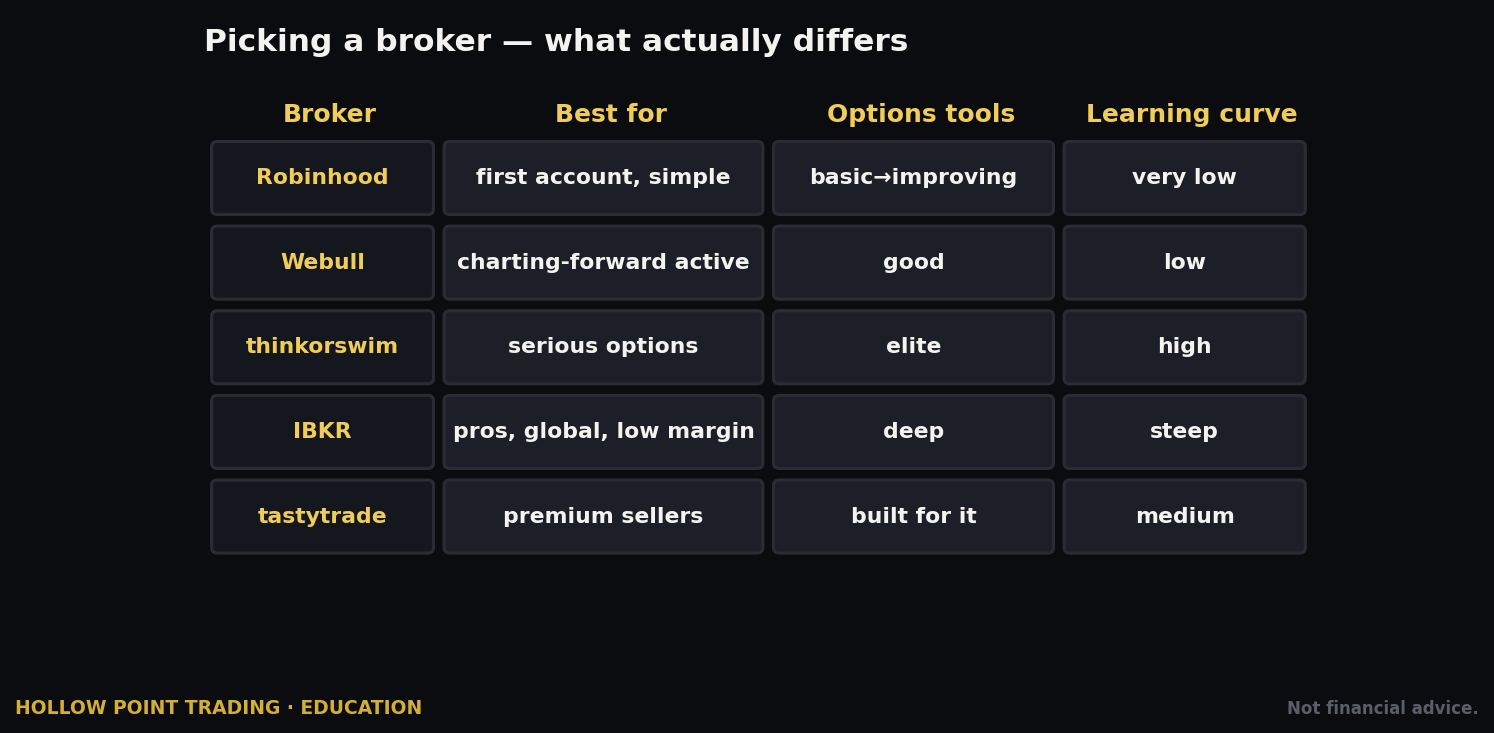
Robinhood — the frictionless on-ramp
- Options: ~$0.50/contract standard, ~$0.35 for Gold members (plus regulatory pass-throughs); pricing has shifted around, so confirm current schedule. Approval Levels 0–3; Level 3 wants a margin account and prior Level 2 activity.
- Platform: the cleanest, simplest app in the business — and that's the point and the problem. Minimal friction means minimal safety rails.
- Best for: absolute beginners buying their first shares, small-account directional options traders who want zero clutter.
- Watch for: thin research, historically thin support, an interface engineered to make trading feel like a game. The ease is a feature and a hazard.
Webull — the app that grew teeth
- Options: $0 commission and $0 contract fee on stock/ETF options; index options ~$0.50/contract. Genuinely one of the cheapest.
- Platform: far more analytical than Robinhood — real charting, Level 2 data, a desktop app, paper trading. Mobile-first but grown up.
- Best for: the trader who's outgrown Robinhood but still lives on mobile; cost-sensitive options traders.
- Watch for: PFOF-driven execution; support and research still trail the legacy giants.
Charles Schwab / thinkorswim — the professional's default
- Options: $0.65/contract. Not the cheapest, and worth it for many.
- Platform: thinkorswim (desktop, web, mobile) is arguably the best retail trading platform ever built — institution-grade charting, analysis, backtesting (thinkBack/OnDemand), and a genuine options lab. Regularly tops "best overall" rankings. Backed by Schwab's research, service, and balance sheet.
- Best for: serious options and active traders who want one platform to grow into for a decade; anyone who values world-class tools and support over shaving contract fees.
- Watch for: the $0.65 fee adds up at high contract volume; thinkorswim's depth is a learning curve.
Fidelity — the trust anchor
- Options: $0.65/contract.
- Platform: Active Trader Pro is solid, not flashy. The real story is everything around trading: no PFOF on stocks, best-in-class cash management, elite research, famously good customer service, and rock-solid custody. Fractional shares, strong retirement tooling.
- Best for: long-term investors and swing traders who want a bulletproof home for real money, with options as a secondary activity; anyone consolidating a full financial life.
- Watch for: the trading platform, while good, isn't thinkorswim; not the cheapest for high-volume options.
Interactive Brokers (IBKR) — the professional's professional
- Options: IBKR Pro tiered from ~$0.65 down to ~$0.15/contract at volume; IBKR Lite offers a fixed rate on the first 1,000 contracts/month. Lowest margin rates in the industry, by a mile. No PFOF on Pro — routes for best execution.
- Platform: Trader Workstation (TWS) is a cockpit — everything, everywhere, all at once. Global markets (stocks, options, futures, forex, bonds in dozens of countries), the deepest product access retail can get.
- Best for: advanced and high-volume traders, anyone using margin heavily, futures and international traders, quants using the API.
- Watch for: TWS is intimidating; the tiered pricing and account structure reward sophistication and punish the casual. Overkill for a beginner buying 10 shares.
ETRADE / Power ETRADE (Morgan Stanley) — the balanced veteran
- Options: $0.65/contract, dropping to $0.50 at 30+ trades/quarter; the Dime Buyback Program lets you close short options positions priced at $0.10 or below with no contract fee — a real edge for premium sellers buying back cheap shorts.
- Platform: *Power ETRADE** is a genuinely excellent, underrated options platform — clean strategy building, risk/reward visualization, fast ticket. Backed now by Morgan Stanley.
- Best for: options traders who want thinkorswim-adjacent power with a friendlier learning curve; premium sellers (that Dime Buyback perk).
- Watch for: two platforms (classic ETRADE vs. Power ETRADE) can confuse newcomers; $0.65 base fee.
tastytrade — built by and for options sellers
- Options: the outlier — $1.00/contract to open, $0 to close, capped at $10 per leg. Trade 50 or 100 contracts and you still pay $10 to open. Multi-leg (an iron condor = 4 legs) is $10 to open, $0 to close. For size and premium selling, the cheapest model in existence; for one-lot directional trades, that $1 is pricier than the free apps.
- Platform: purpose-built for options — probability of profit, buying-power-reduction, and mechanical strategy tools front and center. Plus one of the best free options educations anywhere (the founders literally invented thinkorswim before this).
- Best for: high-volume options sellers, spread traders, anyone who wants to learn premium-selling mechanics from the people who wrote the book.
- Watch for: the $1-to-open stings for tiny directional bets; it's an options-first shop, less about buy-and-hold investing.
Quick verdict
- First account ever / simplest: Robinhood or Fidelity.
- Best free options fees: Webull.
- Best all-around serious platform: Schwab/thinkorswim.
- Best home for long-term real money: Fidelity.
- Best for advanced/high-volume/margin/futures/global: Interactive Brokers.
- Best for premium-selling options at scale: tastytrade (and E*TRADE's Dime Buyback for closing shorts).
The honest truth: for most people, any of these executes a stock trade identically. The differences show up when you trade options seriously, use margin, or need the platform to be a career tool. Choose for who you'll be in two years, not just today.
Part 8 — How to Place Your First Trades
Enough theory. Here's the actual sequence. Labels vary by broker — look for the concept.
Placing your first stock trade
- Fund and confirm buying power. Deposit via ACH, wait out any hold, confirm your available buying power (not just cash balance).
- Find the ticker. Search the symbol. Confirm it's the right company on the right exchange.
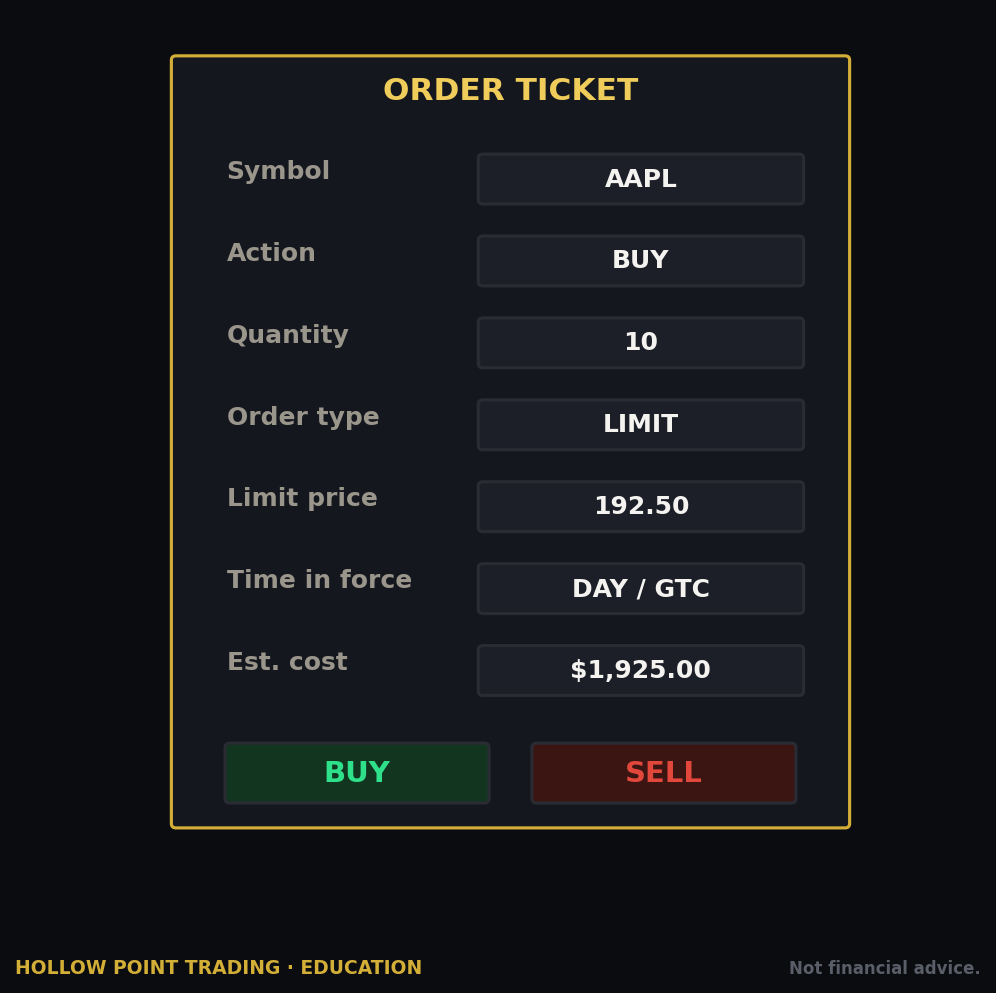
- Open the order ticket. Hit Trade / Buy.
- Choose Buy, and set quantity. Number of shares (or a dollar amount if using fractional).
- Choose your order type. Beginners: use a limit order. Set a price at or near the current ask. A market order works in a liquid name during regular hours, but a limit means no ugly surprise fill.
- Set time-in-force. DAY for a normal order; GTC if you want it to rest across days.
- Set your exit before you're in. The disciplined move: attach a bracket — a target and a stop — so your 1:3 is locked. If your broker doesn't bracket on entry, place the stop immediately after the fill. Don't hold a naked position with no exit plan.
- Review and submit. Check symbol, side, quantity, price, cost. Confirm.
- Manage. Watch the fill. Let the bracket do its job. Don't babysit-and-fiddle a plan you already set.
Placing your first options trade
Assumes you're approved for at least Level 2. We'll buy a single call — the simplest defined-risk directional trade.
- Confirm your approval level. Level 2 buys long calls/puts.
- Pull up the options chain for your underlying. You'll see expiration dates across the top and strikes down the side, split calls/puts, each with a bid, ask, and last.
- Pick an expiration. Longer-dated = more time, more premium, slower theta decay. Beginners: avoid same-week expiries; give the thesis room.
- Pick a strike. At-the-money = near current price (higher premium, higher delta). Out-of-the-money = cheaper, lower probability. Understand that you're buying 100 shares of exposure per contract and paying premium × 100 in dollars.
- Choose Buy to Open. (Closing later is Sell to Close.)
- Set quantity in contracts. One contract = 100 shares of underlying.
- USE A LIMIT ORDER. Options spreads are wide; a market order can cost you dearly. Set your limit at or near the mid between bid and ask and work it.
- Check the total debit. Premium × 100 × contracts = your maximum loss. That defined risk is the whole appeal of a long option — you can't lose more than you paid.
- Review and submit. Symbol, expiration, strike, call/put, buy-to-open, contracts, limit price, total cost. Confirm.
- Plan the exit. Options have two enemies stocks don't: time decay (theta) eroding value every day, and expiration — an out-of-the-money option expires worthless. Know your profit target and your "I'm wrong, get out" price before you enter. Consider closing before expiration week to dodge accelerating theta and assignment risk.
Confluence: the trade is the plan, not the fill
Placing the order is the last five percent. The 95% is the read that got you there: macro backdrop → sector strength → the stock's own structure → the EMA 12/22/55 telling you the trend → confluence stacking → a defined invalidation → a 1:3 or better payoff. The broker just executes it. A perfect order ticket on a garbage setup is still a garbage trade. Do the work upstream; let the platform be dumb and fast.
Part 9 — Common Mistakes and Failure Cases
- Market orders on options or thin stocks. The single most common self-inflicted loss. Wide spread + market order = instant slippage. Limit orders, always, on options.
- Chasing "commission-free" and ignoring the real costs. Bad execution, contract fees, dead cash, and margin rates dwarf the $0 headline. Measure total cost.
- Good-faith violations in a cash account. Spending unsettled funds three times locks you out for 90 days. Know your settled balance or use a margin account.
- Treating buying power as money you own. Margin buying power is rope. The 4x intraday number is not your net worth.
- Getting approved for a level you shouldn't trade. Naked selling approval doesn't obligate you to blow up. Approval ≠ strategy.
- No stop on the ticket. Holding a position with no defined exit is not trading; it's gambling with extra steps. Bracket every entry.
- Ignoring assignment and expiration. Short options can be assigned; long options expire worthless. Manage before expiration week.
- Picking a platform you can't drive under pressure. If you fumble the ticket when price moves, you have the wrong platform or you haven't practiced. Paper trade the ticket until it's muscle memory.
- Over-relying on instant deposits. Trading money that isn't really there yet is how small accounts overextend.
- Never reading the fee schedule or the 606 report. Ten minutes of reading saves months of leakage.
The margin-call failure case, concretely: you're 2:1 long a volatile name, it gaps down 20% on news overnight, your equity drops below maintenance, and the broker liquidates your positions at the open — the worst tick — without asking. You didn't choose the exit; leverage chose it for you. That is the difference between using margin as a tool and being used by it.
Part 10 — The Cheat Sheet
Choosing a broker — the 7 screens: Regulation (FINRA/SEC/SIPC) → Instruments you trade → Fees in full → Options approval ceiling → Platform fit → Execution quality → Service & funding.
Account types:
- Cash — no borrowing, subject to T+1 settlement, no PDT concerns.
- Margin — 2:1 overnight / up to 4x intraday, instant reusable proceeds, can short, exposed to margin calls. $2,000 minimum; the old $25k PDT rule was eliminated June 4, 2026 (verify current framework).
- IRA — tax-advantaged, cash-account rules, "limited margin" waives settlement but not leverage; options usually cap at Level 2–3, no naked calls.
Settlement: Stocks & options T+1 (one business day). Cash accounts must wait for settled funds; margin accounts don't.
Order types:
- Market — fills now, price uncertain. Liquid names only.
- Limit — your price or better, may not fill. Default for options.
- Stop (market) — triggers a market order at your stop; certain exit, uncertain price.
- Stop-limit — triggers a limit; certain price, may not fill.
- Trailing stop — follows price by a set distance.
- OCO / Bracket — target + stop, one cancels the other. Set your 1:3 here.
- OTO / OTOCO — entry triggers the bracket.
- TIF: DAY, GTC, IOC, FOK, GTD, extended-hours.
Options approval ladder:
- L1 — covered calls, cash-secured puts, protective puts.
- L2 — buy calls/puts (defined risk = premium). Most retail lives here.
- L3 — spreads (defined-risk multi-leg); usually needs margin.
- L4 — naked selling (undefined risk); heavily gated.
Broker one-liners (options per-contract fee, verify current):
- Robinhood — ~$0.50 (~$0.35 Gold); simplest app, beginners.
- Webull — $0; cheapest, mobile-first, grown up.
- Schwab/thinkorswim — $0.65; best all-around pro platform.
- Fidelity — $0.65; best home for long-term real money, no stock PFOF.
- Interactive Brokers — ~$0.65→$0.15 tiered, lowest margin rates; advanced/global/high-volume.
- ETRADE/Power ETRADE* — $0.65 ($0.50 active); Dime Buyback for closing shorts.
- tastytrade — $1 open / $0 close, $10/leg cap; premium sellers at scale.
Placing a stock trade: Fund → find ticker → Buy → quantity → limit order → TIF → attach bracket (target + stop) → review → submit → let the plan run.
Placing an options trade: Confirm level → open chain → pick expiration → pick strike → Buy to Open → contracts → limit at the mid → confirm total debit = max loss → submit → plan the exit before theta and expiration bite.
The three rules that outrank every fee comparison: (1) Measure total cost, not the $0 headline. (2) Never send an options order without a limit. (3) Never enter without a defined stop and a 1:3 target on the ticket. The broker executes; you manage the risk.
The broker is not your edge. Your process is your edge — macro to sector to stock, the EMA 12/22/55 read, confluence stacked, 1:3 or pass, discipline over prediction. The broker is the instrument that plays it. Choose the one that gets out of your way, learn its order ticket cold, and let it do exactly what you tell it and nothing more.
Bound by rules, feared by trade.
Not financial advice.
TAGS: #Brokers #BrokerageAccounts #HowToTrade #OptionsTrading #OrderTypes #MarginAccount #CashAccount #IRAInvesting #Robinhood #Webull #thinkorswim #Fidelity #InteractiveBrokers #tastytrade #EtradE #OptionsApprovalLevels #TradingBasics #PFOF #T1Settlement #RiskManagement #HollowPointTrading