
Imagine you walk into a bakery in January and the baker says, "I'll sell you a wedding cake for your June wedding, and we'll lock the price at $300 right now — you pay me in June, I bake it in June, but the price is set today." You shake hands. That handshake is a futures contract. You've agreed on a price today for something that changes hands later.
That's the whole idea. Everything else — the leverage, the ticker symbols, the flashing green and red numbers — is just plumbing built on top of that one simple handshake.
This guide assumes you have never traded anything in your life. We're going to define every word the first time it shows up, walk through real-ish numbers slowly, and by the end you'll actually understand what a futures contract is, why it exists, how it's different from buying a stock, what "leverage" really means (this is the part that hurts beginners), and why the people who survive in this game treat futures with enormous respect.
Let's start at the very bottom.
What a futures contract actually is, in plain English
A futures contract is a legally binding agreement to buy or sell a specific thing, in a specific amount, at a specific price, on a specific future date.
Break that sentence into its four pieces and you understand the whole product:
- A specific thing — this is called the underlying. It could be a barrel of oil, an ounce of gold, a bushel of corn, or a stock-market index like the S&P 500. The "thing" the contract is about.
- A specific amount — every futures contract has a fixed size. One gold contract is 100 ounces. One crude oil contract is 1,000 barrels. You don't get to pick; the amount is standardized so everyone's trading the same unit.
- A specific price — the price you and the other side agree on today.
- A specific future date — called the expiration or delivery date. The day the deal is supposed to settle.
So a single futures contract might be: "Buy 1,000 barrels of crude oil at $75 per barrel, deliverable in December." That whole package is one contract, and it trades on an exchange with a ticker symbol, just like a stock.
The person who agrees to buy later is long the contract. The person who agrees to sell later is short the contract. "Long" and "short" are just trader words for "I'm betting it goes up" (long) and "I'm betting it goes down" (short). Hold those two words; we'll use them constantly.
Here's the part that surprises beginners: you can take either side without owning anything or having the full pile of cash. You can be short crude oil without owning a single drop. You can be long the S&P 500 without buying 500 stocks. You're not trading the thing — you're trading the agreement about the thing.
Why these contracts exist at all (this part matters)
Futures weren't invented by gamblers. They were invented by farmers.
Picture a corn farmer in the spring. He's planting now, but he won't harvest until fall. He has no idea what corn will sell for in the fall — maybe $6 a bushel, maybe $3. If it's $3, he's ruined. That uncertainty is terrifying when your whole year rides on it.
Now picture a cereal company. They need to buy tons of corn in the fall. They also have no idea what it'll cost. If corn spikes to $6, their costs explode.
Both of these people hate uncertainty. So they make a deal in the spring: the farmer agrees to sell corn at $4.50 in the fall, and the cereal company agrees to buy it at $4.50 in the fall. Now both of them can sleep. The farmer knows his price. The company knows its cost. Neither is guessing.
That deal — locked price now, exchange later — is a futures contract, and this activity is called hedging: using futures to lock in a price and remove uncertainty. Hedging is the honest, original purpose of the whole market.
So where do traders like us come in? Somebody has to be willing to take the other side of all these hedges, and to provide liquidity — a fancy word meaning "there's always someone ready to buy or sell so you're never stuck." Traders and speculators fill that role. A speculator is simply someone who trades futures to profit from price moves, not to hedge a real-world business.
That's most retail traders, and that's probably you. There's nothing shameful about it — speculators make the market work by being willing to take risk the hedgers want to shed. But be honest about which one you are. You're not a farmer protecting a crop. You're taking a directional bet, and you should respect that for exactly what it is.
How futures are different from buying a stock
You've probably heard of buying a stock. You give a company money, you own a tiny slice of it, and you hope it grows. Futures feel similar on the surface — numbers go up and down, you try to buy low and sell high — but underneath they are a very different animal. Let's line them up.
1. You own something vs. you agree to something. When you buy a share of stock, you own a piece of a company forever, until you sell. A futures contract isn't ownership — it's a contract, an obligation that expires on a set date. It has a shelf life. A share of Apple can sit in your account for 30 years. A futures contract dies on its expiration date and must be dealt with before then.
2. Expiration. Stocks don't expire. Futures do. Every contract has a month attached to it — the "December contract," the "March contract." As that date approaches, traders who don't want to actually deliver or receive the underlying will roll (close the expiring contract and open the next month's) or simply close out. A beginner who forgets about expiration can get an unwelcome surprise, which we'll cover in the mistakes section.
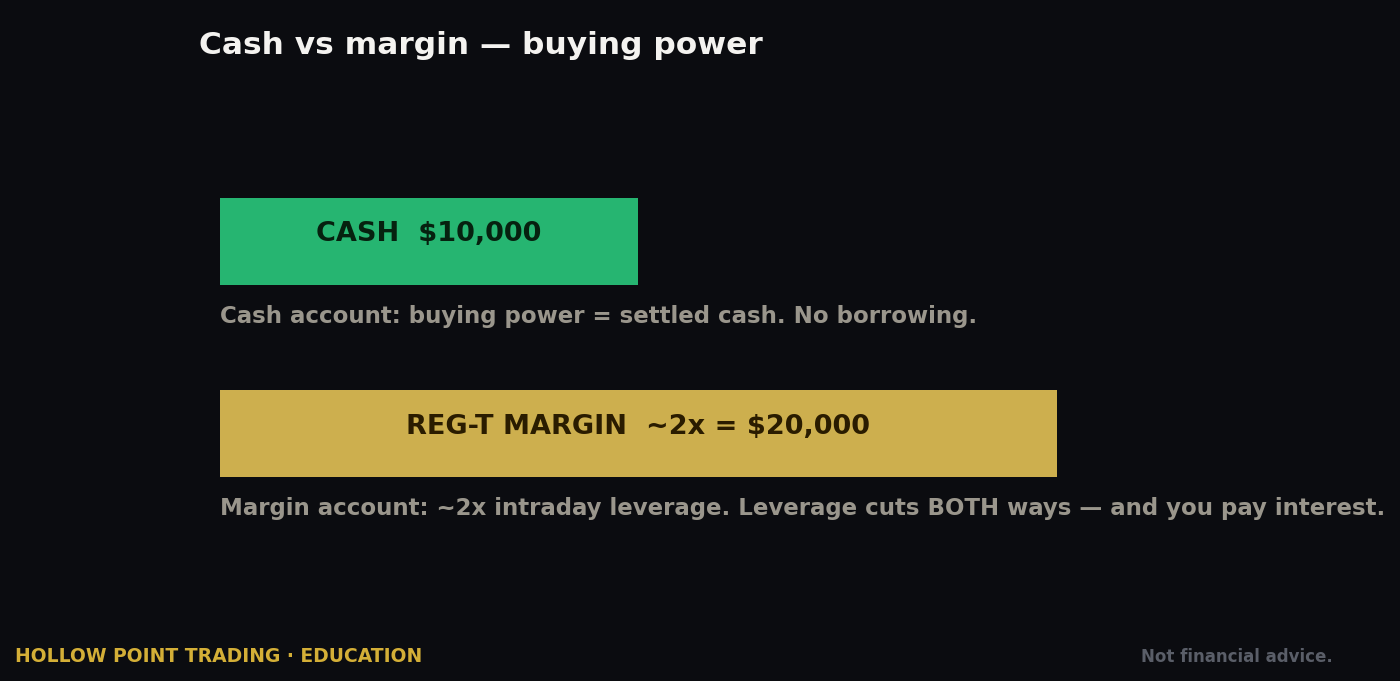
3. Leverage is built in. This is the big one, and it gets its own full section next. When you buy $10,000 of stock, you pay $10,000 (or, with a margin account, maybe half). With futures, you might control $100,000 worth of the underlying while putting up only a few thousand dollars. That multiplier is called leverage, and it is the single most important thing a beginner must understand before touching futures.
4. Long or short, equally easy. With stocks, betting up (buying) is simple; betting down (short selling) is awkward, requires borrowing shares, and comes with extra rules. In futures, going short is exactly as easy as going long. You just click "sell" instead of "buy." The market is symmetrical.
5. Trading hours. Most U.S. stocks trade roughly 9:30 a.m. to 4:00 p.m. Eastern. Major futures trade nearly around the clock — close to 23 hours a day, Sunday evening through Friday afternoon. That's powerful and dangerous: the market can move hard at 3 a.m. while you sleep.
6. What backs the price. A stock's price reflects a company's health — earnings, growth, management. A futures price reflects supply and demand for the underlying thing plus expectations about the future. Different forces, different reasons to move.
Leverage — the beginner's best friend and worst enemy
If you remember one section of this guide, make it this one.
Leverage means controlling a large position with a small amount of your own money. Futures are leveraged by design, and here's how it works.
When you open a futures position, you don't pay the full value of the contract. You put up a good-faith deposit called margin. Margin is not a down payment like on a house — it's more like a security deposit that proves you can cover your losses. There are two flavors:
- Initial margin — the amount you must have in your account to open the position.
- Maintenance margin — the minimum you must keep in the account to hold it. Drop below this and you get a margin call: the broker demands more money, or they close your position automatically.
Let's make it concrete. We'll use the E-mini S&P 500 futures contract (ticker ES), one of the most popular contracts in the world, because it tracks the S&P 500 index — a basket of 500 large U.S. companies that many people treat as "the market."
The E-mini S&P 500 has a multiplier of $50 per index point. That means for every 1 point the S&P 500 index moves, one ES contract gains or loses $50.
Say the S&P 500 index is at 5,000. The full value of one ES contract is:
5,000 points × $50 = $250,000.
One contract represents a quarter-million dollars of market exposure. But your broker doesn't ask for $250,000. They might ask for around $13,000 in initial margin to open it (margin amounts change; this is illustrative).
So with roughly $13,000 you're controlling $250,000. That's your leverage — nearly 19-to-1. Your money is doing the work of nearly nineteen times its size.
Now feel both edges of that blade.
The good edge: the index rises 20 points, from 5,000 to 5,020. You make 20 × $50 = $1,000. You made $1,000 on roughly $13,000 of deposit — about an 8% gain on your money — from a move of just 0.4% in the index. Leverage magnified a tiny market move into a big return.
The bad edge: the index falls 20 points instead. You lose $1,000, just as fast. And if it falls 100 points — which the S&P can do in a single ugly afternoon — that's 100 × $50 = $5,000 gone. More than a third of your deposit, on a move of 2% in the underlying.
This is why we say leverage is a magnifying glass. It doesn't make you a better trader; it makes your outcomes — good and bad — bigger and faster. A beginner who sees only the top example and ignores the bottom one is exactly the person who blows up an account in a week.
Micro contracts — the beginner's on-ramp
Here's genuinely good news for a beginner: the exchanges created micro contracts, which are just tiny versions of the big ones.
The Micro E-mini S&P 500 (ticker MES) is exactly one-tenth the size of the ES. Instead of $50 per point, it's $5 per point. Its margin might be around $1,300 instead of $13,000. Same market, same chart, one-tenth the risk per tick.
For someone learning, this is a gift. You can trade the real market, feel real emotions with real (small) money, and learn the mechanics without betting the rent. A beginner should almost always start with micros. There is no glory in trading a full-size contract before you've proven you can be consistent on a micro. The market does not hand out bravery medals.
A fully worked beginner example, start to finish
Let's walk one complete trade slowly, the way you'd actually do it, using a micro contract so the numbers stay friendly. We'll fold in the Hollow Point Trading discipline as we go, because how you structure the trade matters more than whether this particular one wins.
The setup. It's a normal Tuesday. You've been watching the Micro E-mini S&P 500 (MES). The index is at 5,000. You've done your homework and you believe the market is more likely to grind up today than down. You want to go long (bet it rises).
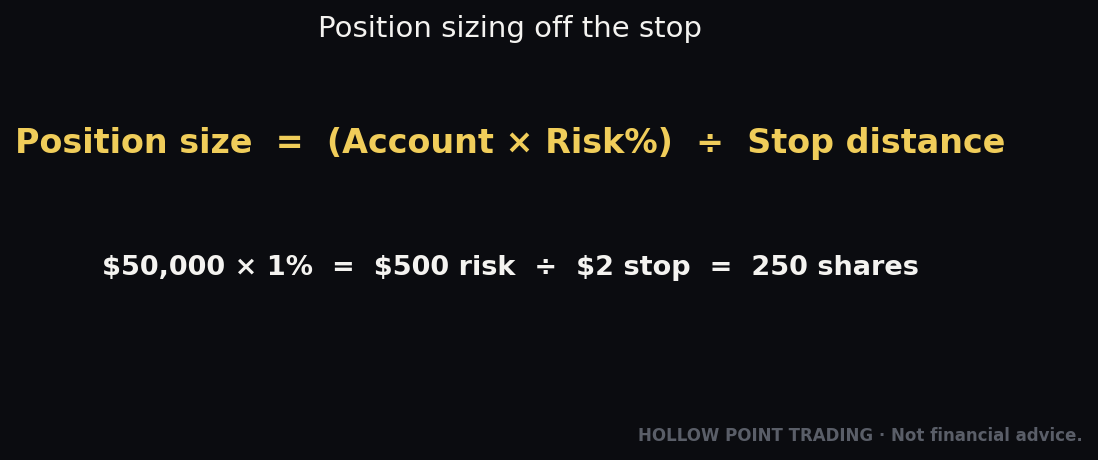
Step 1 — Know your numbers before you click anything. MES is $5 per point. Your account has $3,000 in it. That's real money you'd hate to lose, so we're going to protect it.
Step 2 — Decide your risk FIRST, not your reward. This is the HPT way and it's backwards from how beginners think. Beginners ask "how much can I make?" Professionals ask "how much can I lose, and am I okay with it?"
You decide: on this trade, I am willing to lose $50. That's it. That's my line in the sand. If I'm wrong, I lose fifty dollars and I walk away with my account and my ego intact.
Step 3 — Turn that dollar risk into a stop level. A stop-loss (or just "stop") is an order that automatically closes your trade if price hits a level you set, so a small loss can't quietly become a huge one. It's your seatbelt.
$50 of risk ÷ $5 per point = 10 points. So your stop goes 10 points below your entry. You buy at 5,000, your stop sits at 4,990. If the market falls to 4,990, you're out, down $50, done. No hoping, no "it'll come back," no negotiating with the screen.
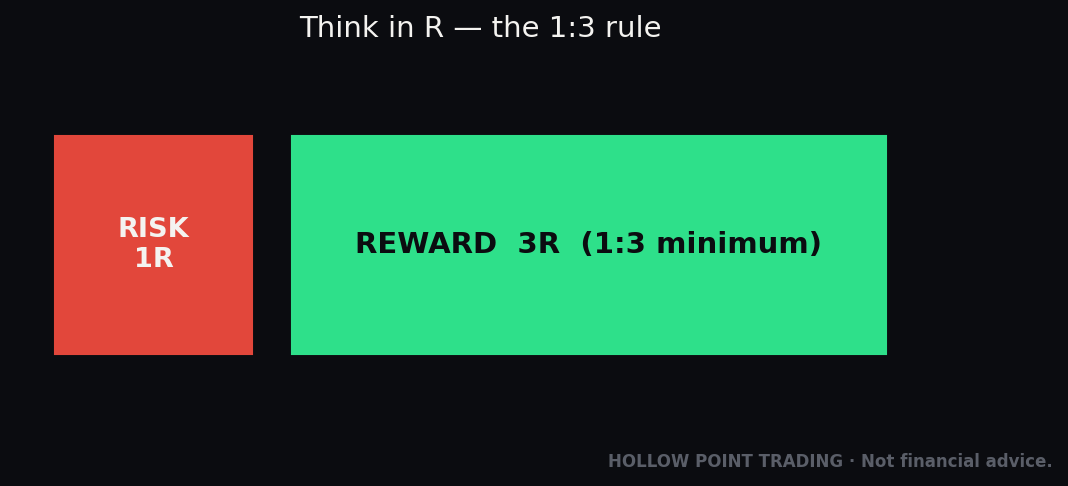
Step 4 — Set your target using 1:3 reward-to-risk. Hollow Point Trading lives by 1:3 reward-to-risk: for every $1 you're willing to lose, you aim to make at least $3. You're risking $50, so your target profit is $150.
$150 ÷ $5 per point = 30 points. Your target sits 30 points above entry, at 5,030. You buy at 5,000, you want out at 5,030.
So the full plan, written down before entering:
- Enter (buy) at 5,000
- Stop at 4,990 (risk: 10 points = $50)
- Target at 5,030 (reward: 30 points = $150)
- Reward-to-risk: 3 to 1
Step 5 — Place the trade and then leave it alone. You buy one MES contract at 5,000. Your margin (~$1,300) is set aside. You've placed your stop and your target as orders. Now — and this is the hard part — you do nothing. The plan makes the decisions, not your feelings.
Step 6 — Two ways it ends.
If it wins: the market drifts up through the day and touches 5,030. Your target order fires, you sell, and you bank 30 points × $5 = $150. On $50 of risk. A clean 1:3.
If it loses: the market rolls over and slides to 4,990. Your stop fires, you're out for –$50. It stings for about ten seconds. Then you notice: your account went from $3,000 to $2,950. You're still completely in the game. You live to trade tomorrow. That is capital protection, and it is the entire point.
Now zoom out and see the beauty of the 1:3 math. Suppose you take ten trades just like this. You're wrong six times and right only four times — a losing record on paper. Watch what happens:
- 6 losses × $50 = –$300
- 4 wins × $150 = +$600
- Net: +$300
You were wrong more often than you were right, and you still made money. That's the quiet power of insisting on 1:3 reward-to-risk. It means you don't have to be a fortune-teller. You just have to lose small and win bigger. Discipline over prediction — this is what that phrase actually cashes out to.
The beginner mistakes to avoid (learn these on someone else's tuition)
Every one of these has drained a real account. Read them twice.
1. Trading without a stop-loss. The fastest way to blow up. Without a stop, a small loss has no floor. Leverage means a "small" move against you can be catastrophic. Never, ever enter a futures trade without knowing exactly where you get out if you're wrong. If you can't define your exit, you can't take the trade.
2. Not understanding contract size before clicking. Beginners see "buy one contract" and think it's like buying one share. It is not. One ES contract can be a quarter-million dollars of exposure. Always know: what's the multiplier, what's one point worth, and what does one contract really control? If you don't know, you're not ready to click.
3. Over-leveraging — trading too many contracts. Just because your margin lets you hold five contracts doesn't mean you should. The account that trades one micro survives; the account that maxes out its margin on the big contract dies on the first rough day. Position size — how many contracts you take — is the throttle on your risk. Beginners should keep it at the lowest possible setting: one micro.
4. Ignoring expiration. Futures expire. If you hold certain contracts past expiration, you can be obligated to actually deliver or take delivery of the underlying — nobody wants a truckload of physical oil showing up. Most retail contracts are cash-settled or you simply close before expiry, but never forget the date. Know when your contract dies.
5. Revenge trading. You take a loss. It makes you angry. You immediately jump back in, bigger, to "win it back." This is how a $50 loss becomes a $500 loss becomes a blown account. The market does not owe you anything, and it cannot be bullied. When you feel the urge to get even, close the laptop.
6. Trading the overnight session half-asleep. Futures trade nearly 24 hours. That does not mean you should. Thin overnight markets move erratically, and a groggy 3 a.m. decision is rarely a good one. Beginners should pick defined hours, ideally when the market is most active and liquid, and stay away the rest of the time.
7. Confusing leverage with skill. A big win from leverage feels like genius. It usually isn't — it's just the magnifying glass working in your favor for a moment. The same tool will magnify your next mistake just as eagerly. Respect the leverage; never mistake it for talent.
8. Skipping the plan. Entering "just to see what happens," with no entry logic, no stop, no target — that's not trading, it's gambling with extra steps. Every trade gets a written plan before you click. If there's no plan, there's no trade.
The beginner cheat-sheet
Tape this above your desk. It's the floor, not the ceiling — but never trade below it.
Before you ever trade futures:
- ☐ I can explain, in my own words, what a futures contract is.
- ☐ I know the difference between long (betting up) and short (betting down).
- ☐ I understand leverage magnifies losses exactly as much as gains.
- ☐ I'm starting with micro contracts, not full-size.
Before every single trade:
- ☐ I know the contract's multiplier (what one point is worth).
- ☐ I've decided my maximum loss in dollars — before anything else.
- ☐ I've placed a stop-loss at that level. No stop, no trade.
- ☐ My target is at least 3× my risk (1:3 reward-to-risk).
- ☐ I'm trading the smallest size that makes sense (one micro).
- ☐ I know when this contract expires.
- ☐ My whole plan is written down before I click.
After the trade:
- ☐ Win or lose, I followed the plan (that's the real scorecard).
- ☐ I did not revenge-trade.
- ☐ I wrote down what happened so I can learn from it.
Quick reference numbers to memorize:
- E-mini S&P 500 (ES): $50 per point.
- Micro E-mini S&P 500 (MES): $5 per point (one-tenth of ES).
- 1 point on MES = $5. 10 points = $50. 30 points = $150.
- Reward-to-risk target: always at least 3:1.
How this fits the bigger Hollow Point picture
Everything you just learned isn't a standalone lesson — it's the first floor of a much taller building, and here's how the rest of it stacks.
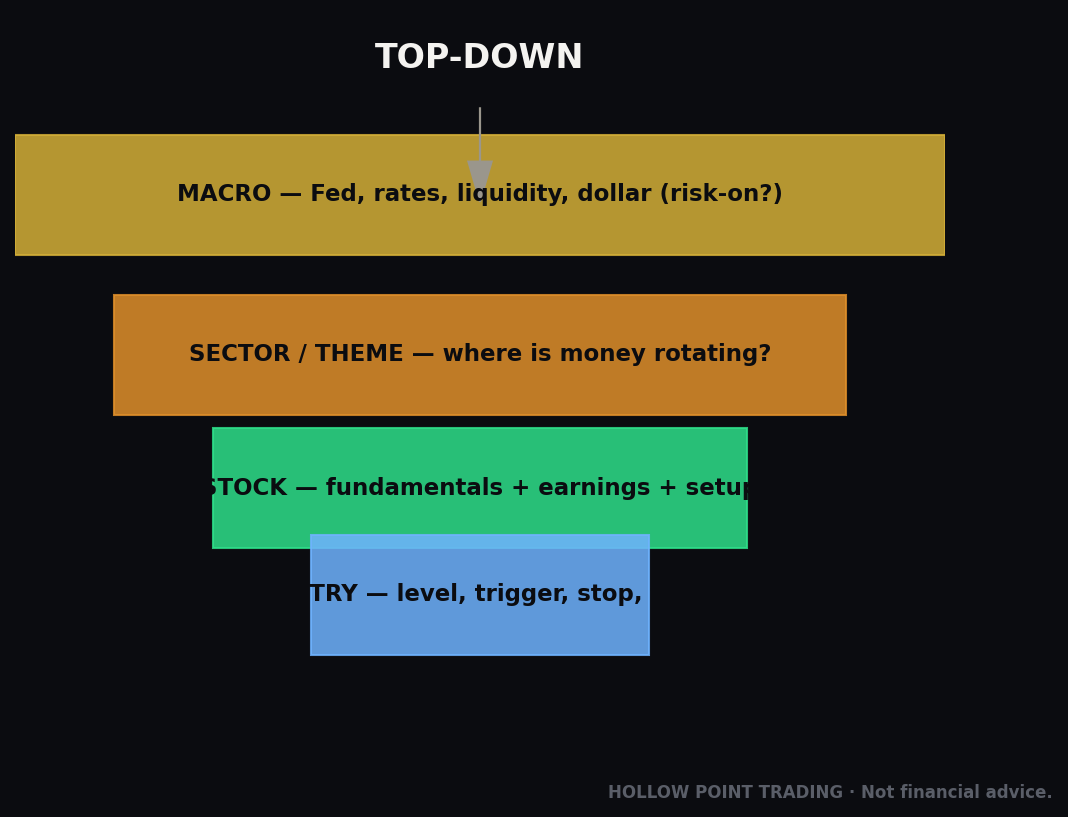
At Hollow Point Trading, we teach a top-down way of seeing markets: macro → sector → stock (or in the futures world, macro → the broad market → the specific contract). The idea is that you don't start by staring at a five-minute chart of one contract. You start big and zoom in:
- Macro — what's the whole economic weather doing? Are interest rates rising? Is the mood risk-on or risk-off? This is the climate everything else lives inside.
- The market / sector — is the broad market (like the S&P 500 that ES tracks) trending up, down, or chopping sideways? Trading against the big tide is how beginners drown.
- The specific contract — only now do you look at the exact thing you're trading, and only in agreement with the two layers above it.
Futures are simply the vehicle many of our traders use to express that view — because they're liquid, they trade nearly around the clock, and (with micros) you can size risk very precisely. But the vehicle is powerful, and power without rules is how people get hurt. That's why the two habits from the worked example aren't optional flavor — they're the load-bearing walls:
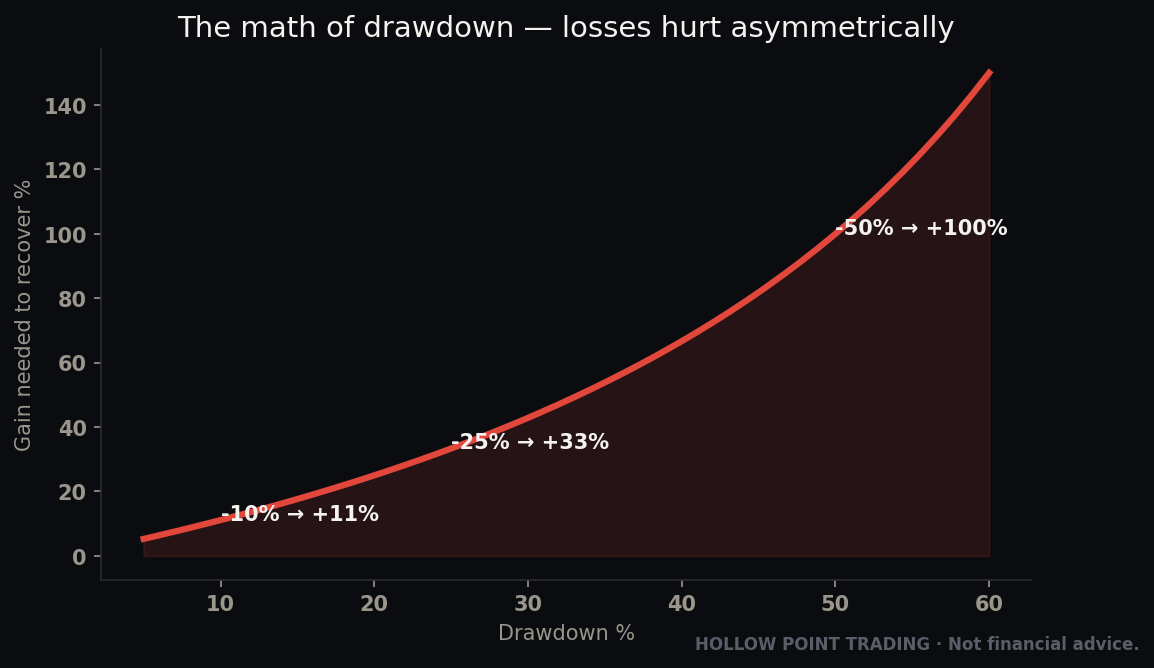
Protect capital first. Your number-one job as a beginner is not to make money. It's to not lose the money that lets you keep playing. A trader with capital and discipline will eventually find good trades. A trader who blew up chasing a leveraged thrill has nothing left to trade with. The stop-loss, the small size, the micros — all of it exists to keep you in the game.
Discipline over prediction. Nobody knows what the market will do next. Not you, not us, not the loudest voice on the internet. What separates traders who last from traders who flame out isn't better crystal balls — it's better rules, followed even when it's boring, even when it's tempting not to. The 1:3 reward-to-risk math proved it: you can be wrong more than half the time and still win, if your discipline is intact. That's the whole edge. It's not exciting, and that's exactly why it works.
So here's your real assignment coming out of this guide. Don't rush to fund an account and click buy. First, make sure you can explain a futures contract to a friend at dinner. Then understand — really feel — that leverage cuts both ways. Then, when you do begin, begin small: one micro, a written plan, a hard stop, a 1:3 target, and the humility to lose fifty dollars gracefully.
Futures are a professional tool. Handled with respect, they're one of the cleanest ways to trade the market. Handled carelessly, they'll teach you an expensive lesson very quickly. You now know which kind of trader you intend to be.
Start Monday with the cheat-sheet, one micro contract, and the patience to let the rules — not your feelings — make every decision. That's the beginning of the whole craft.
Bound by rules, feared by trade.