
If you've spent any time around traders online, you've heard two little words thrown around like everyone was born knowing them: "ES" and "NQ." People say "ES is bidding," "NQ just took out the highs," "watch the ES/NQ divergence" — and if you're new, it sounds like a secret language.
Here's the good news: it isn't secret, and it isn't hard. By the end of this guide you'll understand exactly what ES and NQ are, what they track, why they move, when you can trade them, how the money math works, and how we at Hollow Point Trading actually use the NQ. No prior knowledge needed. We'll define every term the first time it shows up, and we'll walk through real-ish numbers so you can see it, not just read it.
Grab a coffee. Let's build this from zero.
First, What Is a "Future" At All?
Before we can talk about ES or NQ, we have to talk about the word futures, because both of them are futures contracts.
A futures contract is simply an agreement to buy or sell something at an agreed price, with the settlement happening at a set time in the future (hence the name). That "something" is called the underlying — the thing the contract is based on.
Here's a everyday-life analogy. Imagine you order a custom couch today. You agree on a price — say $1,000 — but the couch won't be delivered for three months. You've just made a kind of futures agreement: price locked now, delivery later. If couch prices shoot up to $1,400 next month, your locked-in $1,000 deal is suddenly worth a lot. If couch prices crash to $600, you overpaid. The value of your agreement changes as the price of the underlying couch moves, even though you haven't taken delivery yet.
That's the core idea. A futures contract has a value that rises and falls as the price of the underlying thing rises and falls. Traders buy and sell these contracts all day long, trying to profit from those price swings — they almost never intend to take delivery of anything.
Now, the underlying doesn't have to be a physical object like a couch or a barrel of oil. It can be an index — a number that represents a basket of stocks. And that's exactly what ES and NQ are built on.
What Is a Stock Index? (The Thing ES and NQ Track)
A stock index is a single number that summarizes how a group of stocks is doing, all at once.
Think of it like a class grade average. You don't want to read all 500 students' report cards to know how the class is doing — you look at the class average, one number. If the average goes up, the class as a whole is doing better. A stock index is the market's version of that class average.
Two of the most important indexes in the world:
- The S&P 500 — the average of 500 of the largest U.S. companies (Apple, Microsoft, JPMorgan, ExxonMobil, Walmart, and 495 others). It's the go-to gauge for "how is the U.S. stock market doing?" Broad, diversified, all sectors.
- The Nasdaq-100 — the 100 largest non-financial companies listed on the Nasdaq exchange, heavily weighted toward technology. Think Apple, Microsoft, Nvidia, Amazon, Meta, Tesla, Google. It's the "tech-heavy, growth-heavy" gauge.
So when someone says "the S&P is up today," they mean that class-average number for those 500 companies went up. Same for the Nasdaq-100.
Now here's the connection: you can't buy an index directly. An index is just a number, a calculation — there's nothing to physically own. So the exchanges created futures contracts on those index numbers. That way traders can bet on whether the index number will go up or down.
- ES is the futures contract on the S&P 500 index.
- NQ is the futures contract on the Nasdaq-100 index.
That's it. That's the whole mystery. ES = S&P 500 futures. NQ = Nasdaq-100 futures.
Where the Names Come From
The full names are:
- ES = the E-mini S&P 500 futures contract.
- NQ = the E-mini Nasdaq-100 futures contract.
The "E-mini" part means "electronic, and smaller than the original." Decades ago these contracts were huge — too expensive for regular traders. The exchange (the CME, the Chicago Mercantile Exchange, which is the marketplace where these trade) launched smaller "E-mini" versions that traded electronically. They became wildly popular, and today the E-minis are the standard.
There are even smaller versions called Micros — MES (Micro E-mini S&P 500) and MNQ (Micro E-mini Nasdaq-100) — which are one-tenth the size. We'll come back to those, because for a beginner, the Micros are your best friend.
Why Should a Beginner Even Care About ES and NQ?
Fair question. You might be thinking, "I just want to trade a stock or two — why do I need these?" Here's why they matter even if you never trade them directly:
1. They ARE the market's mood ring. ES and NQ trade nearly 24 hours a day (more on hours soon). So when you wake up and want to know "is the market up or down before it even opens?" — you look at ES and NQ. They're the pre-market pulse. Stocks like Apple or Nvidia don't really trade overnight in a meaningful way, but the futures do. So the futures tell you where the whole market is leaning before the opening bell.
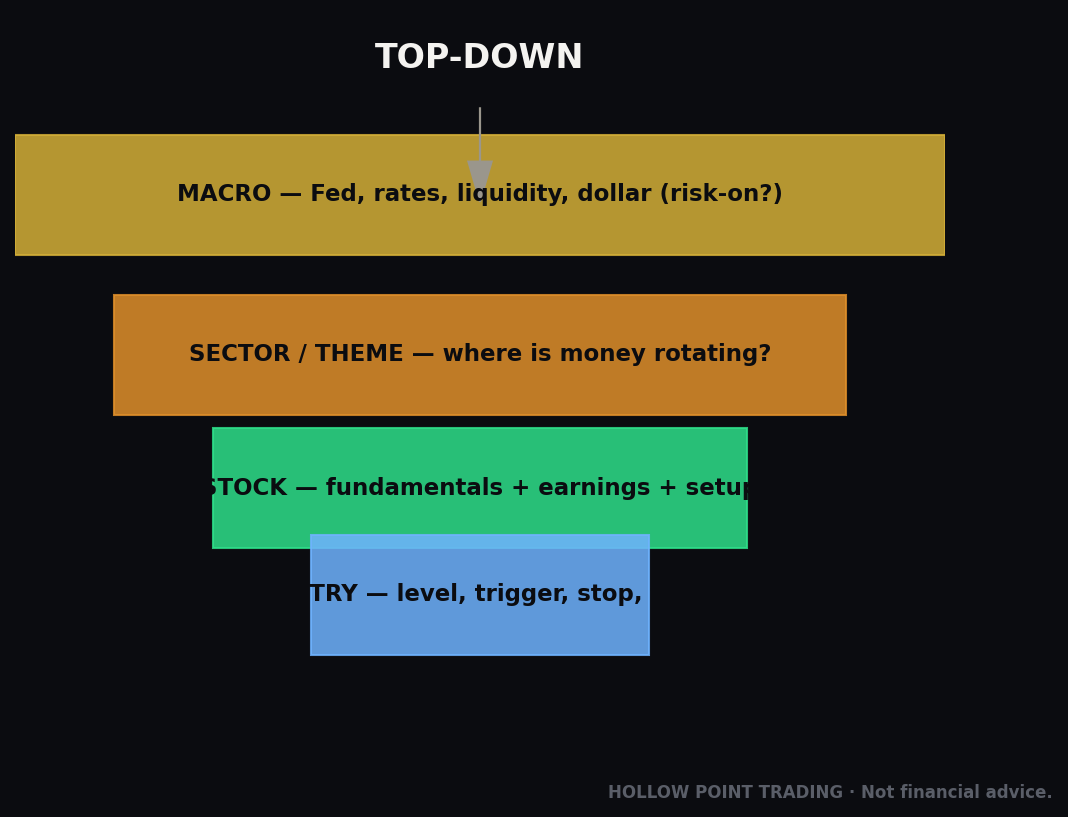
2. They set the tone for everything else. This is central to how we think at Hollow Point Trading. We work top-down: macro → sector → stock. ES and NQ are the "macro" layer — the big-picture tide. If the tide (ES/NQ) is coming in, individual boats (stocks) tend to rise with it. If the tide is going out, even good stocks struggle. You check the index futures first, then narrow down.
3. They're some of the most liquid markets on earth. Liquid means there are tons of buyers and sellers at all times, so you can get in and out easily without the price jumping around on you. For a beginner, liquidity is a gift — it means fair prices and smooth fills.
4. One contract, the whole basket. Instead of buying 500 stocks to bet on the U.S. market, you trade one ES contract. Instant diversification into one instrument.
So even if your first real trade is months away, learning to read ES and NQ makes you a smarter observer of the entire market starting today.
ES vs NQ: The Key Differences
They're cousins, but they behave differently, and understanding the difference is a genuine edge.
ES (S&P 500) is the steadier one. It holds 500 companies across every sector — tech, banks, healthcare, energy, consumer goods. Because it's spread out, no single company or sector dominates. It tends to move a little more calmly.
NQ (Nasdaq-100) is the racier one. It's only 100 companies, and it's dominated by big tech. A handful of giant tech names (Apple, Microsoft, Nvidia, Amazon) make up a huge chunk of it. Tech tends to swing harder — bigger ups, bigger downs. So the NQ is generally more volatile, meaning it moves faster and further. Volatility just means the size of the price swings; more volatility = bigger, quicker moves.
A simple way to hold it in your head:
- ES = the aircraft carrier. Big, steady, turns slowly.
- NQ = the speedboat. Faster, jumpier, more thrilling, easier to get thrown from.
Because tech leads modern markets, the NQ often moves first and moves most. That's exactly why it's our primary trading vehicle at HPT — but that same speed is why it demands discipline. A speedboat rewards a skilled captain and punishes a careless one.
How the Money Actually Works: Points, Ticks, and Dollars
This is the part beginners find confusing, so we'll go slow and use real numbers. Stay with me — once it clicks, it's simple arithmetic.
When you look at the NQ, you'll see a price like 20,000. That number roughly mirrors the Nasdaq-100 index level. When it moves to 20,001, it went up one point. When it moves to 19,999, it dropped one point.
Two vocabulary words:
- A point is a whole-number move (20,000 → 20,001 = one point).
- A tick is the smallest move the contract can make. For both ES and NQ, one tick is 0.25 — a quarter of a point. So prices move 20,000.00 → 20,000.25 → 20,000.50 → 20,000.75 → 20,001.00. Four ticks make one point.
Now, the money. Each contract assigns a dollar value to each point. This is fixed by the exchange:
NQ (E-mini Nasdaq-100):
- 1 point = $20
- 1 tick (0.25) = $5
ES (E-mini S&P 500):
- 1 point = $50
- 1 tick (0.25) = $12.50
MNQ (Micro Nasdaq) — one-tenth the size:
- 1 point = $2
- 1 tick = $0.50
MES (Micro S&P) — one-tenth the size:
- 1 point = $5
- 1 tick = $1.25
So if you're trading one NQ contract and price moves up 10 points in your favor, that's 10 × $20 = $200. If it moves 10 points against you, that's –$200. Notice how fast that adds up — the NQ can move 10 points in a matter of seconds. That's the speedboat.
This is the single most important reason we tell beginners to start with the Micros (MNQ/MES). Same exact market, same charts, same behavior — but every point is worth $2 instead of $20. You get to learn on real money without the real money being able to hurt you badly. A 10-point move on MNQ is $20, not $200. That's the difference between a valuable lesson and a painful one.
A Fully Worked Beginner Example
Let's walk through a complete, simple trade on the Micro NQ (MNQ) so you can see every piece connect. We'll use round, realistic numbers.
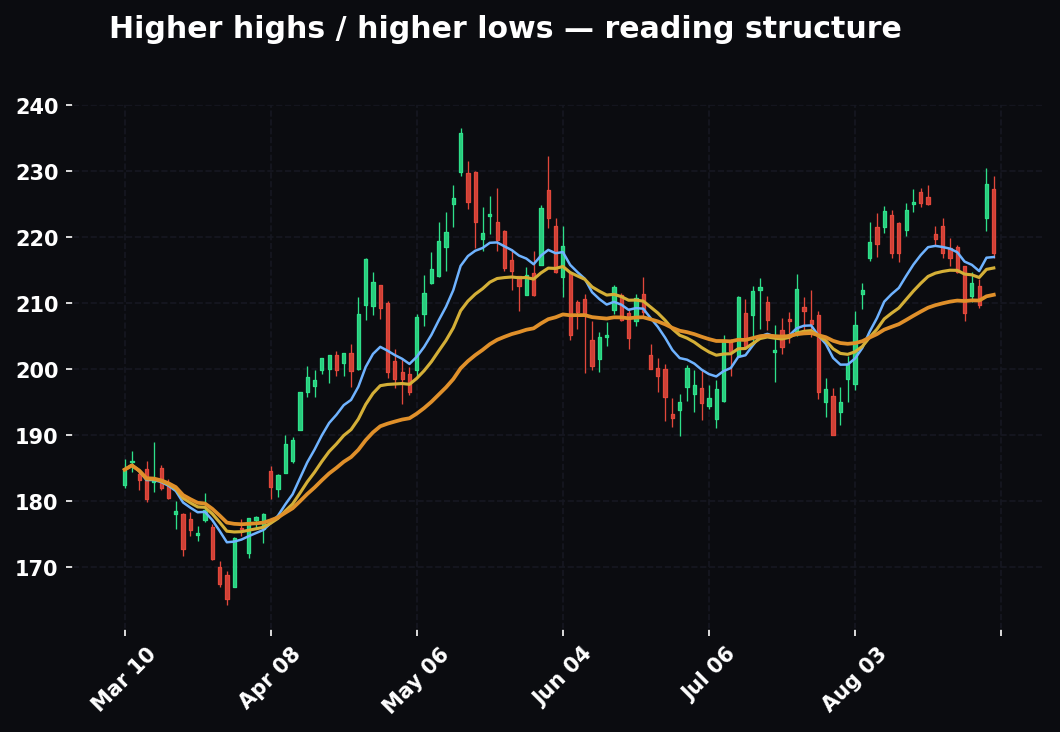
Say it's mid-morning. The NQ has been climbing all session, making higher highs and higher lows (an uptrend — price steadily rising). MNQ is trading at 20,000.
You believe it's going to keep going up, so you decide to go long. Going long just means buying because you expect the price to rise — you profit if it goes up.
Before you click buy, you do the two things HPT never skips: define your risk and define your reward.
- Your stop-loss: a stop-loss is a pre-set price where you'll automatically exit if you're wrong, to cap your loss. You place it at 19,980 — 20 points below your entry. If price falls there, you're out. Your risk is 20 points.
- Your target: where you'll take profit. You place it at 20,060 — 60 points above entry. Your reward is 60 points.
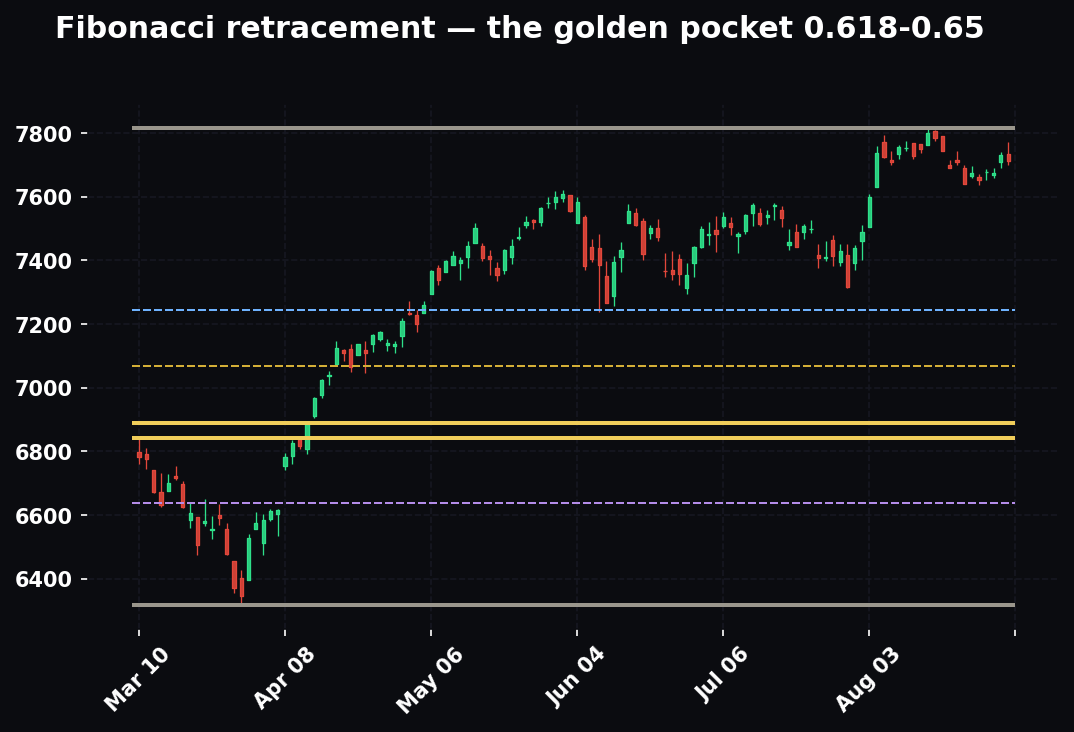
Notice the ratio: risking 20 points to make 60 points. That's 1:3 reward-to-risk — risk one unit to make three. This is a non-negotiable rule at Hollow Point. We only take trades where the potential reward is at least three times the potential risk. Why? Because you don't have to be right very often to make money when your winners are three times the size of your losers.
Now the money math on one MNQ contract (remember: $2 per point):
- If you're wrong and hit your stop: 20 points × $2 = –$40.
- If you're right and hit your target: 60 points × $2 = +$120.
You risked $40 to potentially make $120. Let's say you take this exact setup 10 times over a couple weeks and you're wrong more than half the time — you win only 4 and lose 6:
- 4 wins × $120 = +$480
- 6 losses × $40 = –$240
- Net: +$240, while being wrong 60% of the time.
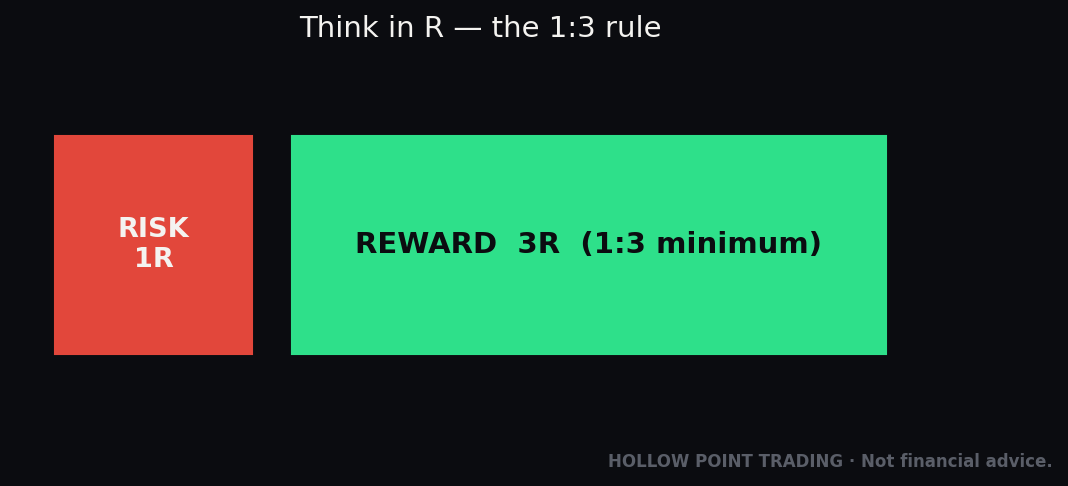
Read that again, because it's the whole game. With a 1:3 ratio, you can lose more often than you win and still come out ahead. That's why HPT obsesses over the ratio and over the stop-loss. We're not trying to predict the future perfectly — we're trying to make sure our wins are bigger than our losses. Discipline over prediction.
Now imagine you'd done that on full-size NQ instead of Micro: every number ×10. That +$240 becomes +$2,400 — but a string of early beginner mistakes becomes –$2,400 just as easily. Learn on Micros first. The lesson costs the same; the tuition is one-tenth.
Why Do ES and NQ Move? (The "What's Driving It" Layer)
Prices don't move randomly (even when it feels like it). Here are the real forces a beginner should know, roughly from biggest-picture to smallest:
1. The macro / economic news. Because ES and NQ represent the whole U.S. market, they react hard to big economic events: interest-rate decisions from the Federal Reserve (the U.S. central bank), inflation reports (like CPI — the Consumer Price Index, which measures how fast prices are rising), and the monthly jobs report. When one of these hits, ES and NQ can lurch violently in seconds. Beginner rule: know when these are scheduled and don't be in a fresh trade the moment they drop.
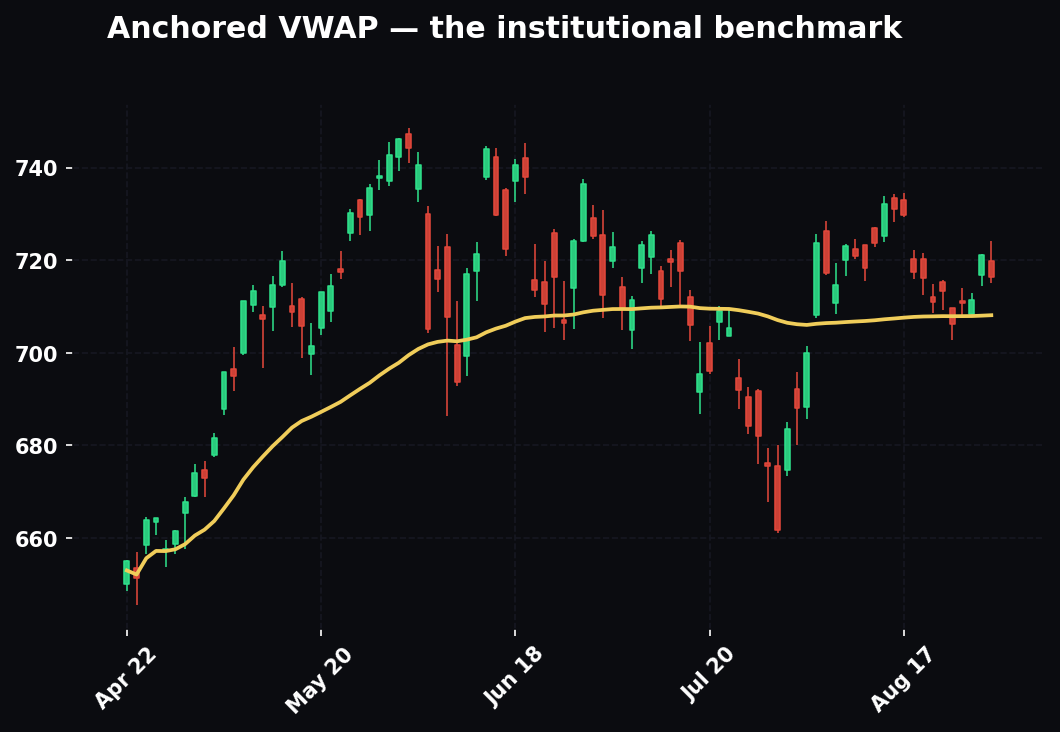
2. Interest rates specifically punish the NQ. Here's a connection worth memorizing: the NQ is full of growth and tech companies whose value depends on profits far in the future. When interest rates rise, future profits are worth less today, so tech gets hit harder — and the NQ (tech-heavy) usually falls more than the ES. When rates fall, tech often flies, and NQ leads the way up. This is why NQ is the racier cousin.
3. Earnings from the giants. The NQ is dominated by a few mega-cap tech names. When Nvidia or Apple reports earnings, it can drag the entire NQ up or down almost by itself. The ES, being more spread out, is less at the mercy of any one company.
4. Sector rotation. Money flows between sectors — sometimes into tech, sometimes into banks or energy. When money floods into tech, NQ outperforms ES. When money flees tech into everything else, ES can hold up while NQ sinks. Watching ES vs NQ together tells you where the money is going. This is the "sector" layer of our macro → sector → stock framework, visible in real time.
5. Overnight / global markets. Because futures trade almost around the clock, they absorb news from Asia and Europe while you sleep. That's why the market can "gap" — open sharply higher or lower than yesterday's close. The futures already priced in the overnight news.
6. Plain old supply and demand at key levels. On the chart, price reacts to support (a price floor where buyers tend to step in) and resistance (a price ceiling where sellers tend to step in), round numbers (like NQ 20,000), and prior highs and lows. This is the technical layer where day-traders live.
When Can You Trade Them? Session Hours Made Simple
One of the best things about ES and NQ: they trade nearly 23 hours a day, Sunday evening through Friday afternoon. Compare that to stocks, which only trade during regular hours. Let's lay out the clock. (We'll use Central Time / CT, since that's Chicago time, where the CME lives — adjust for your own zone.)
- The week opens: Sunday at 5:00 PM CT.
- The week closes: Friday at 4:00 PM CT.
- Daily maintenance break: every day from 4:00 PM to 5:00 PM CT, the market pauses for one hour, then reopens for the next "day" session. So it runs almost continuously, with just that one-hour nightly breather.
Within that near-24-hour stretch, not all hours are equal. The one block every beginner must know:
The Regular Trading Hours (RTH), a.k.a. the "cash session": 8:30 AM to 3:00 PM CT (that's 9:30 AM–4:00 PM Eastern). This is when the actual U.S. stock market is open, when the most volume and the cleanest moves happen. This window — especially the first hour or two after 8:30 AM CT — is where most day-trading action lives.
Everything outside 8:30 AM–3:00 PM CT is called "overnight" or "Globex" (Globex is the name of the CME's electronic trading system). It's open, but it's usually thinner — fewer traders, less volume, choppier and less predictable moves. For a beginner, thin overnight markets are a trap: it looks like you can trade, but the moves can be erratic and the liquidity spotty.
Traders also watch the overnight range — the high and low made while the U.S. slept — because the day session often reacts to those levels. And there are three global "sessions" the pros track:
- Asia session (evening our time),
- London / Europe session (early morning our time, often where the day's tone gets set),
- New York session (our main event, from the 8:30 AM CT open).
Beginner takeaway on hours: Just because it's open doesn't mean you should trade it. The highest-quality, most beginner-friendly window is roughly 8:30 AM to 11:00 AM CT — the meat of the New York morning. Learn that window first. Ignore the 3 AM chop.
Contract Expiration: The One Housekeeping Detail
A futures contract doesn't live forever — it expires. ES and NQ contracts expire quarterly: March, June, September, and December. You'll see the contract written with a code, like NQZ2026 (Z = December) or ESH2026 (H = March). The letters are just month codes (H = March, M = June, U = September, Z = December).
Here's all a beginner needs to do about it: as one contract nears expiration, trading volume "rolls" to the next one. This happens about a week or so before expiration (a period called the roll). Your trading platform will usually point you to the "front month" — the currently-active, most-heavily-traded contract. Just trade the front month. When your platform nudges you to roll to the next contract, follow it. That's the whole task. Don't overthrough this one.
The Beginner Mistakes to Avoid (Learn These the Easy Way)
Every one of these is a lesson someone paid for. Take them for free.
1. Starting on full-size contracts. The single most common wipeout. A beginner opens one full NQ, the speedboat lurches 30 points against them in a minute, and that's –$600 before they understood what happened. Start on Micros (MNQ/MES). Same lessons, one-tenth the cost.
2. Trading without a stop-loss. Going in with no pre-set exit is how a small loss becomes an account-ending loss. You tell yourself "it'll come back." Sometimes it doesn't. *Every trade gets a stop, set before you enter.* No exceptions. Protect capital first.
3. Ignoring the reward-to-risk ratio. Taking trades where you risk 40 points to make 10 is a slow death, even when you win often. Demand at least 1:3. If a setup doesn't offer three times your risk, pass on it. There's always another trade.
4. Trading the overnight chop. The 24-hour clock tempts beginners to trade at all hours. Thin overnight markets punish that. Stick to the New York morning until you have real experience.
5. Trading right into big news. Entering a trade 30 seconds before a Fed decision or CPI print is gambling, not trading. The move can blow through your stop before you blink. Know the economic calendar; stand aside for the big prints.
6. Confusing "the index" with "the futures." The S&P 500 index and the ES future are close but not identical — the future trades overnight and can sit slightly above or below the index (this gap is normal and relates to costs of carry, a detail you can safely ignore for now). Just know: you trade the future (ES/NQ), you reference the index.
7. Oversizing — trading too many contracts. Even on Micros, stacking up ten contracts on a hunch reintroduces all the danger. Size small. Survive first, thrive later. You cannot learn if you're blown up.
8. Revenge trading. You lose one, you're angry, you immediately jump back in "to get it back." That's emotion driving the bus. One trade's outcome never justifies the next entry. The setup does, or nothing does.
How Hollow Point Trades the NQ
Now the part you've been waiting for: how we actually approach it. We trade the NQ as our primary vehicle because it's the leader — tech leads modern markets, and the NQ moves first, moves cleanest, and offers the fast, well-defined swings our system is built to capture. But we trade it on rails. Here's the shape of it, in beginner terms:
We work top-down. Before a single NQ trade, we read the macro (what's the Fed doing, what news is due, is the overall tide up or down?), then the sector (is money flowing into tech or out of it? — we literally watch ES vs NQ to see if tech is leading or lagging), then we drop to the NQ chart itself for the entry. Macro → sector → stock. The NQ trade is the last step, not the first.
We stack confluence across timeframes. Confluence means several independent signals pointing the same direction at once. We don't take a trade because one thing looks good on one chart. We look across multiple timeframes — the higher timeframes (like the daily and hourly) set the bias (the overall lean, up or down), and the lower timeframes (like the 5-minute and 1-minute) give the precise entry. When the big-picture bias and the small-picture entry agree, that's confluence, and that's when we act. When they disagree, we wait.
We demand 1:3. As shown in the worked example, we don't take a trade unless the reward is at least three times the risk. The stop-loss comes first — we decide where we're wrong before we decide where we're right. If the math doesn't give us 1:3, there's no trade, no matter how good it "feels."
We let the tape and the levels talk. We map out the key levels ahead of time — prior day's high and low, overnight range, round numbers, the volume-heavy prices — and we let price come to us at those levels rather than chasing it in the middle of nowhere. Patience at pre-planned levels beats hero entries in empty space.
We protect capital first, always. The number-one job isn't to make money — it's to not lose the account, so that we're still here for the good setups. A trader who survives every bad day gets to profit on the good ones. A trader who blows up gets nothing. Discipline over prediction. We don't need to know the future; we need to manage risk so precisely that being wrong is survivable and being right is profitable.
That's the whole philosophy in one breath: read top-down, trade the leader (NQ), demand 1:3, define the loss before the win, and let the rules — not the emotions — pull the trigger.
Your ES & NQ Beginner Cheat-Sheet
Pin this. It's the whole guide compressed.
WHAT THEY ARE
- ES = E-mini S&P 500 futures → tracks 500 big U.S. companies (steady, diversified — the aircraft carrier).
- NQ = E-mini Nasdaq-100 futures → tracks 100 big tech-heavy companies (fast, volatile — the speedboat).
- MES / MNQ = the Micro versions, one-tenth the size. Beginners start here.
THE MONEY MATH
- NQ: 1 point = $20, 1 tick (0.25) = $5.
- ES: 1 point = $50, 1 tick (0.25) = $12.50.
- MNQ: 1 point = $2. MES: 1 point = $5.
- 4 ticks = 1 point. Smallest move = 0.25.
THE HOURS (Central Time)
- Opens Sunday 5:00 PM, closes Friday 4:00 PM.
- Daily break 4:00–5:00 PM.
- Best beginner window: 8:30–11:00 AM CT (New York morning, the cash session).
- Avoid dead overnight chop.
THE RULES (HPT floor)
- Always set a stop-loss before entering.
- Demand at least 1:3 reward-to-risk.
- Size small (Micros, few contracts).
- Read macro → sector → stock first.
- Stand aside for big news (Fed, CPI, jobs).
- Trade the front-month contract; roll when told.
- Never revenge trade.
Putting It All Together
Let's zoom back out, because you now know more than you think.
ES and NQ are just futures contracts on two famous stock indexes — the broad, steady S&P 500 (ES) and the fast, tech-heavy Nasdaq-100 (NQ). They're the market's around-the-clock pulse, the macro layer we read before anything else. They move on interest rates, economic news, big-tech earnings, sector rotation, and plain supply and demand at key price levels. They trade nearly 23 hours a day, but the golden window is the New York morning. The money math is simple arithmetic once you memorize the point values. And the Micros (MNQ/MES) exist precisely so a beginner can learn the real market at one-tenth the risk.
At Hollow Point, the NQ is our vehicle — but the vehicle was never the point. The point is the process: read the big picture down to the small, stack confluence across timeframes, define your loss before your win, demand three-to-one, and let the rules pull the trigger. Master that process on the Micros, in the morning window, and you'll have built something most people never do — a way of trading that can survive being wrong and still come out ahead.
You don't need to predict the market. You need to respect it, size for it, and follow your rules through it. Do that, and ES and NQ stop being a secret language — and start being your two most useful instruments on the whole screen.
Bound by rules, feared by trade.
Not financial advice.
TAGS: #FuturesForBeginners #ESFutures #NQFutures #SP500 #Nasdaq100 #EminiTrading #MicroFutures #MNQ #DayTradingBasics #LearnToTrade #RiskManagement #RewardToRisk #StockIndex #TradingHours #BeginnerTrading #MacroToStock #TradingDiscipline #HollowPointTrading