
If you're brand new to trading and someone tells you that with $2,000 in your account you can control $150,000 worth of the stock market, your first reaction should not be excitement. It should be a healthy, respectful fear. That gap — the distance between the small pile of cash you actually have and the enormous position you're allowed to control — is the single most important thing a beginner futures trader has to understand. The name for that gap, and the rules around it, is margin.
This guide is going to take you from zero. You don't need to have ever placed a trade. By the end you'll understand what margin actually is, the difference between day-trade margin and overnight margin, why leverage is a double-edged sword, the exact mechanical reason small accounts blow up, and — most importantly — a simple, repeatable way to size your trades so you survive long enough to get good.
Let's build it piece by piece.
First, what is a futures contract? (30-second version)
Before we can talk about margin, you need a one-paragraph picture of what you're actually trading.
A futures contract is a standardized agreement to buy or sell something at a set price on a future date. Originally these were for physical goods — a farmer locking in the price of corn months before harvest. Today, most futures traders never touch the underlying thing. They're trading contracts tied to stock indexes, oil, gold, bonds, and so on, and they close the trade before anything gets delivered. You're betting on the price going up or down, nothing more.
The key detail for beginners is this: one futures contract controls a big chunk of value. A single E-mini S&P 500 contract (ticker ES) moves $50 for every one point the S&P 500 index moves. If the index is sitting at 6,000, one ES contract "controls" about 6,000 × $50 = $300,000 of notional value. Notional just means the full face value of what you're controlling — not what you paid, but the size of the thing you're steering.
You obviously don't have $300,000. So how are you allowed to trade it? That's margin.
What margin actually is (plain English)
Here's the sentence to memorize: Margin is a good-faith deposit your broker requires so you can control a large futures position with a small amount of cash.
It is not a down payment on something you're buying. It's not like putting 20% down on a house and borrowing the other 80%. It's more like a security deposit — a chunk of your money set aside as proof you can cover potential losses, held while the trade is open, and released back to you when you close.
Think of it like renting a very expensive piece of equipment. The rental shop doesn't make you pay the full $50,000 price of the machine. They make you leave a $2,000 deposit. That deposit protects them if you damage the machine. In futures, the "damage" is your trade losing money, and the margin deposit is what the broker uses to make sure they're covered if it does.
Two more plain-English terms you'll hear constantly:
- Notional value — the full size of what you control (our $300,000 example).
- Margin — the small deposit that lets you control it (maybe a few thousand, or even a few hundred).
The ratio between those two numbers is where all the danger and all the opportunity live. Hold that thought — it's called leverage, and we'll get there.
Why a total beginner should care about this — a lot
You might be thinking, "I'll just learn the strategy stuff and figure out margin later." That's backwards, and it's exactly the mistake that ends most new futures accounts inside the first few months.
Here's why margin comes first:
In stocks, if you buy $2,000 of a company and it drops 10%, you lose $200. Painful, survivable. In futures, that same $2,000 might be controlling $300,000 of index exposure. A move that looks tiny on the screen — the index ticking down 1% — is a $3,000 swing against you. Your entire account, and then some, is gone before lunch. Same $2,000 starting point, wildly different outcome, and the only difference is leverage created by margin.
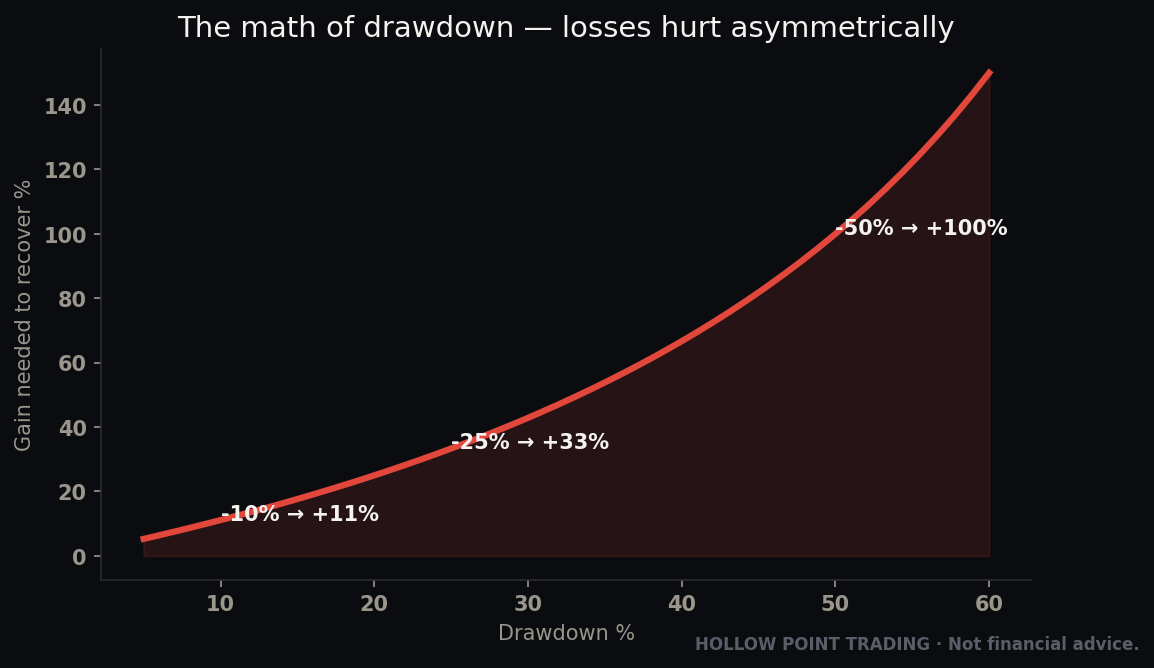
Margin is the mechanism that turns a normal-looking price move into an account-ending event. If you don't understand it before you place your first trade, you're not trading — you're just handing your deposit to someone who does understand it. Beginners who respect margin can trade for years on a small account. Beginners who ignore it are usually gone in weeks. This one topic is the fork in the road.
The two kinds of margin: overnight vs day-trade
This is the part almost nobody explains clearly to beginners, and it's the source of enormous confusion. There are two different margin numbers for the same contract, and which one applies depends on how long you hold the trade.
Overnight (initial) margin — the "official" number
Overnight margin, also called initial margin, is the real deposit the exchange requires to hold a position past the end of the trading day — literally overnight, while the market is closed and news can hit.
This number is set by the exchange (through a risk system called SPAN) and passed to you by your broker. It's the serious, conservative number. For the E-mini S&P 500 (ES), overnight initial margin is commonly somewhere in the $13,000–$17,000 range per contract, depending on the broker and current volatility. It changes over time as markets get calmer or wilder.
Why so high? Because when the market is closed, you can't get out. If something explodes in Asia at 2am, you're stuck holding until things reopen, and the price can gap far from where you left it. The exchange wants a big cushion for that risk.
There's a companion term here: maintenance margin. That's the minimum equity you must keep in the account to keep an overnight position open. It's slightly lower than initial margin. If your account equity drops below maintenance, you get a margin call — a demand to add money or close the position. For a beginner, the simple takeaway is: initial margin is what you need to open overnight; maintenance is the lower line that, if you cross it, triggers a forced fix.
Day-trade margin — the "broker special" number
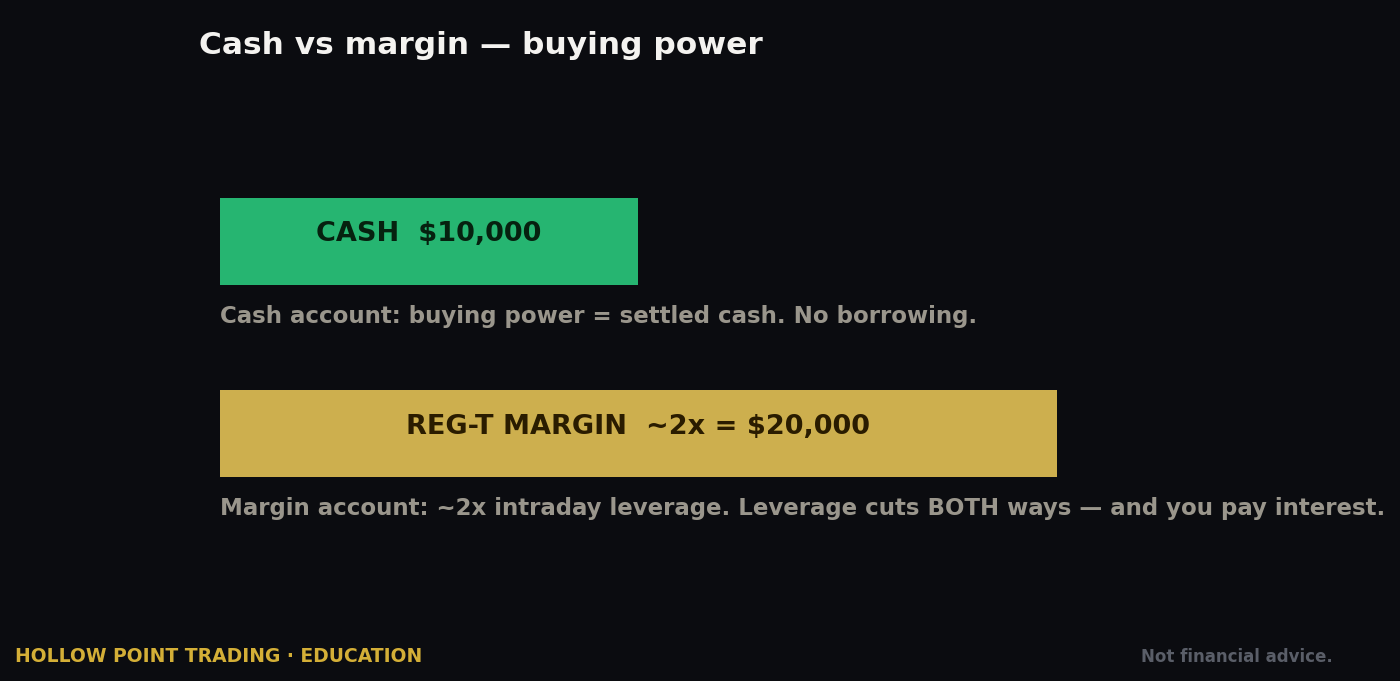
Day-trade margin (sometimes called intraday margin) is a much smaller number your broker offers only if you open and close the trade within the same trading session — no holding overnight.
This is where the eye-popping figures come from. That same ES contract needing ~$15,000 to hold overnight might have a day-trade margin of $500, or even less at some brokers. For micro contracts, day-trade margin can be as low as $50.
Why will a broker let you control $300,000 for $500? Because they're only exposing themselves during hours when the market is open and liquid, and they hold a hidden safety switch: auto-liquidation. If your losses eat into that thin day-trade margin, the broker's system automatically closes your position — often without warning and without asking. The low margin isn't generosity. It's low because the broker can yank the plug the instant you're offside.
This is the number-one trap for beginners. You see "$500 to trade the S&P!" and you think that's the risk. It is not. The $500 is just the deposit required to open the door. Your actual risk is the full dollar movement of a $300,000 position. Confusing "margin required" with "money at risk" is the single most expensive misunderstanding in this entire game.
How leverage works — and why it cuts both ways
Now we connect the pieces. Leverage is simply the ratio of what you control to what you put down.
If you control $300,000 of notional value with $15,000 of margin, your leverage is:
$300,000 ÷ $15,000 = 20 to 1.
If you're using day-trade margin of $500 to control that same $300,000, your leverage is:
$300,000 ÷ $500 = 600 to 1.
Leverage is a multiplier on every price move, in both directions. This is the part beginners feel in their gut only after it's too late, so let's make it concrete.
At 20:1 leverage, a 1% move in the underlying market becomes a 20% move in your account. Nice when it's your way. At 600:1, a 1% market move is a 600% move relative to your deposit — meaning your $500 is wiped out six times over by a move the market makes on a boring Tuesday.
Leverage doesn't know or care which direction you want. It magnifies gains and losses with perfect, indifferent symmetry. A tool that can double your money in an hour can halve it just as fast. The same feature that makes futures attractive is exactly the feature that destroys undisciplined beginners. There is no version of futures where you get the upside of leverage without the downside. They're the same coin.
This is why, at Hollow Point Trading, the first rule isn't about winning. It's about protecting capital first. Leverage means you don't get many mistakes. So you build a process that makes the mistakes small and survivable.
Meet the micros — the beginner's best friend
Before the worked example, you need to know one thing that genuinely changes the game for small accounts: micro futures.
The full-size contracts (ES for the S&P, NQ for the Nasdaq) are big. But the exchange created micro versions that are exactly 1/10th the size:
- ES (E-mini S&P 500): $50 per point → MES (Micro): $5 per point
- NQ (E-mini Nasdaq 100): $20 per point → MNQ (Micro): $2 per point
Everything scales down by ten: the notional value, the margin, and — critically — the dollars you win or lose per point. A one-point move that's $50 on ES is only $5 on MES. For a beginner, this is the difference between a learning cost and a catastrophe. Micros let you learn the mechanics of leverage with real money on the line, but at a size where a mistake stings instead of kills.
If you are a beginner with a small account, you should be trading micros. Full stop. We'll size everything in this guide around them.
A fully worked beginner example
Let's walk through a complete, realistic trade from start to finish, using a Micro E-mini S&P 500 (MES) contract. I'll use round-ish numbers so the math is easy to follow; real numbers vary by broker and day.
The setup:
- You have a $2,000 account.
- You're trading MES. Each point = $5.
- The S&P 500 is at 6,000. One MES contract controls 6,000 × $5 = $30,000 notional.
- Your broker's day-trade margin for MES is $50 per contract.
- The overnight margin for MES is about $1,500 per contract.
Step 1 — How many can you "afford"?
At $50 day-trade margin, your $2,000 could technically open 40 contracts ($2,000 ÷ $50). Hold that number in your head — because in a moment you'll see why using anywhere near it is financial suicide. The broker lets you do it. That doesn't mean you can.
Step 2 — Understand what one contract actually risks.
One MES contract is $5 per point. The S&P routinely moves 30–60 points in a day. So one contract can easily swing $150–$300 in an afternoon — on a $30,000 position controlled by a $50 deposit. Your risk isn't $50. Your risk is however many points the market moves against you, times $5, times your number of contracts.
Step 3 — Plan the trade with a stop.
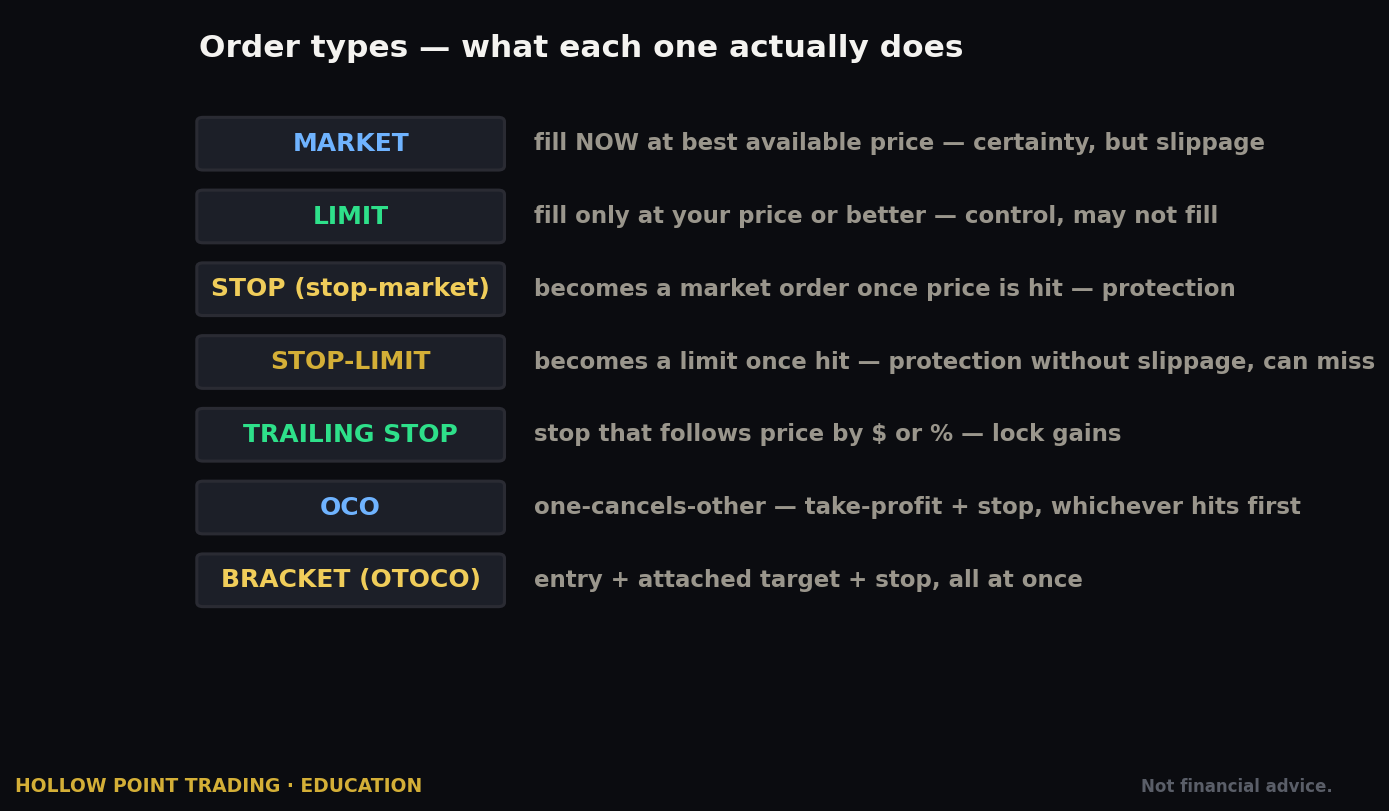
You decide to buy (go long) 1 MES contract at 6,000. You set a stop-loss — an automatic exit — at 5,990, which is 10 points below your entry. A stop is a pre-set order that closes your trade if price hits it, so your loss can't run away from you.
Your planned risk: 10 points × $5 = $50. That's 2.5% of your $2,000 account. Reasonable.
Step 4 — Set the target using 1:3.
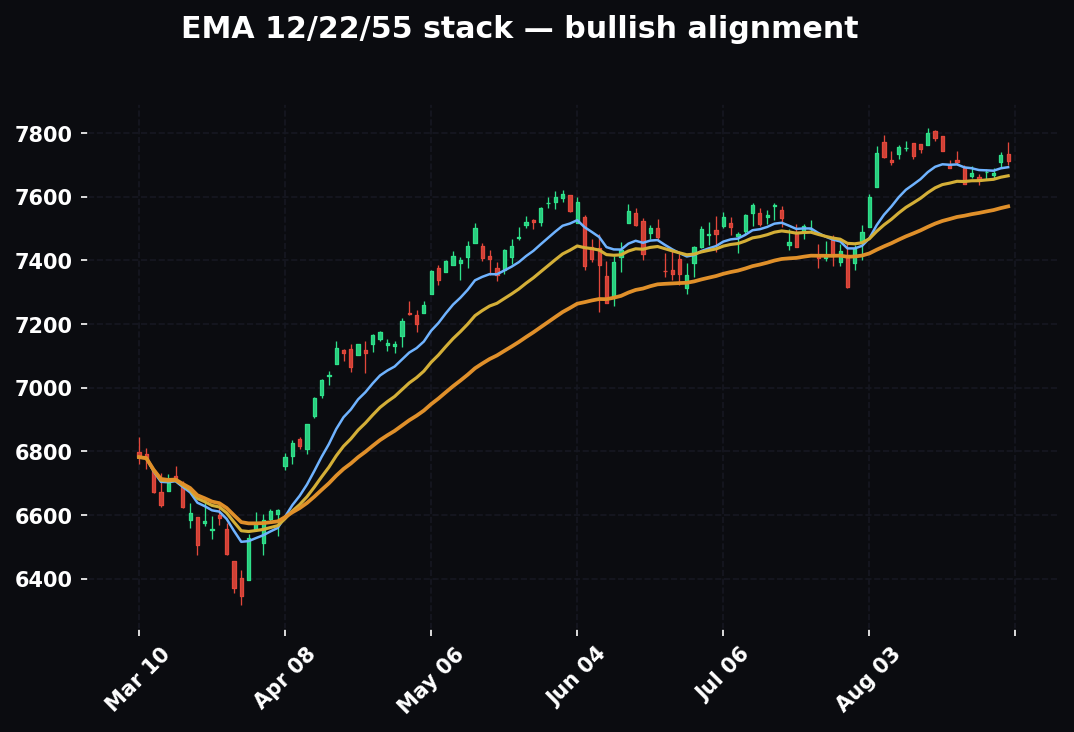
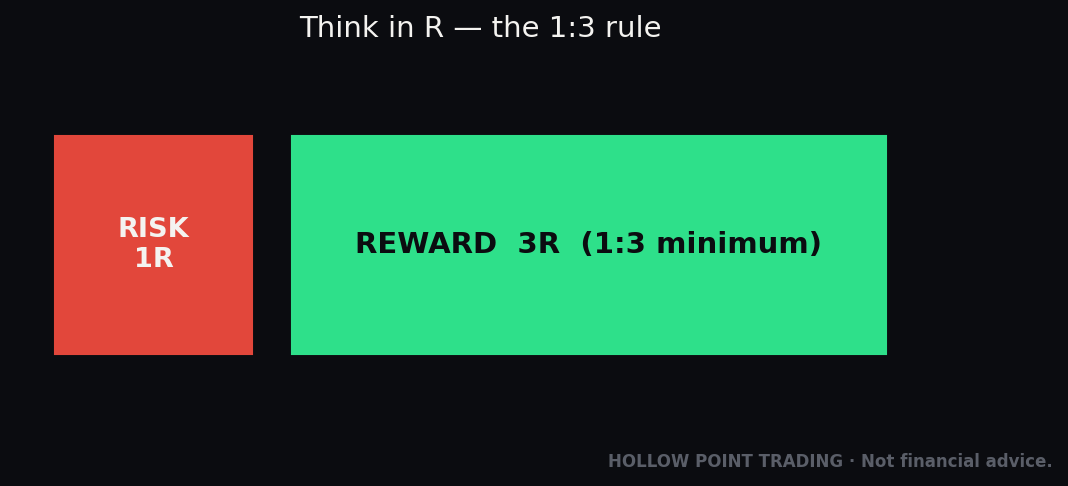
Hollow Point's rule is a minimum 1:3 reward-to-risk ratio — you aim to make at least three times what you're risking. You risked 10 points, so your profit target is 30 points up, at 6,030.
Potential reward: 30 points × $5 = $150. Risk $50 to make $150.
Step 5 — Play it out both ways.
- It works: price climbs to 6,030, your target fills, you make +$150. Your account is now $2,150 — up 7.5%.
- It fails: price drops to 5,990, your stop fills, you lose –$50. Your account is $1,950 — down 2.5%.
Notice the asymmetry the 1:3 rule builds in. You can be wrong more often than you're right and still make money. If you take four of these trades and win only two, you make +$150 +$150 –$50 –$50 = +$200. A 50% win rate is deeply profitable when your winners are three times your losers. That is the quiet math that keeps disciplined traders alive.
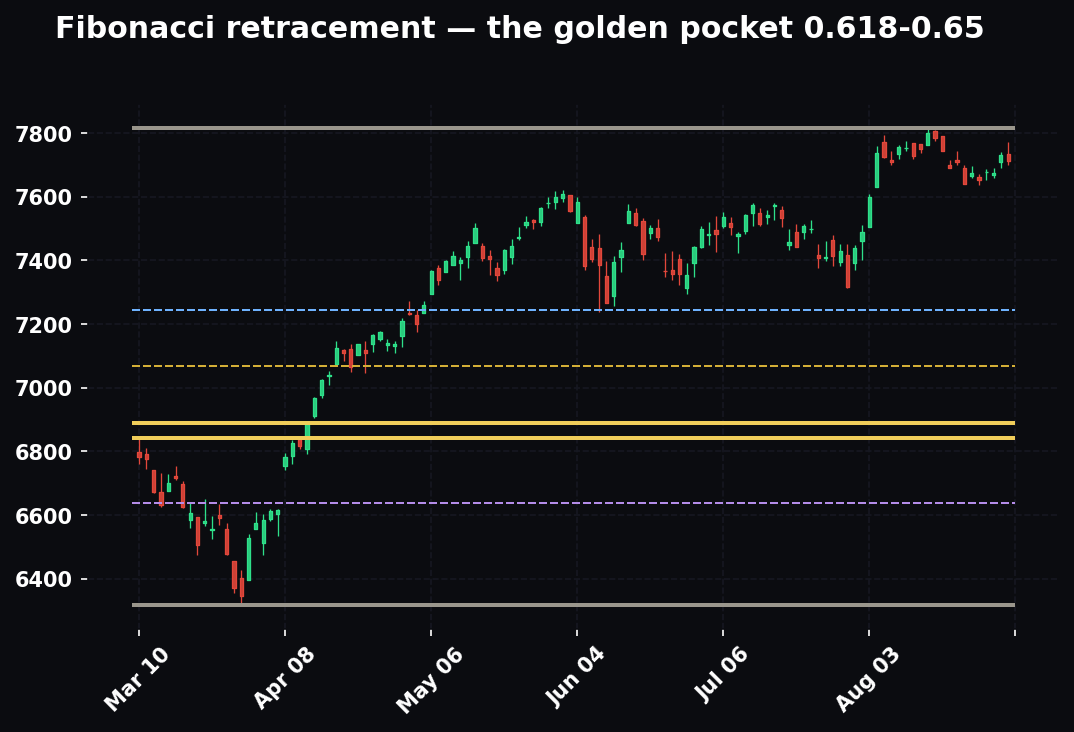
Now the horror version. Suppose you'd listened to the "$50 lets you trade!" voice and opened 20 contracts instead of 1, using $1,000 of margin. Same 10-point drop against you is now 10 × $5 × 20 = $1,000 gone. Half your account, on a move the market makes before breakfast. A 20-point move — utterly ordinary — is $2,000, your entire account, and the broker's auto-liquidation slams you out somewhere in there whether you like it or not. Same market, same stop distance. The only variable that changed was size. That's the whole story of how small accounts blow up, in one paragraph.
Why small accounts blow up — the mechanical truth
Let's name the exact chain of events, because it's almost always the same, and seeing it written out is the best vaccine there is.
1. The beginner confuses margin with risk. They see $50 day-trade margin and mentally file that as "the most I can lose." It isn't. Margin is the entry fee; risk is the full leveraged move.
2. They oversize. Because the margin is tiny, the platform happily lets them load up on contracts. Ten, twenty, forty. Every extra contract multiplies the dollars-per-point, and therefore multiplies how fast a normal move drains the account.
3. They trade without a stop, or with a stop that's too wide for their size. Now a routine wiggle produces a loss they can't stomach, so they freeze, hoping it comes back.
4. Leverage removes the time to recover. In a stock, a bad position can sit for months while you wait. Leveraged futures don't give you months — a big enough intraday move triggers the broker's auto-liquidation, closing you out at the worst possible moment, at whatever price is available. You don't get to wait for the bounce. The plug gets pulled.
5. Tilt finishes the job. Down big and rattled, the beginner "revenge trades" to win it back fast, sizes up even more, and the same mechanism empties what's left.
Every step in that chain traces back to step one: treating the small margin number as the risk number. Fix that single misunderstanding and the whole death spiral loses its fuel. Small accounts don't blow up because the market is unfair. They blow up because leverage was pointed at an account too small to absorb a normal move — a self-inflicted wound, and therefore a completely preventable one.
Sizing safely — the part that actually keeps you alive
Here's the good news: safe sizing is not complicated. It's arithmetic you can do in ten seconds, and it flips the entire game from "how much can I control?" to "how much can I afford to lose?" That flip is the whole discipline.
The core rule: risk a fixed, tiny percentage per trade
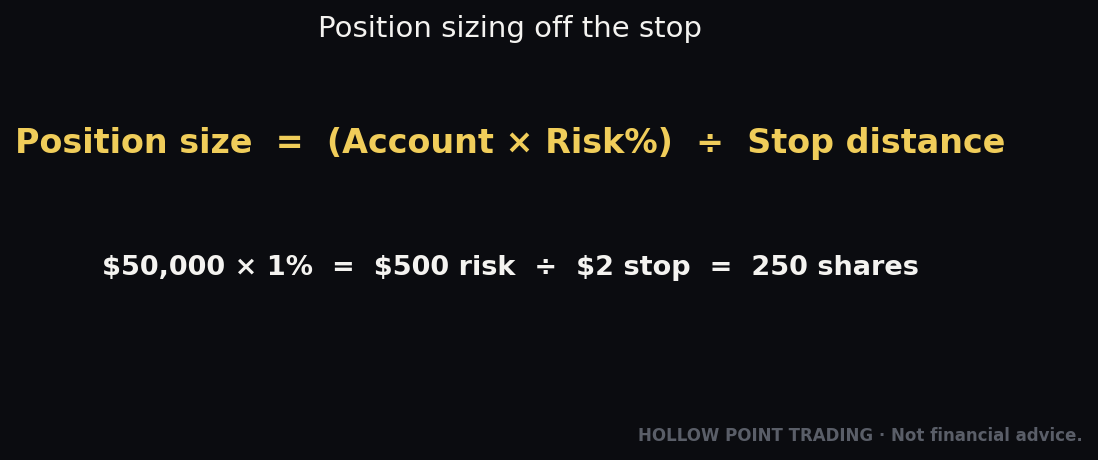
Professional risk management starts with one number: the maximum you'll lose on any single trade, expressed as a percent of your account. For beginners, keep it to 1%, and never more than 2%.
On a $2,000 account, 1% is $20; 2% is $40. That is the most you allow yourself to lose if the trade goes wrong. Everything else is built backward from that ceiling.
The four-step sizing formula
Step 1 — Decide your dollar risk. Account × risk %. ($2,000 × 1% = $20.)
Step 2 — Decide your stop distance in points. Based on the chart — where does the trade "break," the price that proves you wrong? Say 10 points on MES.
Step 3 — Find dollars-per-point-per-contract. For MES that's $5.
Step 4 — Contracts = dollar risk ÷ (stop distance × dollars per point).
$20 ÷ (10 × $5) = $20 ÷ $50 = 0.4 contracts.
You can't trade 0.4 contracts. The honest answer for a $2,000 account with a 10-point stop is: you trade 1 micro and accept slightly more than 1% risk, or you tighten the stop, or you wait for a setup with a smaller stop. What you do not do is round up to a size that blows past your risk ceiling. The formula isn't there to give you permission to trade big; it's there to cap you.
Why this changes everything
Notice what just happened. We never once asked, "How many contracts does my margin allow?" We asked, "How many contracts keep my loss inside 1% of my account?" Those two questions give wildly different answers, and the entire difference between traders who last and traders who don't is which question they let drive the size.
Margin tells you the maximum the broker will let you do. Risk-based sizing tells you the sane amount to actually do. The gap between them is the rope we mentioned at the top. Safe sizing is simply refusing to use most of the rope you're handed.
A few more guardrails for beginners
- Trade micros, not minis. Ten times smaller means ten times more room to be wrong and survive.
- Prefer day-trades to overnight while learning. Overnight holds carry gap risk (price jumping while you sleep) and require the much larger overnight margin. Flat by the close means you sleep, and you're never on the wrong side of a surprise headline you can't react to.
- Always define your stop before you enter. No stop = undefined risk = leverage with the safety off.
- Set a daily loss limit. Decide in advance that if you're down, say, 4% on the day (two full stop-outs), you're done until tomorrow. This kills the revenge-trade spiral before it starts.
- Keep a big cash cushion. Don't run an account where a single trade uses most of your margin. Room in the account is your survival buffer.
The beginner mistakes to avoid (the greatest-hits list)
Read this list twice. Every one of these has personally ended thousands of new accounts.
- Thinking margin is your risk. The margin deposit is the entry fee. Your risk is the full leveraged price move. This is mistake #1 and the parent of most others.
- Sizing off "how many can I afford to open." The platform will let you open a suicidal number of contracts. That the button works doesn't mean you should press it. Size off risk, never off available margin.
- Skipping the stop-loss. Without a pre-set exit, leverage has no brakes. "I'll just watch it closely" is not a stop; it's a prayer.
- Holding overnight to "let it come back." Now you've stacked gap risk on top of a losing position on top of a bigger margin requirement. Losers held overnight are how a bad day becomes a blown account.
- Trading the big contract on a small account. ES/NQ on $2,000 is not trading, it's a coin flip with your rent. Use micros.
- Ignoring that day-trade margin is a privilege, not a right. Brokers can raise it without notice (around major news or holidays) and will auto-liquidate you the instant you breach it. You are not in control of that switch — respect it by never getting close.
- Revenge trading after a loss. The urge to "win it back right now" is the most expensive emotion in the market. A daily loss limit, set before you're emotional, is the cure.
- Confusing a winning streak with skill. Leverage makes a lucky beginner look like a genius for a few weeks — right up until the same leverage collects it all back with interest. Process over outcomes, always.
- Not knowing the contract's dollars-per-point. If you can't instantly say what one point is worth on what you're trading, you cannot size safely. Know your number ($5 MES, $2 MNQ, $50 ES, $20 NQ) cold.
Your margin cheat-sheet
Tape this next to your screen. Run it before every single trade.
The two margin numbers
- Overnight (initial) margin = deposit to hold past the close. Big. Set by the exchange.
- Day-trade (intraday) margin = deposit to trade within one session. Small. Set by the broker. Backed by auto-liquidation.
The core truths
- Margin required ≠ money at risk. Ever.
- Leverage = notional ÷ margin. It multiplies both directions, equally, without mercy.
- Micros = 1/10th of everything. Beginners trade micros.
Before you click buy or sell, answer all five:
- What's my dollar risk cap? (Account × 1%.)
- Where's my stop, in points? (The price that proves me wrong.)
- What's one point worth per contract?
- Contracts = risk ÷ (stop points × point value) — rounded down.
- Is my target at least 3× my risk? (1:3 minimum.)
Standing guardrails
- Stop set before entry, every time.
- Daily loss limit, decided while calm.
- Flat by the close while you're learning.
- Never size off available margin. Size off risk.
If you can't answer all five questions, you don't have a trade. You have a hope. Close the platform.
How this fits the bigger Hollow Point picture
Everything you just read isn't a separate "risk lesson" bolted onto trading. At Hollow Point Trading, it is the trading. Here's how margin discipline plugs into the whole approach.
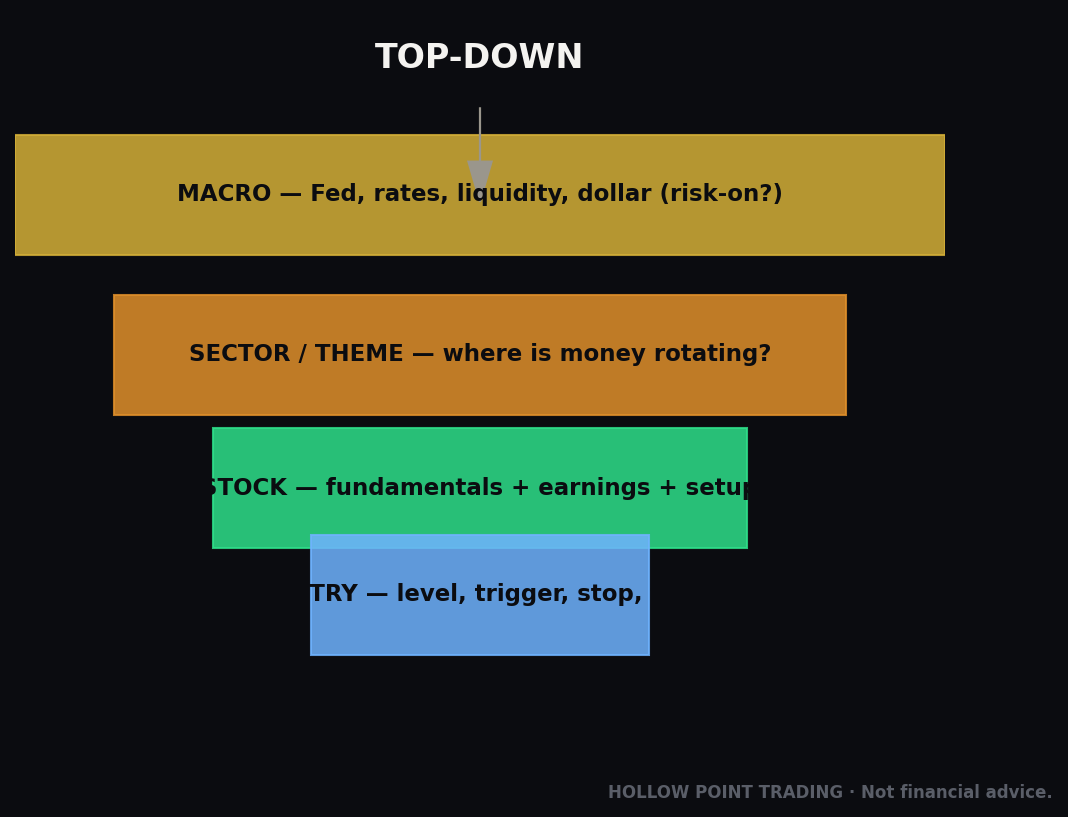
We work top-down: macro → sector → stock (or index). We start by reading the big environment — is the overall market calm or violent, risk-on or risk-off? — then narrow to the sector, then to the specific instrument. Margin lives at the bottom of that funnel, at execution. But it's shaped by the top: when the macro picture is wild and volatile, the smart response is to size down, widen nothing, and respect that leverage is more dangerous in a storm. Margin sizing is where your read on the world turns into an actual number of contracts.
Then there's the phrase you'll hear from us constantly: discipline over prediction. Beginners think trading is about being right. It isn't. Nobody knows what the next candle does. What you can control is your risk per trade, your stop, and your size — and those are all margin-and-sizing decisions. A trader who can't predict a thing but always risks 1% with a 1:3 target will quietly beat a brilliant forecaster who oversizes. The market rewards the process, not the prophecy. Margin discipline is where that philosophy stops being a slogan and becomes math on your order ticket.
And underneath all of it: protect capital first. You cannot trade tomorrow if you're broke today. Leverage's one non-negotiable demand is that you survive your losing streaks — and every trader, including the great ones, has losing streaks. Safe sizing isn't the boring part you get through on the way to the exciting part. It is the edge. It's the thing that keeps you in the seat long enough for skill to compound.
The market handed you a rope strong enough to control hundreds of thousands of dollars. Beginners who don't understand margin use that rope to hang themselves in a matter of weeks. Beginners who do understand it use just enough of it to climb — a little at a time, roped in, never dangling over a drop they can't survive. That's the entire difference. Now you know which one you're going to be.
Trade small. Define your risk. Let the 1:3 math and your survival do the heavy lifting. Come back next week — and the week after that — and one day you'll look up and realize the reason you're still here is the boring lesson everyone else skipped.
Bound by rules, feared by trade.