
Hollow Point Trading • October 3, 2026 • 6:30 p.m. CT edition. U.S. equity markets are closed this Saturday. Friday’s completed candle supplies the price evidence; the company announcements were checked anew this evening.
A chip can reach an engineering team before it is ready to fly. For an investor, the gap between those events is an evidence problem as well as a calendar problem. AMD’s October 1 space-grade packaging announcement makes that distinction unusually visible: early customers are sampling a device while a higher reliability qualification is still being pursued. The stock’s recent rally tells us something different—what buyers and sellers have already done.
Macro — In space computing, reliability is part of the product
Semiconductor demand does not describe one uniform purchasing process. A consumer device, a server and an onboard space system face different requirements. For the last of those, replacing a failed component after deployment may be impractical. It is therefore useful to examine the constraints that a supplier is trying to meet, rather than treating every product bearing an AI label as the same commercial opportunity.
AMD announced that its Versal AI Core XQRVC1902 adaptive system-on-chip is sampling with early-access customers in an enhanced space-grade package. The company says the package is designed for missions lasting up to 15 years. It is testing the device toward MIL-PRF-38535 Class Y qualification; flight-qualified units are expected in the second half of 2027. Those are the company’s stated stages and expectations, not a declaration that qualification has already been completed.
The macro channel here is a demanding end market asking for computation that can survive its operating environment. Better packaging may help address a constraint on where a chip can be considered. It does not establish the number of missions that will adopt the part, the timing of their procurement or the dollars AMD will recognize. The announcement’s strategic relevance can be real while those financial quantities remain unknown.
This also prevents a category error. An onboard adaptive chip and a data-center accelerator can both perform computation without serving identical systems or customers. A space-product milestone should be examined on its own evidence. It cannot automatically be added to a forecast for large server deployments, nor can a broad AI spending thesis settle the qualification questions of this particular package.
Fundamental — Read the verbs as a sequence of evidence
“Sampling,” “testing” and “expected availability” answer different questions. Sampling says that early customers can work with the technology at the stated stage. Testing describes work toward a qualification. Expected availability sets a future timetable that can change. A disclosed sale, shipment or recognized revenue would answer another question. The October 1 announcement does not supply a revenue contribution for this package that would let us collapse the sequence into an earnings estimate.
Imagine a hypothetical satellite developer receiving a sample. It can build an engineering model, evaluate performance and decide whether the device fits its requirements. That exercise may reveal a useful capability or an unresolved issue. Even a successful engineering evaluation need not specify a final purchase quantity. This illustration is not an account of an actual AMD customer; it shows why the first step cannot stand in for all the later ones.
For a research notebook, separate four entries: the stage achieved, the stage still pending, the expected timetable and the missing commercial measurement. In this case, early-access sampling is the achieved company-reported milestone. Class Y qualification remains the work described. Second-half 2027 flight-qualified availability is an expectation. Quantified package revenue remains absent from the cited announcement. Keeping the empty entry visible is more useful than filling it with an unsupported market-size estimate.
Fundamental — A specialized milestone sits inside a much larger company
AMD’s August 4 second-quarter results reported $11.536 billion of total revenue. Embedded revenue was $977 million, up 19% year over year, while Data Center revenue was $6.7 billion. These are historical segment figures. Dividing Embedded revenue by the reported company total gives approximately 8.5%, an arithmetic scale comparison—not the share attributable to space products or this new package. Embedded contains more than the device discussed here.
The distinction matters in both directions. A specialized product can broaden a portfolio without immediately becoming a material driver of consolidated results. Conversely, a relatively small current segment does not tell us that every new product lacks strategic value. The evidence needed to assess value is narrower: qualification progress, customer adoption and later financial disclosure that can support a measurable contribution.
A constructive business case would involve successful progress through the stated requirements and customers moving beyond evaluation into commercial use. A neutral case could involve sound engineering progress with little measurable near-term revenue effect. A less favorable case could involve delays or weak adoption. These are scenarios for future evidence, not reported outcomes or probability estimates. No immediate revenue uplift is assigned in this article.
For a nearer dated checkpoint, AMD’s September 29 media alert schedules Lisa Su’s OCP Global Summit keynote for October 12 at 4:15 p.m. Pacific, or 6:15 p.m. Central. That event concerns broader open AI infrastructure. It may bring information relevant to the wider company, but it is not a promised Class Y qualification date. Keeping those two clocks separate helps a trader avoid treating every upcoming AMD event as confirmation of this space-product thesis.
Technical — The daily rally has already created distance from trend
The fresh publisher-owned TradingView chart requests NASDAQ:AMD and displays the NASDAQ listing on the Cboe One feed, internally identified as BATS:AMD. Friday’s completed daily candle opened at $635.95, reached $645.46, traded down to $628.55 and closed at $633.91, up 2.95% against the prior close. The established 55-day EMA reads $528.86. RSI(14), the only lower panel, reads 70.07.
The June–October frame shows an earlier uneven range followed by a sharp September advance. Friday closed substantially above the rising EMA, but beneath the displayed $639 confirmed-swing reference. This is different from a stock quietly waiting for a catalyst: a large price move is already visible. The image does not establish which announcement caused that move. It also does not show a volume or flow measurement that would justify assigning buyers a particular motive.
Bull scenario: acceptance above $639 followed by a sustained reclaim of Friday’s $645.46 high would improve the immediate continuation case. A subsequent failure to retain the reclaimed boundary would invalidate that specific breakout premise. These are conditions to examine when equities reopen, not a weekend entry instruction or a guaranteed target.
Base scenario: movement between Friday’s $628.55 low and $645.46 high would leave the latest daily range unresolved. Consolidation can let an average catch up without requiring price to fall straight back to it. It can also precede another expansion. The next completed candles would determine whether the range is being retained.
Bear scenario: losing $628.55 and failing to recover it would challenge continuation anchored to Friday’s low. The displayed $600 round number and $596.07 swing low are farther observation references. They are not guaranteed support, and the chart does not promise that price will travel to either. A sustained recovery of the lost Friday boundary would weaken that immediate breakdown interpretation.
Risk — A long qualification calendar does not slow the share price
RSI around 70 describes strong recent momentum on this timeframe; it does not schedule a reversal or authorize unlimited risk. A stock already far above its average can consolidate, extend or retrace. Monday’s opening gap can cross a chosen trigger or invalidation before a trader can execute. A daily image does not show options spreads, implied volatility or time decay.
The useful discipline is to keep each test attached to its evidence. The space package needs subsequent qualification and commercial evidence. The stock needs new price confirmation at the observed boundaries. A keynote can inform the wider thesis while leaving the package timetable unchanged. This is educational research, with no claimed HPT position, executed order, prescribed sizing or realized return
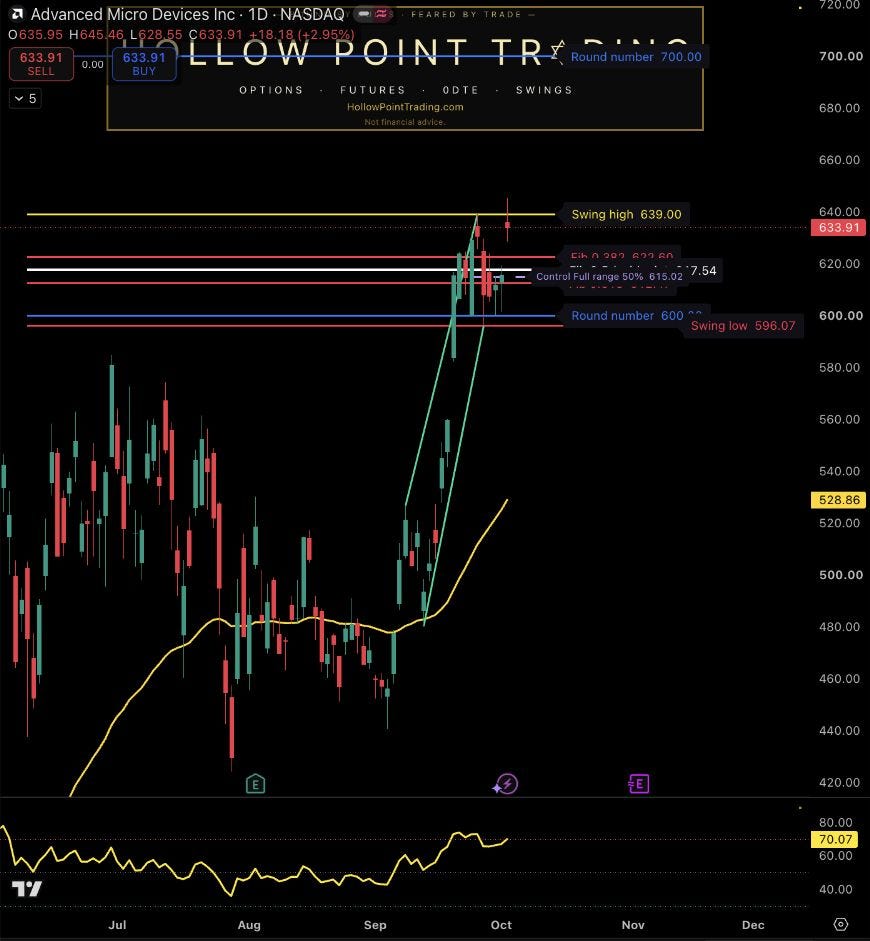
.Source: genuine TradingView publisher-owned chart; requested NASDAQ:AMD, observed BATS:AMD / NASDAQ by Cboe One, daily (1D). Captured October 3, 2026 at approximately 6:35 p.m. America/Chicago. Saturday equities closed; latest completed candle October 2. Established 55-day EMA $528.86; RSI(14) 70.07 is the only lower panel. June–October historical frame. Displayed $639 swing reference and $600 round number are observations, not guaranteed barriers. Static feed-specific image cannot establish news causation, live weekend pricing or executable options terms; indicators change with later bars.
Sources and evidence limits
AMD space-grade Versal sampling and qualification timetable — October 1, 2026
AMD second-quarter results and segment revenue — August 4, 2026
AMD OCP keynote media alert — September 29, 2026
Sampling is a company-reported milestone; qualification and future availability remain expectations. Financial figures are historical reported results. The 8.5% comparison is arithmetic from those figures and cannot isolate space-product sales. The customer example is hypothetical; future business and price cases are analysis. Sources were checked October 3.
Discussion: What evidence would make you treat AMD’s space-grade package as a commercial contributor beyond an engineering milestone, and which next-session price failure would invalidate your continuation case?